
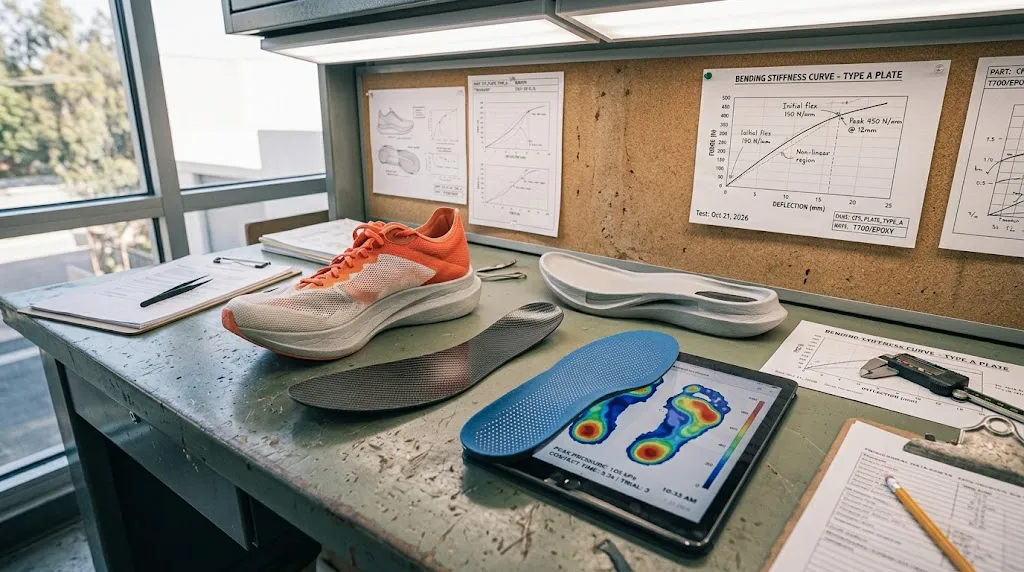
Carbon fiber plates for shoes have transformed distance running since their introduction in elite racing flats, turning what was once a materials curiosity into a measurable performance advantage understood at the biomechanics level. The embedded plate — a thin, curved laminate of carbon fiber reinf
Introduction
Carbon fiber plates for shoes have transformed distance running since their introduction in elite racing flats, turning what was once a materials curiosity into a measurable performance advantage understood at the biomechanics level. The embedded plate — a thin, curved laminate of carbon fiber reinforced polymer (CFRP) sitting between the midsole foam layers — changes how the foot interacts with the ground: it reduces energy loss at the metatarsophalangeal joints, stabilizes the foam under load, and returns a portion of stored elastic energy during toe-off. This guide explains the mechanics behind those effects, the design parameters that determine how a carbon fiber plate for the foot performs, and the manufacturing methods that produce shoe-grade CFRP plates at scale.
How a Carbon Fiber Plate in Running Shoes Changes Gait Mechanics
The primary biomechanical role of a carbon fiber plate in running shoes is not "spring" in the naive sense — the plate does not launch the runner forward like a catapult. Instead, it stiffens the forefoot lever arm, reducing the work required at the metatarsophalangeal (MTP) joints during late stance:
- Lever stiffening: During the final 30-40% of stance, the foot pivots over the MTP joints. A stiff plate spanning this region reduces the angular deformation at the joint, lowering the metabolic cost of maintaining forward progression. Laboratory studies on plate-equipped shoes show 4-8% reductions in oxygen cost at marathon pace compared with matched foam-only midsoles.
- Foam stabilization: High-stack superfoams (PEBA, TPU-based elastomers) compress unevenly under point loads. The plate distributes plantar pressure more evenly across the midsole, reducing local foam bulging that wastes energy and destabilizes the stride.
- Elastic energy return: The plate itself stores strain energy during midstance and releases it during toe-off — typically contributing 3-5% of total energy return in racing shoes, with the majority of energy return still coming from the foam.
The net effect is a small but consistent reduction in metabolic cost over long distances — which compounds into minutes of race-time improvement at elite and sub-elite levels.
Design Parameters of a Carbon Fiber Plate for the Foot
Plate performance depends on stiffness, geometry, and placement — not simply the presence of carbon fiber. The table below summarizes the key parameters and typical ranges for road racing shoes:
| Parameter | Racing Flat Range | Effect on Performance |
|---|---|---|
| Longitudinal bending stiffness | 15-40 N/mm at 20% flex | Higher stiffness reduces MTP work but may impair comfort at slower paces |
| Plate thickness | 0.8-2.5 mm (single layer) | Thicker plates increase stiffness linearly but add mass |
| Toe spring geometry | 18-25° rocker angle | Rocker curvature promotes earlier heel-off, shortening stance duration |
| Drop (heel-toe offset) | 4-10 mm | Interacts with plate curvature to define effective rocker profile |
| Areal weight (plate only) | 80-180 g/m² | Lower areal weight reduces shoe mass; racing targets under 200 g total shoe weight |
Stack height and foam choice interact with plate geometry: a plate that performs well in a 40 mm-stack racing shoe may feel harsh in a 30 mm training shoe, because the foam cannot accommodate the plate's stiffness gradient. Shoe brands tune plate modulus and curvature together with foam density as a single system.
Manufacturing Carbon Fiber Plates for Shoes
Shoe-grade CFRP plates are manufactured differently from aerospace laminates — the priority is consistent flex response at low mass, not extreme strength:
- Prepreg layup and press molding: The most common method. Unidirectional or plain-weave carbon prepreg is laid into plate-shaped molds, vacuum-bagged, and press-cured at 120-150 °C. Fiber orientation is typically 0° along the plate length for maximum longitudinal stiffness, with optional 90° or ±45° plies for torsional stability.
- Sheet molding compound (SMC): Chopped carbon fiber in a resin matrix, compression-molded into plate blanks. Lower cost than prepreg but with reduced stiffness consistency — used in training shoes where the performance margin is less critical.
- Hybrid thermoplastic plates: Carbon-nylon or carbon-TPU prepreg tape, thermoformed into the final rocker geometry. Enables higher production rates and recyclability; used by several brands in high-volume training lines.
Post-molding operations include trimming to outline, edge sealing to prevent delamination during flex cycling, and quality control via dynamic flex testing — plates are cycled 50,000-100,000 times at race-representative loads to verify stiffness retention within tolerance.
Racing vs. Training vs. Trail: How Plate Design Differs
Not all carbon fiber plates for shoes are designed the same — application drives geometry and stiffness:
- Racing flats: Maximum longitudinal stiffness, high toe spring, minimal mass. Optimized for athletes running at or near VO2max, where metabolic cost reduction dominates the design brief.
- Trainer shoes: Moderate stiffness, lower toe spring, often a partial-length plate (forefoot only). Designed to provide a portion of the racing benefit while maintaining comfort for high-mileage training.
- Trail running shoes: Reduced stiffness and often embedded deeper in the midsole to protect against rock strikes. Some designs use segmented or semi-rigid plates that allow multi-directional flex on uneven terrain.
Selecting the right carbon fiber plate for the foot means matching these design variables to the runner's pace, distance, and terrain — not simply choosing the stiffest plate available.
Frequently Asked Questions
Do carbon fiber plates make every runner faster?
No. The metabolic benefit of a carbon fiber plate in running shoes is pace-dependent: laboratory and field studies consistently show the largest reductions in oxygen cost at fast, sustained paces (marathon effort or faster). At easy jogging speeds, the plate's stiffness can increase muscular work rather than reduce it, and some runners report discomfort. recreational runners training at slower paces may see little to no benefit, while competitive athletes at threshold or race pace typically gain 1-4% in efficiency.
How long does a carbon fiber plate in a running shoe last?
The plate itself is highly durable — carbon fiber does not fatigue in the way metals do, and properly manufactured plates retain stiffness for 800-1,200 km of running. The limiting factor is usually the midsole foam, which compresses and loses resilience well before the plate degrades. When foam cushioning noticeably diminishes, the shoe should be retired even if the plate is structurally intact.
Are carbon fiber plates safe for injury-prone runners?
For most runners, yes — but transition gradually. The altered mechanics of a plated shoe (higher stack, stiffer forefoot, rockered geometry) change loading patterns in the Achilles tendon, calf, and metatarsals. Runners with a history of metatarsal stress injuries, Achilles tendinopathy, or instability should introduce plated shoes over several weeks, starting with shorter easy runs before progressing to long runs and races. Consult a sports medicine professional if unsure.
Conclusion
Carbon fiber plates for shoes work by stiffening the forefoot lever, stabilizing superfoams under load, and returning elastic energy during toe-off — a small per-step effect that compounds over marathon distance into meaningful time savings. Plate stiffness, thickness, toe spring, and placement are tuned as a system with midsole foam, and manufacturing ranges from prepreg press molding for racing flats to hybrid thermoplastic thermoforming for high-volume trainers. The right carbon fiber plate for the foot is the one matched to the runner's pace, distance, and training goals — not simply the stiffest or lightest option on the shelf.
YongXian supplies carbon fiber sheets, plates, and custom-cut CFRP components for sporting goods manufacturers and product development teams. Explore our carbon fiber product range or contact our team to discuss material specifications for plate applications in athletic footwear.
Part of topic
Related Articles
- Carbon Fiber Tube for Drone Frames: Sizing and Wall Selection
- Carbon Fiber Plate for Foot Orthotics: Design and Materials
- Carbon Fiber Drone: When Composite Airframes Make Sense
- Carbon Fiber Tubes for RC Planes: Spars, Booms and Frame Components
- Carbon Fiber Rod Fishing: Blank Grades and Action Curves Explained
- Carbon Fiber Tube Protector: Edge Guards and Damage Prevention
Interested in Our Products?
Contact our team for competitive pricing and technical specifications.
Get a QuoteRelated Products

Round Carbon Fiber Tube — 3K Plain Weave T700
Standard round carbon fiber tube manufactured from Toray T700 grade fiber with 3K plain weave. Offers balanced strength and stiffness for general industrial applications including robotics, automation, sports equipment, and aerospace structures.

Square Carbon Fiber Tube — 3K Twill T700
Square cross-section carbon fiber tube manufactured with 3K twill weave for torsional strength. Preferred for structural frames, trusses, and support columns where rectangular geometry offers design flexibility.

Round Carbon Fiber Tube — 3K Twill
Lightweight and ultra-stiff round tubes ideal for drone frames, robotics, and structural applications.

Round Carbon Fiber Tube — UD Unidirectional T700
Unidirectional (UD) round tube with all fibers aligned axially for maximum longitudinal stiffness. Ideal for applications requiring high bending rigidity with minimal weight, such as shafts, struts, and structural reinforcements.

Carbon Fiber Plate — 3K Twill T700 3.0mm
Medium-thickness 3.0mm carbon fiber plate offering significantly higher load capacity while maintaining attractive 3K twill finish. Suitable for structural brackets, reinforcement plates, and load-bearing panels.