
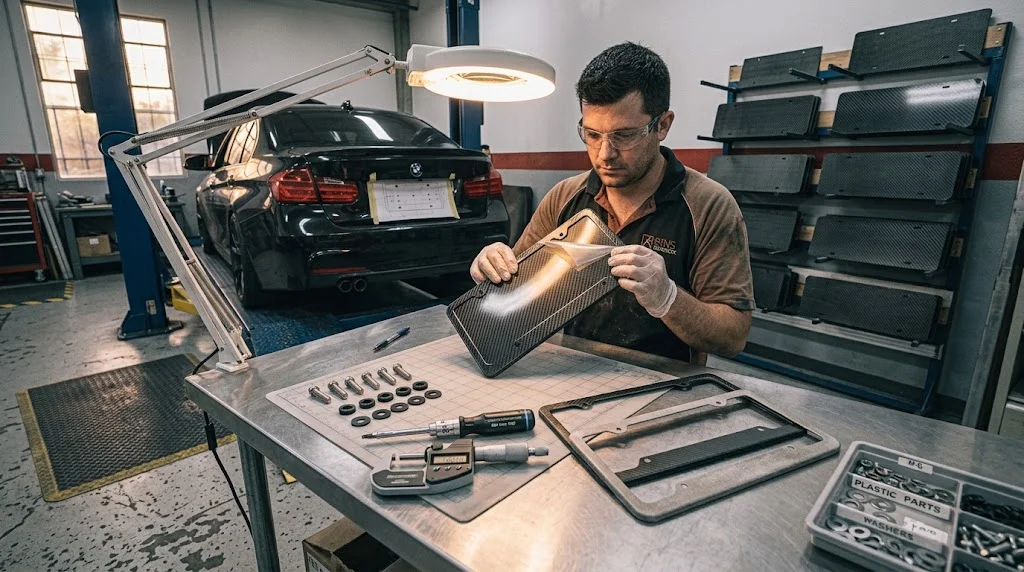
What a carbon fiber license plate custom program actually produces is a small, weather-exposed structural part: a flat frame that must hold its shape through -30 to 80 °C thermal cycles, resist years of UV without yellowing, and bolt to a steel or aluminum body panel without setting up galvanic corr
Introduction
What a carbon fiber license plate custom program actually produces is a small, weather-exposed structural part: a flat frame that must hold its shape through -30 to 80 °C thermal cycles, resist years of UV without yellowing, and bolt to a steel or aluminum body panel without setting up galvanic corrosion. The part weighs 60-120 g, yet every one of those requirements has a process consequence that separates a genuine composite frame from a printed plastic imitation.
The aftermarket is flooded with both. This article explains how a carbon fiber license plate frame is really manufactured, what separates the best carbon fiber license plate frame from the cosmetic failures that delaminate in two summers, the regional fitment standards you have to design around, and how custom work flows through carbon fiber plate custom blanks before it becomes a finished frame.
Carbon Fiber License Plate Custom: What Suppliers Actually Customize
When a buyer requests carbon fiber license plate custom work, four things are genuinely adjustable, and the rest is fixed by the plate standard of the target market:
- Weave and appearance: 2x2 twill is the default; plain weave is steadier and cheaper; forged or chopped-carbon panels give the random-flake look with more local stiffness. A unidirectional layer under the twill improves stiffness at almost no extra cost.
- Frame geometry: a bare rim, a rim with a top mounting tab, or a full backing plate that covers the trunk recess. Frame width typically runs 10-20 mm, and the corner radius must clear the plate's own rounded corners.
- Finish: high-gloss clear coat with UV absorber (most common), satin clear, or a raw sanded finish for paint shops that will clear it themselves. A frame without UV-stabilized clear coat will yellow within two seasons.
- Branding and hardware: laser-etched logos, engraved model text, and the bolt kit — stainless or anodized fasteners, nylon washers and, where the frame touches painted steel, an isolation gasket.
What is rarely customizable is thickness beyond the practical window. A license plate frame has to flex slightly during installation, so 2.0-3.0 mm is the workable band; below 1.5 mm the frame cracks at the mounting slots, above 4 mm it will not seat flush against most bumper recesses.
Carbon Fiber License Plate Frame: Fitment, Thickness and Mounting
Fitment is where most cheap frames fail, because plate standards are not universal. A US passenger plate is 6 x 12 in (152 x 305 mm); a European standard plate is 520 x 110 mm; a Chinese plate is 440 x 140 mm; and a UK rear plate is 520 x 111 mm. A frame drawn for one market will not fit another — the aspect ratio differs enough that the rebate holding the plate edges either gaps or pinches.
| Plate market | Plate size | Typical frame OD | Mounting pattern | Notes for custom frames |
|---|---|---|---|---|
| US passenger | 152 x 305 mm | ~165 x 318 mm | 2 or 4 screw slots | Slot elongation absorbs bumper tolerance; check state law on covered area |
| Europe standard | 520 x 110 mm | ~535 x 125 mm | Side tabs or 2 bolts | Long thin frame is the stiffest layout; needs UD backing to stay straight |
| China standard | 440 x 140 mm | ~455 x 155 mm | 4 screw holes | Wider aspect needs longitudinal stiffness to avoid bowing |
| UK rear | 520 x 111 mm | ~535 x 126 mm | 2 bolts | Reflective plate thickness adds ~2 mm — size the rebate accordingly |
Mounting discipline matters as much as fitment. Bolting carbon fiber to a steel bumper with bare steel screws creates a galvanic couple; in road-salt environments the steel around the hole corrodes first. Use 304 or 316 stainless fasteners with nylon washers, and add a thin EPDM or butyl gasket between frame and paint — the gasket also stops the frame from micro-chattering against the clear coat and marking it.
Best Carbon Fiber License Plate Frame: Material and Finish Checklist
The best carbon fiber license plate frame shares a short list of characteristics, all of them inspectable before purchase:
- Real weave through the rebate edge: on a genuine frame the twill pattern continues to the very edge of the rebate, and cut fibers are visible at an unfinished corner. A hydro-dipped or printed frame shows pattern distortion around corners and recesses.
- Resin-rich but not resin-pooled: clear coat depth should be even; pooling at corners signals hand-spray finishing rather than controlled film build.
- Flatness: lay the frame on glass. Anything over 1 mm gap at a corner indicates cure warpage and will not seat flush.
- Hardware included: a frame sold without isolation washers is not a finished product, however good the carbon looks.
- UV specification: ask what clear system is used and what QUv aging hours it has. A frame with 500 h QUv behind it behaves very differently from one with none.
Price is a rough filter too. Genuine twill frames with proper clear coat land in a band where the carbon material alone costs more than a hydro-dipped ABS frame in total. Suspiciously light frames are often ABS with a printed wrap; suspiciously heavy ones usually carry excess resin.
Carbon Fiber Plate Custom: Blanks, Inlays and Structural Inserts
Most frame makers do not press a frame in one shot. They buy carbon fiber plate custom blanks — flat 2 mm or 3 mm twill plate, cut to a near-net outline — then CNC-mill the rebate and screw slots and finish with clear coat. This route separates cleanly into plate supply and frame machining, which is why plate suppliers and frame suppliers are often different companies.
The alternative, matched-die pressing of the whole frame, is used for volume programs where the rebate geometry cannot be machined cleanly (very tight corner radii, or a wrap-around edge). Tooling for a die press is a multiple of the plate-route cost, so it only pays back above a few thousand pieces per year.
For buyers the implications are simple: for prototypes and short runs, plate-route frames give weave continuity and full custom outline control at low tooling cost; for large series, ask whether the supplier presses or machines, because the answer changes both the price break and the minimum order quantity. Either way, confirm the plate blank itself is autoclave or press cured with void content under 1-2% — a frame machined from a porous plate will craze at the rebate corners long before the carbon fails.
Frequently Asked Questions
Will a carbon fiber license plate frame block my plate number or violate regulations?
It depends on the jurisdiction, not the material. Many US states forbid covering letters or registration stickers, and several European countries limit how much of the plate border a frame may cover. A well-designed frame covers only the outer 10-15 mm of plate border and leaves all characters and tags unobstructed; check your local rule before ordering a backing-style frame that covers more area.
How do I clean a carbon fiber license plate frame without damaging the clear coat?
Use pH-neutral car shampoo and a microfiber cloth; avoid solvent-based bug removers and any polish containing abrasives, which cut the clear coat and expose the weave. For baked-on road film, soak first rather than scrubbing. If the frame has a satin finish, use only products marked safe for matte coats — glossy products will create permanent shine patches.
Can you repair a cracked carbon fiber license plate frame?
Structurally, a cracked frame is usually at end of life. The crack typically starts at a mounting slot, where the frame is thinnest and stress concentration is highest, and runs through both the laminate and the clear coat. Cosmetic filling is possible, but a frame that has cracked once will crack again at the same slot under the same thermal cycling — replacement is the honest fix.
Conclusion
A carbon fiber license plate custom program succeeds or fails on process detail, not on weave pattern: proper plate-standard fitment, a 2.0-3.0 mm layup with a stiffening UD backing, UV-stabilized clear coat, and isolated stainless hardware. Those four decisions are what the best carbon fiber license plate frame has in common, and they are all specified before any carbon is cut.
YongXian supplies carbon fiber plate blanks and finished frames to custom outline and finish. Browse our carbon fiber plate range or contact our engineering team with your plate standard and target quantity for a quotation.
Part of topic
Related Articles
- Carbon Fiber Robot Arms: Lightweight Design Tradeoffs
- Building Carbon Fiber Drone Frames: Layout and Fastening
- Carbon Fiber Tube for Drone Frames: Sizing and Wall Selection
- Carbon Fiber Plates for Running Shoes: How They Work
- Carbon Fiber Plate for Foot Orthotics: Design and Materials
- Carbon Fiber Drone: When Composite Airframes Make Sense
Interested in Our Products?
Contact our team for competitive pricing and technical specifications.
Get a QuoteRelated Products

Round Carbon Fiber Tube — 3K Plain Weave T700
Standard round carbon fiber tube manufactured from Toray T700 grade fiber with 3K plain weave. Offers balanced strength and stiffness for general industrial applications including robotics, automation, sports equipment, and aerospace structures.

Square Carbon Fiber Tube — 3K Twill T700
Square cross-section carbon fiber tube manufactured with 3K twill weave for torsional strength. Preferred for structural frames, trusses, and support columns where rectangular geometry offers design flexibility.

Round Carbon Fiber Tube — 3K Twill
Lightweight and ultra-stiff round tubes ideal for drone frames, robotics, and structural applications.

Round Carbon Fiber Tube — UD Unidirectional T700
Unidirectional (UD) round tube with all fibers aligned axially for maximum longitudinal stiffness. Ideal for applications requiring high bending rigidity with minimal weight, such as shafts, struts, and structural reinforcements.

Carbon Fiber Plate — 3K Twill T700 3.0mm
Medium-thickness 3.0mm carbon fiber plate offering significantly higher load capacity while maintaining attractive 3K twill finish. Suitable for structural brackets, reinforcement plates, and load-bearing panels.