
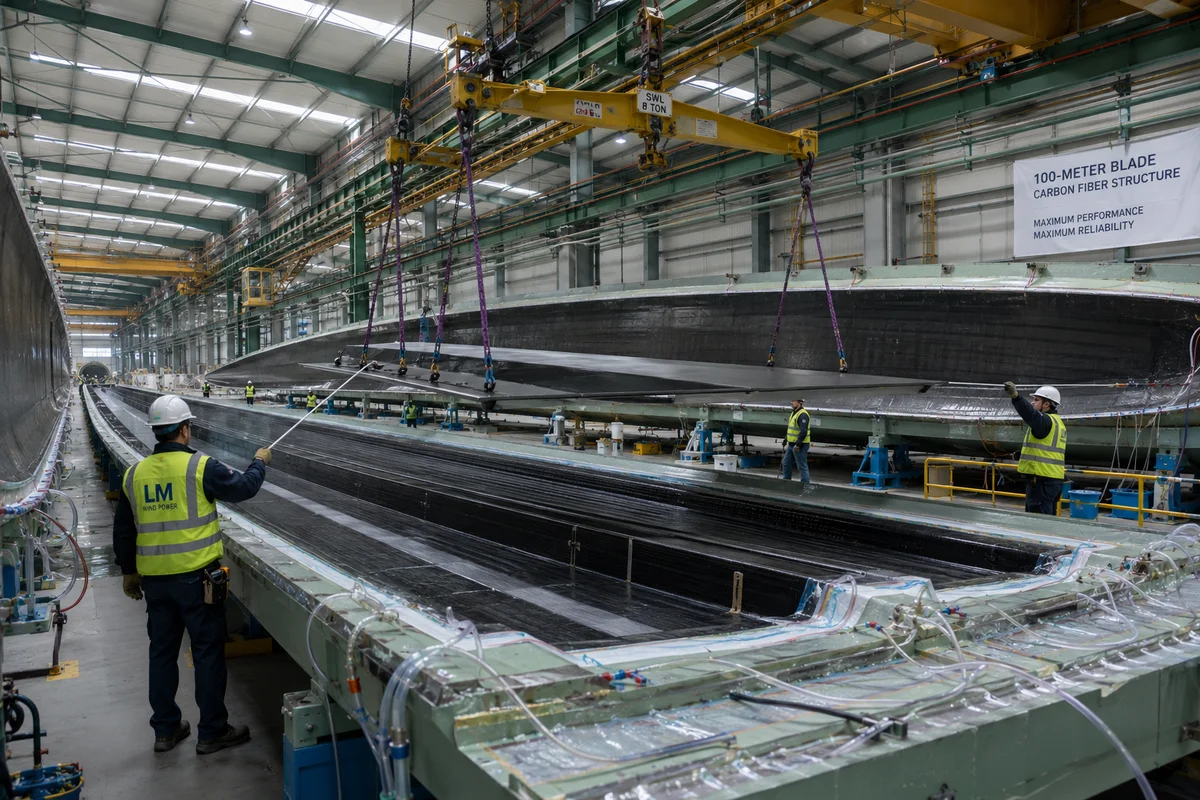
Carbon fiber in wind turbine blade manufacturing — material selection (pultruded CF vs infused fabric), manufacturing challenges for blades over 100 m, cost analysis, and supply chain considerations for 2026.
Why Wind Energy Drives Carbon Fibre Demand
The global wind energy industry consumed an estimated 34,000 metric tonnes of carbon fibre in 2025, making it the second-largest industrial market after aerospace. With offshore wind turbine rotor diameters exceeding 200 m and onshore blades reaching 100 m, carbon fibre has moved from a design option to a structural necessity. Glass fibre alone cannot meet the stiffness and fatigue requirements of blades beyond 80 m length without excessive weight penalties.
Material Forms Used in Wind Turbine Blades
| Material Form | Application in Blade | Fiber Architecture | FVF Achieved | Relative Cost | Market Share (2026 est.) |
|---|---|---|---|---|---|
| Pultruded CF plates (spar caps) | Main load-bearing spar caps | Unidirectional, 60–70 % fibre volume | 65–70 % | Baseline | 55 % |
| Biaxial / triaxial CF fabrics (infusion) | Shear webs, root reinforcement | ±45° biaxial, 0°/±45° triaxial | 50–58 % | 1.2–1.5× pultrusion | 30 % |
| Carbon/glass hybrid fabrics | Transition zones, trailing edge | CF/GF hybrid, various architectures | 48–55 % | 0.7–0.9× full CF | 10 % |
| Prepreg CF (autoclave) | Limited — tip sections, lightning protection | Unidirectional or woven | 58–65 % | 2–3× pultrusion | 5 % |
Manufacturing Challenge: Blades Beyond 100 m
As blade lengths push past 100 m (offshore turbines now reach 120–130 m), manufacturers face four critical challenges:
- Infusion length limits: Standard vacuum-assisted resin infusion has a practical flow length of 8–15 m from the injection point. For a 120 m blade, multiple injection ports and flow media designs are required. Infusion simulation (PAM-RTM, RTM-Worx) is now standard practice before mould construction.
- Pultruded spar cap handling: A 120 m blade requires spar cap sections 100–110 m long. Pultruded carbon fibre plates (50–100 mm wide, 3–8 mm thick) are delivered in sections and assembled on a jig. Alignment tolerance: ± 0.5 mm over 100 m. Thermal expansion mismatch between CFRP and steel tooling requires temperature-controlled assembly halls (± 2 °C).
- Thick laminate curing exotherm: Sections over 30 mm thick (root build-up areas reach 80–120 mm) generate significant exothermic heat during resin cure. For epoxy systems, peak exotherm temperature must stay below 180 °C to prevent thermal degradation. This requires staged cure cycles and low-exotherm resin formulations.
- Leading edge erosion protection: Leading edge speeds on a 120 m blade at 12 rpm reach 90 m/s (324 km/h). Rain erosion testing per ASTM G73 requires protective coatings (polyurethane, polyurea) with 20+ year service life. Carbon fibre substructure must be compatible with coating adhesion.
Material Selection: Pultruded CF vs Infused Fabric
The dominant trend in 2026 is the use of pultruded carbon fibre plates for spar caps combined with infused carbon fabrics for shear webs and root sections. The pultrusion process delivers consistent fibre volume fraction (65–70 %) and tension-tension fatigue performance exceeding 10 million cycles at 60 % of ultimate tensile strength. Infused fabrics offer design flexibility for complex geometries but achieve lower fibre volume (50–58 %) and require careful process control to avoid dry spots in thick sections.
At YongXian, we supply pultruded carbon fibre plates (YX-PC series) in widths from 25 mm to 150 mm, thicknesses from 1.5 mm to 12 mm, with custom cut lengths up to 15 m per section. Our plates are manufactured with 60–68 % fibre volume using 50K large-tow carbon fibre, achieving tensile modulus of 165–185 GPa (axial) and tensile strength of 2,200–2,600 MPa — matching the requirements of major blade OEMs. We also supply multiaxial carbon fabrics (YX-MA series) optimised for vacuum infusion, with areal weights from 400 to 1,200 gsm.
Cost Analysis: Carbon Fibre in Wind Blades
Carbon fibre represents approximately 18–25 % of the total blade material cost for a 100 m+ offshore blade. Breakdown per blade (100 m class, 25 tonnes total weight):
- Pultruded CF plates (spar caps): 3.8 tonnes at €28–35/kg = €106,000–133,000
- Carbon fabrics (shear webs, root): 1.2 tonnes at €35–50/kg = €42,000–60,000
- Glass fibre fabrics (shells): 12 tonnes at €4–7/kg = €48,000–84,000
- Resin, core, adhesive: 8 tonnes at €8–15/kg = €64,000–120,000
- Total blade material cost: €260,000–397,000
- Carbon fibre share of material cost: 18.5–23.5 %
Q: Why is pultruded carbon fibre preferred over infused fabric for spar caps?
A: Pultruded carbon fibre plates offer three key advantages for spar caps: (1) higher fibre volume fraction (65–70 % vs 50–58 %) giving higher axial stiffness and strength; (2) consistent quality with automated process control (Cpk ≥ 1.33 on modulus and thickness); and (3) faster layup — pre-cured plates are positioned and bonded into the spar cap rather than requiring in-situ infusion of multiple fabric layers. The trade-off is less design flexibility for taper and curvature, which is why infused fabrics are preferred at the root transition and tip sections.
Q: How does carbon fibre reduce blade weight compared to all-glass designs?
A: For a 100 m blade, replacing glass fibre spar caps with carbon fibre reduces the spar cap weight by approximately 60–65 % (from 10–11 tonnes glass to 3.5–4 tonnes carbon). Total blade weight reduction: 25–30 %. This weight reduction enables longer blades without increasing root bending moment, allowing turbine OEMs to increase rotor diameter by 8–12 % for the same tower and foundation design, directly increasing annual energy production by 15–25 %.
Q: What are the lightning protection requirements for carbon fibre blades?
A: Carbon fibre's electrical conductivity requires integrated lightning protection systems (LPS). Standard design: metallic receptor at blade tip connected to a down-conductor (copper cable, 50–95 mm² cross-section) running along the spar cap to the blade root, with spark gap connections at each blade section joint. The LPS must handle a peak current of 200 kA per IEC 61400-24. Carbon fibre pultruded plates require surface copper mesh or metallic inserts at receptor attachment points to prevent sparking at the carbon-epoxy interface.
Part of topic
Related Articles
- Carbon Fiber Mooring for Floating Offshore Wind: Fatigue and Corrosion in Deep Water
- Carbon Fiber Bicycle Frame Optimization: Layup Design and Manufacturing for Competitive Racing
- Carbon Fiber CFRP Retrofit for Infrastructure: Bridge and Building Seismic Strengthening
- Carbon Fiber Medical Imaging Equipment: Lightweight Gantry and Couch Structures for MRI/CT
- Carbon Fiber EV Battery Enclosures: Crash Safety and Electromagnetic Shielding Design
- Carbon Fiber Structures for Low-Altitude Economy: UAV Airframes and eVTOL Components
Interested in Our Products?
Contact our team for competitive pricing and technical specifications.
Get a QuoteRelated Products
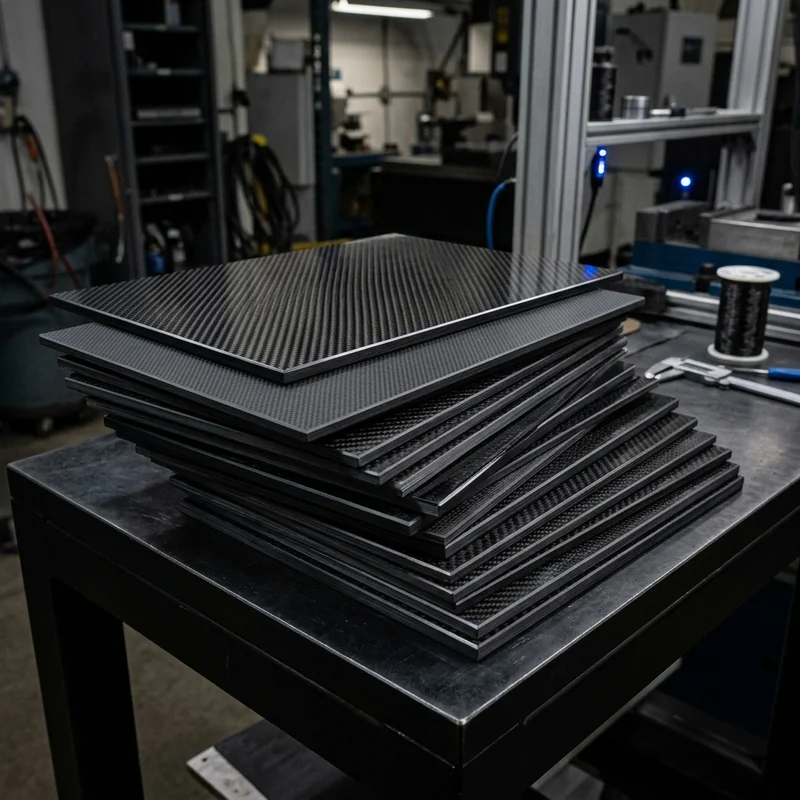
Carbon fiber standard plate-3k stripe
Lightweight, ultra-rigid standard sheets for drone fuselages, robot housings, facades and structural applications.

Carbon Fiber Plate — 3K Twill T700 1.5mm
Thin 1.5mm carbon fiber plate with 3K twill weave surface. Lightweight and stiff, commonly used for covers, panels, drone bodies, and applications requiring a premium aesthetic appearance.
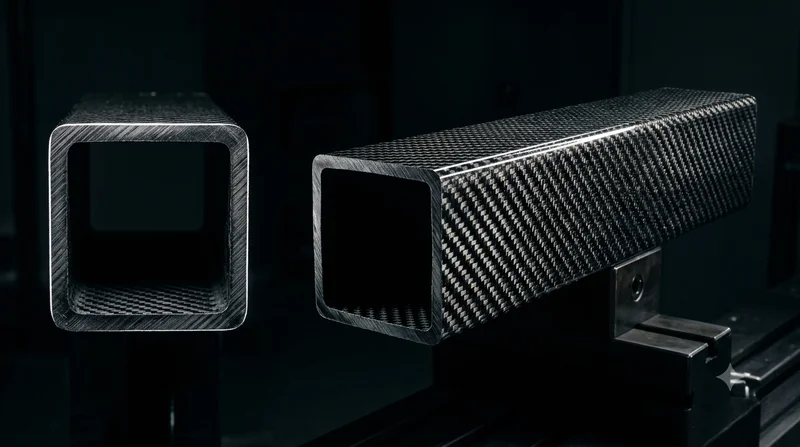
Square Carbon Fiber Tube — 3K Twill T700
Square cross-section carbon fiber tube manufactured with 3K twill weave for torsional strength. Preferred for structural frames, trusses, and support columns where rectangular geometry offers design flexibility.
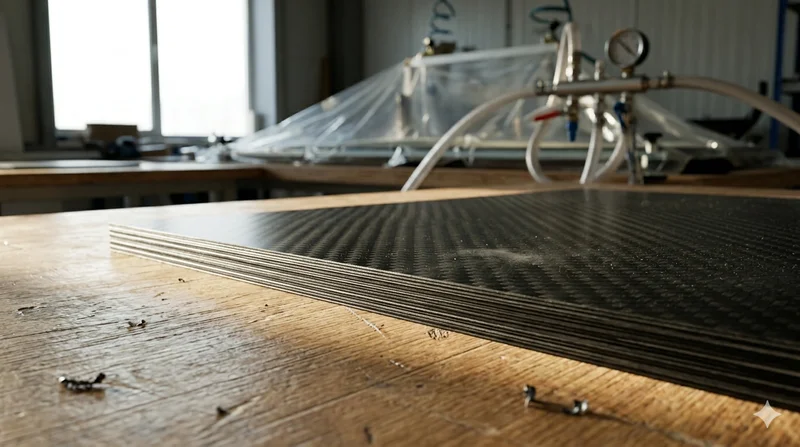
Carbon Fiber Plate — 3K Twill T700 3.0mm
Medium-thickness 3.0mm carbon fiber plate offering significantly higher load capacity while maintaining attractive 3K twill finish. Suitable for structural brackets, reinforcement plates, and load-bearing panels.
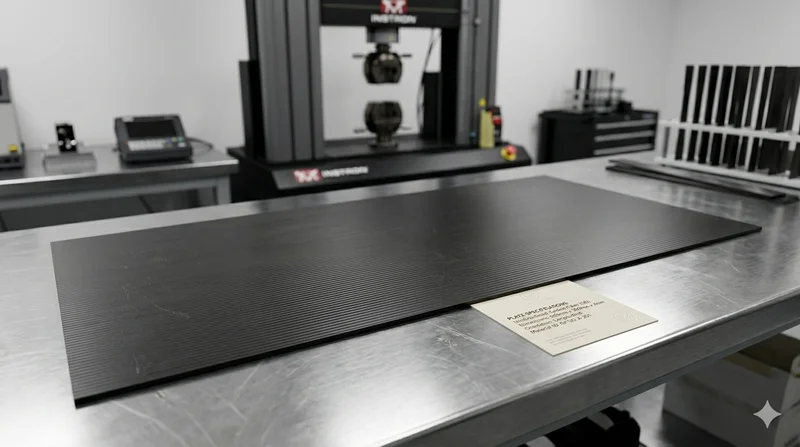
Carbon Fiber Plate — UD Unidirectional T700
Unidirectional carbon fiber plate with all fibers oriented in a single direction for maximum strength along the fiber axis. Essential for structural reinforcements, splints, and applications where load direction is predictable.