
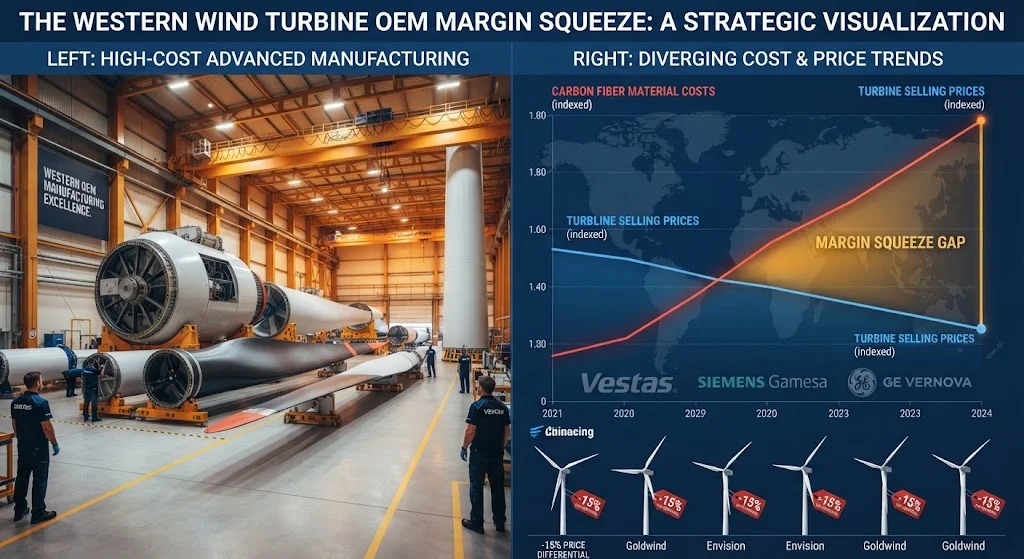
Western wind turbine OEMs face severe margin pressure as carbon fiber costs rise while turbine prices decline. This article analyzes the structural challenges facing Vestas, Siemens Gamesa, and GE Vernova, and their strategies for maintaining profitability.
Introduction
The Western wind turbine OEM market is experiencing unprecedented margin pressure, with the three major manufacturers — Vestas, Siemens Gamesa (now part of Siemens Energy), and GE Vernova — reporting operating margins of 0-5% in recent quarters, well below the 8-12% levels needed for sustainable profitability. Carbon fiber costs represent a significant and growing component of this margin squeeze.
The structural challenge is clear: as turbine designs grow larger and more carbon-fiber-intensive to capture more energy, the material costs that once represented a small fraction of total turbine cost now dominate the bill of materials. Meanwhile, competitive pressures from Chinese manufacturers and aggressive project bidding have pushed turbine selling prices down faster than manufacturers can reduce costs.
Carbon Fiber Cost Impact
Carbon fiber's share of turbine costs has increased dramatically:
Material cost growth: Carbon fiber prices have increased 25-40% since 2020, driven by supply constraints, energy cost inflation, and growing demand from multiple sectors. For a 15 MW offshore turbine with 25-30 tons of carbon fiber, this represents $500,000-$750,000 in material costs per turbine.
Design intensity: The percentage of carbon fiber in blade structures has risen from 20-30% to 40-50% as blade lengths increase. A 100-meter blade requires 25-35 tons of carbon fiber, compared to 10-15 tons for a 70-meter blade.
Waste and yield: Manufacturing waste rates of 15-25% for manual layup processes further increase effective material costs. While automated processes reduce waste, the capital investment required adds to fixed costs.
Competitive Pressures
Chinese turbine manufacturers are intensifying competitive pressure on Western OEMs:
Price competition: Chinese OEMs — Goldwind, Envision, Mingyang — offer turbines at 30-40% lower prices than Western competitors, enabled by lower labor costs, domestic supply chains, and state support.
Technology catch-up: Chinese manufacturers have rapidly closed the technology gap, with 15+ MW offshore turbines now in production. While Western OEMs maintain advantages in reliability and service, the technology premium is narrowing.
Export competition: Chinese OEMs are increasingly competing in international markets that were previously dominated by Western manufacturers, further eroding market share and pricing power.
OEM Response Strategies
Western OEMs are pursuing several strategies to address margin pressure:
Vertical integration: Some OEMs are investing in or acquiring blade manufacturing capabilities to control costs and reduce dependence on external suppliers. Vestas has expanded its blade production footprint significantly.
Material efficiency: Blade designs that optimize carbon fiber usage — through structural analysis, hybrid configurations, and manufacturing process improvements — can reduce material requirements without sacrificing performance.
Service and aftermarket: Growing service and aftermarket businesses provide higher-margin revenue streams that can offset lower equipment margins. Long-term service contracts offer predictable revenue and customer lock-in.
Cost reduction programs: Aggressive cost reduction programs targeting manufacturing efficiency, supply chain optimization, and overhead reduction are essential for maintaining competitiveness.
Market Outlook
The margin pressure on Western turbine OEMs is likely to persist through 2028 as:
Supply chain restructuring: The wind energy supply chain is undergoing significant restructuring, with consolidation, capacity rationalization, and geographic shifts that will take several years to stabilize.
Carbon fiber market evolution: As new carbon fiber production capacity comes online and recycling capabilities develop, material costs may stabilize, but the timeline for meaningful cost reduction is uncertain.
Policy support: Government policies supporting domestic manufacturing — including the US Inflation Reduction Act and EU Net Zero Industry Act — may provide some relief for Western OEMs, but the magnitude and duration of support is uncertain.
Conclusion
Western wind turbine OEMs face a structural margin challenge driven by rising carbon fiber costs, competitive pressure from Chinese manufacturers, and aggressive project bidding. Addressing this challenge requires a combination of material efficiency improvements, vertical integration, service business development, and cost reduction programs. The industry's ability to restore sustainable profitability will determine the pace of wind energy deployment and the competitive landscape of the global wind turbine market.
Part of topic
Related Articles
- Recycled Carbon Fiber Market Forecast 2030: Technology Maturity and Commercialization Path
- South Korea Carbon Fiber Market 2026: Hydrogen Economy and Shipbuilding Innovation
- Wind Turbine Blade Leading Edge Protection 2026: Polyurethane, Tape, and Metallic Shield Solutions
- China Carbon Fiber Overcapacity 2026: Price War Impact and Industry Consolidation
- India Carbon Fiber Market 2026: Wind Energy, Aerospace, and Defense Expansion
- PAN Precursor Market 2026: Acrylonitrile Supply and Carbon Fiber Cost Structure
Interested in Our Products?
Contact our team for competitive pricing and technical specifications.
Get a QuoteRelated Products
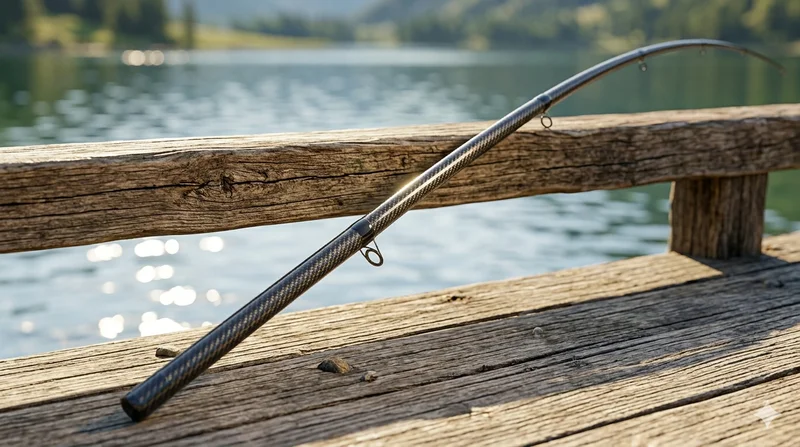
Carbon Fiber Fishing Rod Blank
High-quality carbon fiber fishing rod blank manufactured from multiple grades of Toray carbon fiber cloth. Available in a wide range of lengths, powers, and actions for freshwater and saltwater applications. Suitable for OEM rod building.
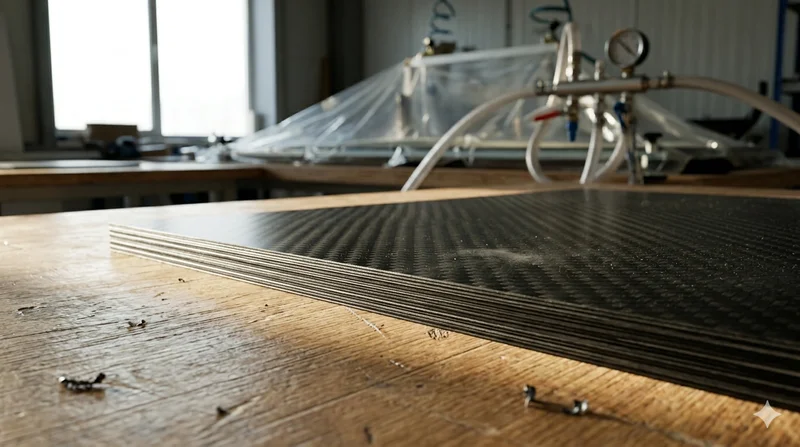
Carbon Fiber Plate — 3K Twill T700 3.0mm
Medium-thickness 3.0mm carbon fiber plate offering significantly higher load capacity while maintaining attractive 3K twill finish. Suitable for structural brackets, reinforcement plates, and load-bearing panels.
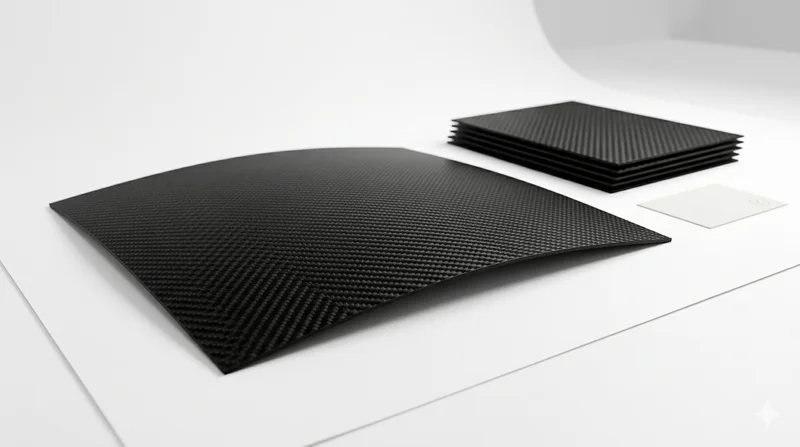
Carbon Fiber Plate — 3K Twill T700 1.5mm
Thin 1.5mm carbon fiber plate with 3K twill weave surface. Lightweight and stiff, commonly used for covers, panels, drone bodies, and applications requiring a premium aesthetic appearance.
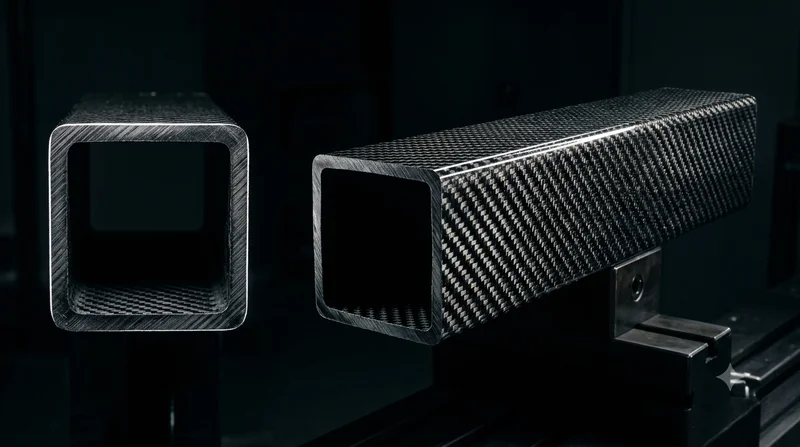
Square Carbon Fiber Tube — 3K Twill T700
Square cross-section carbon fiber tube manufactured with 3K twill weave for torsional strength. Preferred for structural frames, trusses, and support columns where rectangular geometry offers design flexibility.
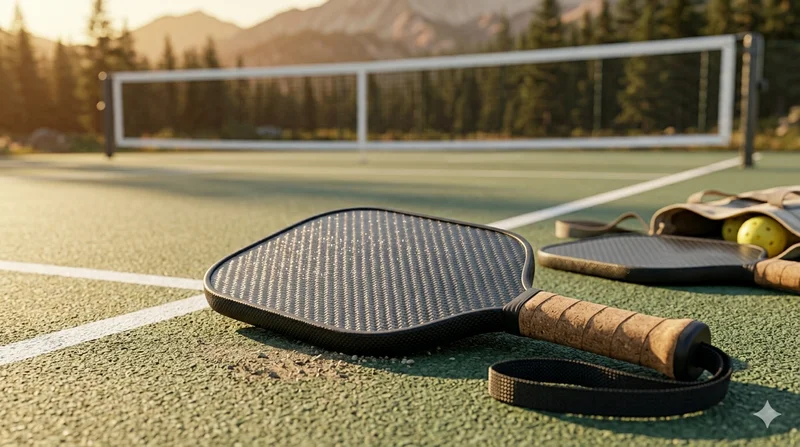
Carbon Fiber Pickleball Paddle
High-performance pickleball paddle with Toray T700 carbon fiber face and polypropylene honeycomb core. Delivers excellent power-to-weight ratio, spin generation, and vibration dampening for competitive play.