
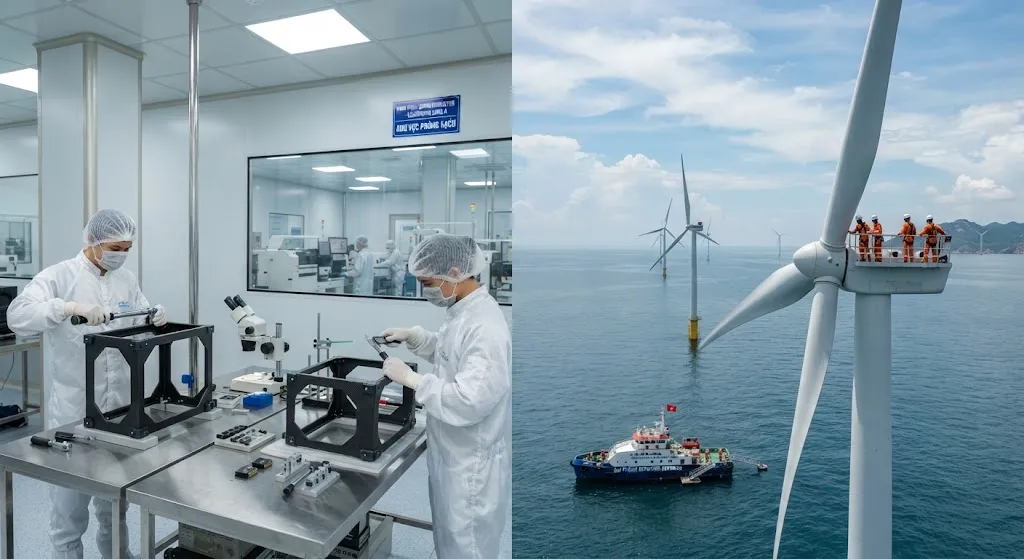
Vietnam has emerged as one of the most dynamic carbon fiber markets in Southeast Asia, positioned at the intersection of two powerful global trends: supply chain diversification away from China and the rapid buildout of renewable energy infrastructure. The country's carbon fiber demand
Introduction
Vietnam has emerged as one of the most dynamic carbon fiber markets in Southeast Asia, positioned at the intersection of two powerful global trends: supply chain diversification away from China and the rapid buildout of renewable energy infrastructure. The country's carbon fiber demand is growing at an estimated 15-20% annually, driven by electronics manufacturers establishing production bases and the government's ambitious offshore wind targets under Power Development Plan VIII.
For carbon fiber producers and composite suppliers, Vietnam represents both immediate opportunity and long-term strategic positioning. The electronics sector provides high-volume, immediate demand for precision carbon fiber components, while offshore wind offers a massive long-term market as Vietnam targets 6 GW of offshore wind capacity by 2030. This article examines the two primary demand drivers, analyzes the supply chain structure, and provides a practical sourcing roadmap for B2B buyers.
Electronics Manufacturing: The Immediate Demand Driver
Vietnam has become the preferred alternative production base for global electronics supply chains seeking to reduce dependence on Chinese manufacturing. Samsung operates its largest smartphone production complex in Thai Nguyen province, while LG, Foxconn, Goertek, and Luxshare have expanded operations across Bac Ninh, Bac Giang, and Ho Chi Minh City. The country now exports over $110 billion in electronics annually, representing 32% of total export value.
This electronics boom creates direct carbon fiber demand in several categories:
- Semiconductor and precision equipment frames: Carbon fiber structural components for wafer handling robots, cleanroom automation, and precision measurement fixtures — replacing aluminum for vibration damping and dimensional stability.
- Consumer electronics enclosures: Laptop lids, tablet frames, and premium audio equipment housings where thin-walled 0.5-0.8 mm carbon fiber laminates deliver stiffness at reduced weight.
- Automation and robotics: Pick-and-place gantry arms and end-effectors for electronics assembly lines, where carbon fiber's specific stiffness reduces cycle times and improves positioning accuracy.
- Test and inspection tooling: Stable composite fixtures for AOI (automated optical inspection) and X-ray inspection stations that must hold micron-level tolerances under thermal cycling.
| Electronics Application | Carbon Fiber Requirement | Annual Volume Estimate (tonnes) | Key Suppliers |
|---|---|---|---|
| Semiconductor equipment frames | High-modulus, precision machined | 200-400 | Toray, Mitsubishi, Formosa |
| Consumer electronics enclosures | Thin-wall prepreg, Class A finish | 500-1,000 | Hyosung, Formosa, Chinese suppliers |
| Industrial automation | Standard modulus, structural grade | 300-600 | Toray, Toho, Chinese suppliers |
| Test fixtures | Dimensional stability, low CTE | 100-200 | Toray, Hexcel |
The compound annual growth rate of Vietnam's electronics production has averaged 11.2% over the past five years, with projections maintaining 10-12% growth through 2028 as Apple diversifies iPad and MacBook assembly into the country.
Offshore Wind Energy: The Long-Term Upside
Vietnam possesses one of the best offshore wind resource bases in Southeast Asia, with the World Bank estimating 475 GW of technical offshore wind potential. The government's Power Development Plan VIII targets 6 GW of offshore wind by 2030, ramping toward 70-90 GW by 2050. Onshore wind capacity already exceeds 7 GW and continues to grow in the Central Highlands.
Wind energy consumes significant carbon fiber in blade spar caps, shear webs, and tower components. A single 15 MW offshore turbine blade set uses 20-35 tonnes of carbon fiber in the structural elements. If Vietnam reaches even one-third of its 2030 offshore target, the annual carbon fiber requirement could reach 12,000-18,000 tonnes — comparable to the current annual consumption of the entire ASEAN region.
Supply Chain Structure and Import Dynamics
Vietnam currently has no domestic carbon fiber precursor or PAN fiber production capacity. All carbon fiber is imported — primarily from Taiwan (Formosa Plastics), South Korea (Hyosung), Japan (Toray, Teijin, Mitsubishi), and increasingly China. Import duties on carbon fiber typically range from 0-5% under ASEAN and CPTPP trade agreements.
Local converters are concentrated in three clusters:
- Northern Red River Delta: Samsung ecosystem suppliers in Bac Ninh and Bac Giang, plus emerging automotive assembly operations. This cluster consumes the highest volume of precision carbon fiber components.
- Ho Chi Minh City and southern industrial belt: Consumer electronics, marine applications, and general industrial composites. Most diversified converter base.
- Da Nang and central Vietnam: Emerging aerospace and wind energy activity, with several Korean and Taiwanese suppliers establishing regional operations.
Growth Projections and Market Opportunities
Vietnam's carbon fiber market is projected to reach 8,000-12,000 tonnes annually by 2030, up from an estimated 3,000-4,000 tonnes in 2025. The growth trajectory is underpinned by several structural factors:
- Electronics diversification: Apple, Samsung, and other major brands continue shifting production to Vietnam, driving compound demand growth of 12-15% annually in precision carbon fiber components.
- Infrastructure megaprojects: The $47 billion Hanoi-Ho Chi Minh City high-speed rail project, metro systems in both cities, and Long Thanh International Airport will consume significant composite materials for bogie frames, interior panels, and structural components.
- Offshore wind pipeline: Power Development Plan VIII's 6 GW target by 2030 creates a structural demand floor for blade-grade carbon fiber, with first large-scale procurement expected in 2028-2029.
- Automotive growth: Vietnam's automotive production is projected to reach 800,000-1,000,000 units annually by 2030, creating secondary demand for lightweight CFRP components in braking, suspension, and body applications.
Frequently Asked Questions
What are the key advantages of sourcing carbon fiber in Vietnam versus China?
Vietnam offers several structural advantages for carbon fiber importers. Tariffs are lower — most carbon fiber raw materials enter at 0-5% under CPTPP and ASEAN preferential schemes, versus 5-8% typical rates in China for non-domestic sources. Documentation requirements are simpler, with no dual-use export control regime comparable to China's licensing framework. Logistically, Vietnam's northern ports serve the electronics cluster within 24 hours, while southern ports handle consumer goods and marine applications. The main trade-off is scale: Vietnam's fragmented converter base means buyers with high-volume requirements often need to import finished components rather than raw material for local conversion.
How will offshore wind development affect carbon fiber demand in Vietnam?
Offshore wind represents the largest long-term carbon fiber demand driver in Vietnam. Power Development Plan VIII targets 6 GW of offshore wind by 2030, with each 15 MW turbine requiring 20-35 tonnes of carbon fiber in blade structures. If Vietnam reaches even one-third of this target, annual carbon fiber demand from wind alone could reach 6,000-9,000 tonnes by 2030. First large-scale blade procurement is expected in 2028-2029 as project development timelines align with manufacturing capacity buildout. Vietnamese converters currently lack the capability to produce wind-grade carbon fiber blade components, creating an import opportunity for established suppliers.
What is the typical lead time for carbon fiber delivery to Vietnam?
Lead times vary by source country and product type. From Japan (Toray, Teijin): 6-10 weeks for standard modulus prepreg, 8-12 weeks for specialty grades. From Taiwan (Formosa): 4-6 weeks for standard products, 6-8 weeks for custom specifications. From South Korea (Hyosung): 3-5 weeks for standard products. From China: 2-4 weeks for commodity grades, but quality consistency varies significantly by supplier. Air freight options exist for urgent requirements (3-5 days from most Asian origins) at premium cost. Most Vietnamese converters maintain 4-8 weeks of safety stock for high-volume applications.
Conclusion
Vietnam's carbon fiber market sits at a strategic inflection point. The electronics manufacturing relocation provides immediate, compounding demand with 12-15% annual growth in precision components. Offshore wind under Power Development Plan VIII offers the largest long-term structural demand driver, with first large-scale procurement expected in 2028-2029. The absence of domestic carbon fiber production means every kilogram consumed is imported, creating a highly accessible market for overseas suppliers with competitive quality, pricing, and logistics.
For B2B buyers evaluating Vietnamese sourcing or suppliers planning to serve Vietnam, the practical path combines imported carbon fiber materials with local secondary processing capabilities. Browse our carbon fiber product range, including materials suited to Vietnam's electronics and wind energy demand, or contact our engineering team for a market entry assessment with pricing and lead-time projections for the Vietnamese market.
Part of topic
Related Articles
- Recycled Carbon Fiber Market Forecast 2030: Technology Maturity and Commercialization Path
- South Korea Carbon Fiber Market 2026: Hydrogen Economy and Shipbuilding Innovation
- Wind Turbine Blade Leading Edge Protection 2026: Polyurethane, Tape, and Metallic Shield Solutions
- China Carbon Fiber Overcapacity 2026: Price War Impact and Industry Consolidation
- India Carbon Fiber Market 2026: Wind Energy, Aerospace, and Defense Expansion
- PAN Precursor Market 2026: Acrylonitrile Supply and Carbon Fiber Cost Structure
Interested in Our Products?
Contact our team for competitive pricing and technical specifications.
Get a QuoteRelated Products

Carbon Fiber Fishing Rod Blank
High-quality carbon fiber fishing rod blank manufactured from multiple grades of Toray carbon fiber cloth. Available in a wide range of lengths, powers, and actions for freshwater and saltwater applications. Suitable for OEM rod building.

Carbon Fiber Plate — 3K Twill T700 3.0mm
Medium-thickness 3.0mm carbon fiber plate offering significantly higher load capacity while maintaining attractive 3K twill finish. Suitable for structural brackets, reinforcement plates, and load-bearing panels.

Carbon Fiber Plate — 3K Twill T700 1.5mm
Thin 1.5mm carbon fiber plate with 3K twill weave surface. Lightweight and stiff, commonly used for covers, panels, drone bodies, and applications requiring a premium aesthetic appearance.

Carbon Fiber Trekking Pole
Lightweight carbon fiber trekking pole manufactured from high-grade carbon fiber tube. Weighs only 160g per pole while providing superior shock absorption and durability for hiking, trail running, and backpacking.

Square Carbon Fiber Tube — 3K Twill T700
Square cross-section carbon fiber tube manufactured with 3K twill weave for torsional strength. Preferred for structural frames, trusses, and support columns where rectangular geometry offers design flexibility.