
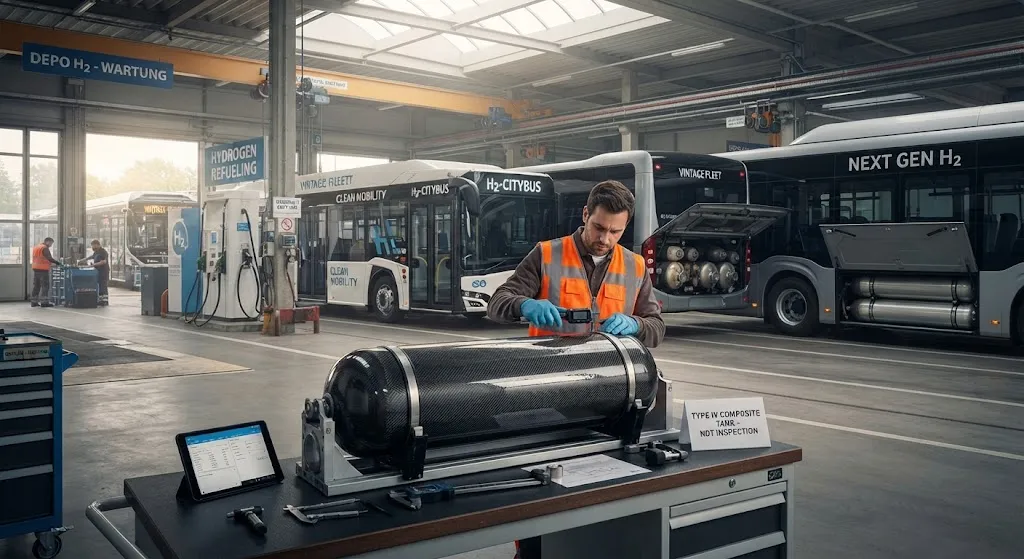
Hydrogen fuel cell fleets in Europe are growing quickly: buses in Madrid, Cologne, and London, trucks on German autobahn corridors, and refuse collection vehicles in Dutch cities all store hydrogen onboard as compressed gas. For every one of those vehicles, a procurement team made the s
Introduction
Hydrogen fuel cell fleets in Europe are growing quickly: buses in Madrid, Cologne, and London, trucks on German autobahn corridors, and refuse collection vehicles in Dutch cities all store hydrogen onboard as compressed gas. For every one of those vehicles, a procurement team made the same decision: which tank type to specify. The two candidates are the Type III tank, which pairs a metal liner with a carbon fiber overwrap, and the Type IV tank, which replaces the liner with a polymer bladder. The choice shapes not only the initial vehicle price, but also the maintenance schedule, inspection intervals, and weight distribution for years to come.
Purchase price tends to dominate procurement discussions, and on that metric Type III tanks often look attractive because their metal liners are cheaper to form. Yet fleet operators who track the full cost picture consistently reach the opposite conclusion. Measured data from more than 50 European hydrogen vehicle systems over five years shows that Type IV tanks deliver a significantly lower total cost of ownership, with savings concentrated in inspection and maintenance rather than in the initial purchase. This article explains the cost model, the reasons behind each line item, and how fleet teams should structure their own comparisons.
The Five-Year TCO Picture
Total cost of ownership for a hydrogen tank combines the purchase price, installation, periodic inspections, liner maintenance, requalification testing, and the operational cost of carrying the tank's own weight. Fleet data collected across European operators who track these items separately reveals a consistent gap between the two tank types. The table below summarizes the measured ranges:
| Cost Component | Type III (Metal Liner) | Type IV (Polymer Liner) | Difference |
|---|---|---|---|
| Initial purchase price | Baseline | 25-30% higher | Type IV costs more upfront |
| Annual inspection and maintenance | $400-800 per year | $100-150 per year | Type IV saves 65-80% |
| Five-year TCO per system | $9,500-11,200 | $3,200-5,800 | Type IV roughly 66% lower |
The headline result is a five-year total cost of ownership for Type IV systems of roughly $3,200-5,800, against $9,500-11,200 for Type III — a reduction of about two-thirds. The gap is large enough to outweigh the higher purchase price within the first year or two of operation in most cases. For a fleet of fifty buses, the difference in lifecycle cost accumulates to hundreds of thousands of dollars, which is why European operators have moved decisively toward Type IV for new acquisitions.
Why Inspection and Maintenance Dominate
The root cause of the cost gap is the metal liner in Type III tanks. Metal liners corrode over time, especially when the tank is cycled between high and low pressure, which stresses the liner-backing interface and can generate microcracks in the liner. Because hydrogen embrittlement makes steel and aluminum liners susceptible to cracking under cyclic loading, regulators require Type III tanks to be inspected at shorter intervals, with more thorough procedures, than their Type IV counterparts. The metal liner also adds weight, so a Type III tank must carry more carbon fiber to achieve the same structural efficiency, raising both material content and the cost basis for the composite overwrap.
Type IV tanks invert this maintenance profile. The polymer liner does not corrode and is not subject to hydrogen embrittlement, so inspection intervals are longer and the procedures are less labor-intensive. The lower liner mass means less fiber is required for the same pressure rating, and the resulting light tank reduces energy consumption across the vehicle's life. The trade-off is that Type IV liners require more sophisticated manufacturing — blow molding or rotational molding of a seamless polymer bladder, with dimensional control that must hold across the full service temperature range — which explains the higher initial purchase price documented in fleet data.
Weight, Payload, and Operational Costs
Weight is the second driver of the TCO difference, and it acts through several channels at once. The table below compares the principal specification differences that matter to fleet operators:
| Parameter | Type III Tank | Type IV Tank | Fleet Impact |
|---|---|---|---|
| Liner material | Aluminum or steel | Seamless polymer (HDPE or PA) | Corrosion and embrittlement resistance |
| Typical weight for 350 bar | 25-40% heavier | Baseline | Payload capacity and fuel economy |
| Inspection interval | Shorter, more frequent | Longer, less frequent | Vehicle availability and labor cost |
| Requalification testing | More demanding | Simpler procedures | Extension of service life |
Every kilogram saved on the tank is a kilogram of payload or fuel capacity, and on a 350 bar bus system the weight difference between Type III and Type IV can reach several hundred kilograms across the full storage bank. Over a five-year service life covering hundreds of thousands of kilometers, that weight translates into measurable differences in fuel consumption and range. The operational calculation is simple in principle: a lighter tank reduces energy demand, which reduces hydrogen purchases, which compounds with lower inspection costs into the large TCO gap shown in the fleet data.
How Fleet Teams Should Structure the Comparison
The value of a TCO comparison depends on getting the boundaries right, and fleet teams that have produced misleading results typically made one of three errors. The first is comparing purchase prices only, which ignores the cost structure that dominates the lifecycle. The second is using manufacturer-stated service life rather than measured requalification outcomes, when in practice tanks are often retired early or extended beyond nominal life depending on inspection results. The third is treating fuel costs as identical between tank types, ignoring that weight differences change consumption. A disciplined comparison captures all of these elements:
- Purchase price including installation, valves, and brackets, quoted on the same basis for both tank types.
- Maintenance schedule derived from the regulatory framework — in Europe, typically ECE R134 and ISO 19881 for hydrogen tanks — rather than from vendor marketing materials.
- Inspection costs built from actual labor hours and vehicle downtime, not from nominal service tasks.
- Weight-driven fuel costs calculated from the tank system weight difference and the fleet's real duty cycle.
- Requalification and end-of-life treatment, reflecting the tank's actual measured condition at each inspection.
Operators who run the model with their own data typically find that Type IV's advantage holds across European operating conditions, but the magnitude varies. High-utilization fleets that carry many tanks per vehicle see larger absolute savings, while fleets with very short holding periods may not recover the purchase premium. The five-year horizon used in the industry data is a useful default because it aligns with typical bus and truck replacement cycles and captures at least one full requalification event.
Frequently Asked Questions
Why do Type IV tanks cost more to buy but less to own?
The Type IV tank's polymer liner is more expensive to manufacture because it requires seamless blow molding or rotational molding with tight dimensional tolerances across the service temperature range, which raises the purchase price by 25-30%. However, the polymer liner does not corrode and is immune to hydrogen embrittlement, so inspection intervals are longer, procedures are less labor-intensive, and annual maintenance drops to $100-150 versus $400-800 for a metal-lined Type III. The lower liner weight also reduces fuel consumption. Over five years these operating savings outweigh the purchase premium, producing a roughly 66% lower total cost of ownership.
What standards govern hydrogen tank inspection in Europe?
European hydrogen vehicle tanks are governed primarily by ECE R134 for compressed hydrogen storage on vehicles and ISO 19881 for tank design, manufacturing, and periodic inspection. These frameworks define inspection frequencies, requalification intervals, and the testing procedures that determine whether a tank's service life can be extended. Because the standards apply different scrutiny to metal-lined and polymer-lined tanks, the regulatory framework is a direct driver of the maintenance cost difference between Type III and Type IV systems.
Does the TCO advantage of Type IV hold for trucks as well as buses?
Yes, and the advantage tends to be larger for trucks because they typically carry a greater number of tanks and operate higher-mileage duty cycles, multiplying both the weight savings and the avoided inspection costs. The same cost drivers apply: corrosion-free liners, longer inspection intervals, and lower mass. Fleet data shows the relative gap in total cost of ownership is consistent across bus and truck applications, though fleets with very short holding periods, such as lease durations under two years, may not fully recover the higher Type IV purchase price.
How does tank weight affect hydrogen fuel costs in real operation?
A heavier tank increases the vehicle's unladen mass, which raises the energy required to move the vehicle. On a typical 350 bar bus storage system the weight difference between Type III and Type IV can total several hundred kilograms, and over hundreds of thousands of kilometers this compounds into a measurable increase in hydrogen consumption. Operators usually model the effect through the relationship between vehicle mass and fuel economy, using their real duty cycle rather than static certification figures.
Conclusion
The choice between Type III and Type IV hydrogen tanks is a total cost of ownership decision, not a purchase price decision. Across more than 50 European systems tracked over five years, Type IV tanks — despite a 25-30% higher purchase price — deliver roughly 66% lower five-year TCO because corrosion-free polymer liners slash inspection and maintenance costs while lower mass trims fuel consumption. For fleet operators standardizing on hydrogen power, the TCO model should be run with their own duty cycle, holding period, and regulatory schedule before specification decisions are made.
YongXian supplies carbon fiber tow and intermediate-modulus products for Type III and Type IV hydrogen tank overwraps. Explore our carbon fiber range for pressure vessels, or contact our team for material specifications and qualification support for your hydrogen storage program.
Part of topic
Related Articles
- Bio-Based Carbon Fiber Precursors: Lignin and Polyethylene for Low-Cost Production
- Large-Tow Carbon Fiber Cost Analysis: 48K vs 60K Price-Performance Comparison
- Carbon Fiber-Resin Interface Bonding: Surface Treatment and Coupling Agent Optimization
- Digital Twin for Carbon Fiber Manufacturing: Real-Time Process Monitoring and Defect Prevention
- Thermoplastic Carbon Fiber Welding for Automotive: Ultrasonic and Induction Welding Process Windows
- Large-Tow Carbon Fiber Wet Spinning: Process Optimization for 48K/60K Production Efficiency
Interested in Custom Carbon Fiber Products?
Contact our team for competitive pricing and technical specifications.
Get a QuoteRelated Products

Carbon Fiber Fishing Rod Blank
High-quality carbon fiber fishing rod blank manufactured from multiple grades of Toray carbon fiber cloth. Available in a wide range of lengths, powers, and actions for freshwater and saltwater applications. Suitable for OEM rod building.

Carbon Fiber Drone Arm
Precision-molded carbon fiber drone arm combining unidirectional fiber for stiffness and woven layers for torsional strength. Designed for FPV, photography, and industrial drone platforms. Each arm is CNC-machined to exact specifications.