
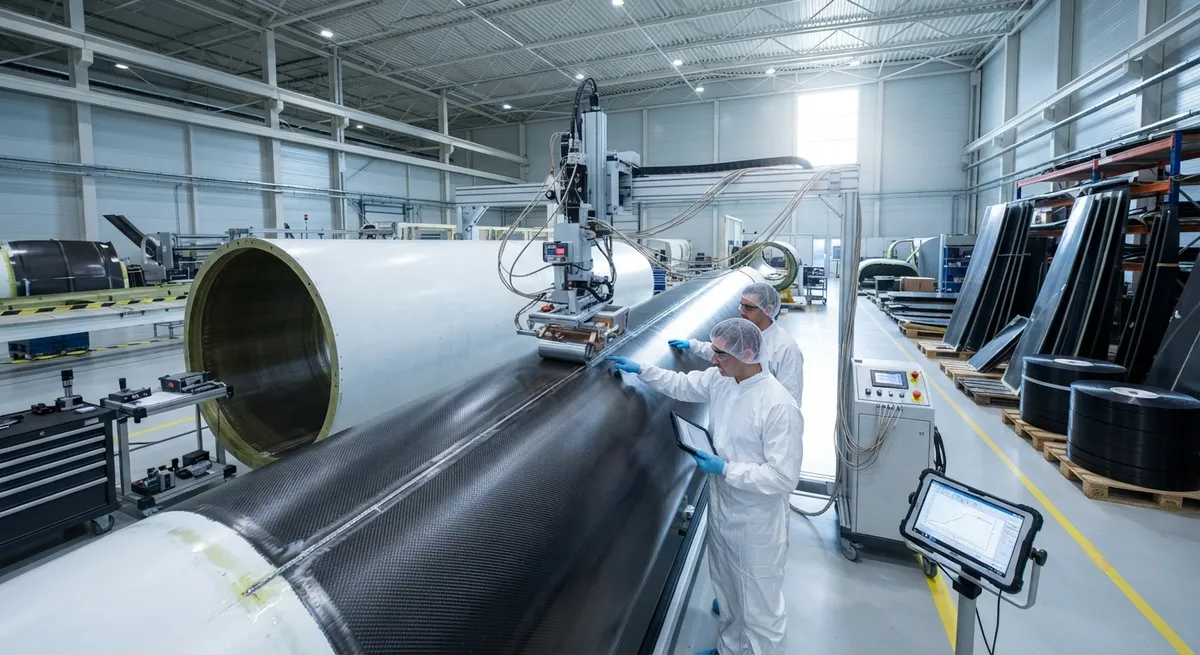
Thermoplastic carbon fiber composites have been called the future of airframe manufacturing for two decades, but it took the EU-funded HESTIA project to prove the concept at full aircraft scale. In 2022, a consortium led by GKN Aerospace Fokker completed a 4-meter-diameter thermoplastic
Introduction
Thermoplastic carbon fiber composites have been called the future of airframe manufacturing for two decades, but it took the EU-funded HESTIA project to prove the concept at full aircraft scale. In 2022, a consortium led by GKN Aerospace Fokker completed a 4-meter-diameter thermoplastic fuselage barrel demonstrator — the largest ever built — using panels produced by continuous compression molding and joined by automated induction welding. The milestone matters because it attacks the two things that make conventional fuselages expensive: the hours-long autoclave cure cycle and the tens of thousands of rivets that hold an aluminum or thermoset skin together.
For carbon fiber suppliers and component manufacturers, HESTIA is not an academic exercise. The project's stated targets — 25% lower production cost, 10% lower structural weight, and a build rate of 60 to 70 aircraft per month equivalent — directly describe the cost curve that next-generation single-aisle programs will demand. This article unpacks the materials, the welding processes, and the rate economics, and translates them into practical guidance for buyers evaluating thermoplastic carbon fiber solutions.
What the HESTIA Project Actually Demonstrated
HESTIA (part of the European Clean Sky 2 program) set out to prove that an entire fuselage barrel section could be manufactured from thermoplastic carbon fiber at rates compatible with narrowbody production. The consortium — GKN Fokker, Aernnova, DLR, and a network of European research institutes — built a demonstrator barrel roughly 4 meters in diameter with integrated stringers, frames, and window frames. Rather than curing a monolithic skin in an autoclave, the barrel was assembled from flat panels that were formed and consolidated in minutes, then welded together in a fully automated line.
The key result was speed. Where a thermoset fuselage skin requires 60-90 minutes of autoclave time at elevated pressure plus debulk steps, each HESTIA panel was consolidated in under 10 minutes by continuous compression molding, and the joining welds ran at rates measured in meters per minute. The entire concept was designed around a production philosophy borrowed from the automotive industry: standardize the panel, automate the joint, and eliminate the fasteners.
- Welded joints replace rivets: Induction welding produces a true fusion bond with no mechanical fastener, eliminating thousands of drill-and-fasten operations per barrel and the corrosion protection work that follows them.
- Continuous compression molding replaces autoclave: In-line consolidation of the skin panels removes the batch bottleneck of autoclave processing.
- Reversible joining: Unlike thermoset adhesives, thermoplastic welds can in principle be re-opened and re-made, simplifying repair and end-of-life recycling.
Materials Behind the Barrel: Matrices, Tapes, and Consolidation
The HESTIA demonstrator relies on high-performance thermoplastic matrices — primarily polyphenylene sulfide (PPS) and polyether ether ketone (PEEK) — reinforced with unidirectional carbon fiber tape. These semicrystalline matrices offer three structural advantages over epoxy: they are inherently tough and damage-tolerant, they absorb almost no moisture (eliminating the need for protective coatings), and they can be melted and welded repeatedly without degrading mechanical properties.
Manufacturing starts with continuous compression molding (CCM), in which a layup of thermoplastic prepreg tape is heated above the matrix melt temperature and consolidated between moving steel belts under pressure. The process turns a roll of carbon fiber/PPS tape into a consolidated panel in minutes, with a void content below 1%, and it is inherently scaleable — the same line can make window-belt panels, crown panels, and flat stock for shear webs.
Stiffeners are then welded onto the skin using induction welding, where a moving coil heats a susceptor at the weld interface and the two thermoplastic surfaces fuse under roller pressure. Because the weld is local and automated, the process produces consistent, inspectable joints at rates that make fuselage assembly a production line rather than a manual trade.
High-Rate Manufacturing: Thermoplastic vs Thermoset Economics
| Parameter | Thermoset Prepreg + Autoclave | Thermoplastic CCM + Welding |
|---|---|---|
| Skin consolidation time | 60-90 min autoclave + debulk steps | 5-10 min continuous molding |
| Joint method | Rivets + sealant (10,000-20,000 per barrel) | Automated induction welding |
| Joining rate | Manual drill/rivet, ~1-2 min per fastener | Welding head, meters per minute |
| Waste generation | High trim scrap, frozen storage for prepreg | Low scrap; rolls stored at room temperature |
| Projected barrel cost | Baseline | ~25% lower (HESTIA target) |
| Structural weight | Baseline | ~10% lower (HESTIA target) |
The rate difference is the decisive factor. A single-aisle program produces roughly 50-70 aircraft per month at full rate, and each barrel needs its skin panels, stringers, and frames joined into a pressure vessel. Autoclave batch processing and manual fastening create a hard ceiling on output; welding an automated line removes it. This is why every major airframer is now funding thermoplastic fuselage research, from the Clean Sky demonstrators in Europe to MFFD (Multifunctional Fuselage Demonstrator) work in Germany.
Structural Performance and Certification Considerations
Thermoplastic carbon fiber structures bring their own certification questions. The good news is that welded joints can be qualified through process control plus representative test coupons, similar to adhesive bonding — but regulators require proof that a welded structure tolerates realistic in-service damage. PEEK and PPS matrices shine here: their interlaminar fracture toughness is typically 5-10 times higher than brittle epoxy systems, which means damage grows more slowly and inspection intervals can be relaxed.
Flammability, smoke, and toxicity performance also meets aerospace requirements, and the absence of moisture ingress removes the biggest environmental degradation mechanism in fuselage service. Suppliers entering this market should expect buyers to ask for three things: traceability of welding process parameters, a validated non-destructive inspection method for weld lines, and test data at elevated temperature and humidity.
Frequently Asked Questions
How much faster is thermoplastic fuselage manufacturing compared with thermoset autoclave production?
The consolidation step itself is 6-10 times faster: a skin panel that spends 60-90 minutes in an autoclave can be continuously compression molded in 5-10 minutes. The bigger gain is in joining. An automated induction welding head joins stiffener lines at meters per minute, while riveting a thermoset or aluminum barrel requires one to two minutes per fastener across tens of thousands of holes. The HESTIA program targeted a 25% overall cost reduction and a build-rate ceiling comparable to 60-70 aircraft per month.
Are welded thermoplastic joints as strong as riveted or adhesive-bonded joints?
Welded fusion joints eliminate the mechanical fastener and its stress concentrations, and they avoid the surface-preparation sensitivity of adhesive bonding. Interlaminar fracture toughness of PEEK and PPS systems is 5-10 times higher than typical epoxies, which improves damage tolerance. Certification still requires process-control-based qualification, representative coupon testing, and validated NDT of the weld line — the same evidence chain used for bonded primary structure.
What does HESTIA mean for carbon fiber suppliers and component manufacturers?
It signals a shift in what buyers will specify: unidirectional thermoplastic tape (rather than thermoset prepreg), flat consolidated panels with tight dimensional control, and welded sub-assemblies delivered ready for fuselage integration. Suppliers that invest in thermoplastic tape production, CCM capacity, or automated welding cells are positioning for the next single-aisle platform decision, expected in the late 2020s.
Conclusion
The HESTIA barrel demonstrator converted thermoplastic carbon fiber from a promising laboratory material into a production-ready fuselage concept. Continuous compression molding collapses the cure cycle from hours to minutes, automated induction welding replaces tens of thousands of rivets, and PPS/PEEK matrices deliver the toughness and moisture resistance that certification authorities demand. For airframers the result is a credible path to 60-plus aircraft per month; for the supply chain it is a clear signal about the materials and processes that next-generation programs will buy.
If your company is evaluating thermoplastic carbon fiber for fuselage, stiffener, or panel applications, browse our carbon fiber product range for tapes, laminates, and profile options, or contact our engineering team to discuss material selection and qualification planning for welded thermoplastic structures.
Part of topic
Related Articles
- Carbon Fiber Tube for Sale: Comparing Listings and Avoiding Bad Specs
- Carbon Fiber Engine Parts: High-Temperature Performance for Racing and Performance Vehicles
- Carbon Fiber Body Parts: Automotive Exterior Panels and Structural Components
- Carbon Fiber Drone Body Manufacturing: Monocoque Design and Production Methods
- Carbon Fiber Drone Parts Supplier: FPV Frames, Arms and Structural Components
- Filament Wound Epoxy Tubes: Industrial Applications from Oil and Gas to Aerospace
Interested in Our Products?
Contact our team for competitive pricing and technical specifications.
Get a QuoteRelated Products
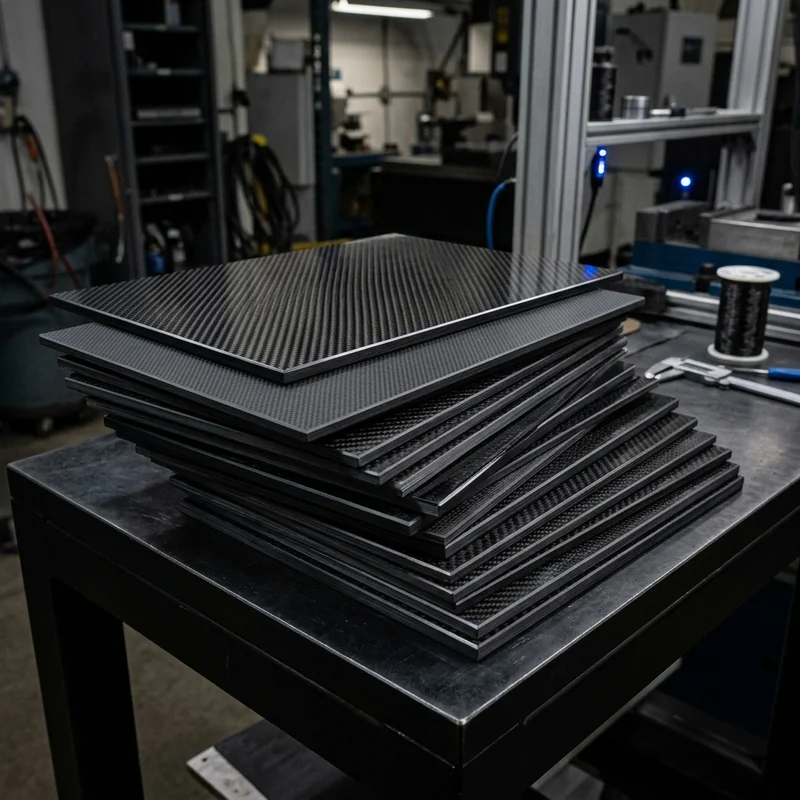
Carbon fiber standard plate-3k stripe
Lightweight, ultra-rigid standard sheets for drone fuselages, robot housings, facades and structural applications.

Carbon Fiber Plate — 3K Twill T700 3.0mm
Medium-thickness 3.0mm carbon fiber plate offering significantly higher load capacity while maintaining attractive 3K twill finish. Suitable for structural brackets, reinforcement plates, and load-bearing panels.

Carbon Fiber Plate — 3K Twill T700 1.5mm
Thin 1.5mm carbon fiber plate with 3K twill weave surface. Lightweight and stiff, commonly used for covers, panels, drone bodies, and applications requiring a premium aesthetic appearance.

Square Carbon Fiber Tube — 3K Twill T700
Square cross-section carbon fiber tube manufactured with 3K twill weave for torsional strength. Preferred for structural frames, trusses, and support columns where rectangular geometry offers design flexibility.
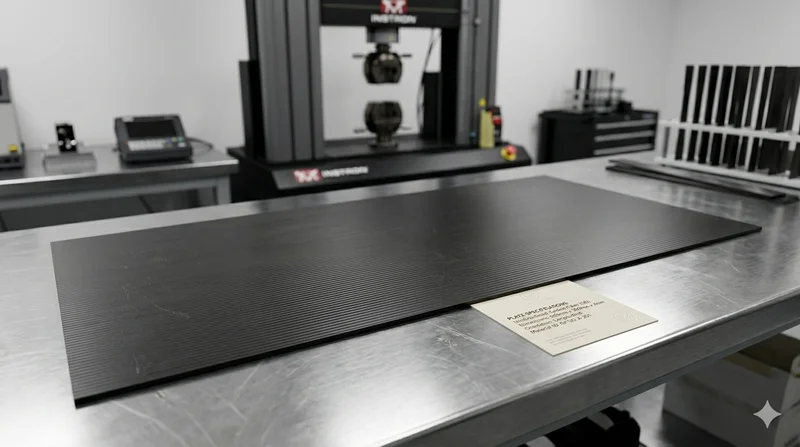
Carbon Fiber Plate — UD Unidirectional T700
Unidirectional carbon fiber plate with all fibers oriented in a single direction for maximum strength along the fiber axis. Essential for structural reinforcements, splints, and applications where load direction is predictable.