
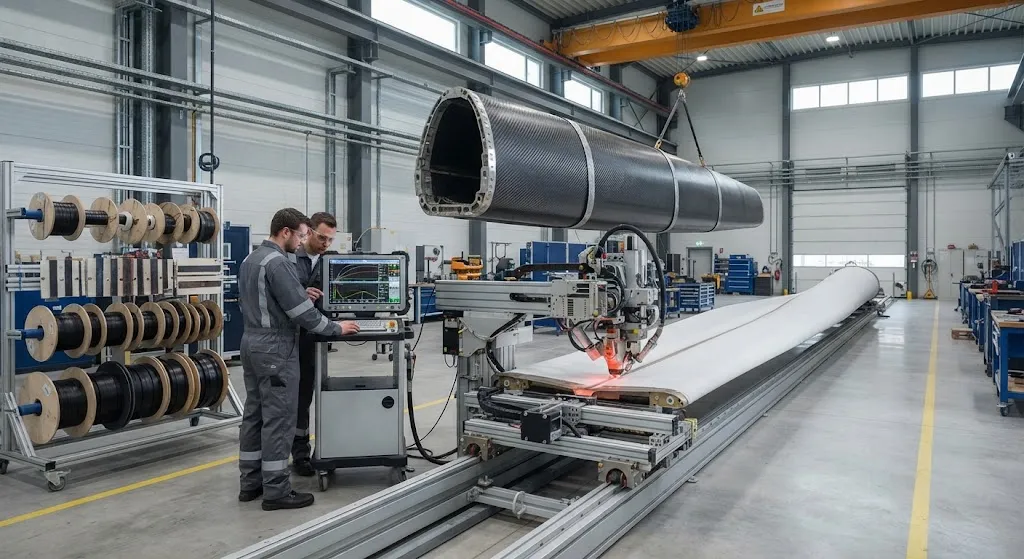
Adhesive bonding has been the default joining method for wind turbine blades for decades, and for good reason: it is forgiving, tolerant of manufacturing tolerances, and works across dissimilar materials. But it is also heavy. The adhesive layer in a large blade can run thick enough to
Introduction
Adhesive bonding has been the default joining method for wind turbine blades for decades, and for good reason: it is forgiving, tolerant of manufacturing tolerances, and works across dissimilar materials. But it is also heavy. The adhesive layer in a large blade can run thick enough to account for a meaningful share of the bondline weight, and every kilogram added at the shell-to-spar interface is a kilogram that must be carried for the blade's 25-year life. Thermoplastic blades change the rules because they can be welded. Instead of applying paste adhesive and waiting for cure, manufacturers can heat the mating surfaces and fuse them under pressure, producing a joint that is lighter, faster to make and — crucially — separable again at end of life. This article compares thermal welding with the other heat-based joining routes, explains why NREL and IACMI are funding the weld-integrated line, and maps where welding replaces adhesive in a real thermoplastic blade.
Why Weld Instead of Bond
The argument for welding starts with the adhesive bondline itself. Structural adhesives for blades are toughened epoxies or polyurethanes, applied at 3-10 mm thickness to absorb the peel and shear loads between shell halves. That thickness is the problem: it is dead weight, it creates a hidden inspection challenge, and it locks the blade into a glued assembly at end of life. Welding replaces the adhesive zone with a consolidated thermoplastic joint that uses the matrix already present in the part:
- Weight: a weld line is typically 1 mm or less versus 3-10 mm of adhesive, removing kilograms of bondline mass from a large blade.
- Speed: fusion happens in seconds to minutes under heat and pressure, versus hours of adhesive open time, close time and cure.
- Strength continuity: the weld uses the same polymer as the parts, so there is no interface material with different stiffness and fatigue response.
- Recyclability: a welded joint can be reheated and separated, allowing clean disassembly of the blade at retirement instead of a glued composite waste stream.
- Automation: welding is a machine-controlled thermal process with repeatable temperature, pressure and time parameters.
The trade-off is joining freedom. Adhesive can bond any two surfaces, whereas welding demands thermoplastic matrices on both sides of the joint and adequate heat control. For blade makers this is a design constraint, not a barrier — it is why the weld-integrated approach is being developed as part of fully thermoplastic blade concepts.
Heat Sources Compared: the Welding Process Family
Thermal welding is a process family, not a single machine. Each heat source reaches the weld interface differently, and the choice shapes speed, tooling cost, joint design and whether the process suits a factory line or an in-situ repair. The table below compares the main routes for blade-scale joining:
| Process | Heat Generation | Typical Speed | Tooling Cost | Blade Fit |
|---|---|---|---|---|
| Hot plate welding | Heated platen touches both surfaces, then parts are pressed together | Medium | Low-medium | Long straight bondlines, shell-to-shell joints |
| Thermal welding (element) | Resistive or conductive element at the interface heats the matrix | Medium | Medium | Continuously welded spar-shell assembly |
| Induction welding | Alternating field heats a susceptor at the joint line | High | Medium-high | Curved joints, local repair, energy director |
| Ultrasonic welding | High-frequency vibration creates frictional heat at the interface | Very high | Low | Discrete welds, smaller-area joints, rapid cycles |
| Resistance welding | Current through a metal mesh or strip at the interface | High | Low | Local patches and repair welds |
The family logic is complementary rather than competitive: hot plate and thermal element welding suit long continuous bondlines built on a blade line, induction suits curved and repaired joints, ultrasonic suits point welds, and resistance suits patches. A weld-integrated blade factory may use two or three of them in different stations.
The NREL and IACMI Research Line
The U.S. national laboratory and manufacturing institute programs treat welding as a route to fully recyclable blades. NREL's thermoplastic blade research has moved from coupon-scale welding demonstrations toward blade-scale joining, while IACMI's composites institute funds projects that combine thermoplastic infusion, recycled fiber feedstocks and weld-based assembly in a single demonstrator blade. The research question is not whether a weld can hold — coupon data for welded thermoplastics is well established — but whether a welded blade can be built at production rates with acceptable quality assurance.
Two technical threads dominate the current work. The first is weld quality sensing: because a weld line is hidden inside the joint, the line must be monitored in real time through temperature, pressure and displacement feedback rather than inspected after the fact. The second is repeatability at scale: a weld-integrated blade demands that every meter of a 20-30 meter shell-to-spar joint reaches the same fusion temperature, which pushes heating technology toward distributed and zoned control. These are the barriers that separate the research line from serial production, and they are the same barriers that make the process family — not a single favored machine — the practical answer.
Weld-Integrated Joining in the Blade Structure
In a weld-integrated thermoplastic blade, the spar cap and shear webs are consolidated as thermoplastic parts first, then welded to the shell skin rather than adhesively bonded. The sequence removes the entire adhesive-cure logistic from the assembly hall: no mixing, no open-time clock, no bondline thickness gauging, no cleanroom-grade surface prep on the glue faces. Each joint becomes a repeatable thermal operation with a defined time-temperature-pressure recipe.
The structural consequence is a lighter but stricter assembly. Because the weld uses only the matrix polymer, the joint's static and fatigue strength tracks the thermoplastic matrix's own properties, which are well characterized for PA6, PA12 and PPS blade-grade systems. The design must keep the weld line in compression or low-peel regions of the blade, exactly as adhesive bondlines are placed today, but with the added advantage that a weld can be re-melted — a locally damaged joint can be reheated, reopened, and rewelded in place, something no cured adhesive allows.
Frequently Asked Questions
How does thermal welding differ from induction welding for blades?
Both are thermoplastic fusion processes; they differ in how heat reaches the joint. Induction welding uses an alternating electromagnetic field to heat a susceptor placed at the joint line, which suits curved joints and localized work because the coil can follow arbitrary paths. Thermal welding here refers to conductive element heating, where the element or a heated platen is in direct contact and heat conducts into the matrix — well suited to long continuous bondlines and factory-integrated assembly. The practical choice is geometry: straight shell-to-spar joints run well with element welding, while complex curves and repairs favor induction.
What are the quality assurance challenges of welded blade joints?
The weld line is hidden inside the joint, so post-facto inspection cannot easily verify fusion quality. QA therefore moves to process monitoring: real-time temperature, pressure and displacement at the weld head, with the fusion parameters recorded per meter of weld. Ultrasonic inspection can still find voids at the weld plane, and process data provides the traceability that bonds need for certification. This shift from inspect-after to monitor-during is the main engineering investment the NREL-IACMI line is making.
Can a welded blade still be repaired at sea with wet methods?
Yes — and in some ways more easily. A welded thermoplastic joint can be reheated locally and re-fused, or a damaged section can be cut out and a patch welded in place using a portable heating element or induction tool. Wet repair methods remain available for the thermoset layers and outer shell sections that still use infused glass or carbon, so offshore repair keeps both toolkits: conventional wet patch work for infused areas and weld-tool repair for the thermoplastic joints. The re-melt capability is a repair advantage cured adhesives never had.
Are welded thermoplastic blades already in serial production?
Not yet at full blade scale. Welded thermoplastic joints are well proven at coupon and sub-component level, and weld-integrated demonstrator blades have been built in research programs, but serial production is waiting on weld quality sensing, repeatable fusion at long bondline lengths, and the broader thermoplastic blade infrastructure — tape supply, thermoforming capacity and recycling logistics. The NREL and IACMI lines are closing exactly those gaps; the first serial weld-integrated blades are expected to arrive with the current generation of thermoplastic blade programs.
Conclusion
Thermal welding converts blade assembly from a gluing operation into a machine-controlled fusion operation, cutting bondline weight, opening the door to automated quality and making the blade recyclable at retirement. The process family — hot plate, thermal element, induction, ultrasonic and resistance — gives blade makers a toolkit rather than a single answer, and the NREL and IACMI research lines are industrializing exactly the pieces that block serial adoption: weld sensing, long-bondline repeatability and demonstrator validation.
For blade designers and composite process engineers evaluating weld-integrated assembly, the first step is comparing heat sources against your bondline geometry and matrix system. Explore our carbon fiber products and thermoplastic-capable materials, or contact our engineering team to discuss welding trials and material support for thermoplastic blade programs.
Part of topic
Related Articles
- Bio-Based Carbon Fiber Precursors: Lignin and Polyethylene for Low-Cost Production
- Large-Tow Carbon Fiber Cost Analysis: 48K vs 60K Price-Performance Comparison
- Carbon Fiber-Resin Interface Bonding: Surface Treatment and Coupling Agent Optimization
- Digital Twin for Carbon Fiber Manufacturing: Real-Time Process Monitoring and Defect Prevention
- Thermoplastic Carbon Fiber Welding for Automotive: Ultrasonic and Induction Welding Process Windows
- Large-Tow Carbon Fiber Wet Spinning: Process Optimization for 48K/60K Production Efficiency
Interested in Our Products?
Contact our team for competitive pricing and technical specifications.
Get a QuoteRelated Products

Square Carbon Fiber Tube — 3K Twill T700
Square cross-section carbon fiber tube manufactured with 3K twill weave for torsional strength. Preferred for structural frames, trusses, and support columns where rectangular geometry offers design flexibility.
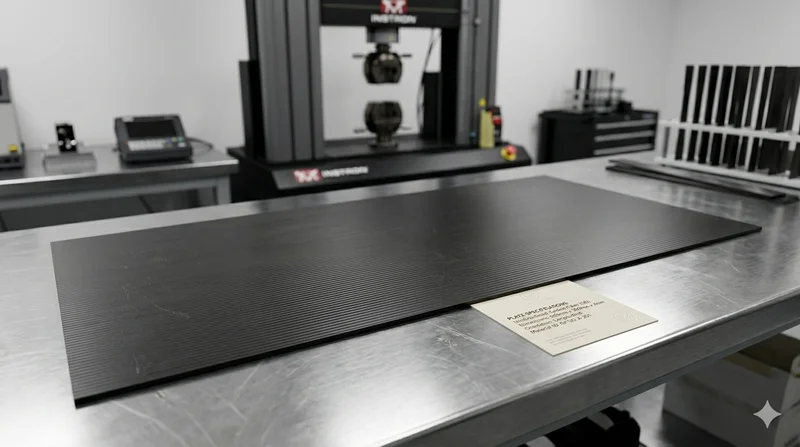
Carbon Fiber Plate — UD Unidirectional T700
Unidirectional carbon fiber plate with all fibers oriented in a single direction for maximum strength along the fiber axis. Essential for structural reinforcements, splints, and applications where load direction is predictable.
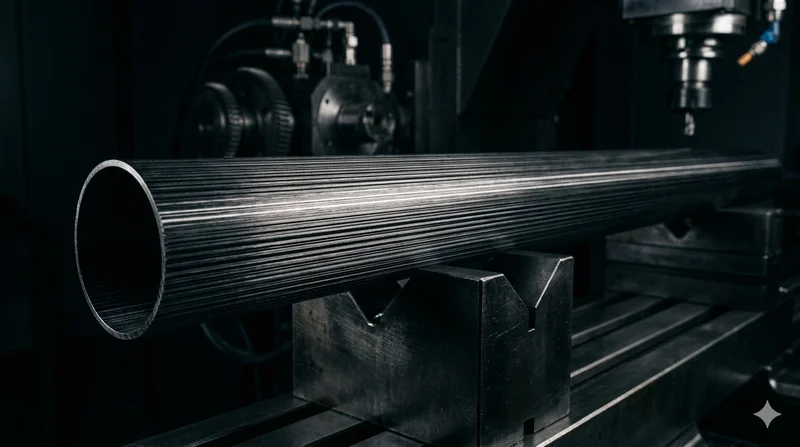
Round Carbon Fiber Tube — UD Unidirectional T700
Unidirectional (UD) round tube with all fibers aligned axially for maximum longitudinal stiffness. Ideal for applications requiring high bending rigidity with minimal weight, such as shafts, struts, and structural reinforcements.
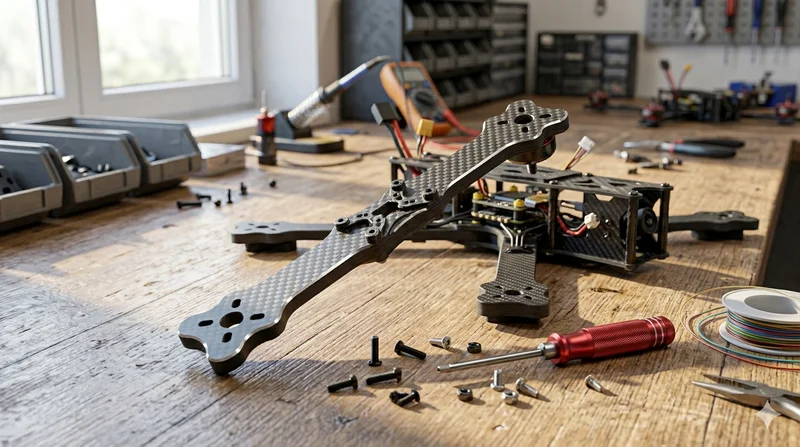
Carbon Fiber Drone Arm
Precision-molded carbon fiber drone arm combining unidirectional fiber for stiffness and woven layers for torsional strength. Designed for FPV, photography, and industrial drone platforms. Each arm is CNC-machined to exact specifications.
Carbon Fiber Tablet Case — Ultra-Light Protective Shell
Lightweight carbon fiber protective case for tablets and iPads. Molded from T700 3K prepreg with reinforced corner protection. Adds minimal weight while providing superior rigidity and drop protection compared to polycarbonate or silicone cases. Ideal for field workers, enterprise deployments, and professionals requiring durable tablet protection.