
Few environments punish a structural material as relentlessly as the deep ocean. A submarine hull must resist crushing hydrostatic pressure at hundreds of meters, endure corrosive seawater that never stops attacking bare metal, and carry the magnetic and acoustic signature of the hull i
Introduction
Few environments punish a structural material as relentlessly as the deep ocean. A submarine hull must resist crushing hydrostatic pressure at hundreds of meters, endure corrosive seawater that never stops attacking bare metal, and carry the magnetic and acoustic signature of the hull in a way that keeps the boat undetectable by mines and sensors. For most of submarine history, this meant pressure-tight steel. Steel is strong and weldable, but it is also magnetic, heavy, and prone to corrosion that must be managed for a vessel's entire life.
Composite materials — and carbon fiber in particular — challenge the steel monopoly. Carbon fiber is non-magnetic, essentially immune to seawater corrosion, and significantly lighter than steel at equal strength. These properties align precisely with three standing problems of submarine design: reducing magnetic signature, eliminating corrosion of the outer hull, and freeing weight for payload, propulsion, or battery. The opportunity is real, yet the pressure hull has remained stubbornly metallic because a full-depth composite pressure hull demands certification, manufacturing scale, and through-life confidence that no fleet is willing to accept yet. This article explains where carbon fiber composites have earned their place in submarine structures today, and what would be required to extend them to the hull itself.
Why the Magnetic Signature Matters
Naval strategy depends on the submarine remaining undetected. Two sensor classes are relevant here. Magnetic Anomaly Detectors (MAD) and magnetic-influence naval mines sense perturbations in Earth's magnetic field caused by a ferromagnetic hull. A steel hull creates a measurable anomaly at a distance that a well-tuned MAD system can detect through modest water depth; a mine fitted with a magnetic-influence fuze triggers when its magnetometer registers a field change above a threshold. Reducing the hull's magnetic moment and permeability directly shrinks the detection radius and the mine's operating window.
Carbon fiber composites are non-magnetic and non-ferromagnetic by nature: carbon filaments have no ferromagnetic response, and the resin binds fibers without introducing magnetic domains. This removes the structural source of magnetic signature entirely. A boat whose structural signatures around key sensors are composite avoids the need for onboard degaussing coils to the same degree, and creates a smaller, more predictable target for magnetic detectors. The non-magnetic property is therefore not a convenience but a stealth capability.
Corrosion Resistance in Seawater
Seawater corrosion is a life-cycle cost and a readiness issue. Steel hulls are protected by coatings and impressed-current cathodic protection, both of which require maintenance and reduce the intervals between dockings. Composites eliminate the corrosion mechanism at the material level: there is no metal to oxidize, and carbon fiber and resin are chemically stable in seawater over decades. This is the most operationally valuable property of composites for a navy, because it shifts maintenance from the hull surface toward internals and extends the time a boat spends at sea.
Care must still be taken at interfaces. Carbon is noble relative to many metals, so where a carbon fiber part contacts a steel or alloy component, galvanic coupling can accelerate corrosion of the metal. Designers mitigate this with insulating barriers (glass layer, isolation washers, or adhesive bonding that separates carbon from metal), by isolating fasteners, and by avoiding direct carbon-to-metal contact in seawater-wet areas. Properly designed, a composite hull section and its metallic substructure coexist without the corrosion that metal-on-metal joints would suffer.
Where Carbon Fiber Earns Its Place Today
Rather than replacing the entire hull, carbon fiber composites are being adopted in specific submarine components where non-magnetic, corrosion, and weight properties are decisive:
- Non-magnetic upper and outer hull sections: On boats where the non-magnetic requirement is strict, sections of the outer hull (the non-pressure casing that streamlines the boat) and appendages are built in composite. This reduces magnetic signature and removes the corrosion of the outer shell while the pressure hull retains steel or titanium for depth capability.
- Propulsor and propeller parts: Pump-jet shrouds, stator vanes, and ducting around the shaft are natural composite candidates. Carbon fiber's stiffness and tailored layup control flow, and its corrosion resistance suits the seawater environment; non-magnetic and non-conductive composite shrouds also help manage hydrodynamic and vibratory signatures.
- Sonar domes and acoustic windows: Composite sonar domes must be transparent to sound while watertight and pressure-resistant. Fiber-reinforced composites are used where a large, curved, acoustically transparent structural surface is needed, free from the corrosion pitting and magnetic mass of metal.
- Non-magnetic equipment and mountings: Masts, hatches, masts housings, and internal structures near sensitive sensors are made composite to keep local magnetic mass low and to reduce eddy-current heating and conductor interference.
The pattern is deliberate: composites adopt positions where non-magnetic and corrosion advantages are large relative to the premium cost, while the primary pressure hull remains metallic because the certification and in-service burden of a full composite pressure vessel is not yet justified.
Weight, Stiffness, and the Pressure Hull Question
The most debated composite use is the pressure hull itself. The table below compares a steel and a carbon fiber pressure hull section for a typical middle-band submarine at equal strength:
| Property | Steel (HY-80/100 class) | Carbon Fiber Laminate | Composite Advantage for Hull |
|---|---|---|---|
| Density | 7.8 g/cm³ | 1.6 g/cm³ | ~5x lighter material |
| Tensile strength | 550-900 MPa | 1,500-2,400 MPa (unidirectional) | Higher specific strength |
| Buckling resistance (stiffness) | High (E≈200 GPa) | Lower modulus unless thick/hybrid | Must add stiffness or ribs |
| Sea water corrosion | Yes (coatings needed) | None | Eliminates external corrosion |
| Magnetic signature | Ferromagnetic | Non-magnetic | Reduces detection radius |
| Weldability / joinability | Excellent | Adhesive/mechanical joints | Joints remain the hard problem |
The core difficulty for a composite pressure hull is not strength but compression stability under deep hydrostatic pressure. A thin-walled composite cylinder must resist catastrophic buckling, and composites' stiffness-to-weight must be managed carefully to avoid buckling at the depths a submarine reaches. Designers would need thicker walls, a hybrid steel-composite ring-stiffened architecture, or orthotropic layup tuning to bring buckling resistance into line with steel. Combined with the challenge of pressure-tight, fatigue-proof joints between composite sections and the metallic ends, these factors keep the promised "composite submarine hull" in the research and demonstration phase rather than in the fleet.
Qualification and Inspection of Naval Composites
Naval composites must survive conditions no aircraft composite faces: sustained hydrostatic pressure, seawater exposure, and shock loading from depth charges and nearby explosions. Qualification therefore spans:
- Hydrostatic pressure testing: Prototype sections are cycled to design pressure plus margin, in pressure vessels, to validate the pressure-retaining capability including through-loading where submarine components experience belt-press (lateral) and end-on (axial) compression simultaneously.
- Shock qualification: Underwater explosion (UNDEX) testing applies a shock spectrum to composite components to prove they retain pressure integrity and function after transient overpressure from nearby detonations — a requirement few composites outside naval/military applications face.
- Seawater durability: Accelerated seawater exposure, cyclic pressure-testing in seawater, and galvanic-coupling tests validate that the resin system and interfaces remain intact over the design life.
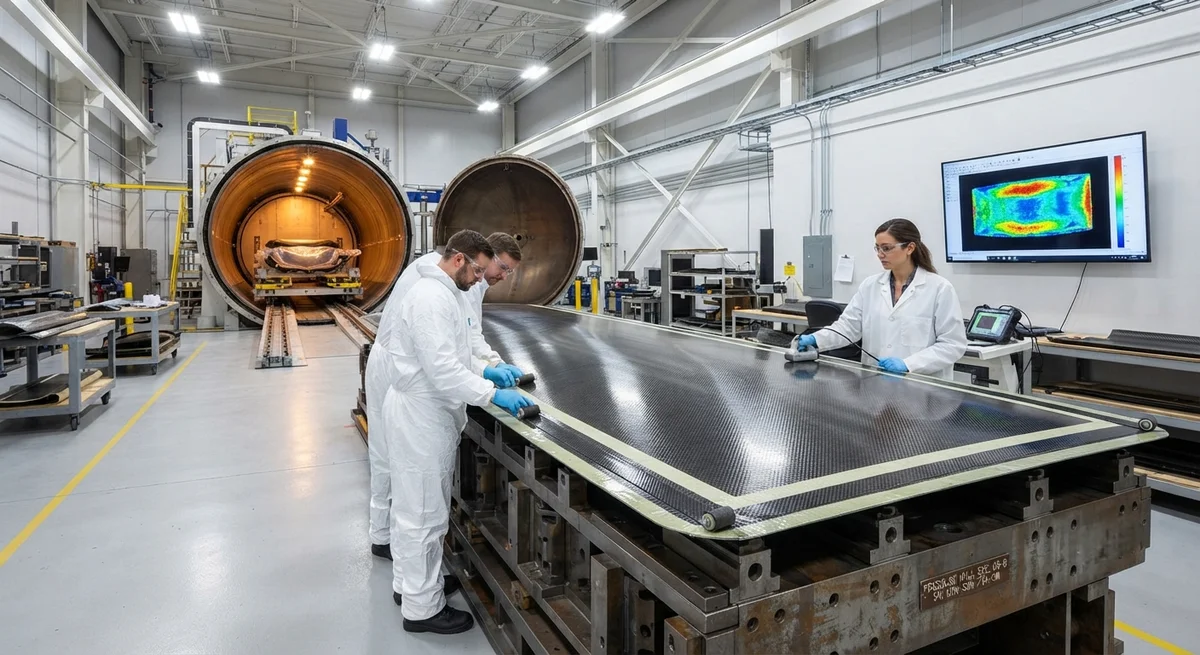
- Through-life inspection: Composites are inspected by ultrasonic testing, thermography, and visual/borescope checks following the same philosophy as aerospace — defect detection before critical growth — but adapted to thick, pressurized sections.
Naval authorities apply stringent quality standards, including documentation of fiber content, void content, layup sequence, and curing parameters, so that the component's performance at sea matches the certified design envelope.
Frequently Asked Questions
Can a submarine pressure hull be made entirely of carbon fiber?
In principle yes, and demonstrators exist, but it is not in fleet service. The blockers are compression buckling under deep hydrostatic pressure — where the composite must be thickened or stiffened to match steel's resistance — and the difficulty of making pressure-tight, fatigue-proof joints between composite sections and the metallic ends. Composite pressure hull sections would also require new certification and through-life inspection confidence. Until these are resolved to fleet standards, the pressure hull stays metallic, and carbon fiber is used for non-pressure outer sections, propulsor parts, sonar domes, and mast structures where its non-magnetic and corrosion benefits are decisive.
How do composites reduce a submarine's magnetic signature?
Carbon fiber and resin are non-magnetic and non-ferromagnetic, so a composite structure contributes no ferromagnetic response to the hull's magnetic signature. Where a steel hull creates a measurable anomaly detectable by magnetic anomaly detectors and able to trigger magnetic-influence mines, composite sections remove that source of field perturbation. This shrinks the detection radius and the mine operating window, and reduces reliance on degaussing. Because the effect is structural rather than added-on, it is durable for the component's entire life.
How does galvanic corrosion affect carbon fiber parts in contact with metal on a submarine?
Carbon is electrically noble relative to many metals, so where a carbon fiber part touches steel or an alloy, the couple can accelerate corrosion of the metal — the opposite of protecting it. Naval designers avoid direct carbon-to-metal contact in seawater-wet areas by inserting an insulating glass layer, using isolation washers or adhesive bonding to separate the materials, and isolating fasteners. With these barriers, a composite section and its metallic substructure coexist without the corrosion metal-on-metal joints would suffer, and the composite itself remains corrosion-free.
What makes submarine composites different from aircraft composites?
Submarine composites must withstand sustained hydrostatic pressure and survive shock loading from underwater explosions — conditions no aircraft part faces. They must remain watertight and pressure-tight through cyclic pressurization, resist seawater exposure over decades, and manage galvanic coupling with nearby metals. Qualification includes hydrostatic cycling, underwater-explosion shock testing, seawater durability and galvanic testing, and through-life ultrasonic/thermographic inspection adapted to thick pressurized sections. The pressure and immersion environment, rather than temperature or fire envelope, defines the material's requirements.
Conclusion
Carbon fiber composites are quietly changing submarine construction where it matters most: reducing the magnetic signature that makes a boat detectable, eliminating the corrosion that forces steel hulls into dry dock, and cutting weight in the components that carry the boat's acoustic and hydrodynamic signature. Outer hull sections, propulsor shrouds and vanes, sonar domes, and mast structures are the today-proof adoption; the full composite pressure hull remains the ambitious next step that certification and joint-sealing hurdles still hold back.
For naval architects and defense contractors, the practical decisions are where carbon fiber adds the most signature and corrosion benefit for the cost, how to manage metal-composite interfaces, and how to qualify components against hydrostatic and shock loading. Explore our carbon fiber fabrics and marine-grade composite materials for non-magnetic naval structures, or contact our engineering team to discuss material selection and qualification for your maritime program.
Related Articles
- Carbon Fiber Tube for Sale: Comparing Listings and Avoiding Bad Specs
- Carbon Fiber Engine Parts: High-Temperature Performance for Racing and Performance Vehicles
- Carbon Fiber Body Parts: Automotive Exterior Panels and Structural Components
- Carbon Fiber Drone Body Manufacturing: Monocoque Design and Production Methods
- Carbon Fiber Drone Parts Supplier: FPV Frames, Arms and Structural Components
- Filament Wound Epoxy Tubes: Industrial Applications from Oil and Gas to Aerospace
Interested in Our Products?
Contact our team for competitive pricing and technical specifications.
Get a QuoteRelated Products
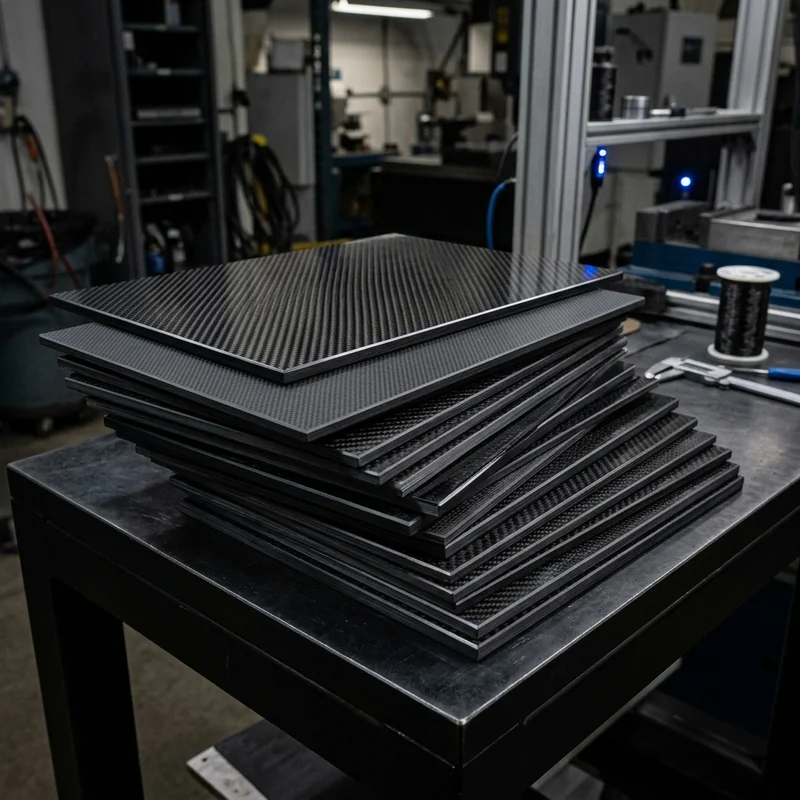
Carbon fiber standard plate-3k stripe
Lightweight, ultra-rigid standard sheets for drone fuselages, robot housings, facades and structural applications.

Carbon Fiber Plate — 3K Twill T700 3.0mm
Medium-thickness 3.0mm carbon fiber plate offering significantly higher load capacity while maintaining attractive 3K twill finish. Suitable for structural brackets, reinforcement plates, and load-bearing panels.

Carbon Fiber Plate — 3K Twill T700 1.5mm
Thin 1.5mm carbon fiber plate with 3K twill weave surface. Lightweight and stiff, commonly used for covers, panels, drone bodies, and applications requiring a premium aesthetic appearance.

Square Carbon Fiber Tube — 3K Twill T700
Square cross-section carbon fiber tube manufactured with 3K twill weave for torsional strength. Preferred for structural frames, trusses, and support columns where rectangular geometry offers design flexibility.
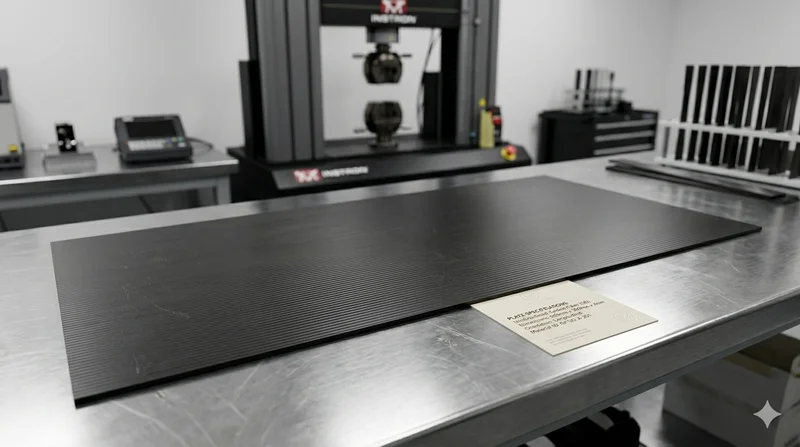
Carbon Fiber Plate — UD Unidirectional T700
Unidirectional carbon fiber plate with all fibers oriented in a single direction for maximum strength along the fiber axis. Essential for structural reinforcements, splints, and applications where load direction is predictable.