
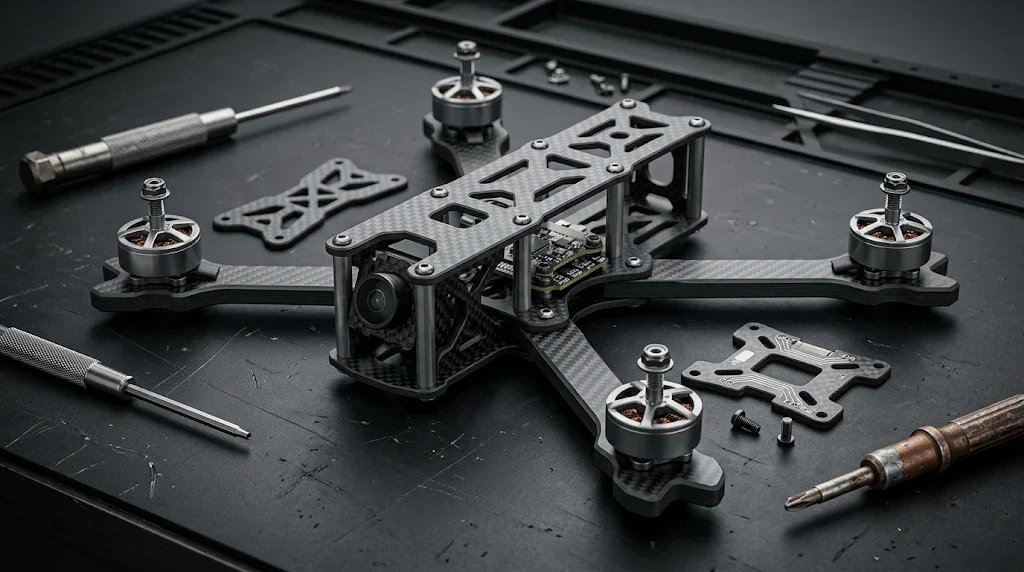
Compared with thinner arms, a 4mm carbon fiber drone frame can reduce flex and may survive more hard landings or repeated impacts. That can help keep motor alignment and stack mounting more stable after minor crashes. The downside is weight. Extra grams can reduce agility, increase current draw, sho
What a 4mm carbon fiber drone frame changes in practice
Compared with thinner arms, a 4mm carbon fiber drone frame can reduce flex and may survive more hard landings or repeated impacts. That can help keep motor alignment and stack mounting more stable after minor crashes. The downside is weight. Extra grams can reduce agility, increase current draw, shorten flight time, or require changes to the power system. Thickness also interacts with vibration: a stiffer 4mm carbon fiber drone frame may shift resonance, so pilots should recheck filters and tuning after the upgrade.
Thickness alone does not guarantee reliability. Fiber orientation, resin quality, CNC accuracy, chamfers, and hole design all influence whether the arm fails at a root, a motor hole, or an impact point. A cleanly machined {kw} with sensible geometry can outperform a thicker but poorly finished plate.
Best-fit use cases
| Use case | Why 4 mm helps | What to verify |
|---|---|---|
| Freestyle | More margin for repeated crashes | All-up weight, response, spare arm cost |
| Cinematic payload | Supports camera and accessories | Vibration, motor heat, flight time |
| Industrial inspection | Improves robustness in field work | Mounting pattern, service access, payload balance |
| Training fleet | Reduces repair downtime | Batch consistency, easy replacement, inventory |
| Racing | May be heavier than needed | Lap-time loss versus breakage risk |
How to source or customize a 4mm carbon fiber drone frame
When buying a 4mm carbon fiber drone frame, confirm the actual thickness of arms and plates, motor hole spacing, stack mounting pattern, and material quality. For custom projects, provide wheelbase, arm geometry, prop size, electronics layout, antenna routing, camera position, and expected payload. If the aircraft operates in harsh conditions, describe likely crash or handling risks. A clear RFQ helps the supplier judge whether a 4mm carbon fiber drone frame should prioritize impact tolerance, weight control, or assembly convenience.
- Verify the arm and plate thickness of the 4mm carbon fiber drone frame, not just the product title.
- Check CNC edge quality, chamfers, and hole accuracy.
- Use correct screw lengths to avoid damaging carbon or loosening hardware.
- Test-fly and review tuning after changing to a {kw}.
- Keep spare arms for operations where downtime is expensive.
Assembly and maintenance tips
After installing a 4mm carbon fiber drone frame, inspect motor screws, stack mounts, and camera plates for correct fit. On the first flights, monitor vibration and motor temperature. After a crash, examine arm roots and bolt holes for white stress marks, fraying, or delamination. Carbon damage can be subtle, so a visual check and gentle flex test can help identify parts that should be replaced. For commercial teams, logging frame revisions and failure locations makes future 4mm carbon fiber drone frame purchasing decisions more accurate.
It is also wise to evaluate the total system. If the frame becomes heavier, propellers, battery capacity, and payload distribution may need adjustment. The goal is a balanced aircraft, not simply a thicker arm.
Procurement and fleet planning
For teams operating multiple aircraft, a 4mm carbon fiber drone frame should be evaluated as part of a maintenance plan. Standardizing arm thickness, hardware, and spare parts can simplify repairs and reduce downtime. Before scaling, test a small batch under real missions and record how the 4mm carbon fiber drone frame performs in crashes, transport, vibration, and routine service. If the frame is custom, confirm revision control so future orders match the approved geometry and hole pattern.
A thicker frame can be cost-effective when failures interrupt operations, training, or customer delivery. The right metric is not only frame price, but total operating cost: spare parts, labor, lost flight time, and risk to payload equipment. Used in the right context, a {kw} can be a practical reliability upgrade.
- Standardize hardware and spares for the selected frame.
- Track failure locations to improve future revisions.
- Test payload balance and vibration after changes.
- Confirm drawing revisions before repeat orders.
- Compare total operating cost, not only unit price.
Frequently asked questions
Is a 4mm carbon fiber drone frame always better than 3 mm or 5 mm?
No. A 4mm carbon fiber drone frame is often a practical balance, but the right thickness depends on aircraft size, payload, flying style, and power system. Thicker is not always better if it harms response or flight time.
Will a thicker frame prevent all crash damage?
No. A 4mm carbon fiber drone frame can reduce some arm failures, but motors, props, electronics, cameras, and antennas can still be damaged. Frame thickness is one part of overall durability.
What information is needed for a custom quote?
Provide drawings or dimensions, thickness, hole patterns, quantity, finish requirements, payload, and use case. Clear details help determine whether a 4mm carbon fiber drone frame design is suitable for the mission.
For carbon fiber plate cutting, CNC machining, or custom drone frame discussions, contact Yongxian.
Related Articles
- Carbon Fiber Composite Core Repair Service: Damage Assessment and Return to Service
- carbon fiber fishing rod Guide: Modulus, Guides, and Durability
- What One Carbon Fiber Plate Means in Shoe Specs
- Carbon Fiber Rods for Fishing: Blank Selection for Builders
- Carbon Fiber Toe Plates: Rocker Design in Footwear
- Carbon Fiber Drones (carbon fiber drones): Airframes, Payloads, and Cost Impact
Interested in Our Products?
Contact our team for competitive pricing and technical specifications.
Get a QuoteRelated Products

Round Carbon Fiber Tube — 3K Plain Weave T700
Standard round carbon fiber tube manufactured from Toray T700 grade fiber with 3K plain weave. Offers balanced strength and stiffness for general industrial applications including robotics, automation, sports equipment, and aerospace structures.

Round Carbon Fiber Tube — 3K Twill
Lightweight and ultra-stiff round tubes ideal for drone frames, robotics, and structural applications.

Carbon Fiber Plate — 3K Twill T700 3.0mm
Medium-thickness 3.0mm carbon fiber plate offering significantly higher load capacity while maintaining attractive 3K twill finish. Suitable for structural brackets, reinforcement plates, and load-bearing panels.

Square Carbon Fiber Tube — 3K Twill T700
Square cross-section carbon fiber tube manufactured with 3K twill weave for torsional strength. Preferred for structural frames, trusses, and support columns where rectangular geometry offers design flexibility.
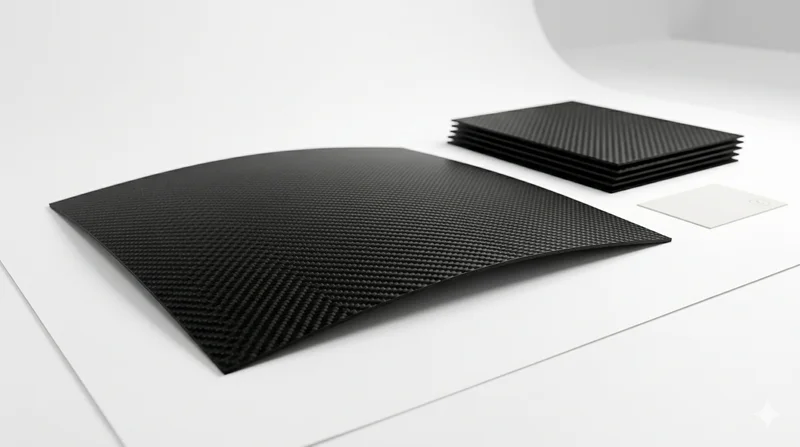
Carbon Fiber Plate — 3K Twill T700 1.5mm
Thin 1.5mm carbon fiber plate with 3K twill weave surface. Lightweight and stiff, commonly used for covers, panels, drone bodies, and applications requiring a premium aesthetic appearance.