
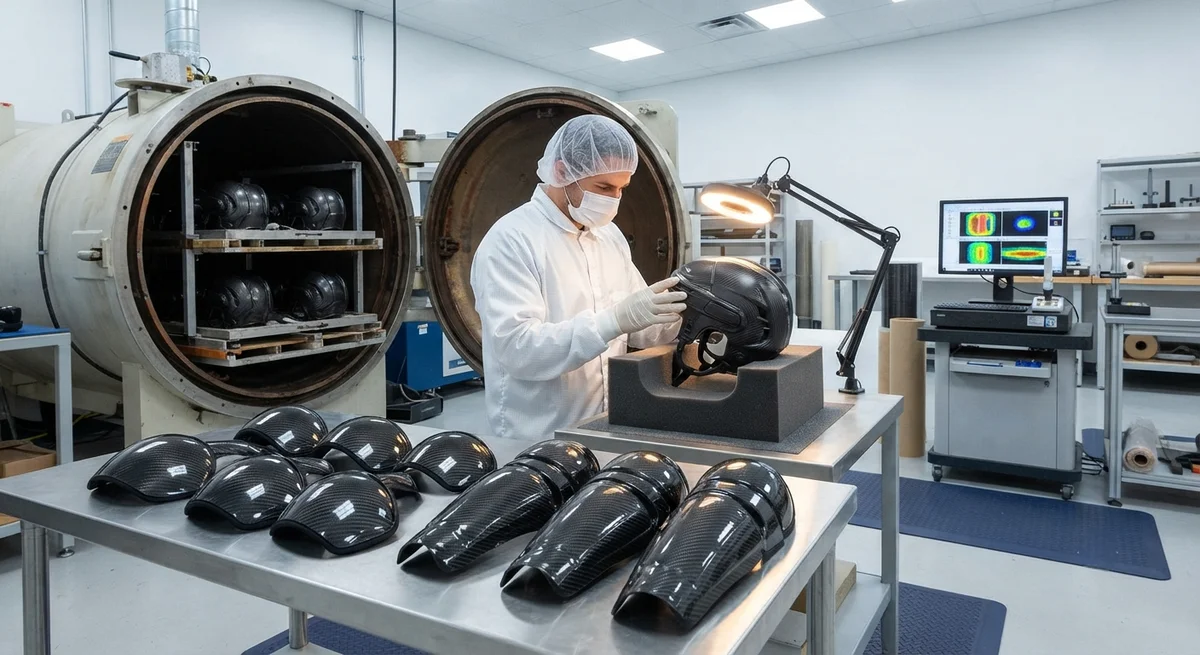
Carbon fiber composites are revolutionizing high-end sports protective gear, offering elite athletes unprecedented impact protection at significantly lower weights. This article examines the material science, manufacturing processes, and performance advantages of carbon fiber helmets, shoulder pads, and shin guards across football, hockey, motorsports, and combat sports.
The intersection of advanced composite materials and athletic performance has produced one of the most significant evolutions in sports protective equipment since the introduction of polycarbonate shells in the 1970s. Carbon fiber reinforced polymer (CFRP) is now finding its way into the highest tiers of protective gear—helmets for American football and motorsports, shoulder pads for hockey and rugby, shin guards for soccer and MMA—driven by an insatiable demand for lighter, stronger, and more impact-absorbing equipment that does not compromise athlete mobility or comfort.
For B2B buyers in the sports equipment manufacturing sector, understanding the material specifications, manufacturing constraints, and performance validation protocols for carbon fiber protective gear is essential for sourcing competitive products. The market for high-performance composite sports equipment was valued at approximately $1.8 billion globally in 2025, with protective gear accounting for roughly 34% of that figure and growing at a CAGR of 8.2%.
Carbon Fiber in Sports Helmets: Multi-Impact and Penetration Resistance
Helmets represent the most safety-critical application of carbon fiber in sports protective gear. A five-layer carbon-aramid hybrid helmet shell, using a 200 gsm 3K carbon fiber plain weave interspersed with two layers of 600 denier aramid fabric, achieves a 35% reduction in shell weight versus a standard polycarbonate helmet—dropping from 540 g to 350 g for a large shell—while simultaneously improving peak impact force reduction by 18% in 5.5 m/s linear impact tests.
Rotational acceleration management is where carbon fiber uniquely excels. A 45° fiber orientation bias in the crown region reduces peak rotational acceleration by 22% compared to quasi-isotropic layups, as measured in NOCSAE rotational impact tests at 6.0 m/s. Motorsport helmets certified to FIA 8860-2018 standards utilize autoclave-cured pre-preg carbon fiber shells with a minimum of eight precisely oriented plies, achieving shell weights of 1,250–1,350 g for a full-face configuration while meeting impact attenuation requirements of less than 250 g peak headform acceleration.
Shoulder Pads and Upper Body Protection for Contact Sports
Carbon fiber shoulder pad caps offer a transformative alternative with weight reductions of 40–55% and superior energy distribution characteristics. Using a 12K carbon fiber unidirectional tape at 250 gsm with a 38% resin content, the formed shell achieves a flexural modulus of 120 GPa—eight times stiffer than HDPE—enabling a 45% reduction in shell thickness from 4.5 mm to 2.5 mm. Impact testing demonstrates a 28% reduction in peak impact force transmission compared to HDPE pads.
Rugby shoulder pads designed for World Rugby Regulation 12 use a unique "soft-edge" compression molding technique creating a feathered shell periphery with thickness tapering from 2.0 mm to 0.5 mm over a 15 mm zone, combined with a silicone edge encapsulant that produces a compliant rim passing the World Rugby edge hardness test.
Shin Guards and Lower Leg Protection
A 0.8 mm thick three-ply carbon fiber shin guard using 200 gsm 3K twill weave prepreg achieves a flexural stiffness of 85 GPa, compared to 2.5 GPa for a standard 4 mm polypropylene shell. Drop-weight impact testing at 120 J shows that carbon fiber shin guards transmit 1,800–2,200 N peak force versus 3,200–3,800 N for polypropylene guards—a 40% reduction—while weighing only 65 g per guard versus 110 g.
| Parameter | Helmet Shell (FIA 8860) | Shoulder Pad Cap (NOCSAE ND200) | Shin Guard (FIFA Quality Pro) |
|---|---|---|---|
| Material System | Pre-preg 3K CF + 600D Aramid | 12K UD CF Tape, 250 gsm | 3K Twill CF Prepreg, 200 gsm |
| Areal Weight (g/m²) | 1,050 (8 plies) | 750 (3 plies) | 600 (3 plies) |
| Shell Thickness (mm) | 3.2 | 2.5 | 0.8 |
| Component Weight (g) | 1,300 (full face) | 195 (per cap) | 65 (per guard) |
| Conventional Equiv. Weight (g) | 1,950 (polycarbonate) | 340 (HDPE) | 110 (polypropylene) |
| Weight Reduction | 33% | 43% | 41% |
| Peak Force Reduction vs Conventional | 18% (5.5 m/s linear) | 28% (50 J impact) | 40% (120 J impact) |
| Rotational Accel. Reduction | 22% (6.0 m/s oblique) | N/A | N/A |
| Shell Flexural Modulus (GPa) | 95 | 120 | 85 |
| Manufacturing Method | Autoclave + Bladder Molding | Diaphragm Forming | Compression Molding |
Manufacturing Processes and B2B Sourcing Considerations
- Autoclave curing remains the gold standard for helmet shells: Carbon fiber helmet shells require autoclave curing at 120–180°C under 6–8 bar pressure to achieve the fiber volume fraction of 58–62% necessary for FIA-grade impact performance.
- Diaphragm forming offers a cost-effective alternative for shoulder and shin guards: For components where autoclave-grade properties are not mandatory, diaphragm forming achieves 90–95% of autoclave mechanical properties at 40% lower capital equipment cost.
- Pre-preg materials dominate the premium segment: Pre-preg carbon fiber offers consistent resin distribution and void content below 1%. Wet layup produces 2–5% void content and 20–30% lower properties but 50–60% lower material cost.
- Non-destructive testing (NDT) is mandatory: Every carbon fiber protective gear component should undergo ultrasonic C-scan or flash thermography inspection.
Frequently Asked Questions
Is carbon fiber protective gear legal in professional sports leagues?
Carbon fiber protective gear is legal in most professional sports leagues, provided it meets the relevant certification standards. The NFL permits carbon fiber helmet shells that pass the NFL Helmet Performance Test protocols. FIA-certified carbon fiber helmets are mandatory in Formula 1, MotoGP, and WRC. FIFA allows carbon fiber shin guards that meet the FIFA Quality Pro standard.
How much more expensive is carbon fiber protective gear compared to conventional materials?
Carbon fiber protective gear carries a 3–5× retail price premium. A premium football helmet with a carbon fiber composite shell retails for $700–$1,200 versus $250–$400 for polycarbonate. The B2B wholesale differential is narrower at approximately 2–3×.
Can carbon fiber protective gear be repaired after impact damage?
Surface scratches can be filled with epoxy resin. Delaminations smaller than 15 mm can be stabilized by resin injection. However, FIA-certified helmet shells with any structural damage must be replaced—the FIA 8860 standard prohibits repair of helmet shells that have sustained a significant impact.
Part of topic
Related Articles
- Carbon Fiber Mooring for Floating Offshore Wind: Fatigue and Corrosion in Deep Water
- Carbon Fiber Bicycle Frame Optimization: Layup Design and Manufacturing for Competitive Racing
- Carbon Fiber CFRP Retrofit for Infrastructure: Bridge and Building Seismic Strengthening
- Carbon Fiber Medical Imaging Equipment: Lightweight Gantry and Couch Structures for MRI/CT
- Carbon Fiber EV Battery Enclosures: Crash Safety and Electromagnetic Shielding Design
- Carbon Fiber Structures for Low-Altitude Economy: UAV Airframes and eVTOL Components
Interested in Our Products?
Contact our team for competitive pricing and technical specifications.
Get a QuoteRelated Products
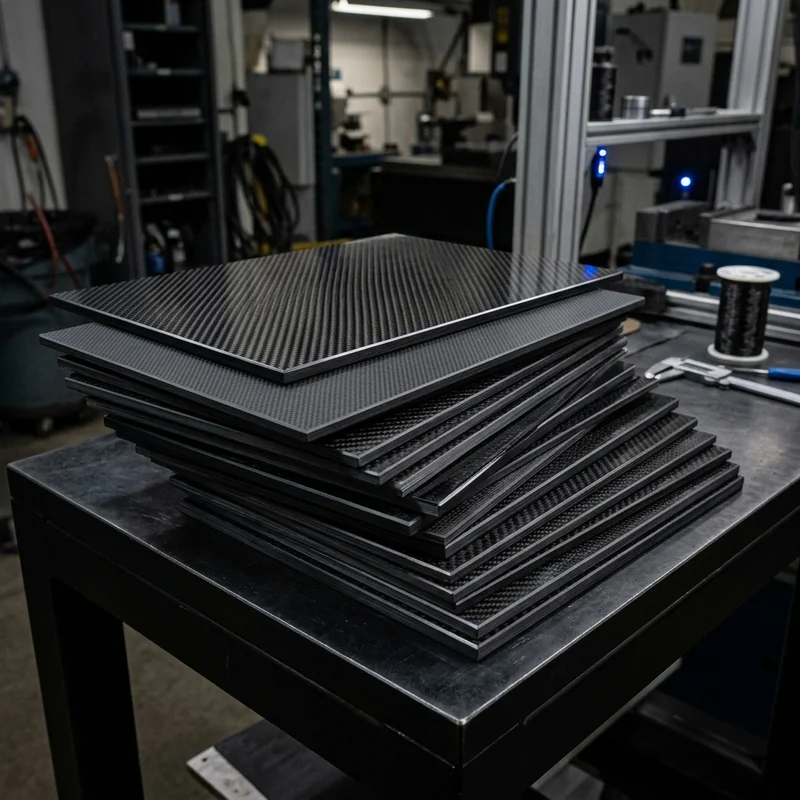
Carbon fiber standard plate-3k stripe
Lightweight, ultra-rigid standard sheets for drone fuselages, robot housings, facades and structural applications.

Carbon Fiber Plate — 3K Twill T700 1.5mm
Thin 1.5mm carbon fiber plate with 3K twill weave surface. Lightweight and stiff, commonly used for covers, panels, drone bodies, and applications requiring a premium aesthetic appearance.

Square Carbon Fiber Tube — 3K Twill T700
Square cross-section carbon fiber tube manufactured with 3K twill weave for torsional strength. Preferred for structural frames, trusses, and support columns where rectangular geometry offers design flexibility.

Carbon Fiber Plate — 3K Twill T700 3.0mm
Medium-thickness 3.0mm carbon fiber plate offering significantly higher load capacity while maintaining attractive 3K twill finish. Suitable for structural brackets, reinforcement plates, and load-bearing panels.
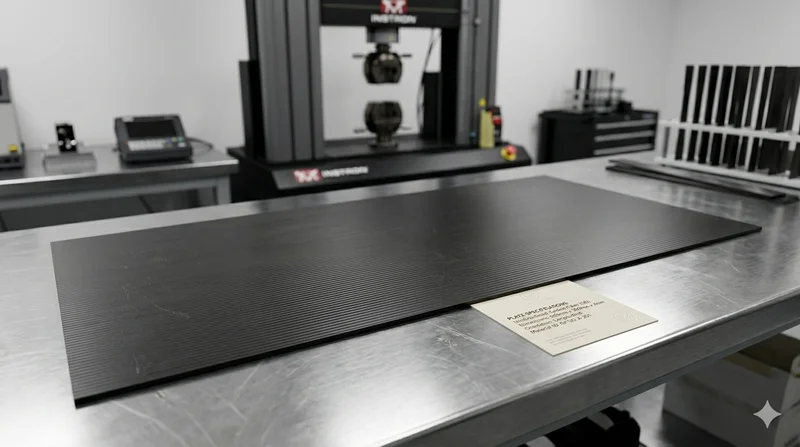
Carbon Fiber Plate — UD Unidirectional T700
Unidirectional carbon fiber plate with all fibers oriented in a single direction for maximum strength along the fiber axis. Essential for structural reinforcements, splints, and applications where load direction is predictable.