
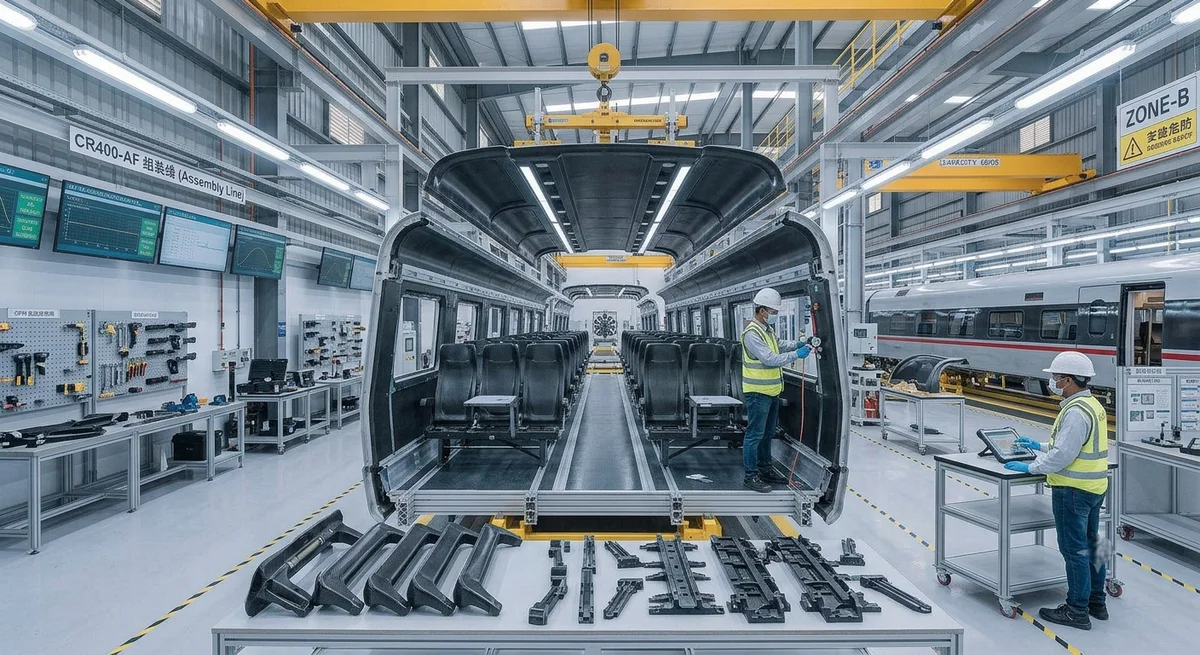
Carbon fiber composites are transforming railway vehicle manufacturing by reducing interior component weight by 40-60% while meeting stringent fire safety standards. This article examines seat structures, interior panels, roof modules, and weight reduction strategies for high-speed trains operating at 350+ km/h, with technical data for B2B railway supply chain buyers.
The global high-speed rail network continues to expand at an unprecedented pace, with China's operational high-speed rail mileage exceeding 45,000 km by 2026 and Europe, Japan, and emerging markets adding new lines annually. As train operating speeds push past 350 km/h — and next-generation designs target 400-500 km/h — weight reduction of both interior and structural components has become a critical design imperative. Every kilogram saved in train mass directly reduces energy consumption, track wear, and rolling resistance.
Carbon fiber composites are at the forefront of this weight reduction revolution in railway rolling stock. The global market for carbon fiber composites in railway applications is projected to reach $1.2 billion by 2031, growing at a 15.8% CAGR from 2026. B2B buyers in the railway supply chain — from train manufacturers (CRRC, Alstom, Siemens Mobility, Talgo, Stadler) to tier-1 interior suppliers and component fabricators — need detailed technical data on material selection, certification requirements, and cost-performance trade-offs.
Interior Seat Structures
Passenger seats represent one of the largest interior weight contributors in a high-speed train. A standard CR400-series high-speed train has 576-1,200 seats depending on configuration. Weight reduction per seat directly multiplies across the entire fleet.
| Component | Traditional Material | Weight (kg) | CFRP Replacement | Weight (kg) | Weight Saving | Cost Multiplier |
|---|---|---|---|---|---|---|
| Seat frame (2-abreast) | Aluminum alloy 6061 | 12.5 | CFRP compression molded (IM7/epoxy) | 5.8 | −54% | 2.5-3.5× |
| Seat frame (3-abreast) | Steel + aluminum hybrid | 18.0 | CFRP hybrid (CFRP + aluminum inserts) | 8.5 | −53% | 2.8-4.0× |
| Armrest | Aluminum die-cast | 1.8 | CFRP compression molded | 0.9 | −50% | 2.0-3.0× |
| Tray table | ABS/PC injection molded | 1.2 | CFRP sandwich (CFRP skin + foam core) | 0.5 | −58% | 3.0-5.0× |
| Seat mounting rail | Aluminum extrusion 6005A | 3.5 | Pultruded CFRP profile | 1.6 | −54% | 2.0-2.5× |
| Leg assembly (per seat pair) | Aluminum + steel hinges | 5.2 | CFRP with titanium inserts | 2.8 | −46% | 3.0-4.0× |
| Total per seat (2-abreast) | 24.2 | 11.6 | −52% | 2.5-3.5× |
For a CR400 16-car trainset with 1,200 seats, replacing all seat frames and associated components with CFRP saves approximately 15,120 kg (15.1 tonnes) — equivalent to eliminating approximately 10 adult passengers worth of dead weight from the power-to-weight ratio calculation.
- Manufacturing process: Compression molding of CFRP seat frames using high-speed press (cycle time: 4-8 minutes per part) with sheet molding compound (SMC) or prepreg compression. Fast-curing epoxy systems (2-5 min gel time at 150°C) enable production rates of 60-90 parts per mold per shift.
- Fire safety compliance: Seat shell CFRP must comply with EN 45545-2 R1 (HL3) requiring Dₛ(4) < 150 and MAHRE < 60 kW/m², or TB/T 3237 B1 in China requiring oxygen index ≥ 32%. APP/intumescent additive systems at 18-22 phr provide compliance with < 10% mechanical property reduction.
- Impact resistance: Seat backs must withstand luggage impact (per EN 12629: 20 kg dropping from 200 mm). CFRP with ±45° outer plies and 0° core provides 15-20 J impact energy absorption without penetration, meeting or exceeding aluminum seat back performance.
- Vibration fatigue: High-speed train seats experience broadband vibration (5-2,000 Hz) at amplitudes up to ±5 mm. CFRP seat frames demonstrate 10⁷-cycle fatigue life with zero failures at 80% of ultimate load — significantly exceeding the service life requirement of 6×10⁶ cycles (30 years × 200 cycles/day).
Interior Panels: Sidewalls, Ceiling, and Bulkheads
Interior panels in high-speed trains serve multiple functions: aesthetic finish, thermal insulation, acoustic damping, fire barrier, and structural integration. Carbon fiber sandwich panels are increasingly replacing aluminum honeycomb and glass fiber reinforced plastic (GFRP) panels.
| Panel Type | Conventional Material | Conventional Weight (kg/m²) | CFRP Alternative | CFRP Weight (kg/m²) | Saving |
|---|---|---|---|---|---|
| Sidewall panel | Aluminum honeycomb + GFRP skins | 6.5-8.0 | CFRP skin + aluminum honeycomb core (Nomex optional) | 3.8-5.5 | −30-42% |
| Ceiling panel | GFRP/foam sandwich | 4.0-5.5 | CFRP/foam sandwich (PIR or phenolic foam core) | 2.5-3.8 | −30-38% |
| Bulkhead (inter-car) | Aluminum sheet + fire barrier | 12.0-18.0 | CFRP + intumescent layer + foam core | 6.5-10.0 | −44-46% |
| Luggage rack shelf | Aluminum sheet + supports | 5.0-7.0 | Pultruded CFRP flat panel + CFRP bracket | 2.8-4.0 | −43-44% |
| Door panel (interior) | Aluminum + ABS trim | 8.0-12.0 | CFRP compression molded (class A surface) | 4.5-7.0 | −42-44% |
| Window frame trim | Aluminum extrusion | 2.5-4.0 | Pultruded CFRP profile | 1.2-2.0 | −50-52% |
Key design considerations for CFRP interior panels in railway applications:
- Fire performance: CFRP panels must meet EN 45545-2 R7 (HL3): CFE > 20 kW/m², MAHRE < 60 kW/m², Dₛ(4) < 150. For Chinese high-speed trains (CR400/CRH): TB/T 3237 B1 — oxygen index ≥ 32%, after-flame time < 10 s, burn length < 150 mm. Russian GOST 12.1.044-89 Group V0 requires OI > 28% and Dₘ < 500 m²/kg. CFRP with APP-based intumescent resin formulations consistently meets these requirements.
- Acoustic performance: High-speed trains at 350 km/h generate interior noise levels of 62-68 dB(A). CFRP panels with constrained-layer damping (viscoelastic interlayer, 0.5-1.0 mm thick) achieve sound transmission loss (STL) of 32-38 dB at 500-2,000 Hz, comparable to aluminum-GFRP panels at 45-55% lower weight.
- Thermal insulation: CFRP has thermal conductivity of 5-50 W/m·K in-plane (fiber direction) and 0.3-0.8 W/m·K through-thickness — approximately 10-50× lower than aluminum in the thickness direction. Combined with PIR or phenolic foam cores (k = 0.022-0.030 W/m·K), CFRP sandwich panels achieve U-values of 0.4-0.8 W/m²·K for typical interior panel thicknesses (12-25 mm), meeting EN 12667 requirements.
- Surface finish: Class A surface quality (paint-ready or molded-in color) requires controlled shrinkage (< 0.05%) and minimal porosity (< 1.5%). In-mold coating (IMC) techniques using polyurethane or acrylic topcoats (80-120 μm) applied during compression molding achieve automotive-grade surface finish with DOI (distinctness of image) > 80.
Roof Structure Modules
One-piece carbon fiber roof modules represent the most significant recent advancement in railway composite application. The roof structure carries HVAC ducting, overhead luggage racks, lighting channels, and antenna mounts while providing crashworthiness contribution and pressure-tight sealing.
| Parameter | Conventional Aluminum Roof | CFRP Integrally-Molded Roof | Improvement |
|---|---|---|---|
| Module dimensions (typical) | 25,000 × 3,400 × 300 mm | 25,000 × 3,400 × 300 mm | Same envelope |
| Module weight | 3,800-4,500 kg | 1,900-2,500 kg | −44-50% |
| Weight per car (for 2 modules) | 8,500 kg | 4,400 kg | −48% |
| Number of components | 150-200 (welded/extruded) | 1 (monolithic + bonded inserts) | −99% |
| Number of fasteners | 800-1,200 | 80-120 | −90% |
| Assembly time | 160-200 hours | 40-60 hours | −70% |
| Pressure tightness | Welded seams, sealant | Continuous monolithic shell | Superior (no seams) |
| Buckling load (kN/m) | 120-180 (aluminum alloy) | 200-350 (CFRP with foam core) | +60-95% |
| Tooling cost | — | $800,000-1,500,000 | High initial investment |
| Production rate | — | 2-4 modules per week (autoclave) or 6-10/week (OOA) | Depends on cure method |
The CFRP roof module is manufactured using automated fiber placement (AFP) over a male tool with integrated core (PET foam, 60-120 kg/m³, 15-30 mm thickness). The layup sequence is: outer CFRP skin (1.0-1.5 mm, ±45° plies) + PET foam core + inner CFRP skin (1.5-2.0 mm, quasi-isotropic with local 0° reinforcement). Integrally co-cured stiffeners (unidirectional CFRP doublers, 2-4 mm thick) are placed at 400-600 mm spacing in the longitudinal direction. Metal inserts for HVAC duct connections, luggage rack attachment, and lighting rail mounting are bonded and secondarily bolted.
- CRRC demonstrator project: The CR400AF carbon fiber roof demonstrator (2024-2025) achieved 48% weight reduction with simultaneous 40% reduction in component count. The 25-meter single-piece module passed all static, fatigue, pressure (50 kPa differential), and fire testing per EN 45545-2 HL3. The project confirmed CFRP roof viability for next-generation Chinese high-speed trains.
- Cost analysis: CFRP roof module cost is currently 3.5-5.5× the equivalent aluminum welded structure. However, total cost of ownership analysis considering 48% weight savings (0.12-0.18 kWh/km energy reduction per train set at 350 km/h), 70% reduced assembly labor, and elimination of corrosion maintenance over 30-year life yields a payback period of 6-10 years — acceptable for many high-speed rail operators.
Weight Reduction Strategy: System-Level Impact Analysis
| Parameter | Conventional Train (Aluminum/Steel Interior) | Carbon Fiber Optimized Train | Improvement |
|---|---|---|---|
| Interior weight per car | 12,500-15,000 kg | 6,800-8,500 kg | −43-46% |
| Total trainset weight (16 cars) | 840,000 kg | 786,000 kg | −54,000 kg (−6.4%) |
| Traction energy per km | 42-48 kWh | 38-44 kWh | −8-12% |
| Annual energy cost (300,000 km) | $504,000-576,000 | $456,000-528,000 | −$48,000 |
| Max operational speed | 350 km/h | 350 km/h (same) | Same speed, lower energy |
| Axle load reduction | 17.5 tonnes/axle | 16.4 tonnes/axle | −1.1 tonnes (−6.3%) |
| Track wear reduction | Baseline | −6-8% reduced dynamic load | Extended track service life |
| CO₂ emissions (annual, 300,000 km) | 3,800-4,300 tonnes | 3,400-3,900 tonnes | −400 tonnes (−10.5%) |
| Interior manufacturing cost premium | Baseline | +$420,000-650,000 per trainset | +2.0-3.0× |
| Interior weight cost efficiency | — | $7.8-12.0 per kg saved | Very cost-effective |
FAQ
How does the fire safety certification for CFRP train interior components differ between Chinese (TB/T 3237) and European (EN 45545-2) standards?
Both standards require CFRP interior components to achieve stringent fire performance, but they use different test methods and metrics. EN 45545-2 (HL3, most stringent) requires: for R1 (seats) — smoke density Dₛ(4) < 150 per ISO 5659-2, maximum average rate of heat emission (MAHRE) < 60 kW/m² per ISO 5660-1; for R7 (interior panels) — critical flux at extinguishment (CFE) > 20 kW/m² per ISO 9239-1, smoke production rate (SPR) < 0.25 m²/s. TB/T 3237 (B1, highest for Chinese rail) requires: oxygen index ≥ 32% per GB/T 2406, smoke density grade < 75% per GB/T 8323, after-flame time < 10 s, burn length < 150 mm per GB/T 8410. The key difference is that EN 45545-2 emphasizes heat release and smoke dynamics (cone calorimeter-based), while TB/T 3237 emphasizes oxygen index and direct flame exposure results. In practice, CFRP with APP-based intumescent system at 18-22 phr passes both standards. Suppliers seeking global market access should design to the more demanding of the two — typically EN 45545-2 HL3, which is generally the stricter standard for heat release metrics.What is the cost premium and payback period for switching from aluminum to CFRP train interior components?
The cost premium varies by component type. Seat frames: 2.5-3.5× cost multiplier vs. aluminum. Interior panels: 2.5-4.0×. Roof modules: 3.5-5.5× (highest premium due to tooling and AFP manufacturing). Despite the high upfront premium, total cost of ownership (TCO) analysis for high-speed train operations shows attractive payback periods. For seat frames (15,120 kg saved per trainset, 3.0× cost premium): premium = $350,000-500,000 per trainset; annual energy savings = $8,000-10,000; track wear savings = $3,000-5,000; payback = 25-45 years — marginal for seats alone. For roof modules (4,100 kg saved per car × 16 cars = 65,600 kg, 4.5× premium): premium = $1.2-1.8 million per trainset; annual energy savings = $35,000-48,000; track maintenance savings = $15,000-22,000; reduced assembly labor savings = $80,000-120,000 (one-time); payback = 6-10 years. The roof module case is compelling. Combining all interior CFRP components (seats, panels, roof, luggage racks) achieves a blended premium of 3.0-3.5× with a system payback of 8-12 years. CRRC estimates that for Chinese high-speed trains operating 300,000+ km annually, the payback period for full CFRP interior is 8-10 years with a 30-year vehicle service life — net positive lifecycle economics.Can CFRP train interior components be repaired or refurbished during the 30-year service life of a high-speed train?
Yes. CFRP interior components have established repair protocols that extend service life comparable to aluminum equivalents. Cosmetic repairs (surface scratches, minor gouges): filled with epoxy paste filler (< 0.5 mm depth), sanded, and re-coated with matching paint/finish. Cost: $50-150 per repair. Structural repairs (delaminations, cracks): patch repair using pre-cured CFRP patches (0.5-2.0 mm thick, 3-5 ply, matched fiber orientation) bonded with film adhesive or two-part epoxy. Process: damage removal by grinding/abrasion (tapered, 20:1 to 40:1 scarf ratio), patch application, vacuum bagging, and heat cure (80°C for 2 hours or room temperature cure for 24 hours with heater blanket). Cost: $200-800 per repair. Full component replacement: only required for < 5% of components over 30 years (primarily impact-damaged seat shells and door panels). Aluminum interior components require similar repair frequency for dents and scratches, but CFRP's corrosion resistance eliminates the need for corrosion-related replacement (a significant cost factor for aluminum components in humid climates). For high-speed train operators, the CFRP repair cost over 30 years is estimated at 60-75% of aluminum repair cost, primarily due to the absence of corrosion repairs.What specific carbon fiber grades and resin systems are specified for railway interior CFRP components meeting EN 45545-2 HL3?
Standard modulus PAN-based carbon fiber (E = 230-260 GPa, e.g., Toray T700S, Zoltek PX35, SGL 50K) is the predominant grade for railway interior components, offering the lowest cost ($12-22/kg) while providing adequate stiffness for interior structural applications. Intermediate modulus fiber (E = 290-345 GPa, e.g., Toray T800S) is specified for roof structural skins and high-load seat frames where higher stiffness reduces deflection under load. The resin system is the critical element for EN 45545-2 HL3 compliance. Epoxy formulations with 18-22 phr APP-based intumescent additives are standard. Specific qualified systems include: (1) Fire-retardant epoxy SMC (e.g., Hexcel HexMC with FR additives, Gurit FR epoxy) — compression molding, Tg > 130°C. (2) Phenolic resin CFRP — inherently fire-retardant (LOI 35-40%), low smoke, but lower mechanical properties and difficult processing (requires 160-180°C press cure, volatile emission during cure). (3) Fire-retardant epoxy prepreg (e.g., Cytec Cycom FR 2040, Gurit FR45) — for autoclave or vacuum-bag cure, Tg > 140°C, OSU heat release < 50 kW/m². Phenolic systems are the most fire-retardant but have 20-30% lower mechanical properties than epoxy and higher moisture absorption (2-4%). Fire-retardant epoxy is the preferred choice for the balance of processability, mechanical performance, and certification compliance.Part of topic
Related Articles
- Carbon Fiber Mooring for Floating Offshore Wind: Fatigue and Corrosion in Deep Water
- Carbon Fiber Bicycle Frame Optimization: Layup Design and Manufacturing for Competitive Racing
- Carbon Fiber CFRP Retrofit for Infrastructure: Bridge and Building Seismic Strengthening
- Carbon Fiber Medical Imaging Equipment: Lightweight Gantry and Couch Structures for MRI/CT
- Carbon Fiber EV Battery Enclosures: Crash Safety and Electromagnetic Shielding Design
- Carbon Fiber Structures for Low-Altitude Economy: UAV Airframes and eVTOL Components
Interested in Our Products?
Contact our team for competitive pricing and technical specifications.
Get a QuoteRelated Products
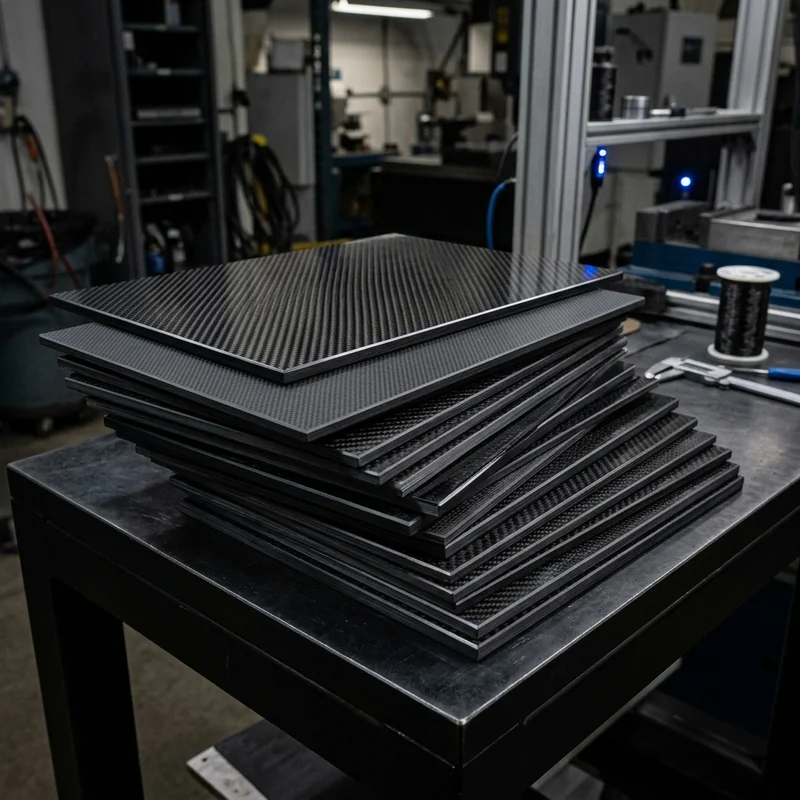
Carbon fiber standard plate-3k stripe
Lightweight, ultra-rigid standard sheets for drone fuselages, robot housings, facades and structural applications.

Carbon Fiber Plate — 3K Twill T700 1.5mm
Thin 1.5mm carbon fiber plate with 3K twill weave surface. Lightweight and stiff, commonly used for covers, panels, drone bodies, and applications requiring a premium aesthetic appearance.

Square Carbon Fiber Tube — 3K Twill T700
Square cross-section carbon fiber tube manufactured with 3K twill weave for torsional strength. Preferred for structural frames, trusses, and support columns where rectangular geometry offers design flexibility.

Carbon Fiber Plate — 3K Twill T700 3.0mm
Medium-thickness 3.0mm carbon fiber plate offering significantly higher load capacity while maintaining attractive 3K twill finish. Suitable for structural brackets, reinforcement plates, and load-bearing panels.
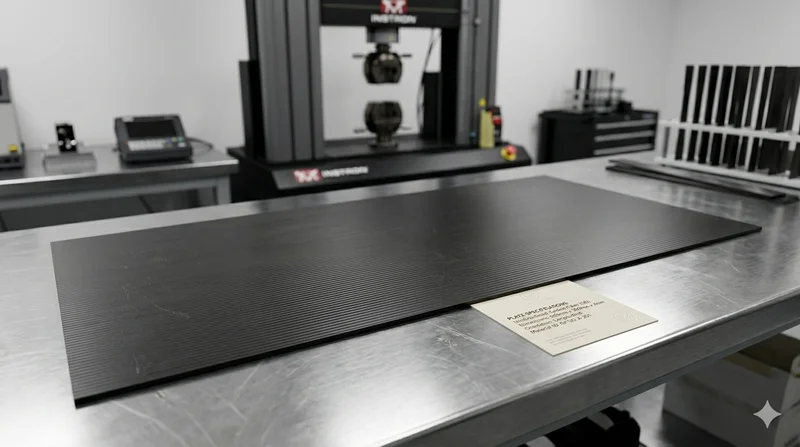
Carbon Fiber Plate — UD Unidirectional T700
Unidirectional carbon fiber plate with all fibers oriented in a single direction for maximum strength along the fiber axis. Essential for structural reinforcements, splints, and applications where load direction is predictable.