
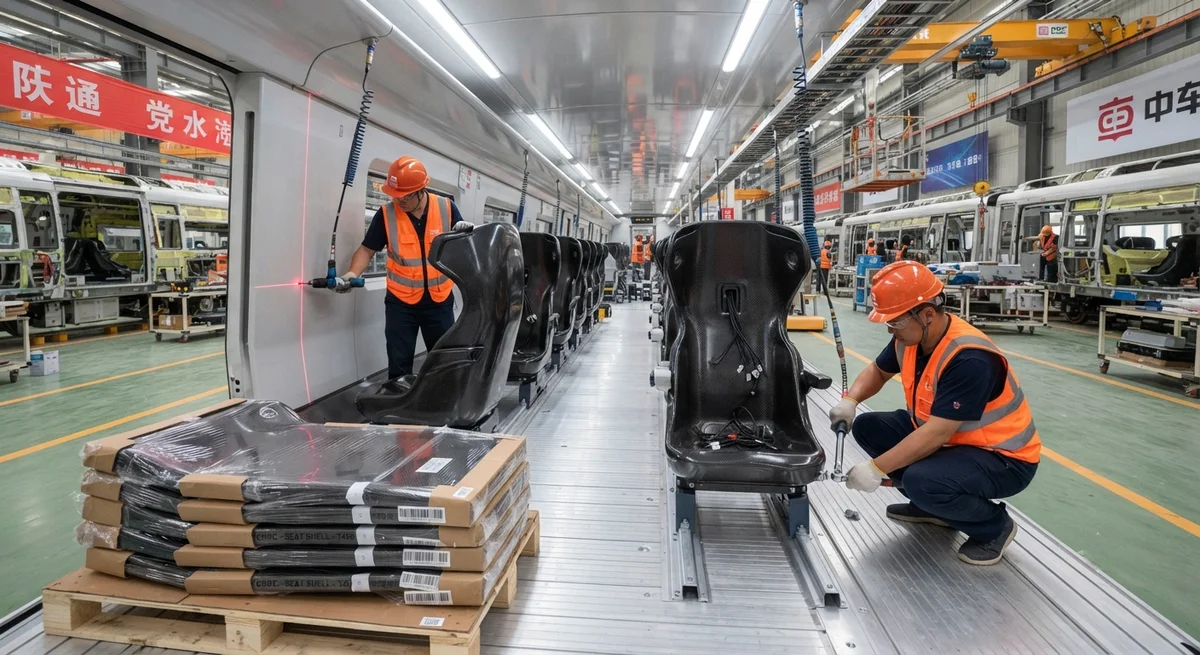
Discover how carbon fiber railway seat structures reduce mass by 40–60% while meeting stringent EN 45545 fire safety standards. Detailed material comparisons, weight reduction data, and manufacturing
Introduction to Carbon Fiber Railway Seats
The global high-speed rail market is expanding at an unprecedented pace, with new lines opening across Europe, Asia, and the Middle East. As train operating speeds push beyond 350 km/h, every kilogram of interior mass directly impacts acceleration energy, braking distance, and track wear. Carbon fiber reinforced polymer (CFRP) seat structures have emerged as the leading lightweight interior solution, offering 40–60% mass reduction over conventional aluminum or steel frames while meeting strict fire-smoke-toxicity (FST) requirements for railway passenger vehicles.
Railway interior seating is a demanding application: seats must withstand repeated dynamic loading over decades of service, resist accidental impact from passenger luggage and service carts, comply with EN 45545 (European railway fire safety standard), and remain comfortable for passengers during journeys lasting up to eight hours. Carbon fiber composites uniquely satisfy all these requirements in a single integrated shell design.
Design Architecture and Material Selection
Monocoque Shell vs. Framed Construction
Two primary design approaches dominate CFRP railway seating:
- Monocoque shell design: The seat back, pan, and side supports are molded as a single continuous component. This eliminates all mechanical fasteners at the structural joint, reducing part count by 60–70% compared to welded aluminum frames. Typical shell thickness ranges from 2.5 mm to 4.0 mm depending on load zone.
- Hybrid frame with composite skins: A thin CFRP shell is bonded over a lightweight metallic subframe. Preferred for retrofit applications where existing attachment points must be preserved, though it sacrifices some weight savings (typically 35% reduction vs. 50%+ for monocoque).
Material System Requirements
Railway applications demand specialized epoxy resin systems formulated for low heat release and smoke density. The table below compares material candidates for CFRP seat structures:
| Material System | Density (g/cm³) | Tensile Modulus (GPa) | EN 45545 Class | Relative Cost | Typical Application |
|---|---|---|---|---|---|
| Standard epoxy + T700SC carbon | 1.55 | 130 | R22-HL3 | 1.0× (baseline) | Second-class seat shells |
| Phenolic epoxy + T700SC carbon | 1.58 | 125 | R22-HL2 / R23-HL3 | 1.3× | First-class / business seats |
| Bismaleimide (BMI) + IM7 carbon | 1.60 | 165 | R22-HL1 / R23-HL2 | 2.1× | Driver cabins / premium |
| Fire-retardant vinyl ester + glass/carbon hybrid | 1.70 | 85 | R22-HL2 | 0.8× | Low-cost regional trains |
For most high-speed rail applications, a phenolic epoxy system with T700SC carbon fiber strikes the optimal balance between FST compliance (R22-HL2 minimum), mechanical performance, and cost. The 1.3× cost premium over standard epoxy is offset by weight savings of 12–15 kg per seat pair.
Fire Safety Compliance (EN 45545)
EN 45545 defines three hazard levels (HL1–HL3). HL3, the most stringent, applies to sleepers and double-deck high-speed trains. CFRP seat manufacturers must demonstrate compliance across four test parameters:
- Heat release rate (HRR) — peak ≤ 60 kW/m² for HL3
- Total heat release (THR) — ≤ 20 MJ/m²
- Smoke production rate (SPR) — peak ≤ 0.25 m²/s
- Specific optical density (Ds) — ≤ 300 after 4 minutes
Phenolic epoxy carbon fiber systems comfortably pass these thresholds, while standard epoxies generally require intumescent gel-coat or fire-barrier interlayers to reach HL3 certification.
Weight Reduction and Performance Benefits
The transition from conventional aluminium seat structures to CFRP monocoque shells yields measurable operational advantages. A typical high-speed train carriage seats 70–85 passengers. Replacing aluminium seat frames (18 kg per seat) with CFRP shells (8.5 kg per seat) reduces total carriage mass by approximately 680–800 kg. Over a 500 km operating route, this mass reduction translates to:
- 7–9% reduction in traction energy consumption per trip
- Reduced dynamic track loading, extending rail grinding intervals by 12–18 months
- Lower braking system wear — brake disc replacement intervals extended by 25%
- Increase in payload capacity allowing two additional revenue seats per carriage while maintaining the same axle load
CFRP seats also demonstrate superior fatigue resistance. In accelerated testing to 5 million cycles (simulating 30 years), carbon fiber monocoque shells retained 92% of initial stiffness, compared to 78% for welded aluminum frames — attributed to the absence of weld heat-affected zones and stress concentrations at fastener holes.
Manufacturing and Integration Considerations
Production Methods
High-pressure resin transfer molding (HP-RTM) is the preferred manufacturing process for CFRP railway seat shells at volumes exceeding 10,000 units per year. Cycle times of 4–8 minutes per shell are achievable with multi-cavity tooling. For lower volumes, prepreg autoclave curing remains viable, with cycle times of 45–60 minutes per part. In-mold coating — applying a textured gel coat during the molding cycle — eliminates secondary painting operations and improves scratch resistance for the demanding public-transit environment.
Integration with Train Systems
Modern CFRP seat modules include integrated cable routing channels for USB power outlets, seatback screens, and occupancy sensors. The composite shell can be molded with bosses and mounting inserts in a single operation, eliminating bracket assemblies required in metal frame designs. YongXian CarbonFiber provides custom insert placement within ±0.3 mm positional tolerance to guarantee interchangeability across carriage layouts.
FAQ: Carbon Fiber Railway Seat Structures
What are the main cost drivers for CFRP railway seats compared to aluminum?
Raw material costs for CFRP (carbon fiber fabric + phenolic resin) are 3–5× higher than aluminum extrusions per kilogram. However, total assembled seat cost is only 20–40% higher because CFRP monocoque designs eliminate welding, reduce fastener count by 70%, and integrate armrest brackets and cable channels into the molded part. When lifecycle fuel savings and increased passenger capacity are factored in, the total cost of ownership of CFRP seats is frequently lower than aluminum within 3–5 years of service.
Can CFRP seats be recycled at end of life?
Yes. Carbon fiber from end-of-life seat shells can be recovered via pyrolysis (thermal recycling) with 90–95% fiber modulus retention. The recovered fibers are used in non-structural components such as interior trim panels, luggage racks, and HVAC ducting. Several European railway operators now mandate recyclability as part of their procurement specifications. Hybrid material systems (CFRP on metallic subframes) should be designed for disassembly to enable separation of the two material streams.
How do CFRP seats perform in extreme temperature conditions?
Carbon fiber has a negative coefficient of thermal expansion (−0.5 to −1.0 × 10⁻⁶/°C along the fiber direction), while the phenolic resin matrix has a positive CTE (25–40 × 10⁻⁶/°C). The net effect, balanced across a 0/90° quasi-isotropic layup, yields a near-zero in-plane CTE. CFRP seat shells maintain dimensional stability across the full −40°C to +85°C railway operating range. No significant creep has been observed in accelerated aging tests at 70°C and 90% relative humidity over 3,000 hours.
What is the typical lifespan of a CFRP railway seat?
CFRP monocoque seat shells are designed for a minimum service life of 25 years with regular visual inspection. Leading operators report zero structural failures in CFRP seats after 10+ years of revenue service. The primary replacement driver is not structural degradation but aesthetic wear — upholstery damage, graffiti, or updated interior design schemes. The composite substrate itself remains serviceable indefinitely when protected from UV exposure by upholstery or gel coat.
Are CFRP seats compatible with existing carriage attachment interfaces?
Yes. Seat attachment to the carriage floor uses standard C-rails (EN 12663-compliant) with bolted interface brackets. The composite shell is molded with embedded metallic load inserts at the four floor-attachment points plus any wall- or ceiling-stabilizer connections. YongXian CarbonFiber provides engineering support for interface reverse-engineering, allowing CFRP seats to be retrofitted into existing rolling stock without floor-rail modification.
Part of topic
Related Articles
- Carbon Fiber Mooring for Floating Offshore Wind: Fatigue and Corrosion in Deep Water
- Carbon Fiber Bicycle Frame Optimization: Layup Design and Manufacturing for Competitive Racing
- Carbon Fiber CFRP Retrofit for Infrastructure: Bridge and Building Seismic Strengthening
- Carbon Fiber Medical Imaging Equipment: Lightweight Gantry and Couch Structures for MRI/CT
- Carbon Fiber EV Battery Enclosures: Crash Safety and Electromagnetic Shielding Design
- Carbon Fiber Structures for Low-Altitude Economy: UAV Airframes and eVTOL Components
Interested in Our Products?
Contact our team for competitive pricing and technical specifications.
Get a QuoteRelated Products
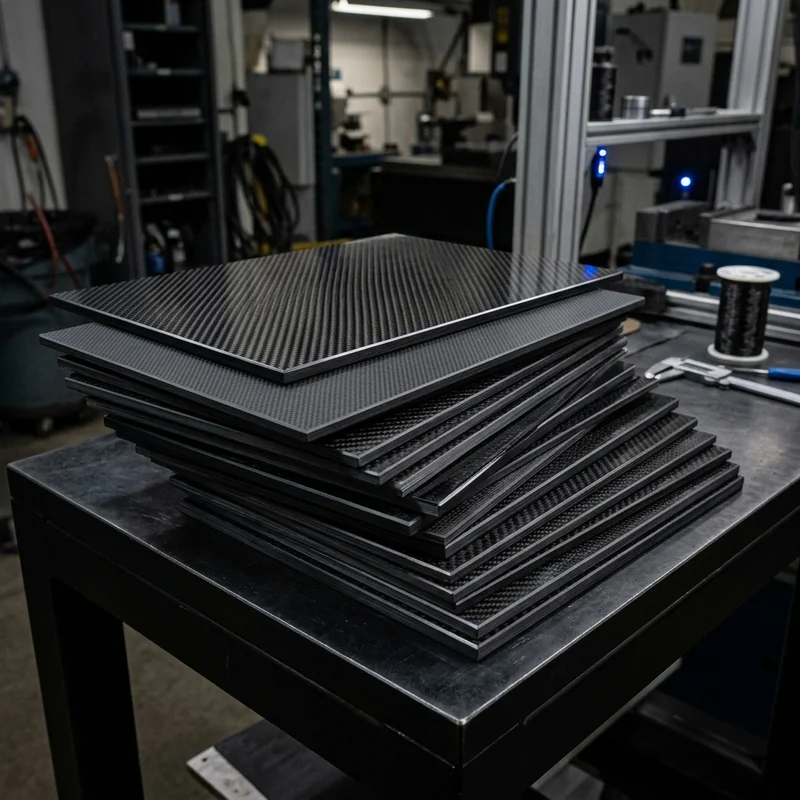
Carbon fiber standard plate-3k stripe
Lightweight, ultra-rigid standard sheets for drone fuselages, robot housings, facades and structural applications.

Carbon Fiber Plate — 3K Twill T700 1.5mm
Thin 1.5mm carbon fiber plate with 3K twill weave surface. Lightweight and stiff, commonly used for covers, panels, drone bodies, and applications requiring a premium aesthetic appearance.

Square Carbon Fiber Tube — 3K Twill T700
Square cross-section carbon fiber tube manufactured with 3K twill weave for torsional strength. Preferred for structural frames, trusses, and support columns where rectangular geometry offers design flexibility.

Carbon Fiber Plate — 3K Twill T700 3.0mm
Medium-thickness 3.0mm carbon fiber plate offering significantly higher load capacity while maintaining attractive 3K twill finish. Suitable for structural brackets, reinforcement plates, and load-bearing panels.
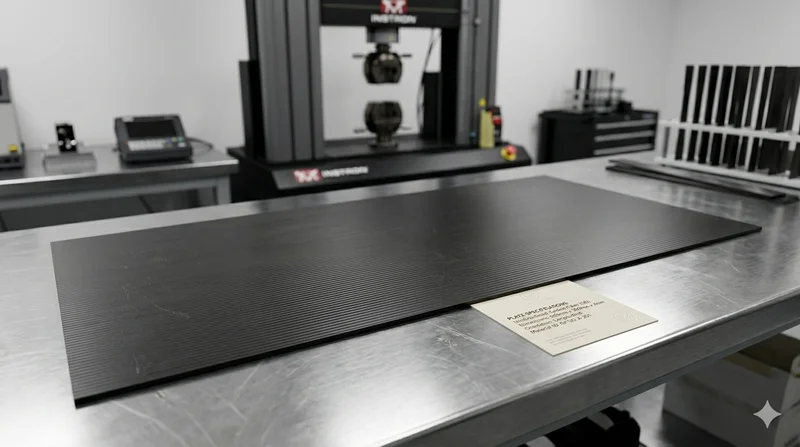
Carbon Fiber Plate — UD Unidirectional T700
Unidirectional carbon fiber plate with all fibers oriented in a single direction for maximum strength along the fiber axis. Essential for structural reinforcements, splints, and applications where load direction is predictable.