
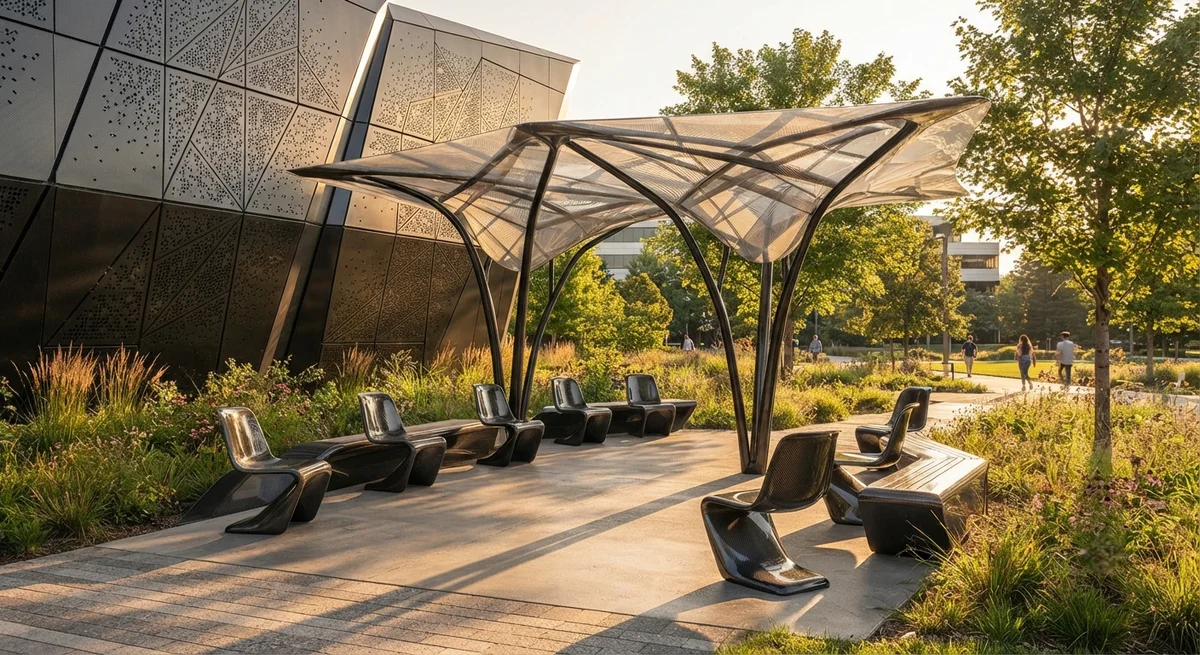
Carbon fiber is emerging as a premium material for outdoor furniture and architectural cladding, offering corrosion resistance, low thermal conductivity, and design flexibility. Compare CFRP against teak, aluminium, and stainless steel for outdoor applications.
Introduction
Carbon fiber reinforced polymer (CFRP) has traditionally been associated with aerospace, automotive, and sporting goods — high-performance applications where cost is secondary to weight savings and mechanical properties. However, a growing market is emerging for carbon fiber in outdoor furniture, architectural cladding, and permanent outdoor structures, where the material's unique combination of corrosion resistance, UV stability (with proper coating), high specific stiffness, and design flexibility offers compelling advantages over traditional materials such as teak wood, powder-coated aluminium, stainless steel, and concrete.
This article examines the engineering properties, manufacturing processes, and design possibilities of carbon fiber for outdoor furniture and architectural applications, providing procurement professionals with the technical foundation needed to evaluate CFRP for their outdoor product lines.
Material Property Comparison for Outdoor Applications
| Property | Teak Wood | Powder-Coated Aluminium | 304 Stainless Steel | CFRP (UV-resistant grade) |
|---|---|---|---|---|
| Density (g/cm³) | 0.65–0.85 | 2.70 | 7.90 | 1.50–1.60 |
| Tensile strength (MPa) | 5–15 (perpendicular to grain) | 130–310 | 520–720 | 1,800–2,800 |
| Flexural modulus (GPa) | 10–13 | 69 | 193 | 70–140 (layup dependent) |
| UV resistance (years without degradation) | 1–3 (requires annual treatment) | 5–10 (coating dependent) | 20+ (staining possible) | 10–15 (with UV-resistant topcoat) |
| Corrosion in marine environment | Moderate (fungus/rot) | Moderate (coating damage) | Moderate (crevice corrosion) | Excellent (no corrosion) |
| Thermal conductivity (W/m·K) | 0.15–0.20 | 205 | 16 | 0.5–1.0 |
| Maintenance requirement | Annual oiling/sanding | Occasional touch-up | Occasional cleaning | Minimal (wash only) |
| Fabrication energy (MJ/kg) | 2–5 (air-dried) | 150–200 | 50–80 | 200–400 |
| Design life in outdoor use (years) | 5–15 (with maintenance) | 10–20 | 20–50 | 25–50 |
Applications in Outdoor Furniture
Contract-Grade Seating Systems
Carbon fiber outdoor furniture is increasingly specified for high-end hospitality, corporate campus, and public space applications where durability, low maintenance, and distinctive aesthetics are required. The material enables thin-section, organic forms that are impossible to achieve with metal or wood.
- Aerospace-grade prepreg construction: 4–8 plies of 3K or 6K twill-weave carbon fiber fabric with a UV-stable epoxy or acrylic resin system, oven-cured at 120–150°C for 30–60 minutes.
- Surface finish options: Clear gloss or matte UV-resistant topcoat (revealing the carbon fiber weave pattern); pigmented topcoat in custom colours; textured surface with anti-slip properties for outdoor deck applications.
- Structural performance: A carbon fiber cantilever chair weighing 3–4 kg can support 200 kg static load with a safety factor of 3:1, compared with a teak or aluminium chair weighing 8–12 kg.
- Fire retardancy: Meets CAL 117 and BS 5852 for contract furniture; flame-retardant resin systems are available for public space applications.
Architectural Cladding and Canopies
- Translucent carbon fiber panels: Thin 0.5–1.0 mm CFRP skins with a honeycomb core produce rigid panels weighing 2–4 kg/m² — 60–80% lighter than aluminium composite panels of equivalent stiffness.
- Fritted or perforated surfaces: Laser-cut or water-jet cut patterns in CFRP panels provide solar shading while maintaining structural integrity, with a coefficient of thermal expansion (1.5–2.5 ppm/°C) that is 3× closer to glass than aluminium.
- Double-curved canopy structures: The ability to mould CFRP into compound curvatures without springback makes it ideal for iconic architectural forms. A 15 m diameter canopy in CFRP can be fabricated as 6–8 interlocking segments weighing 250–400 kg each — versus 800–1,200 kg per steel segment.
FAQ
Q: Does carbon fiber outdoor furniture become hot in direct sunlight?
No — this is one of the key comfort advantages of CFRP for outdoor furniture. The thermal conductivity of CFRP (0.5–1.0 W/m·K) is significantly lower than aluminium (205 W/m·K) and comparable to wood (0.15–0.20 W/m·K). In direct sunlight on a 40°C day, a carbon fiber chair seat surface temperature rises to approximately 42–46°C, while an aluminium chair reaches 55–65°C.Q: What is the recommended UV protection system for outdoor CFRP?
A three-layer system is recommended: (1) UV absorber additives in the epoxy resin system (benzotriazole or triazine type, 0.5–2.0% by weight); (2) an intermediate clear coat with UV-blocking nano-ceramic particles (50–100 nm TiO₂ or ZnO); and (3) a topcoat with aliphatic polyurethane providing 10–15 years of outdoor durability. Without protection, the epoxy matrix begins to yellow and degrade after 2–3 years of direct UV exposure.Q: How does CFRP outdoor furniture perform in freezing conditions?
CFRP performs excellently in freezing conditions. The epoxy matrix maintains its mechanical properties down to approximately −50°C, and the material's low thermal conductivity means that the surface of a carbon fiber chair remains closer to ambient temperature than metal alternatives. No embrittlement issues have been reported in standard epoxy systems above −40°C.Q: Can carbon fiber outdoor furniture be repaired if damaged?
Yes — and much more easily than teak or aluminium. Surface scratches can be repaired with a two-part epoxy filler followed by local re-coating. Structural damage such as cracks or delamination can be repaired with bonded CFRP patches (similar to aerospace repair procedures) at 10–20% of the replacement cost. Most hotels and public space operators maintain a stock of 5–10% spare parts per installation for modular replacement.Q: What is the cost premium for CFRP outdoor furniture compared to premium teak?
Contract-grade CFRP outdoor furniture carries a 2–5× cost premium over premium teak furniture at initial purchase. However, total cost of ownership modelling over a 15-year period (including maintenance labour, replacement frequency, and disposal) typically shows CFRP achieving 20–40% lower total cost due to eliminated annual oiling and replacement requirements. For aluminium, the TCO comparison favours CFRP when the product design life exceeds 10 years.Part of topic
Related Articles
- Carbon Fiber Mooring for Floating Offshore Wind: Fatigue and Corrosion in Deep Water
- Carbon Fiber Bicycle Frame Optimization: Layup Design and Manufacturing for Competitive Racing
- Carbon Fiber CFRP Retrofit for Infrastructure: Bridge and Building Seismic Strengthening
- Carbon Fiber Medical Imaging Equipment: Lightweight Gantry and Couch Structures for MRI/CT
- Carbon Fiber EV Battery Enclosures: Crash Safety and Electromagnetic Shielding Design
- Carbon Fiber Structures for Low-Altitude Economy: UAV Airframes and eVTOL Components
Interested in Our Products?
Contact our team for competitive pricing and technical specifications.
Get a QuoteRelated Products
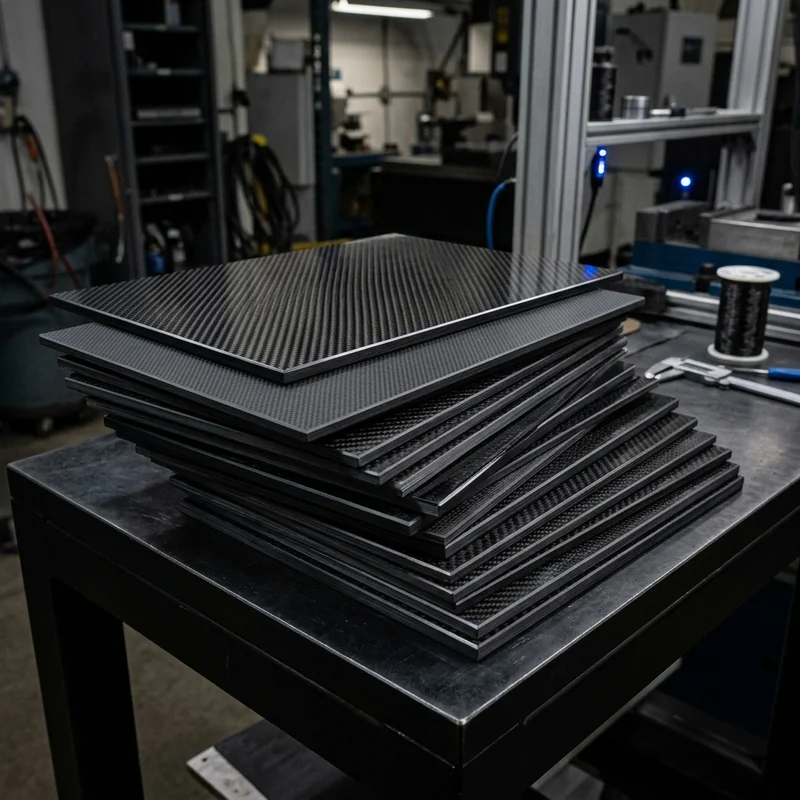
Carbon fiber standard plate-3k stripe
Lightweight, ultra-rigid standard sheets for drone fuselages, robot housings, facades and structural applications.

Carbon Fiber Plate — 3K Twill T700 1.5mm
Thin 1.5mm carbon fiber plate with 3K twill weave surface. Lightweight and stiff, commonly used for covers, panels, drone bodies, and applications requiring a premium aesthetic appearance.

Square Carbon Fiber Tube — 3K Twill T700
Square cross-section carbon fiber tube manufactured with 3K twill weave for torsional strength. Preferred for structural frames, trusses, and support columns where rectangular geometry offers design flexibility.

Carbon Fiber Plate — 3K Twill T700 3.0mm
Medium-thickness 3.0mm carbon fiber plate offering significantly higher load capacity while maintaining attractive 3K twill finish. Suitable for structural brackets, reinforcement plates, and load-bearing panels.
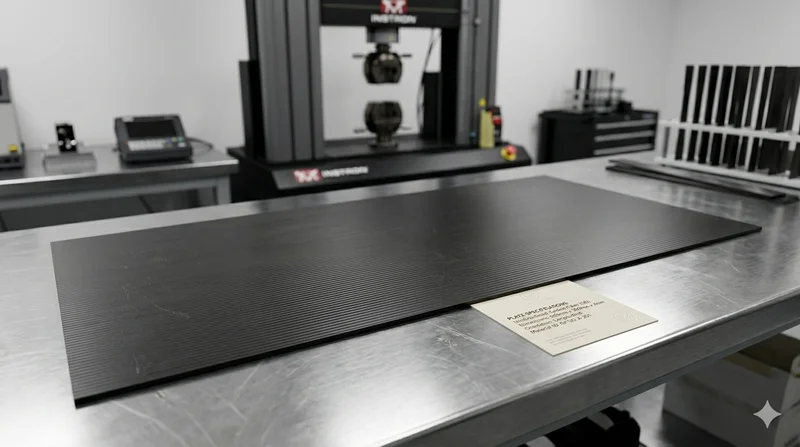
Carbon Fiber Plate — UD Unidirectional T700
Unidirectional carbon fiber plate with all fibers oriented in a single direction for maximum strength along the fiber axis. Essential for structural reinforcements, splints, and applications where load direction is predictable.