
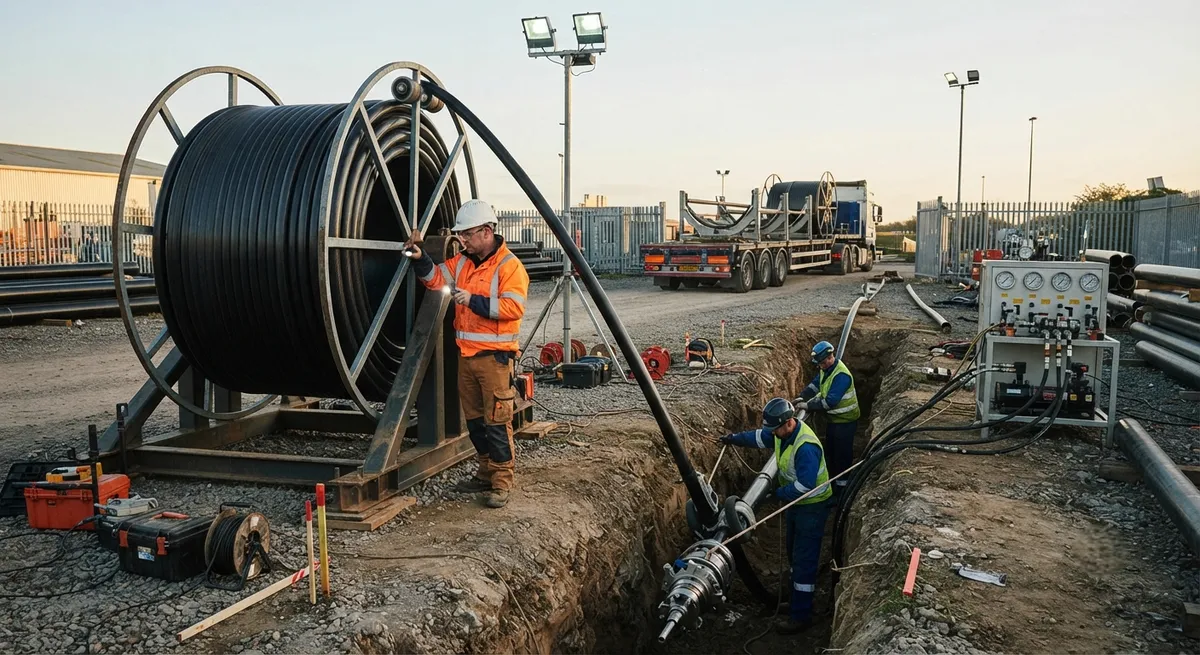
Spoolable composite pipe (SCP) is continuous carbon or glass fiber reinforced polymer tube manufactured in a single length of hundreds of meters to a few kilometers, then spooled onto a reel for transport and installation. At the site the pipe is pulled from the reel into a prepared tre
Introduction
Spoolable composite pipe (SCP) is continuous carbon or glass fiber reinforced polymer tube manufactured in a single length of hundreds of meters to a few kilometers, then spooled onto a reel for transport and installation. At the site the pipe is pulled from the reel into a prepared trench or laid on the seabed, and terminated with a qualified end fitting. It is used for hydrocarbon flow lines, produced-water disposal, water injection, and gas gathering, where corrosion resistance and fast installation outweigh its lower pressure and temperature limits versus steel.
Spoolable pipe is governed by constraints different from welded steel: bending strain during reeling, load sharing in a layered laminate, and chemical resistance. This article covers the installation economics where the reel pays back, the corrosion resistance that makes the pipe attractive, and the failure modes an operator must plan for.
Installation Economics: Why the Reel Wins
The installed-cost comparison is not a pipe price comparison. A steel flow line is bought as lengths of pipe, welded into a string by qualified welders, radiographically inspected, coated, and hydro-tested — a campaign measured in weeks. A spoolable system is one continuous pipe that a small crew lays at several kilometers per day with no field welding, because joints are the classic weak point of any pipeline; the capital equipment is a reel trailer.
| Cost and schedule driver | Welded steel | Spoolable FRP/CFP |
|---|---|---|
| Field joining | Weld each joint, X-ray, coating repair | None during pull-in (reel joints factory-made) |
| Installation crew | Large welding, rigging and inspection team | Small pulling crew, one reel operator |
| Schedule for 5 km line | Weeks (welding–NDT–hydro test) | Days (one pull, one hydro/backfill) |
| Integrity management | Corrosion, weld defects, cathodic protection | Chemical compatibility, handling damage, bonding |
Because the pipe is reeled and later un-reeled, the material is designed to be strained during bending and sized by fiber strength. Carbon fiber reinforcement adds high axial stiffness, which allows longer reel lengths, a tighter minimum bend radius, and lower fatigue under cyclic pressure. Offshore reel-lay is standard for composite risers and flow lines; onshore, the crew saving alone can justify spoolable pipe.
Corrosion Resistance and Chemical Compatibility
The defining corrosion advantage is inherent. Carbon fibers are chemically resistant, and the polymer matrix is chosen for the produced-fluid chemistry: epoxy resin systems cover most service. Produced water contains dissolved CO2, H2S, salts, and organic acids — in steel these drive sweet and sour corrosion and chloride pitting; in composite pipe the same environment is a matrix-selection question, and if the chemistry changes the matrix can be upgraded without replacing the whole system. The matrix slowly absorbs water at service temperature, which sets the wet-service life limit; steel instead needs cathodic protection equipment the composite does not.
The flow is safe when the pipe stays within its qualified operating window, even in aggressive sour fluid — but the layer stack must be built to the qualified thickness and sequence, and comparing a spoolable to a steel riser requires understanding the sour-service chemistry, because carbon steel may be explicitly de-rated by the sour-water rules of the code.
Failure Modes in Service
The realistic failures of spoolable pipe come from the matrix, the adhesive, and the installation process, not from the fibers:
- Burst failure: overpressure or degraded hoop capacity at a joint or anchor; this is the mode laboratory burst tests are designed around.
- Microcrack/permeability failure: repeated pressure cycling makes the matrix develop radial microcracks that leak under the outer jacket — the classic fatigue limit; the stack is sized so no lay-up sequence creates a continuous through-thickness cracking path.
- End fitting pull-out: a loss of radial load (drift, salt crystallization) or adhesive shear failure can push a metal end fitting off the composite body even though the pipe survives.
- Reel bending and buckling: spooling damage (bend strain, fiber crush) can reduce usable burst pressure — hence acceptance uses a torque/tension envelope and the API 3× bend test.
- UV, thermal aging, delamination: the outer layer ages under ultraviolet, and thermal contraction at wellhead and hot couplings can crack the laminate or kill adhesion; thermal cycling is the closest proxy for this aging limit.
Erosion and solids: fines, sand and scale follow the same flow-assurance rules as steel, but without the pitting-corrosion path — the composite surface is checked for abrasion wear rather than corrosion pits.
Qualification and Field Testing
Operators now expect field-verifiable integrity, not just laboratory qualification. The set includes the full hydrostatic test, pressure cycling, and long-term hydrostatic tests over 1,000 to 10,000 hours at elevated temperature, with the pipe classified per API 15 S, API 17J, and spoolable-pipe standards such as ISO 14692. Produced-fluid chemistry is qualified by dedicated exposure testing.
In the field, acceptance never comes from a burst test alone: installer records confirm the winch pull-in load, lay speed, and backfill compression, compared against the reel-bend qualification of the material. Any deviation from the qualified reeling envelope must be reviewed before commissioning, because installation strain directly drives service life.
Frequently Asked Questions
Why can't steel lines be laid as fast as spoolable composite pipe?
The bottleneck of steel is the joint: welding — with fabrication, X-ray, and coating repair — accounts for the entire crew and schedule, and long-distance joints are also where CUI (corrosion under insulation) issues live. Spoolable pipe removes the field weld: the reel arrives with factory-made joints that are simply paid out, leaving the crew to lower the pipe and make up a few reels.
Is spoolable composite pipe structural at both low and high pressure?
The range is real, but operators select it against the service pressure and temperature: spoolable pipe suits low- to medium-pressure lines (usually ~20-100 bar for produced fluids), with a temperature ceiling set by the polymer glass transition (typically 70-95°C for standard liners, 120-150°C for upgraded systems). Some liner systems reach 150-200 bar, with the limit set by the end fittings; beyond the composite rating, steel remains the choice.
How is the failure "accepted" in the code for composite pipe strength?
Reinforced thermoset pipe strength is a statistical design basis: short-term burst strength is extrapolated by a long-term regression against time and temperature, then divided by partial safety factors set by the standard (such as the h-factors of ISO 14692). Specimen stacks burst-tested at increasing temperatures project the 50-year creep limit, and fluid-compatibility tests validate the chemistry limit — the rating is a derived figure, not a certificate claim.
Conclusion
Spoolable carbon fiber composite pipe has earned a clear place in the oil and gas portfolio: it converts a month-long, welding-driven construction activity into a single-day pull, removes the corrosion mechanism that plagues steel inventories, and brings fiber-matrix design flexibility to the fluid chemistries the well produces. None of it works without installation quality and supplier validation — spooling strain, end fitting, and chemistry decide service life. For operators planning well tie-ins, water injection, and gathering systems, our spoolable composite pipe products and end fittings are manufactured with the laminate designed for pressure, temperature, and chemistry, and delivered with qualified joints and commissioning procedures. Contact our pipeline engineering team for spooling-strain calculations, end-fitting ratings, and site support on your oil & gas project.
Part of topic
Related Articles
- Carbon Fiber Tube for Sale: Comparing Listings and Avoiding Bad Specs
- Carbon Fiber Engine Parts: High-Temperature Performance for Racing and Performance Vehicles
- Carbon Fiber Body Parts: Automotive Exterior Panels and Structural Components
- Carbon Fiber Drone Body Manufacturing: Monocoque Design and Production Methods
- Carbon Fiber Drone Parts Supplier: FPV Frames, Arms and Structural Components
- Filament Wound Epoxy Tubes: Industrial Applications from Oil and Gas to Aerospace
Interested in Our Products?
Contact our team for competitive pricing and technical specifications.
Get a QuoteRelated Products
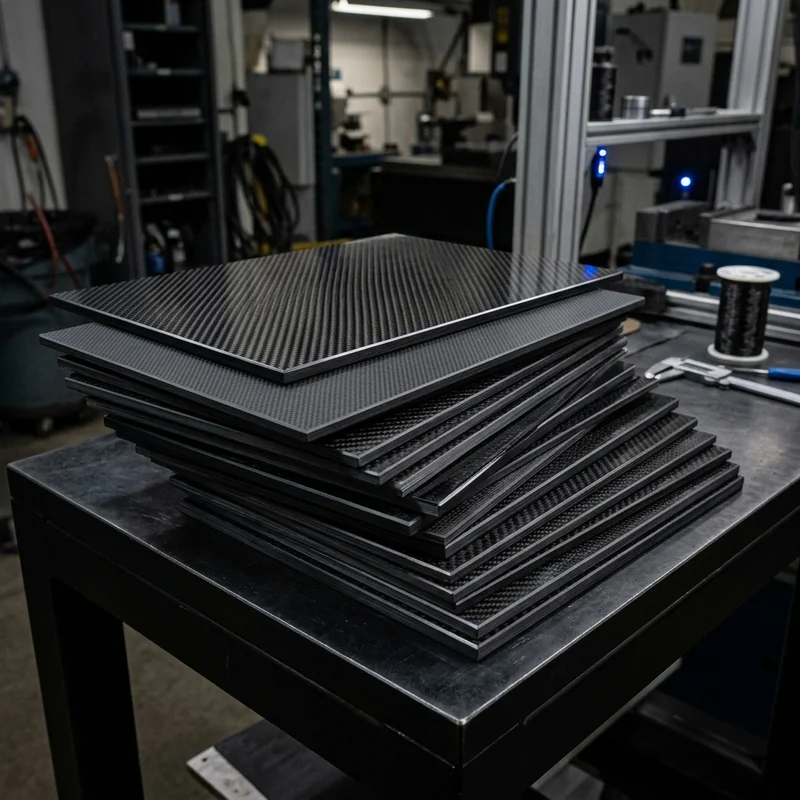
Carbon fiber standard plate-3k stripe
Lightweight, ultra-rigid standard sheets for drone fuselages, robot housings, facades and structural applications.

Carbon Fiber Plate — 3K Twill T700 3.0mm
Medium-thickness 3.0mm carbon fiber plate offering significantly higher load capacity while maintaining attractive 3K twill finish. Suitable for structural brackets, reinforcement plates, and load-bearing panels.

Carbon Fiber Plate — 3K Twill T700 1.5mm
Thin 1.5mm carbon fiber plate with 3K twill weave surface. Lightweight and stiff, commonly used for covers, panels, drone bodies, and applications requiring a premium aesthetic appearance.

Square Carbon Fiber Tube — 3K Twill T700
Square cross-section carbon fiber tube manufactured with 3K twill weave for torsional strength. Preferred for structural frames, trusses, and support columns where rectangular geometry offers design flexibility.
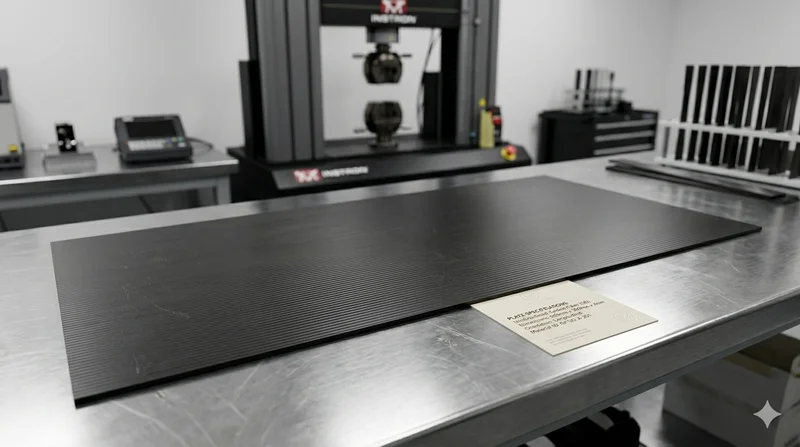
Carbon Fiber Plate — UD Unidirectional T700
Unidirectional carbon fiber plate with all fibers oriented in a single direction for maximum strength along the fiber axis. Essential for structural reinforcements, splints, and applications where load direction is predictable.