
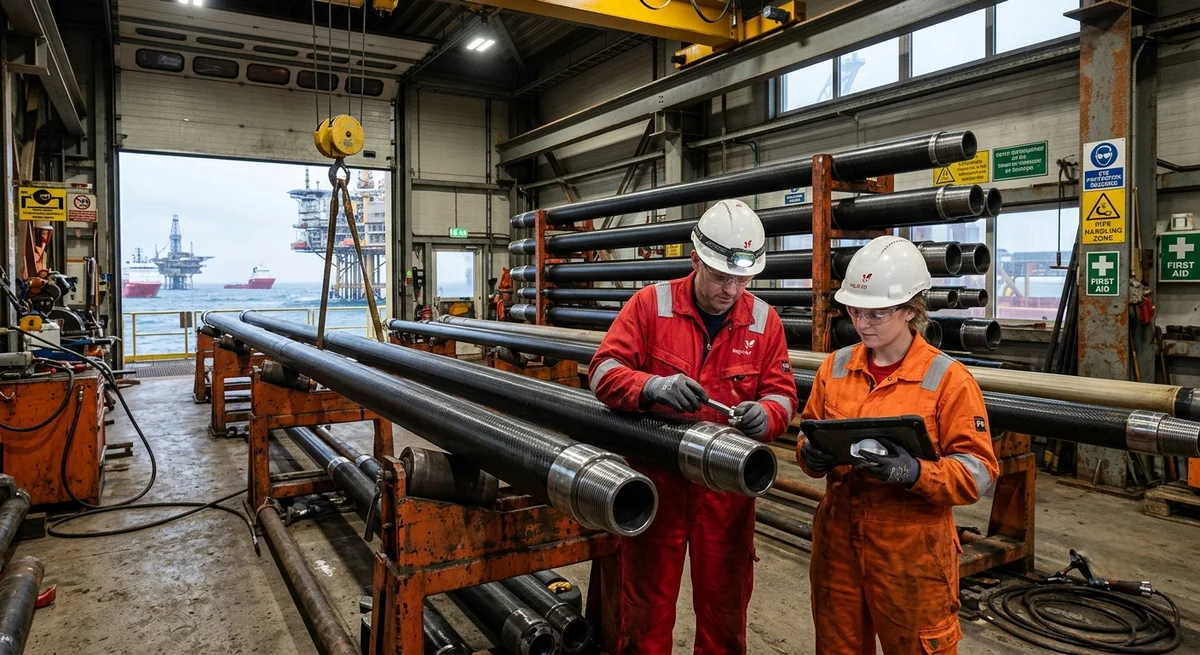
Carbon fiber tubulars and risers for oil and gas applications — corrosion resistance, weight savings, and mechanical performance data for downhole and deepwater environments.
Carbon Fiber in Oil and Gas: 2026 Engineering Guide
The oil and gas industry consumed approximately 3,200 tonnes of carbon fiber in 2025, growing at 11.5% CAGR (2021-2026). Two dominant applications drive this growth: downhole tubulars (sucker rods, tubing strings, and casing liners) and deep-sea risers (drilling risers, production risers, and export pipelines). Carbon fiber offers three critical advantages: corrosion resistance eliminating scale/inhibitor costs, 60-80% weight reduction reducing top tension requirements, and fatigue performance exceeding steel by 3-10× in sour service environments.
Material Comparison: Downhole Sucker Rods
| Parameter | Steel (Grade D) | Carbon Fiber (Filament Wound) | Carbon Fiber (Pultruded) | Improvement |
|---|---|---|---|---|
| Tensile strength (MPa) | 620-790 | 1,200-1,800 | 1,000-1,400 | 1.5-2.5× |
| Weight in fluid (kg/m, 25 mm rod) | 3.85 | 0.85 | 0.95 | −75 to −78% |
| Corrosion rate in H₂S (mm/year) | 0.25-0.50 (sour) | <0.01 | <0.01 | 25-50× improvement |
| Fatigue life at 200 MPa (cycles) | 2×10⁵ (NACE MR0175) | >10⁷ | 5×10⁶ | 25-50× |
| Max operating temperature (°C) | 200+ | 150 (epoxy), 250 (PEEK) | 180 (epoxy) | — |
| Cost per rod (25 mm×10 m, USD) | $180 | $650 | $480 | 2.7-3.6× |
| Service life in sour well (years) | 1-3 | 8-15 | 5-10 | 3-5× |
Deep-Sea Riser Architectures
Deepwater risers (1,500-3,000 m water depth) dominate the high-performance end of the oil and gas CF market.
| Riser Type | Water Depth (m) | Weight in Water (kg/m) | Max Working Pressure (MPa) | Installed Cost ($M/km) |
|---|---|---|---|---|
| Steel catenary riser (SCR) | 1,000-2,500 | 180-350 | 35-70 | $4.5-8.0 |
| CFRP SCR (carbon fiber) | 1,500-3,500 | 35-70 | 35-70 | $6.5-12.0 |
| Top-tensioned riser (TTR) — steel | 1,000-3,000 | 120-250 | 20-50 | $5.0-9.0 |
| TTR — CFRP hybrid | 1,500-3,500 | 25-50 | 25-60 | $7.0-13.0 |
CF Downhole Tubular Specifications
- Sucker rods (2.5-3.5 m sections): 22-32 mm diameter, filament-wound ±45°/0° CF/epoxy with protective polyurethane coating. API 11B modified specification. End fittings: 4140 steel, zinc-plated, mechanically swaged (pull-out load >350 kN).
- Tubing strings (9 m sections): 60-114 mm OD, 5-10 mm wall, ±55° filament-wound CF/epoxy with inner thermoplastic liner (PVDF or PEEK). Connections: premium-threaded steel couplings.
- Casing liners (3-12 m sections): 114-340 mm OD, 6-15 mm wall, hybrid CF/glass with ±45°/0°/±45° lay-up. Used for corrosion-resistant completion strings in CO₂ and H₂S environments.
Q: What is the maximum operating temperature for carbon fiber downhole components?
A: The temperature limit is resin-system dependent. Standard epoxy systems limit CF components to 120-150°C continuous (up to 180°C short-term). Bismaleimide (BMI) resin extends to 200-230°C, and PEEK thermoplastic extends to 250-260°C. For ultra-high temperature wells (>260°C), pitch-based carbon fiber with polyimide resin (e.g., PMR-15) can reach 300-350°C, but at 8-15× the cost. No commercially available CF system currently operates above 350°C continuous — ceramic matrix composites (CMC) are required for those conditions.
Q: How are carbon fiber risers joined and terminated with metal connectors?
A: CFRP-to-metal connection is the most critical design element. Three methods: (1) Adhesive bonding — conical scarf joint with epoxy adhesive providing 25-40 MPa shear strength, validated by 200,000+ cycle fatigue testing per API 17J. (2) Mechanical swaging — metal connector cold-formed onto CF tube, interference fit of 0.05-0.15 mm on radius, 400-800 kN axial pull-out capacity for 150 mm OD risers. (3) Hybrid adhesive/swage — combination used by most Tier-1 riser suppliers (Aker Solutions, TechnipFMC). All connectors require cathodic protection to prevent galvanic corrosion in seawater.
Q: What inspection and monitoring systems are used for CF downhole equipment?
A: CF downhole components require aerospace-adapted NDT methods: (1) Phased-array ultrasonic testing detects delaminations and fiber waviness to ±0.5 mm resolution; performed at factory and every 2 years in service. (2) Acoustic emission — continuous monitoring via embedded fiber Bragg grating (FBG) sensors detects incipient fiber failure. (3) Distributed temperature sensing (DTS) — optical fiber embedded in CF structure provides real-time temperature profile every 0.5 m. (4) Borescope inspection of internal bore for liner degradation. API 17J/ISO 13628-6 require all three NDT methods as minimum for production riser qualification.
Related Articles
- Carbon Fiber Mooring for Floating Offshore Wind: Fatigue and Corrosion in Deep Water
- Carbon Fiber Bicycle Frame Optimization: Layup Design and Manufacturing for Competitive Racing
- Carbon Fiber CFRP Retrofit for Infrastructure: Bridge and Building Seismic Strengthening
- Carbon Fiber Medical Imaging Equipment: Lightweight Gantry and Couch Structures for MRI/CT
- Carbon Fiber EV Battery Enclosures: Crash Safety and Electromagnetic Shielding Design
- Carbon Fiber Structures for Low-Altitude Economy: UAV Airframes and eVTOL Components
Interested in Our Products?
Contact our team for competitive pricing and technical specifications.
Get a QuoteRelated Products
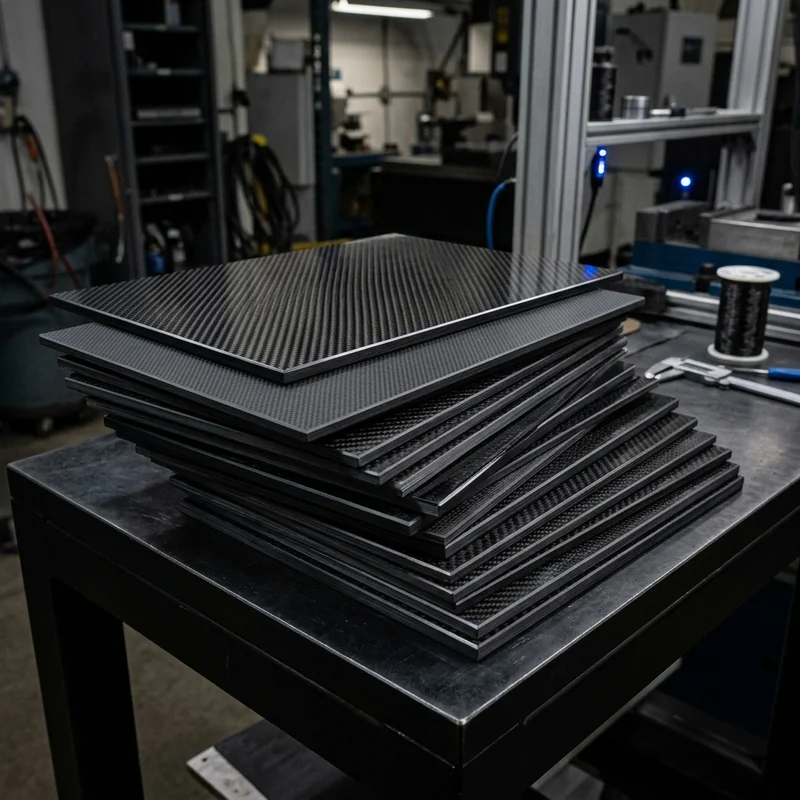
Carbon fiber standard plate-3k stripe
Lightweight, ultra-rigid standard sheets for drone fuselages, robot housings, facades and structural applications.

Carbon Fiber Plate — 3K Twill T700 1.5mm
Thin 1.5mm carbon fiber plate with 3K twill weave surface. Lightweight and stiff, commonly used for covers, panels, drone bodies, and applications requiring a premium aesthetic appearance.

Square Carbon Fiber Tube — 3K Twill T700
Square cross-section carbon fiber tube manufactured with 3K twill weave for torsional strength. Preferred for structural frames, trusses, and support columns where rectangular geometry offers design flexibility.

Carbon Fiber Plate — 3K Twill T700 3.0mm
Medium-thickness 3.0mm carbon fiber plate offering significantly higher load capacity while maintaining attractive 3K twill finish. Suitable for structural brackets, reinforcement plates, and load-bearing panels.
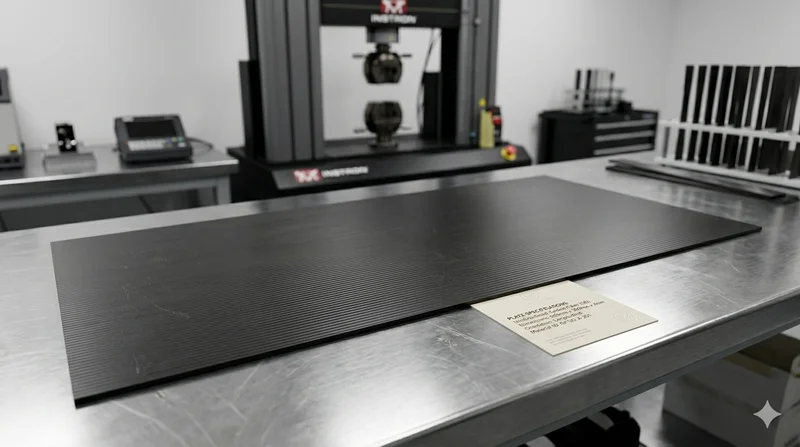
Carbon Fiber Plate — UD Unidirectional T700
Unidirectional carbon fiber plate with all fibers oriented in a single direction for maximum strength along the fiber axis. Essential for structural reinforcements, splints, and applications where load direction is predictable.