
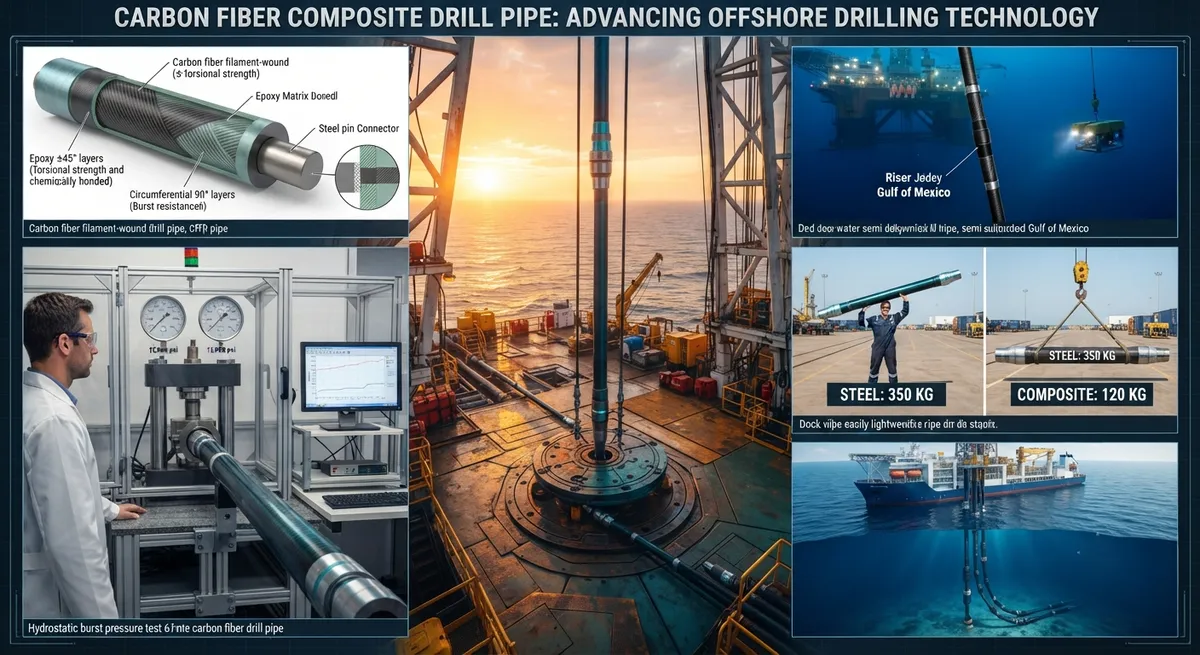
Explore how carbon fiber composite drill pipes and riser systems are transforming deep-well and offshore oil and gas drilling. Lighter, corrosion-resistant, and fatigue-tolerant, carbon fiber extends reach, reduces rig load, and enables production from deeper reservoirs than ever before.
The Weight Challenge in Deep-Well Drilling
As oil and gas exploration moves into deeper waters and more challenging reservoirs, the mechanical demands on drill strings and riser systems have surged. Traditional steel drill pipes, while strong, impose severe weight penalties that limit the total depth a rig can achieve. Every additional meter of steel drill pipe adds several hundred kilograms of mass, requiring larger derricks, more powerful top drives, and increased buoyancy compensation on floating platforms.
Carbon fiber reinforced polymer (CFRP) drill pipes and risers have emerged as a compelling alternative. By replacing steel with high-modulus carbon fiber-epoxy composites, operators can reduce the weight of the drill string by up to 60%. This reduction translates directly into extended reach capabilities — operators can drill deeper from the same platform without upgrading the rig's mechanical systems.
Material Properties and Composite Architecture
Carbon fiber drill pipes are manufactured using a filament winding process, where continuous carbon fiber tows impregnated with high-temperature epoxy resin are wound onto a mandrel at precisely controlled angles. The resulting tube exhibits exceptional specific stiffness (stiffness-to-weight ratio) that surpasses steel by a factor of 4 to 5.
| Property | Steel (S-135 Grade) | CFRP Drill Pipe | Improvement |
|---|---|---|---|
| Density (g/cm³) | 7.85 | 1.55–1.65 | −79% |
| Yield Tensile Strength (MPa) | 931 | 1,200–1,800 | +29% to +93% |
| Specific Stiffness (GPa/(g/cm³)) | 26 | 105–135 | +300% to +420% |
| Fatigue Life at 80% UTS (cycles) | 10⁵–10⁶ | >10⁷ | >10× |
| Corrosion Rate in H₂S Environment (mm/year) | 0.5–2.0 | <0.01 | Near-zero |
| Weight per 9m Joint (kg) | ~320 | ~110 | −66% |
Riser Systems for Ultra-Deep Water
Marine riser systems connect the floating drilling platform to the subsea wellhead, providing a conduit for the drill string and returning drilling mud. In ultra-deep water (depths exceeding 3,000 meters), the weight of conventional steel risers becomes prohibitive. The riser must support its own weight, withstand wave and current loading, and contain high-pressure drilling fluids — all while maintaining structural integrity over years of service.
Hybrid composite risers, combining carbon fiber structural layers with a thin steel or titanium inner liner for fluid permeation resistance, offer a practical solution. Field trials in the Gulf of Mexico and offshore Brazil have demonstrated that CFRP risers can reduce top tension requirements by 50–55%, allowing existing semi-submersible rigs to operate in water depths previously accessible only by drillships.
- Weight savings: A 3,000m CFRP riser string weighs approximately 850 tonnes, compared to 2,100 tonnes for steel — a 60% reduction.
- Fatigue tolerance: Carbon fiber's superior fatigue performance eliminates the need for frequent riser inspection and replacement cycles typical of steel risers in harsh offshore environments.
- H₂S corrosion immunity: In sour gas wells, CFRP components are completely immune to sulfide stress cracking (SSC), a common failure mode for high-strength steel drill pipes.
- Thermal stability: Advanced epoxy resin systems maintain mechanical properties from cryogenic (−40°C) to elevated downhole temperatures (180°C), covering the full operating envelope of most offshore wells.
Field Performance and Reliability Data
Since the early 2000s, multiple collaborative projects between oil majors (Shell, BP, Chevron) and composite manufacturers have field-tested CFRP drill pipes and risers. The Composite Drill Pipe (CDP) project, a joint industry program running from 2003 to 2015, accumulated over 50,000 operating hours on test strings deployed in land and offshore wells across Texas, the North Sea, and the Middle East. Key findings include:
- Wear resistance: CFRP tool joints fitted with hardened steel connectors showed wear rates comparable to conventional steel tool joints after 10,000 rotating hours.
- Pressure integrity: Burst pressure ratings of CFRP risers exceeded 70 MPa (10,000 psi) in hydrostatic testing, meeting or exceeding API 16R specifications.
- Service life: Projected fatigue life of CFRP drill pipes exceeds 20 years under typical drilling loads, compared to 5–8 years for premium steel strings in corrosive environments.
Frequently Asked Questions
How are carbon fiber drill pipes connected to each other?
CFRP drill pipes use hybrid connectors — typically forged steel or titanium pin-and-box connections bonded and mechanically locked to the composite tube ends. The connector design ensures load transfer without damaging the composite laminate. Several proprietary systems exist, including the Smart Joint connector (patented by Advanced Composite Products & Technology) and the Hydril Wedge Thread profile adapted for composite terminations. These connectors have been fully qualified to API 7-2 and ISO 13679 standards.
Can carbon fiber drill pipes be used with existing rig equipment?
Yes, with minor modifications. CFRP drill strings are designed with standardized outer diameters and tool joint configurations that are compatible with existing rotary tables, elevators, slips, and tongs. However, the lower weight requires adjustments to the drawworks braking system and hook load monitoring algorithms. BOP (blowout preventer) rams may also need elastomer seal upgrades to accommodate the smoother surface finish of composite pipes. Most rig retrofits cost between $50,000 and $150,000 per rig, a fraction of the savings from reduced fuel and handling costs over the string's lifetime.
What is the cost comparison between CFRP and steel drill pipe strings?
The initial procurement cost of a CFRP drill string is 2–3 times higher than a comparable premium steel string — approximately $800–$1,200 per meter for CFRP versus $300–$500 per meter for S-135 steel. However, the total cost of ownership (TCO) over a 10-year period favors CFRP when weight-related savings are factored in. Operators report TCO reductions of 25–40% due to: (1) lower fuel consumption (the lighter string requires less energy to rotate and hoist), (2) reduced inspection and maintenance costs (no corrosion or fatigue crack checks), (3) longer service life, and (4) the ability to drill deeper wells without upgrading the rig, avoiding $5–$15 million in capital expenditures.
Are there any limitations to using CF drill pipes in high-temperature wells?
Standard carbon fiber-epoxy composites have a maximum continuous service temperature of approximately 150–180°C, depending on the resin formulation. For wells exceeding this range (common in geothermal and ultra-deep HPHT reservoirs), operators can specify bismaleimide (BMI) or polyimide resin systems that extend the thermal envelope to 250–320°C. Alternatively, hybrid solutions using a carbon fiber body with a titanium inner liner can be specified. Most deep-water oil and gas wells operate below 150°C, making standard epoxy systems suitable for the vast majority of applications.
Part of topic
Related Articles
- Carbon Fiber Mooring for Floating Offshore Wind: Fatigue and Corrosion in Deep Water
- Carbon Fiber Bicycle Frame Optimization: Layup Design and Manufacturing for Competitive Racing
- Carbon Fiber CFRP Retrofit for Infrastructure: Bridge and Building Seismic Strengthening
- Carbon Fiber Medical Imaging Equipment: Lightweight Gantry and Couch Structures for MRI/CT
- Carbon Fiber EV Battery Enclosures: Crash Safety and Electromagnetic Shielding Design
- Carbon Fiber Structures for Low-Altitude Economy: UAV Airframes and eVTOL Components
Interested in Our Products?
Contact our team for competitive pricing and technical specifications.
Get a QuoteRelated Products
Carbon fiber standard plate-3k stripe
Lightweight, ultra-rigid standard sheets for drone fuselages, robot housings, facades and structural applications.
Carbon Fiber Plate — 3K Twill T700 3.0mm
Medium-thickness 3.0mm carbon fiber plate offering significantly higher load capacity while maintaining attractive 3K twill finish. Suitable for structural brackets, reinforcement plates, and load-bearing panels.
Carbon Fiber Plate — 3K Twill T700 1.5mm
Thin 1.5mm carbon fiber plate with 3K twill weave surface. Lightweight and stiff, commonly used for covers, panels, drone bodies, and applications requiring a premium aesthetic appearance.
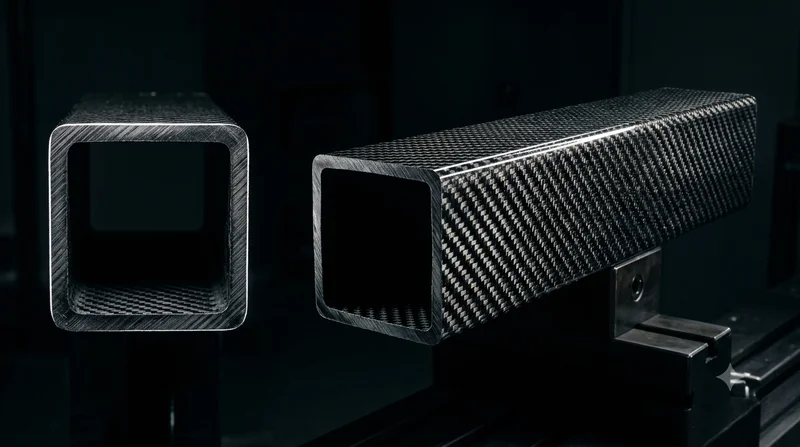
Square Carbon Fiber Tube — 3K Twill T700
Square cross-section carbon fiber tube manufactured with 3K twill weave for torsional strength. Preferred for structural frames, trusses, and support columns where rectangular geometry offers design flexibility.
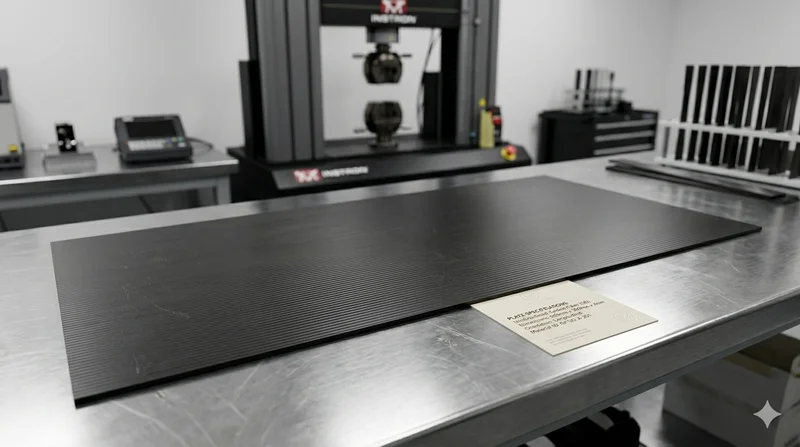
Carbon Fiber Plate — UD Unidirectional T700
Unidirectional carbon fiber plate with all fibers oriented in a single direction for maximum strength along the fiber axis. Essential for structural reinforcements, splints, and applications where load direction is predictable.