
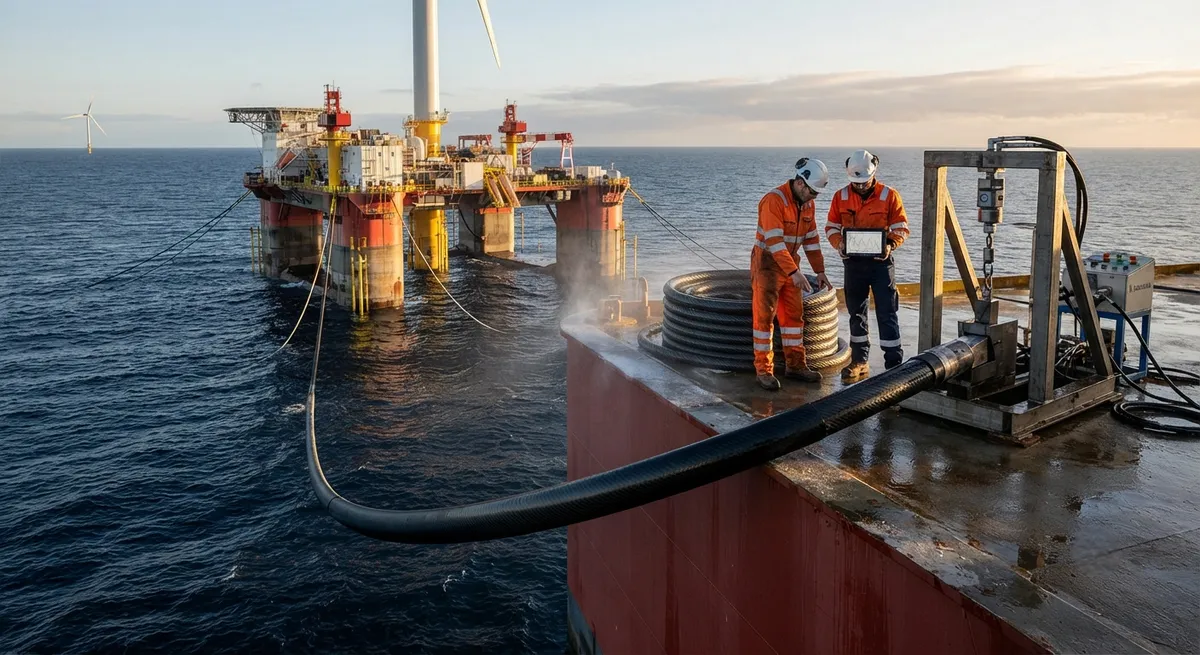
Floating offshore wind has moved out of the demonstration phase. Hywind Scotland and the WindFloat concept series proved that spar and semi-submersible platforms can carry turbines in 100-300 meters of water, where fixed-bottom foundations stop being economical. The platform only floats
Introduction
Floating offshore wind has moved out of the demonstration phase. Hywind Scotland and the WindFloat concept series proved that spar and semi-submersible platforms can carry turbines in 100-300 meters of water, where fixed-bottom foundations stop being economical. The platform only floats if the mooring system holds it in place, and that system is becoming the engineering bottleneck.
Steel chain has served mooring for decades, but at deep water sites it gets heavy. A 157 mm R4 stud link chain has a breaking strength of 21.7 MN, yet it weighs about 438 kg per meter in water. Suspended in a catenary at 200 meters depth, that chain drives enormous pretension, fatigue damage, and handling cost. Polyester rope solves the weight problem but brings its own limits: low axial stiffness, creep over decades of service, and scarce tension-tension fatigue data. Carbon fiber rope sits in a different class: density 1.80 g/cm³ against 7.85 for steel, far higher specific strength, no corrosion in seawater, high axial stiffness, and demonstrated tension-tension fatigue lives beyond 10 million cycles.
Why Floating Wind Needs a New Mooring Class
Fixed-bottom turbines are bolted to the seabed, so their loads stay simple. A floating platform is held by its mooring lines alone, and every wave, current, and wind gust passes through them. In shallow water a catenary of heavy chain provides restoring force through its own weight. In deep water that approach collapses. The chain needed to hold a 12-15 MW turbine at 250 meters depth weighs more than the platform can reasonably carry, and its fatigue life shrinks as the load range grows.
This is why synthetic ropes entered the picture. A taut-leg system, anchored with near-vertical synthetic lines, produces restoring force through axial stiffness instead of weight. The rope must hold high mean tension with a small load range, exactly the profile that stresses fatigue life. The choice of fiber decides whether a taut-leg design is feasible at all.
How the Three Systems Compare
Table 1 gathers representative values for a mooring line sized near a 20 MN breaking strength.
| Property | Steel chain (R4, 157 mm) | Polyester rope | Carbon fiber rope |
|---|---|---|---|
| Material density (g/cm³) | 7.85 | 1.38 | 1.80 |
| Weight in water (kg/m) | ≈ 438 | ≈ 8 | ≈ 25 |
| Axial stiffness (GN) | ≈ 15 | ≈ 10 | ≈ 45 |
| Tension-tension fatigue (cycles) | ≈ 1-5 × 10⁶ | creep-dominated | > 10⁷ |
| Corrosion in seawater | High, needs cathodic protection | None | None |
| Relative cost per meter | Baseline | Low-moderate | High |
| Installation handling | Heavy, large vessels required | Light, spoolable | Light, spoolable with care |
Carbon fiber rope combines the low weight of synthetics with stiffness that approaches chain. That combination is what taut-leg mooring needs: high mean load capacity without the mass penalty, and stiffness to keep the platform offset inside the turbine's operating envelope.
Fatigue Performance in Tension-Tension Loading
Mooring fatigue is not structural steel fatigue. The loading is tension-tension with R-ratios near 0.6-0.9 at low frequency, with the full wave spectrum superimposed. Steel chain fails this test in two ways: corrosion pitting accelerates crack initiation, and the working load range sits close to the fatigue endurance limit of the steel grade.
Polyester fails it quietly. The fiber creeps under sustained load, stiffness drops with time, and the rope slackens or needs re-tensioning. Creep data covering a 30-year design life is still scarce.
Carbon fiber shows the opposite behavior. The fiber is linear-elastic to failure with virtually no creep, and its tension-tension fatigue curve is flat. Test programs on carbon fiber rope and terminator assemblies show fatigue lives beyond 10⁷ cycles at load levels where steel chain and polyester are already degraded. The result is a mooring line that does not soften with age.
- Carbon fiber axial stiffness can exceed 40 GN in a mooring-size rope, against roughly 10 GN for polyester at the same breaking strength.
- Specific strength of roughly 2.4-3.5 GPa at a density of 1.80 g/cm³ gives a strength-to-weight ratio about 5-7 times that of R4 steel chain.
- A carbon fiber rope rated near 20 MN breaking strength weighs about 6% of the in-water mass of an equivalent steel chain, cutting top tension and winch loads.
Terminations and Bend-Over-Sheave Limits
A mooring rope is only as good as its end fitting. Carbon fiber is stiff and sensitive to stress concentrations, so termination design dominates the reliability discussion. Splice-based ends are difficult with high-modulus fiber, so the industry is converging on potting and wedge-socket terminations that spread the load over a long bonded length. Three rules shape the design:
- Spread the load over a long bonded length so no single fiber point carries peak stress.
- Size sheaves and fairleads for stricter D/d ratios than polyester allows.
- Keep the rope clear of reverse bending at the touch-down point during winching.
Bend-over-sheave (BOS) testing matters for deployment, since the rope is winched over fairleads during installation. DNV-ST-0119 and API RP 2SM set the framework: they require fatigue qualification testing, cyclic bending checks, and in-service inspection intervals that match the fiber's failure modes.
Cost, Protection, and the Road Ahead
Floating wind projects now under development, from Hywind to the WindFloat series, mostly rely on steel chain and polyester hybrids. Carbon fiber mooring is still in the R&D-to-pilot stage, driven by offshore engineering firms and fiber suppliers that see the weight and fatigue advantage at scale.
The obstacles are real. Cost per meter remains several times that of polyester. The fiber needs UV shielding in the jacket and abrasion protection at the touch-down zone. A single field failure in a terminator could set the technology back years, so qualification programs are necessarily slow. None of these are fundamental physics problems. They are engineering and manufacturing problems, and they are being worked on.
Frequently Asked Questions
Q: How long can carbon fiber mooring lines last in seawater?
A: Carbon fiber itself is inert to seawater corrosion. Its polymer matrix must be selected for moisture and hydrolysis resistance, and the jacket protects against UV and abrasion. Design lives of 25-30 years are realistic for the fiber, provided terminations are inspected per the design standard.
Q: Is carbon fiber mooring stronger than steel chain?
A: At the same diameter, yes, and far lighter. A carbon fiber rope can deliver 20 MN of breaking strength at roughly 6% of the in-water weight of an R4 steel chain of equivalent capacity, which is why it suits taut-leg mooring at 100-300 meters of depth.
Q: What standards apply to carbon fiber mooring lines?
A: DNV-ST-0119 for floating wind structures and API RP 2SM for synthetic mooring ropes are the relevant frameworks. They require tension-tension fatigue qualification, cyclic bend-over-sheave tests, and terminator validation before a rope enters service.
Conclusion
Floating offshore wind at 100-300 meters of depth needs mooring lines that are light, stiff, and corrosion-proof. Steel chain brings weight and corrosion, polyester brings creep and softness, and carbon fiber brings high specific strength, high axial stiffness, and fatigue lives beyond 10 million cycles. The remaining work sits in terminations, protection, and cost reduction, but the material case is clear. Explore our carbon fiber materials to see how the fiber itself is made, and contact our engineering team to discuss rope construction, test programs, and qualification for your mooring project.
Related Articles
- Carbon Fiber Mooring for Floating Offshore Wind: Fatigue and Corrosion in Deep Water
- Carbon Fiber Bicycle Frame Optimization: Layup Design and Manufacturing for Competitive Racing
- Carbon Fiber CFRP Retrofit for Infrastructure: Bridge and Building Seismic Strengthening
- Carbon Fiber Medical Imaging Equipment: Lightweight Gantry and Couch Structures for MRI/CT
- Carbon Fiber EV Battery Enclosures: Crash Safety and Electromagnetic Shielding Design
- Carbon Fiber Structures for Low-Altitude Economy: UAV Airframes and eVTOL Components
Interested in Our Products?
Contact our team for competitive pricing and technical specifications.
Get a QuoteRelated Products
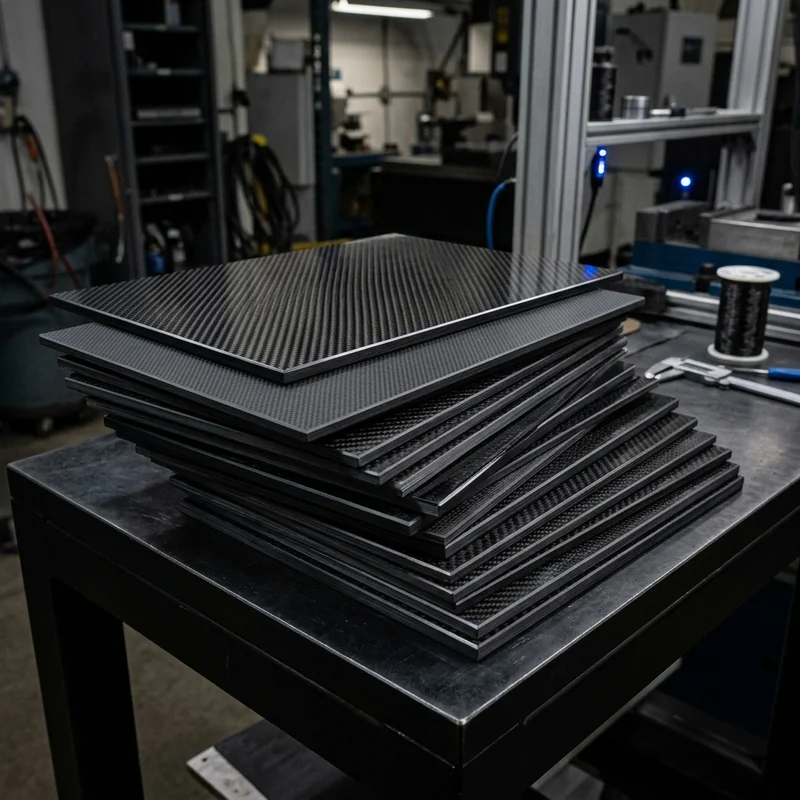
Carbon fiber standard plate-3k stripe
Lightweight, ultra-rigid standard sheets for drone fuselages, robot housings, facades and structural applications.

Carbon Fiber Plate — 3K Twill T700 3.0mm
Medium-thickness 3.0mm carbon fiber plate offering significantly higher load capacity while maintaining attractive 3K twill finish. Suitable for structural brackets, reinforcement plates, and load-bearing panels.

Carbon Fiber Plate — 3K Twill T700 1.5mm
Thin 1.5mm carbon fiber plate with 3K twill weave surface. Lightweight and stiff, commonly used for covers, panels, drone bodies, and applications requiring a premium aesthetic appearance.

Square Carbon Fiber Tube — 3K Twill T700
Square cross-section carbon fiber tube manufactured with 3K twill weave for torsional strength. Preferred for structural frames, trusses, and support columns where rectangular geometry offers design flexibility.
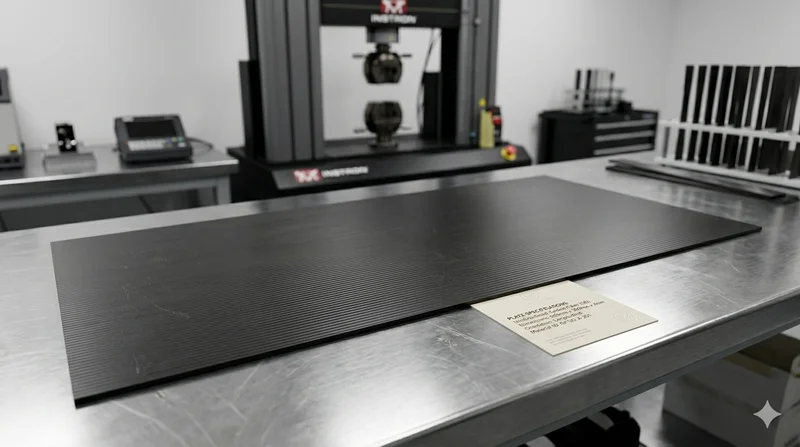
Carbon Fiber Plate — UD Unidirectional T700
Unidirectional carbon fiber plate with all fibers oriented in a single direction for maximum strength along the fiber axis. Essential for structural reinforcements, splints, and applications where load direction is predictable.