
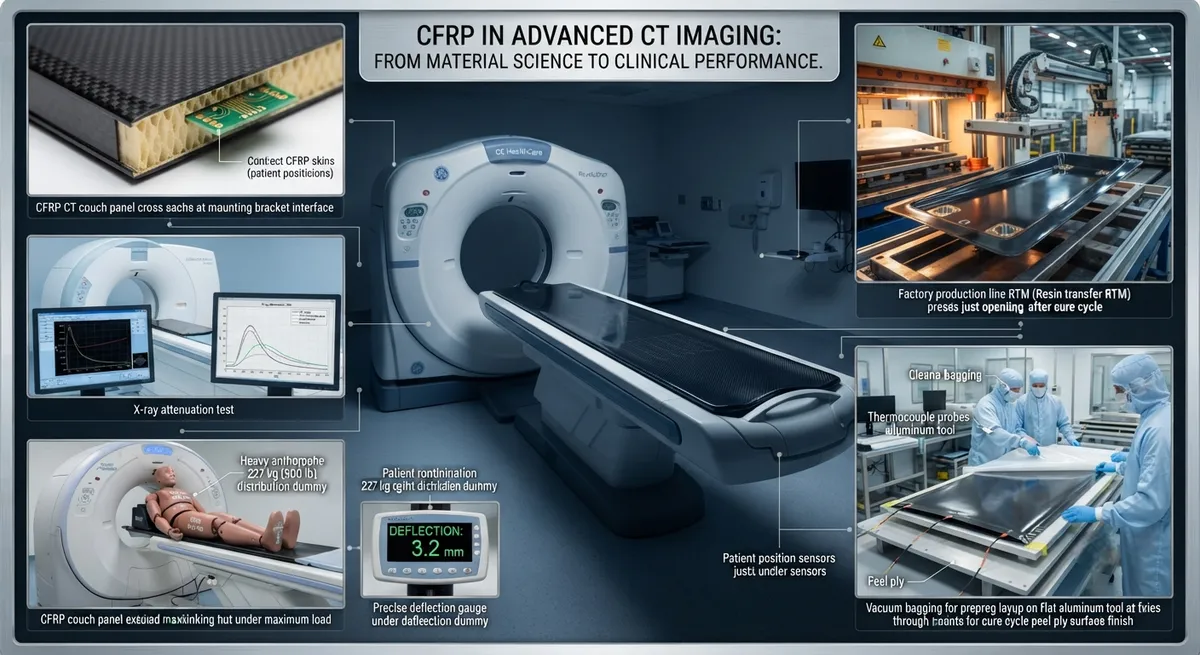
Technical analysis of carbon fiber composite CT scanner couch panels — radiolucency requirements, mechanical design, regulatory compliance, and manufacturing processes for medical imaging patient support systems.
Computed tomography (CT) scanner couch panels occupy a uniquely demanding position in medical device engineering. They must be transparent to X-ray radiation (radiolucent) to avoid image artifacts, yet strong and stiff enough to support patients weighing up to 227 kg (500 lbs) without measurable deflection. They must resist repeated disinfection with aggressive chemicals, maintain dimensional stability over 10+ years of clinical use, and keep weight low enough for motorized positioning systems. Carbon fiber reinforced polymer (CFRP) composites have become the near-universal material of choice for CT couch panels since their introduction in the early 2000s.
- Radiolucency: CFRP panels achieve −950 to −990 HU attenuation at 120 kVp, eliminating beam-hardening artifacts common with polycarbonate or aluminum patient supports.
- Structural stiffness: Flexural deflection under 227 kg (500 lb) patient load is 2.5–4.0 mm for a 3.5 mm thick CFRP panel, well under the IEC 60601-2-44 limit of 10 mm.
- Chemical resistance: CFRP withstands over 10,000 disinfection cycles with hospital-grade quaternary ammonium and hydrogen peroxide cleaners without surface degradation.
- Thermal stability: Near-zero coefficient of thermal expansion (−0.5 to 1.0 ppm/°C) ensures patient registration accuracy across operating temperature ranges.
Radiolucency Requirements
Radiolucency in CT imaging is quantified by the X-ray attenuation coefficient — measured in Hounsfield Units (HU). The ideal couch panel material should have an attenuation profile as close to air (HU = −1,000) as possible. CFRP achieves this through a combination of low atomic number constituents (carbon, Z=6; epoxy hydrogen/carbon/oxygen) and thin cross-sections (typically 2.5–5.0 mm). A standard CFRP CT couch panel produces an attenuation of −950 to −990 HU at 120 kVp, compared to −500 to −700 HU for a polycarbonate panel of equivalent thickness, and +200 to +600 HU for aluminum. This near-negligible attenuation means that CFRP couch panels eliminate beam-hardening artifacts, ring artifacts, and scatter noise that would compromise diagnostic image quality — particularly critical in cardiac CT, perfusion studies, and low-dose screening protocols.
Mechanical Performance and Structural Design
| Property | CFRP Couch Panel | Polycarbonate Panel | Aluminum Panel | Requirement (IEC 60601-2-44) |
|---|---|---|---|---|
| Tensile modulus (GPa) | 70–120 | 2.3 | 69 | — |
| Flexural deflection at 227 kg | 2.5–4.0 mm | 15–22 mm | 3.5–5.5 mm | <10 mm |
| CT attenuation at 120 kVp (HU) | −950 to −990 | −500 to −700 | +200 to +600 | As close to −1000 as possible |
| Areal density (kg/m²) | 4.5–7.0 | 8.5–12.0 | 10.5–14.0 | — |
| Thermal expansion (ppm/°C) | −0.5 to 1.0 | 65–70 | 23 | Minimal for registration accuracy |
| Chemical resistance (disinfectants) | Excellent | Good (may craze) | Excellent | Must withstand 10,000+ disinfection cycles |
Manufacturing and Regulatory Considerations
CT couch panels are typically manufactured using prepreg hand layup with vacuum bagging or autoclave cure, or high-pressure resin transfer molding (HP-RTM) for volume production. Common fiber architectures include unidirectional (0°/90°) cross-ply laminates for bending stiffness, ±45° layers for torsional rigidity, and thin woven fabric surface plies for impact resistance and cosmesis. The resin system must meet ISO 10993 biocompatibility testing for patient contact (cytotoxicity, sensitization, irritation). Panels must pass IEC 60601-2-44 structural integrity testing at 1.5× the rated patient weight without permanent deformation — typically 340 kg for a 227 kg rated panel. UL 60601-1 flammability classification (V-0 or HB) is typically achieved through brominated or phosphorus-based flame retardant additives in the epoxy formulation.
Market Leaders and Supply Chain
The global market for CT couch composite panels is estimated at approximately $185 million in 2026, growing at 6.2% CAGR. Key OEM customers include GE HealthCare (Revolution CT, 40% market share in CFRP couch procurement), Siemens Healthineers (SOMATOM series, 30%), Canon Medical (Aquilion series, 18%), and United Imaging (uCT series, 12%). Primary CFRP panel suppliers include Gurit (medical division, operating from Switzerland), Mitsubishi Chemical Advanced Materials (MCCFRP sheet products), Röchling (high-performance thermoplastics division), and several specialized Chinese manufacturers serving the domestic OEM market. Panel pricing ranges from $1,200 to $4,800 per unit depending on size, complexity, and regulatory documentation requirements.
Frequently Asked Questions
Can carbon fiber couch panels be repaired if damaged?
Minor surface damage — scratches, chips, or small impact marks — can typically be cosmetically repaired using epoxy filler and sanding. Structural damage such as delamination, cracks through the panel, or edge splitting generally requires full panel replacement. Most OEMs do not certify field repairs of CT couch panels due to the difficulty of verifying restored mechanical strength and radiolucency uniformity. Replacement panels are shipped as assembled units with integrated mounting brackets, typically with 48-hour emergency delivery available from major OEM parts depots.
How does carbon fiber thickness affect CT image quality?
Panel thickness is a direct trade-off between mechanical stiffness and radiolucency. A 3.0 mm CFRP panel provides adequate stiffness for 160 kg patient capacity with −980 HU attenuation at 120 kVp. Increasing to 5.0 mm raises stiffness by 2.8× (cube of thickness ratio) but degrades attenuation to −950 HU. For high-end CT systems performing cardiac or perfusion imaging, manufacturers use 2.5–3.5 mm panels and compensate stiffness with carbon fiber sandwich core structures (Nomex or PMI foam) that maintain radiolucency. For bariatric CT systems (≥250 kg capacity), 5.0–6.0 mm solid laminate panels are used, with software-based beam-hardening correction algorithms to compensate for the increased attenuation.
What is the service life of a carbon fiber CT couch panel?
The designed service life of a CFRP CT couch panel is typically 10–12 years or 100,000 patient positioning cycles, whichever comes first. Real-world data from GE HealthCare's Revolution fleet shows a mean time between replacement (MTBR) of approximately 8.3 years, with the primary failure modes being surface coating degradation from chemical disinfectants (45% of replacements), structural fatigue cracks at mounting bolt interfaces (30%), and delamination near the headrest pivot joint (15%). Premature failure can be accelerated by repeated loading beyond the rated patient weight, exposure to non-approved cleaning chemicals (especially bleach-based solutions), and impact damage from dropped instruments or patient falls during transfer.
Part of topic
Related Articles
- Carbon Fiber Mooring for Floating Offshore Wind: Fatigue and Corrosion in Deep Water
- Carbon Fiber Bicycle Frame Optimization: Layup Design and Manufacturing for Competitive Racing
- Carbon Fiber CFRP Retrofit for Infrastructure: Bridge and Building Seismic Strengthening
- Carbon Fiber Medical Imaging Equipment: Lightweight Gantry and Couch Structures for MRI/CT
- Carbon Fiber EV Battery Enclosures: Crash Safety and Electromagnetic Shielding Design
- Carbon Fiber Structures for Low-Altitude Economy: UAV Airframes and eVTOL Components
Interested in Our Products?
Contact our team for competitive pricing and technical specifications.
Get a QuoteRelated Products
Carbon fiber standard plate-3k stripe
Lightweight, ultra-rigid standard sheets for drone fuselages, robot housings, facades and structural applications.

Carbon Fiber Plate — 3K Twill T700 3.0mm
Medium-thickness 3.0mm carbon fiber plate offering significantly higher load capacity while maintaining attractive 3K twill finish. Suitable for structural brackets, reinforcement plates, and load-bearing panels.

Carbon Fiber Plate — 3K Twill T700 1.5mm
Thin 1.5mm carbon fiber plate with 3K twill weave surface. Lightweight and stiff, commonly used for covers, panels, drone bodies, and applications requiring a premium aesthetic appearance.

Square Carbon Fiber Tube — 3K Twill T700
Square cross-section carbon fiber tube manufactured with 3K twill weave for torsional strength. Preferred for structural frames, trusses, and support columns where rectangular geometry offers design flexibility.
Carbon Fiber Plate — UD Unidirectional T700
Unidirectional carbon fiber plate with all fibers oriented in a single direction for maximum strength along the fiber axis. Essential for structural reinforcements, splints, and applications where load direction is predictable.