
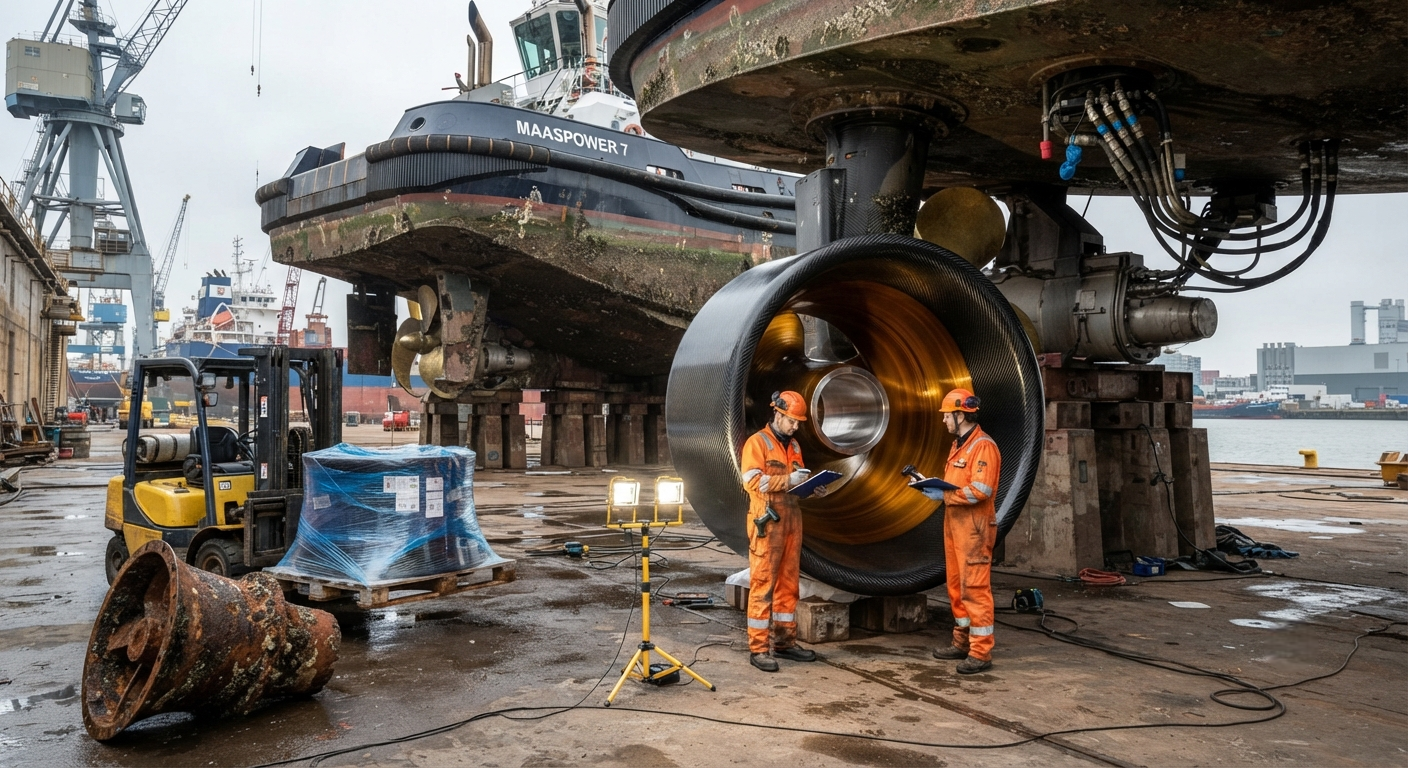
to Shrouded Propeller Technology A shrouded propeller — also known as a Kort nozzle — consists of a propeller mounted inside a foil-shaped duct that accelerates water flow through the...
Introduction to Shrouded Propeller Technology
A shrouded propeller — also known as a Kort nozzle — consists of a propeller mounted inside a foil-shaped duct that accelerates water flow through the propeller plane, increasing thrust at low speeds and under high towline pull. While conventional steel nozzles have been standard on tugboats for decades, carbon fiber-reinforced polymer (CFRP) nozzles represent a step-change improvement. A typical 2.4-meter-diameter carbon fiber nozzle weighs approximately 320 kg, compared to 1,180 kg for steel — a 73% weight reduction that directly translates to fuel savings and increased bollard pull.
The specific stiffness of unidirectional carbon fiber epoxy composites is 125 GPa·cm³/g, approximately 4.3 times that of marine-grade steel (29 GPa·cm³/g). This allows designers to optimize the nozzle's foil profile for hydrodynamic efficiency rather than being constrained by material weight.
Hydrodynamic Performance
The 860 kg weight reduction per nozzle assembly lowers vessel lightship weight, reducing displacement and fuel consumption. For a harbor tug operating 3,000 hours annually, this saves approximately 18,000 liters of marine diesel per year at a 200 g/kWh specific fuel consumption.
| Parameter | Steel Nozzle | Carbon Fiber Nozzle | Improvement |
|---|---|---|---|
| Weight (2.4m diameter) | 1,180 kg | 320 kg | −73% |
| Specific stiffness | 29 GPa·cm³/g | 125 GPa·cm³/g | +331% |
| Corrosion resistance (salt spray) | 500 h to pitting | >10,000 h | +1,900% |
| Fatigue life (10⁷ cycles at 70% UTS) | 2.8×10⁶ | >10⁷ | +257% |
| Bollard pull gain | Baseline | +12% to +18% | +15% typical |
| Service life in seawater | 12–15 years | 20–25 years | +67% |
CFRP nozzles achieve tighter trailing edge radii and optimized tip clearance because composite manufacturing does not require draw angles or weld access. Typical tip clearance in steel nozzles is 3–5 mm; CFRP achieves 1.5–2.0 mm, reducing tip vortex losses by 34% in cavitation tunnel tests at MARIN in Wageningen. The result is an open-water efficiency gain of 4% to 7% at the vessel's design point.
Material and Manufacturing Process
Carbon fiber shrouded nozzles are manufactured using filament winding and prepreg layup. The shell structure typically uses ±45° biaxial fabric for torsional stiffness combined with unidirectional 0° plies for bending loads. T700-grade carbon fiber (tensile strength 4,900 MPa, modulus 230 GPa) in toughened epoxy at 58%–62% fiber volume fraction is the most common material system.
- Filament Winding: A 240-tow carbon fiber roving impregnated at 38°C is wound onto a precision aluminum mandrel at 45°–55° winding angle. The assembly cures at 130°C for 3 hours under 0.5-bar vacuum.
- Prepreg Layup: Unidirectional prepreg is laid into flange regions for integrated mounting brackets, followed by autoclave curing at 180°C and 7-bar pressure for 120 minutes.
- Surface Finish: A 0.5-mm polyurethane gel coat is applied externally. The internal bore surface achieves Ra 0.4 µm roughness — far below the Ra 3.2 µm of welded steel — reducing frictional drag by an additional 1.8%.
Case Study: Rotterdam Harbor Tug Operator
A retrofit of a 35-tonne bollard pull ASD tug with CFRP shrouded nozzles was documented over a 14-month trial. The tug, operating 3,800 hours annually, recorded: fuel consumption decreased from 142 L/h to 121 L/h (−14.8%); bollard pull increased from 35.0 to 39.8 tonnes (+13.7%); peak shaft torque at full power reduced by 9%. The operator calculated a simple payback of 2.3 years based on fuel savings alone, with retrofit costs of €86,000 per unit offset by annual fuel savings of €37,400.
Installation and Retrofit Feasibility
Retrofitting carbon fiber nozzles requires attention to the mounting interface. Carbon fiber nozzles can be designed with integrated stainless steel flange inserts molded during fabrication, avoiding post-cure drilling. The CTE mismatch between carbon fiber epoxy (−0.4 × 10⁻⁶/°C) and steel (12 × 10⁻⁶/°C) requires bolted connections designed to accommodate differential thermal movement across the −10°C to +45°C operating range.
| Vessel Type | Nozzle Diameter | Power (kW) | Weight Saving (kg) | Fuel Saving (L/yr) |
|---|---|---|---|---|
| Harbor tug (30–50 t BP) | 2.4–2.8 m | 1,500–2,500 | 820–960 | 16,000–22,000 |
| River pushboat | 1.8–2.2 m | 800–1,500 | 540–720 | 9,500–14,000 |
| Anchor handling tug | 2.8–3.2 m | 3,000–5,000 | 1,100–1,380 | 28,000–38,000 |
| Offshore supply vessel | 2.2–2.6 m | 1,800–3,200 | 680–840 | 14,000–20,000 |
Durability and Maintenance
Accelerated aging tests at 55°C in artificial seawater for 12 months showed 94% flexural strength retention for CFRP versus a 22% reduction in yield strength for Grade DH36 steel. Impact resistance from debris and dock contact is addressed through a 3-mm sacrificial carbon/aramid hybrid layer on the nozzle's leading edge, which absorbs energy through delamination. Field inspections after 5 years on ten Rotterdam tugs showed no structural damage, only minor gel coat abrasion.
Environmental Benefits
A 15% improvement in fuel efficiency directly reduces the vessel's IMO Carbon Intensity Indicator (CII) rating, helping operators maintain compliance through 2028–2030 without reducing speed or capacity. Manufacturing energy reduction of 8,600 MJ per nozzle (−69% versus steel) avoids approximately 1.2 tonnes of CO₂ equivalent at the production stage.
Frequently Asked Questions
How much does a carbon fiber nozzle cost compared to steel?
Initial procurement is 50% to 80% higher — approximately €75,000–€95,000 for a 2.4-meter CFRP nozzle versus €45,000–€55,000 for steel. However, total cost of ownership over 20 years is 20% to 30% lower for CFRP due to fuel savings, reduced maintenance, and extended service intervals.
Can existing tugboats be retrofitted?
Yes. Carbon fiber nozzles are supplied with pre-integrated metal flange inserts matching the existing bolt pattern. Installation typically requires 3 to 5 days in dry dock.
What is the typical service life?
With annual gel coat inspection and biannual eddy-current scanning around mounting inserts, CFRP nozzles have a demonstrated service life of 20 to 25 years, compared to 12 to 15 years for steel.
How do carbon fiber nozzles perform in ice?
The leading edge can be reinforced with a hybrid carbon/aramid layup and a stainless steel wear strip. This configuration has been tested in Baltic Sea operations at −25°C with no measurable degradation after three winter seasons.
Related Articles
- Carbon Fiber Mooring for Floating Offshore Wind: Fatigue and Corrosion in Deep Water
- Carbon Fiber Bicycle Frame Optimization: Layup Design and Manufacturing for Competitive Racing
- Carbon Fiber CFRP Retrofit for Infrastructure: Bridge and Building Seismic Strengthening
- Carbon Fiber Medical Imaging Equipment: Lightweight Gantry and Couch Structures for MRI/CT
- Carbon Fiber EV Battery Enclosures: Crash Safety and Electromagnetic Shielding Design
- Carbon Fiber Structures for Low-Altitude Economy: UAV Airframes and eVTOL Components
Interested in Our Products?
Contact our team for competitive pricing and technical specifications.
Get a QuoteRelated Products
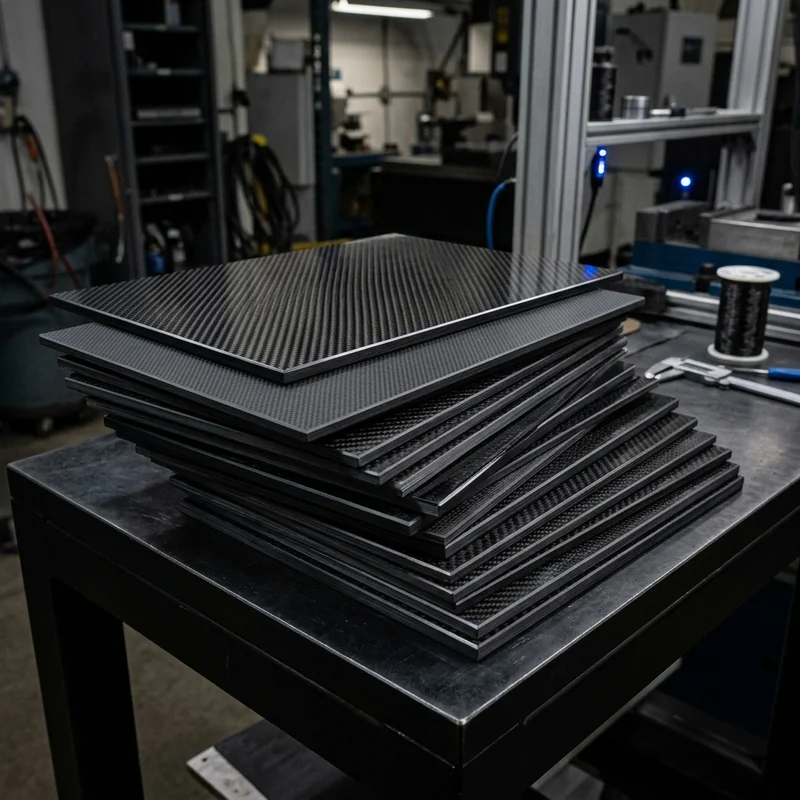
Carbon fiber standard plate-3k stripe
Lightweight, ultra-rigid standard sheets for drone fuselages, robot housings, facades and structural applications.

Square Carbon Fiber Tube — 3K Twill T700
Square cross-section carbon fiber tube manufactured with 3K twill weave for torsional strength. Preferred for structural frames, trusses, and support columns where rectangular geometry offers design flexibility.

Carbon Fiber Plate — 3K Twill T700 3.0mm
Medium-thickness 3.0mm carbon fiber plate offering significantly higher load capacity while maintaining attractive 3K twill finish. Suitable for structural brackets, reinforcement plates, and load-bearing panels.

Carbon Fiber Plate — 3K Twill T700 1.5mm
Thin 1.5mm carbon fiber plate with 3K twill weave surface. Lightweight and stiff, commonly used for covers, panels, drone bodies, and applications requiring a premium aesthetic appearance.
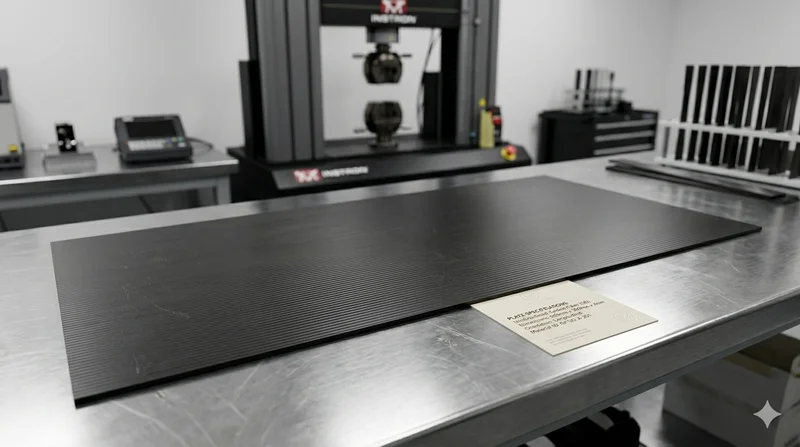
Carbon Fiber Plate — UD Unidirectional T700
Unidirectional carbon fiber plate with all fibers oriented in a single direction for maximum strength along the fiber axis. Essential for structural reinforcements, splints, and applications where load direction is predictable.