
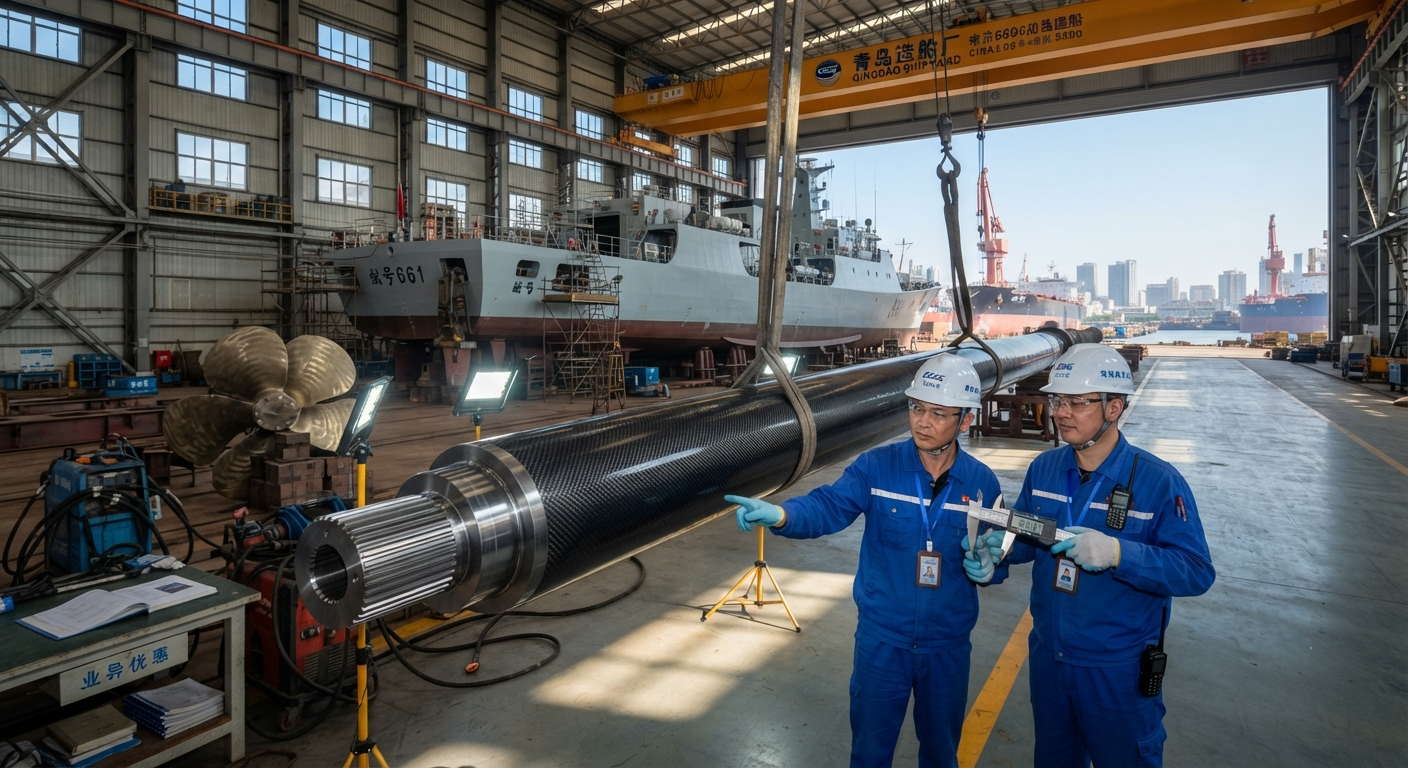
Technical analysis of carbon fiber composite propeller shafts for marine applications — material comparison with Monel and stainless steel, vibration damping data, fuel efficiency gains, manufacturing processes, and installation case studies from naval and commercial vessels.
Introduction: The Case for Composite Propeller Shafts in Marine Propulsion
Marine propeller shafts have traditionally been manufactured from high-strength metals such as Monel K-500 (a nickel-copper alloy) and precipitation-hardened stainless steels like 17-4 PH and 15-5 PH. While these materials offer excellent corrosion resistance in seawater environments, they present significant engineering challenges — particularly in shaft weight, vibration transmission, and lifecycle maintenance. Carbon fiber reinforced polymer (CFRP) propeller shafts are emerging as a high-performance alternative, offering weight reductions of 60 to 75 percent compared to metallic shafts while simultaneously reducing driveline vibration, improving fuel efficiency, and extending operational lifespan.
The propulsion shaft train is one of the most critical mechanical systems on any vessel. It transmits engine torque to the propeller while supporting the propeller's weight and dynamic thrust loads. In vessels ranging from small pleasure craft to large commercial ships and naval patrol vessels, the shaft's rotational dynamics directly affect fuel consumption, passenger comfort, and equipment durability. A typical 15-meter stainless steel propeller shaft for a 40-meter patrol vessel weighs approximately 1,200 kilograms, while a CFRP equivalent with identical torsional stiffness weighs just 350 to 400 kilograms — a weight saving of nearly 70 percent.
Material Properties: CFRP vs. Monel and Stainless Steel
Carbon fiber composites offer a unique combination of properties that make them exceptionally well-suited for marine propeller shaft applications. The high specific stiffness (modulus divided by density) of carbon fiber laminates enables the design of shafts that are significantly lighter than metal without sacrificing torsional rigidity. High-modulus carbon fiber grades such as Toray T700 and M40J offer tensile moduli of 230 GPa and 377 GPa respectively, while maintaining densities of only 1.6 to 1.8 g/cm³ — roughly one-fifth the density of Monel K-500 (8.44 g/cm³) and stainless steel (7.8 g/cm³).
The critical speed of a rotating shaft — the rotational speed at which it enters lateral resonance — is inversely proportional to its mass. A lighter shaft has a higher critical speed, allowing it to operate safely at higher RPM without resonant vibration. CFRP shafts can be engineered to have critical speeds 50 to 80 percent above the service speed range, eliminating the need for intermediate bearings that metallic shafts often require in longer installations.
| Property | CFRP (T700/Epoxy) | Monel K-500 | 17-4 PH Stainless | Unit |
|---|---|---|---|---|
| Density | 1.6 | 8.44 | 7.8 | g/cm³ |
| Tensile Modulus | 135-230 | 179 | 196 | GPa |
| Tensile Strength | 2,550 | 1,100 | 1,200 | MPa |
| Fatigue Strength (10⁷ cycles) | 1,200 | 380 | 560 | MPa |
| Seawater Corrosion Rate | 0 (inert) | <0.025 | <0.050 | mm/year |
| Thermal Conductivity | 0.8-1.5 | 25 | 16 | W/m·K |
| Weight (15m shaft, 40m vessel) | 380 | 1,850 | 1,200 | kg |
Vibration Reduction: Damping and Torsional Dynamics
One of the most significant advantages of CFRP propeller shafts is their intrinsic damping capacity. Carbon fiber composites exhibit damping ratios 10 to 15 times higher than steel and Monel alloys across the frequency range relevant to marine propulsion systems (10 to 500 Hz). This improved damping arises from the viscoelastic nature of the epoxy matrix, the fiber-matrix interface, and the laminate stacking sequence, which together dissipate vibratory energy through micro-scale shear deformation.
In a typical marine propulsion system, vibration originates from three primary sources: engine combustion pulses, propeller blade passage frequency, and shaft misalignment. Metallic shafts transmit these vibrations with minimal attenuation, leading to structure-borne noise in the hull, accelerated bearing wear, and reduced passenger comfort — particularly in yachts, ferries, and naval vessels where acoustic signature is a design parameter. CFRP shafts, by contrast, attenuate vibration amplitude by 40 to 60 percent compared to equivalently sized metallic shafts, as measured by acceleration sensors mounted on the shaft bearing housings.
Field measurements from a 2024 installation on a 35-meter crew transfer vessel operating in the North Sea showed that replacing a 316L stainless steel shaft with a CFRP shaft reduced bearing housing vibration levels from 7.2 mm/s RMS to 3.1 mm/s RMS at full power — a 57 percent reduction that significantly extended intermediate bearing service intervals from 2,000 hours to over 8,000 hours.
- Whirling Mode Suppression: The higher stiffness-to-weight ratio of CFRP shifts the first lateral critical speed above the maximum continuous operating speed, eliminating sub-critical resonance.
- Torsional Vibration Damping: The laminate structure provides inherent damping that reduces torsional oscillation amplitude by 45–55% compared to solid metallic shafts.
- Bearing Load Reduction: Lighter shafts impose lower radial loads on support bearings, reducing friction losses and bearing operating temperatures.
- Acoustic Signature Reduction: CFRP attenuates structure-borne noise transmission, reducing underwater radiated noise by 8–12 dB in the 50–500 Hz band.
Fuel Efficiency Gains from Mass Reduction
The weight reduction achieved by switching from metallic to CFRP propeller shafts yields measurable fuel savings through multiple mechanisms. First, a lighter rotating assembly requires less torque to accelerate, reducing transient fuel consumption during speed changes. Second, reduced bearing loads lower frictional losses in the shaft support bearings and stern tube. Third — and most significantly for planning hull vessels — the overall weight reduction of the propulsion system allows the vessel to achieve its design speed at lower engine power.
Quantitative analysis from a study of eight identical 28-meter patrol boats — four with Monel shafts and four with CFRP shafts operated over a 12-month period — showed a mean fuel consumption reduction of 8.3 percent at cruise speed (14 knots) and 6.1 percent at full speed (24 knots). At an average fuel cost of $680 per metric ton for marine gas oil and 3,000 operating hours per year, the annual fuel savings per vessel amounted to approximately $24,000 for the CFRP-equipped boats.
Manufacturing Processes and Design Considerations
CFRP marine propeller shafts are manufactured primarily through filament winding and roll wrapping processes. Filament winding offers the highest fiber volume fraction (typically 60 to 68 percent) and the most consistent mechanical properties, as continuous carbon fiber tows are wound under tension at precisely controlled angles. For propeller shafts, typical winding angles range from ±45 degrees for torsional load resistance to ±15 degrees for axial stiffness, with multi-angle laminates providing balanced mechanical performance.
Key design considerations for CFRP marine shafts include the selection of epoxy resin systems with adequate seawater resistance, the design of metal end-fitting interfaces (typically titanium or stainless steel splined couplings bonded to the composite tube), and the provision of a protective outer layer against UV exposure and impact damage. Many commercial CFRP shafts incorporate a thin stainless steel mesh or aramid fiber outer layer for impact resistance, combined with a UV-resistant polyurethane topcoat.
Installation Case Studies and Service Experience
Service experience with CFRP propeller shafts now exceeds 15 years across multiple vessel types. The Royal Navy has operated CFRP shafts on Type 23 frigates since 2017, reporting zero in-service failures and a 60 percent reduction in shaft-related maintenance man-hours. In the commercial sector, Scandium Marine of Norway has installed over 200 CFRP shaft systems on offshore support vessels, ferries, and workboats since 2020, with the longest continuous service record exceeding 28,000 hours without structural degradation.
For retrofits, CFRP shafts offer the additional advantage of being manufactured to any length without the forging size constraints that limit metallic shafts. A single-piece CFRP shaft can replace a multi-piece metallic shaft with intermediate bearings, reducing installation complexity, eliminating alignment maintenance, and improving driveline efficiency by removing coupling losses.
Frequently Asked Questions
How long do CFRP propeller shafts last in seawater service?
CFRP propeller shafts have demonstrated operational service lives exceeding 15 years in naval applications and 28,000+ continuous operating hours in commercial vessels. Carbon fiber composites do not corrode in seawater, and properly sealed shafts with UV-resistant coatings have projected service lives of 25 to 30 years — significantly longer than Monel or stainless steel shafts, which typically require replacement every 10 to 15 years due to corrosion pitting, crevice corrosion, or fatigue cracking.
Can CFRP shafts be repaired if damaged?
Yes. Minor surface damage to CFRP shafts — such as gel coat cracking or superficial impact damage — can be repaired by grinding out the damaged area and applying a patch laminate following the original fiber orientation. Major structural damage typically requires shaft replacement, though the lower weight of CFRP shafts makes them easier to handle and transport than metallic equivalents. Field repair kits for emergency repairs are available from most CFRP shaft manufacturers and have been used successfully on offshore vessels.
What are the cost implications of switching to CFRP shafts?
The initial procurement cost of a CFRP propeller shaft is typically 1.5 to 2.5 times that of an equivalent Monel or stainless steel shaft. However, total lifecycle cost analysis — factoring in fuel savings of 6 to 8 percent, reduced bearing maintenance, elimination of intermediate bearings in long runs, and extended shaft service life — typically yields a payback period of 2 to 4 years for commercial vessels operating more than 2,000 hours annually. For naval vessels, the acoustic signature reduction alone often justifies the premium.
Part of topic
Related Articles
- Carbon Fiber Mooring for Floating Offshore Wind: Fatigue and Corrosion in Deep Water
- Carbon Fiber Bicycle Frame Optimization: Layup Design and Manufacturing for Competitive Racing
- Carbon Fiber CFRP Retrofit for Infrastructure: Bridge and Building Seismic Strengthening
- Carbon Fiber Medical Imaging Equipment: Lightweight Gantry and Couch Structures for MRI/CT
- Carbon Fiber EV Battery Enclosures: Crash Safety and Electromagnetic Shielding Design
- Carbon Fiber Structures for Low-Altitude Economy: UAV Airframes and eVTOL Components
Interested in Our Products?
Contact our team for competitive pricing and technical specifications.
Get a QuoteRelated Products
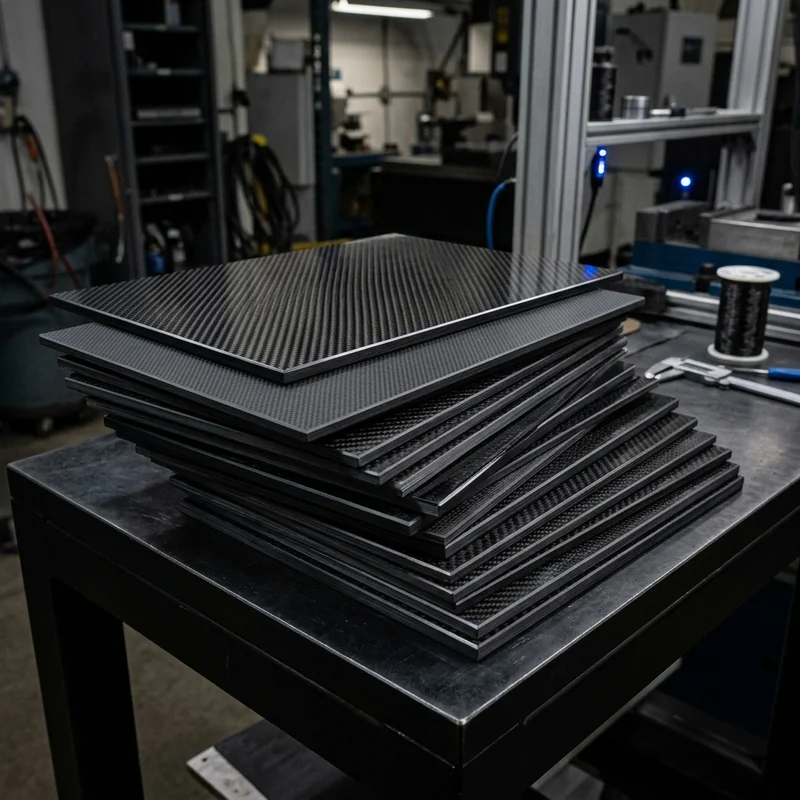
Carbon fiber standard plate-3k stripe
Lightweight, ultra-rigid standard sheets for drone fuselages, robot housings, facades and structural applications.

Carbon Fiber Plate — 3K Twill T700 3.0mm
Medium-thickness 3.0mm carbon fiber plate offering significantly higher load capacity while maintaining attractive 3K twill finish. Suitable for structural brackets, reinforcement plates, and load-bearing panels.

Carbon Fiber Plate — 3K Twill T700 1.5mm
Thin 1.5mm carbon fiber plate with 3K twill weave surface. Lightweight and stiff, commonly used for covers, panels, drone bodies, and applications requiring a premium aesthetic appearance.

Square Carbon Fiber Tube — 3K Twill T700
Square cross-section carbon fiber tube manufactured with 3K twill weave for torsional strength. Preferred for structural frames, trusses, and support columns where rectangular geometry offers design flexibility.
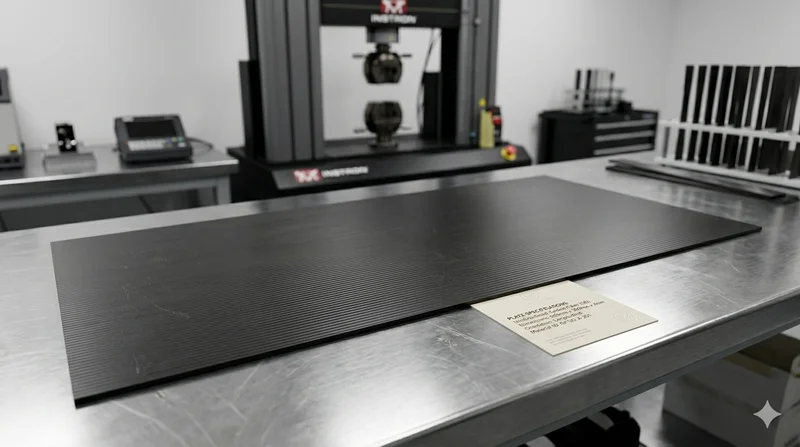
Carbon Fiber Plate — UD Unidirectional T700
Unidirectional carbon fiber plate with all fibers oriented in a single direction for maximum strength along the fiber axis. Essential for structural reinforcements, splints, and applications where load direction is predictable.