
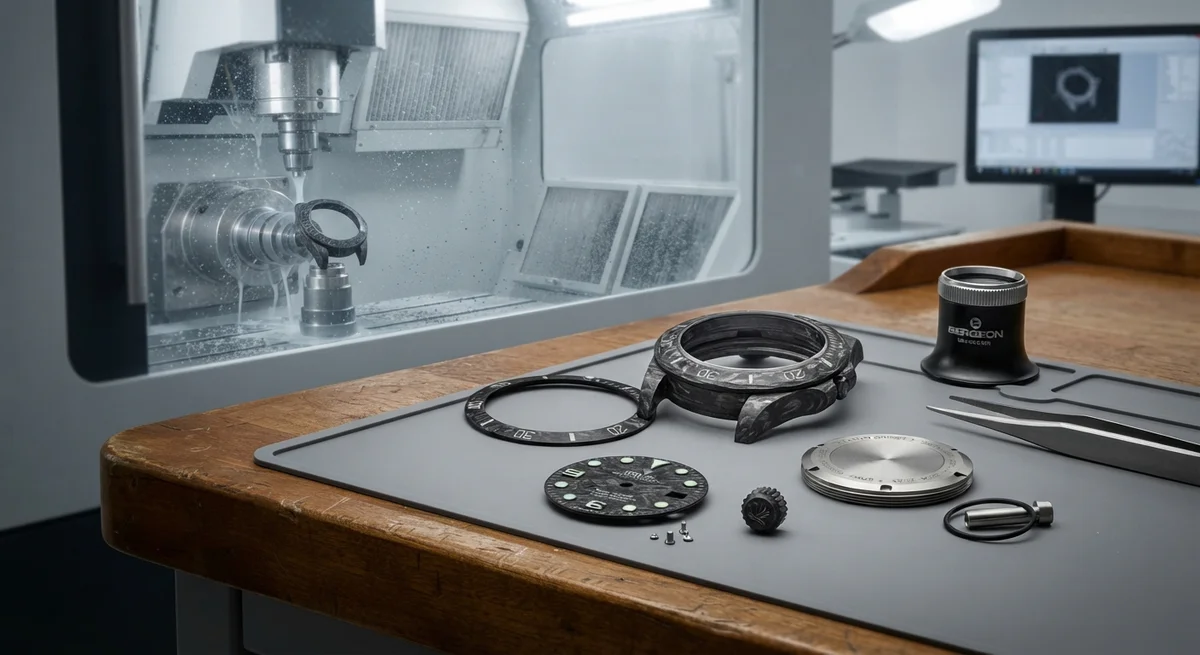
Carbon fiber has become a premier material in luxury watchmaking, offering unique aesthetics, extreme lightness, and structural rigidity. This article examines manufacturing processes, material variants, and quality standards for watch-grade CFRP components.
Introduction: Carbon Fiber in Horology
Luxury watchmaking has embraced carbon fiber composites not merely as a lightweight structural material but as a design language — the distinctive 2×2 twill weave, forged carbon's organic marbled texture, and unidirectional carbon's technical striations each communicate advanced material technology and contemporary luxury. From Richard Mille's iconic tonneau cases to Audemars Piguet's forged carbon Royal Oak Offshores, carbon fiber components have transitioned from exotic rarity to an established category in high-end watchmaking, representing an estimated 8-12% of luxury watch models priced above CHF 20,000 in 2026.
The application of carbon fiber in watchmaking presents unique manufacturing challenges: the components are small (typical case diameter 40-48 mm, wall thickness 1.0-2.5 mm), require micron-level dimensional precision (±0.02 mm on critical mating surfaces), must withstand daily wear including impacts, temperature cycles, and perspiration exposure, and must achieve a surface finish that meets the aesthetic standards of a luxury consumer product. This article provides watch brand procurement specialists and movement manufacturers with a detailed technical evaluation of carbon fiber watch component manufacturing.
Carbon Fiber Variants in Watchmaking
| Material Variant | Fiber Architecture | Aesthetic Characteristic | Relative Cost | Typical Applications |
|---|---|---|---|---|
| Forged carbon (PCC — Precision Carbon Composite) | Random short fibers (3-12 mm length) in resin matrix | Organic, marbled, stone-like surface; each piece unique | 2.5-3.5× (vs stainless steel case) | Case bodies, bezels (Audemars Piguet, Hublot) |
| Unidirectional (UD) carbon | Parallel 0° fiber layers, cross-ply [0/90] or [±45] | Parallel technical striations; directional light reflection | 3.0-4.5× | Case bodies, dial plates, skeleton bridges |
| 2×2 twill woven carbon | Woven fabric, 1K or 3K tow, checkered pattern | Classic carbon fiber checkerboard; most recognizable | 3.5-5.0× | Bezels, dials, case backs (Richard Mille) |
| Carbon nanofiber / CNT composite | Carbon nanotubes dispersed in polymer matrix | Solid dark grey/black; no visible fiber pattern | 5.0-8.0× | Case bodies (ultra-light models) |
| Carbon-TPT (Thin Ply Technology) | Ultra-thin prepreg layers (30-50 µm per ply) | Fine geometric pattern; subtle moiré effect | 6.0-10.0× | Case bodies, bezels (Richard Mille, customized) |
| Carbon/aluminum hybrid (CCA) | Carbon fiber layers interleaved with aluminum foil | Alternating carbon weave and metallic bands | 4.0-7.0× | Bezels, case mid-sections (bell & Ross, TAG Heuer) |
Forged carbon dominates the volume segment due to its combination of distinctive aesthetics, isotropic mechanical properties (eliminating the fiber orientation sensitivity of woven composites in small parts), and cost-effective compression molding process. Carbon-TPT and UD carbon occupy the premium tier, used by brands where fiber alignment and visual precision justify the 2-3× cost premium over forged carbon.
Manufacturing Processes for Watch-Grade CFRP
| Process | Suitable For | Dimensional Tolerance | Surface Finish (Ra) | Cycle Time per Part | Tooling Cost (USD) |
|---|---|---|---|---|---|
| Compression molding (forged carbon) | 3D case bodies, bezels | ±0.05 mm | 0.8-1.5 µm | 8-15 min (incl. cure) | $15,000-$40,000 |
| Prepreg compression molding | Woven/UD cases, bezels | ±0.03 mm | 0.4-0.8 µm | 20-40 min | $25,000-$60,000 |
| CNC machining from block | Dial plates, skeleton bridges | ±0.01 mm | 0.2-0.5 µm | 30-90 min (machining only) | $5,000-$15,000 (fixture) |
| Injection molding (short-fiber filled) | Crowns, pushers, buckle frames | ±0.02 mm | 0.3-0.6 µm | 30-60 sec | $20,000-$50,000 |
| Autoclave (prepreg layup) | Complex shapes, thin profiles | ±0.05 mm | 0.3-0.5 µm | 4-8 hours (incl. cure + cool) | $10,000-$30,000 |
Forged Carbon Compression Molding
The dominant process for watch case production: chopped carbon fiber strands (3-12 mm, typically 6 mm for 45 mm cases) are mixed with epoxy resin at a fiber-to-resin ratio of approximately 60:40 by weight. The mixture is placed in a heated chrome-plated steel mold (150-170°C) and compressed at 80-150 bar for 5-10 minutes. The random fiber orientation produces isotropic in-plane mechanical properties — critical for thin-walled cases where local stress concentrations from crown holes, pusher channels, and spring-bar lug holes could otherwise initiate cracking in an oriented laminate. Post-molding, the case blank undergoes CNC machining for the movement cavity, crown tube hole, spring bar lugs, and case-back threads, requiring 4-6 machining operations on a 5-axis CNC mill.
Mechanical and Physical Properties Comparison
| Property | Forged Carbon | 2×2 Twill CFRP | Carbon-TPT | 316L Stainless Steel | Titanium Grade 5 |
|---|---|---|---|---|---|
| Density (g/cm³) | 1.40-1.50 | 1.50-1.60 | 1.45-1.55 | 8.00 | 4.43 |
| Tensile strength (MPa) | 180-280 (isotropic) | 600-800 (0° direction) | 750-950 | 485 | 950 |
| Flexural modulus (GPa) | 15-25 | 55-70 (0°) | 65-85 | 193 | 114 |
| Hardness (Rockwell M) | 90-105 | 100-115 | 105-120 | — (Rockwell B 85) | — (Rockwell C 36) |
| Thermal expansion (µm/m·K) | 12-18 | 0.5-2.0 (longitudinal) | 0.5-1.5 | 16.0 | 8.6 |
| Corrosion resistance (perspiration test, ISO 9227) | Excellent — no corrosion after 500 hr salt spray | Excellent | Excellent | Good (minor pitting after 500 hr) | Excellent |
| Weight — 45 mm case body (g) | 8-10 | 9-11 | 9-11 | 48-55 | 27-32 |
| Surface scratch resistance | Moderate (epoxy dominant) | Moderate-High (fiber rich surface) | High (thin plies, hard surface) | High | Moderate-High |
The weight advantage of carbon fiber watch cases is transformative: a 45 mm forged carbon case body weighs 8-10 grams versus 48-55 grams for the same geometry in 316L stainless steel — an 80-83% reduction. For a complete watch (case, bezel, case back, crown, buckle), carbon fiber reduces overall weight from 150-200 g (steel) to 45-70 g — a 60-70% total weight reduction. This weight saving is not merely cosmetic; it significantly improves wearing comfort for large-diameter watches and reduces strap wear from gravitational pull.
Surface Finish and Scratch Resistance
The surface finish of watch-grade CFRP is a critical quality parameter. Luxury watch consumers expect a surface that maintains its appearance through daily wear. Two strategies are employed:
- Resin-rich surface (forged carbon): The outer surface is predominantly epoxy resin (10-50 µm thick) with visible fiber pattern beneath. This is softer (pencil hardness H-2H) but provides the distinctive forged carbon marble appearance. A clear UV-cured hard coat (20-30 µm, hardness 3-4H) can be applied for improved scratch resistance.
- Fiber-rich surface (woven/TPT): The surface is ground and polished to expose the carbon fiber, creating a hard surface dominated by the carbon fibers themselves (pencil hardness 6-9H). This offers superior scratch resistance but requires precise grinding to avoid fiber pull-out or delamination. The exposed fiber surface is typically sealed with a thin (5-10 µm) clear coat for chemical resistance.
Water Resistance and Seal Design
Water resistance is a fundamental requirement for luxury watches (typically 50-300 m rating for carbon fiber models). The challenge with CFRP cases is achieving a reliable seal at the case back and crown interfaces. Key considerations:
| Seal Interface | Typical Design | CFRP Challenge | Solution |
|---|---|---|---|
| Case back to case body | O-ring in groove + threaded case back | CFRP threads wear faster than metal; O-ring groove surface roughness | Titanium or steel threaded insert bonded into CFRP case; polished O-ring groove surface (Ra <0.4 µm) via insert |
| Crown tube to case | Pressed or threaded crown tube + O-ring | CFRP cannot withstand repeated crown tube insertion/pull-out | Bonded metal crown tube insert (titanium or 316L); minimum 3 mm axial engagement |
| Sapphire crystal to bezel | Gasket + bezel press-fit or screw-down | CFRP bezel thermal expansion mismatch with sapphire | Metal bezel insert ring; or CF bezel with <0.03 mm concentricity tolerance |
| Pusher buttons | Threaded pusher tubes + O-rings | Thread stripping in CFRP | Metal pusher tube inserts bonded into CFRP; minimum 4 full thread engagements in metal insert |
The industry standard solution is a hybrid construction: a carbon fiber case body with bonded-in metal inserts (typically titanium Grade 5 or 316L stainless steel) at all sealing interfaces. The metal inserts are either over-molded during the compression molding process or bonded post-cure with structural epoxy adhesive (e.g., 3M Scotch-Weld DP420, lap shear strength >25 MPa on grit-blasted CFRP). The bond interface must be designed to withstand thermal cycling (−20°C to +60°C, 10,000+ cycles per ISO 2281) without degradation.
Quality Control and Testing
Luxury watch brands impose stringent quality standards on CFRP components. Typical acceptance criteria include:
- Dimensional inspection: All critical mating surfaces (case back thread, crystal seat, crown tube bore) measured by CMM; tolerance ±0.02 mm on metal inserts, ±0.05 mm on CFRP surfaces
- Visual inspection: 100% inspection under controlled lighting (D65, 1,000 lux) at 30 cm viewing distance; defect categories: fiber misalignment, surface porosity, resin-rich/deficient areas, color uniformity
- Water resistance testing: 100% of watches tested to ISO 2281: over-pressure test (125% of rated pressure), condensation test (40°C to 18°C transition), and immersion test (1 hour at rated depth + 10 minutes at 125%)
- Thermal cycling: Sample testing: 500 cycles −20°C to +60°C, 30-minute dwell at each extreme; maximum acceptable change in water resistance: 5% reduction in leak rate
- Scratch testing: Taber abrasion (CS-10 wheel, 500 g load, 100 cycles); maximum acceptable gloss reduction: 30% for resin-rich surfaces, 15% for fiber-rich surfaces
Cost Analysis for B2B Buyers
| Component | Material | Manufacturing Process | Unit Cost (USD, qty 1,000) | Unit Cost (USD, qty 10,000) | Lead Time (weeks) |
|---|---|---|---|---|---|
| Case body (45 mm) | Forged carbon | Compression mold + CNC | $85-$140 | $55-$85 | 8-12 |
| Case body (45 mm) | Carbon-TPT | Prepreg mold + CNC | $180-$280 | $120-$180 | 12-18 |
| Bezel | 2×2 twill CFRP | Prepreg mold + CNC | $35-$60 | $22-$38 | 6-10 |
| Dial plate | UD carbon | CNC from plate | $18-$35 | $12-$22 | 4-8 |
| Crown + buckle set | Forged carbon or CFRP | Injection mold + CNC | $25-$50 | $15-$30 | 6-10 |
| Metal insert set (Ti/316L) | Ti Grade 5 or 316L | CNC machining | $30-$55 | $18-$35 | 4-6 |
| Complete case set (case + bezel + inserts + crown) | — | — | $195-$390 | $125-$260 | 10-18 |
For comparison, a complete 316L stainless steel case set (case body + bezel + case back + crown) for a similar watch is typically $45-$90 at 1,000-unit quantities. The carbon fiber premium of 3-4× is justified by the weight savings, unique aesthetics, and the added complexity of metal insert integration. For reference, a forged carbon case set saves approximately 55-75 g versus steel — at retail prices of $5,000-$50,000+ per watch, the incremental component cost is negligible relative to the brand value achieved.
Frequently Asked Questions
Q: How durable are carbon fiber watch cases compared to steel or titanium?
A: Carbon fiber watch cases are highly durable in most wear scenarios but differ in failure modes. In impact resistance (drop testing from 1 m onto hard tile), forged carbon cases absorb impact energy through micro-cracking at the impact site without catastrophic failure — unlike steel which dents and titanium which can gouge. For abrasion resistance, fiber-rich carbon surfaces (woven/TPT) with hardness 6-9H outperform both steel and titanium. However, resin-rich forged carbon surfaces are softer (H-2H pencil hardness) and more susceptible to micro-scratches from abrasive dust. The practical advantage of carbon fiber for daily wear is its low density: a carbon case is 70-80% lighter than steel, which significantly reduces impact energy in a drop event (E = ½mv²), meaning the carbon watch experiences less force on impact. Combined with the energy-absorbing micro-cracking mechanism, carbon cases typically survive drops better than metal.
Q: Can carbon fiber watch cases be resized, repaired, or refinished?
A: Resizing (spring-bar adjustment on bracelets) is unaffected by case material. Case repair of CFRP is extremely difficult and generally not feasible — cracks in carbon fiber propagate through the resin matrix and delaminate the fiber layers, requiring full case replacement. Refinishing is also complex: the surface is not a uniform material like polished steel but a composite with fiber and resin domains. Attempting to polish a forged carbon case with conventional metal-polishing compounds will preferentially abrade the softer resin phase, leaving a recessed, diffusive surface. Manufacturers recommend replacing scratched CFRP components rather than attempting refinishing. Some aftermarket specialists offer clear-coat reapplication for forged carbon surfaces with UV-cured hard coat systems, but this requires complete disassembly.
Q: What are the limitations of carbon fiber for water-resistant watch cases?
A: The primary limitation is the thermal expansion mismatch between CFRP (0.5-2.0 × 10⁻⁶/K in the fiber direction) and metal inserts (16 × 10⁻⁶/K for 316L steel), which can cause seal failure during thermal cycling. This is addressed by using titanium inserts (8.6 × 10⁻⁶/K, closer to CFRP) and applying flexible sealants (silicone-based, not epoxy) at the insert-to-CFRP interface. A second limitation is thread wear: CFRP threads (directly molded or machined) have lower shear strength than metal threads and are prone to stripping after 10-20 assembly/disassembly cycles. The industry solution — bonded metal threaded inserts — is well-established but adds cost and complexity. A third limitation: water absorption (0.5-1.5% weight gain for epoxy in long-term immersion) can cause micro-dimensional changes that affect seal compression over multi-year deployments. For diving watches rated to 300+ m, annual seal inspection is recommended.
Q: How is carbon fiber watch quality verified for luxury brands?
A: Verification follows a multi-stage protocol. First, incoming material inspection: resin-content analysis (TGA per ASTM E1131), fiber type verification (FTIR or Raman spectroscopy), and mechanical test coupons (tensile per ASTM D3039, flexural per ASTM D790). Second, in-process inspection: CMM dimensional verification after molding, after CNC machining, and after insert bonding — each stage with pass/fail criteria. Third, finished component testing: water-resistance sample testing per ISO 2281, thermal cycling per brand-specific protocols (typically −20°C to +60°C, 500+ cycles), and UV aging (1,000 hours QUV per ASTM G154, maximum acceptable gloss reduction: 20%). Fourth, serialized traceability: each CFRP case body is laser-marked with a unique serial number linking to its manufacturing batch, material lot, and inspection records. This traceability is required for warranty management and is increasingly demanded by secondary-market authentication services.
Q: What is the production MOQ for custom carbon fiber watch components?
A: The minimum order quantity (MOQ) depends on the manufacturing process. For compression-molded forged carbon cases: typical MOQ is 200-500 units per reference per color, driven by mold cost amortization (mold life: 5,000-15,000 cycles for chrome-plated steel). For prepreg compression molding (woven/TPT cases and bezels): MOQ is 100-300 units, with mold life 3,000-8,000 cycles. For CNC-machined components from CFRP plate (dials, bridges): MOQ can be as low as 10-50 units, limited only by CNC setup time (2-4 hours). For custom metal inserts: MOQ of 100-500 units. Lead times for first articles: 8-14 weeks (mold fabrication: 4-8 weeks; first articles: 2-4 weeks; inspection and qualification: 2-3 weeks). It is strongly recommended to commission a prototype run (10-25 units) for dimensional and aesthetic qualification before committing to full production MOQ.
Conclusion
Carbon fiber has established itself as a premier material in luxury watchmaking, offering a unique combination of weight reduction (70-80% vs steel), distinctive aesthetics, and structural performance that aligns with the contemporary demand for technical luxury. For watch brand procurement specialists, the key specification parameters for CFRP watch components include: material variant selection (forged carbon for volume, woven/TPT for premium positioning), dimensional tolerance requirements (±0.02 mm on sealed interfaces, ±0.05 mm on cosmetic surfaces), metal insert design for sealing interfaces and crown tubes, surface finish specification (resin-rich vs fiber-rich), and quality acceptance criteria aligned with ISO 2281 (water resistance) and brand-specific thermal cycling protocols. As manufacturing processes mature and cost continues to decrease with volume, carbon fiber is projected to expand beyond its current 8-12% penetration of the >CHF 20,000 watch segment to 18-25% by 2030, driven by millennial and Gen-Z consumers' preference for technical, lightweight luxury.
Related Articles
- Carbon Fiber Mooring for Floating Offshore Wind: Fatigue and Corrosion in Deep Water
- Carbon Fiber Bicycle Frame Optimization: Layup Design and Manufacturing for Competitive Racing
- Carbon Fiber CFRP Retrofit for Infrastructure: Bridge and Building Seismic Strengthening
- Carbon Fiber Medical Imaging Equipment: Lightweight Gantry and Couch Structures for MRI/CT
- Carbon Fiber EV Battery Enclosures: Crash Safety and Electromagnetic Shielding Design
- Carbon Fiber Structures for Low-Altitude Economy: UAV Airframes and eVTOL Components
Interested in Our Products?
Contact our team for competitive pricing and technical specifications.
Get a QuoteRelated Products
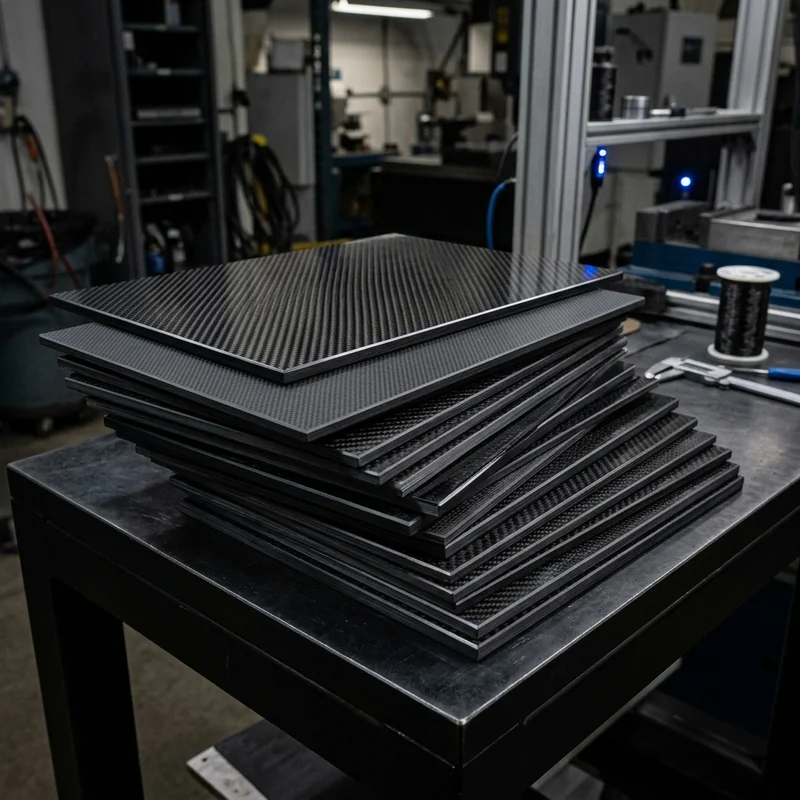
Carbon fiber standard plate-3k stripe
Lightweight, ultra-rigid standard sheets for drone fuselages, robot housings, facades and structural applications.

Carbon Fiber Plate — 3K Twill T700 1.5mm
Thin 1.5mm carbon fiber plate with 3K twill weave surface. Lightweight and stiff, commonly used for covers, panels, drone bodies, and applications requiring a premium aesthetic appearance.

Square Carbon Fiber Tube — 3K Twill T700
Square cross-section carbon fiber tube manufactured with 3K twill weave for torsional strength. Preferred for structural frames, trusses, and support columns where rectangular geometry offers design flexibility.

Carbon Fiber Plate — 3K Twill T700 3.0mm
Medium-thickness 3.0mm carbon fiber plate offering significantly higher load capacity while maintaining attractive 3K twill finish. Suitable for structural brackets, reinforcement plates, and load-bearing panels.
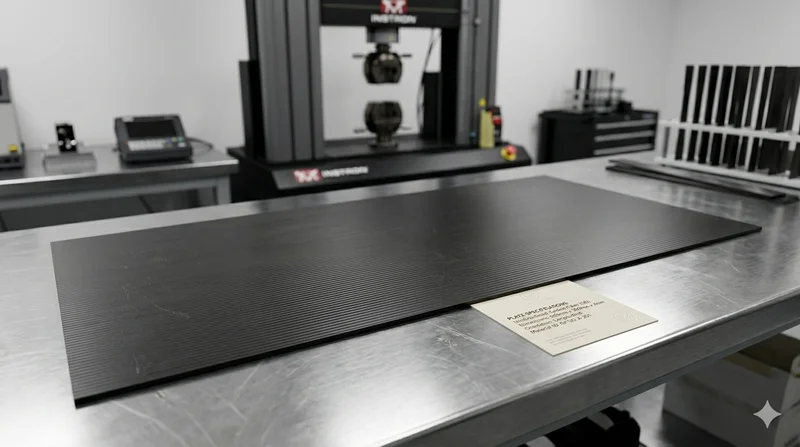
Carbon Fiber Plate — UD Unidirectional T700
Unidirectional carbon fiber plate with all fibers oriented in a single direction for maximum strength along the fiber axis. Essential for structural reinforcements, splints, and applications where load direction is predictable.