
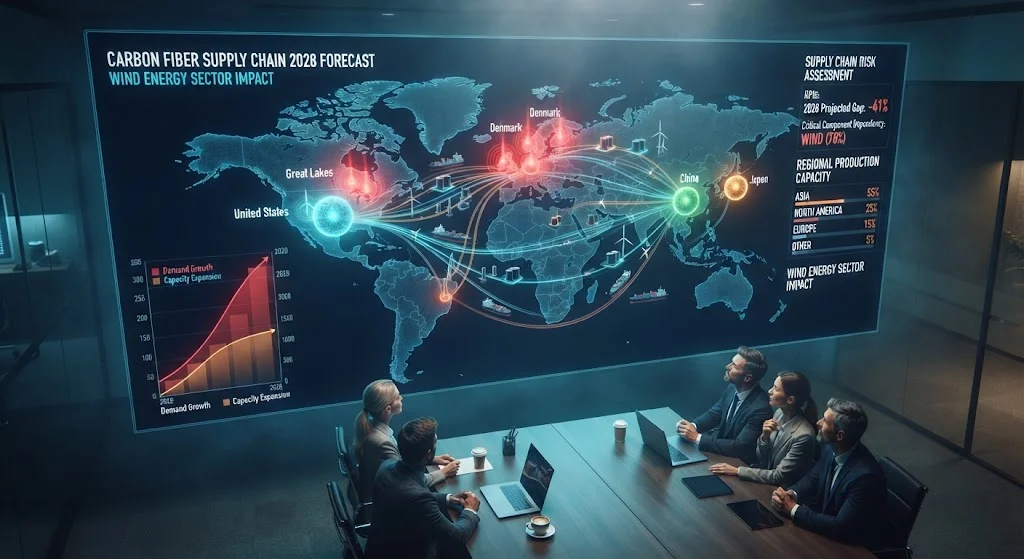
Industry analysts project a significant shortage of large-tow carbon fiber by 2028 as wind turbine blade demand outpaces production capacity. This article examines the supply-demand dynamics, capacity expansion timelines, and risk mitigation strategies for wind energy manufacturers.
Introduction
The carbon fiber industry faces a structural supply challenge as wind energy demand growth threatens to outstrip large-tow fiber production capacity by 2028. Large-tow carbon fiber — typically 24K to 50K filament counts — is the workhorse material for wind turbine blade spar caps, consuming approximately 60% of global carbon fiber production by volume.
Multiple industry analyses project that cumulative wind energy demand will require 180,000-220,000 tons of large-tow carbon fiber annually by 2028, while current production capacity plus announced expansions will deliver only 140,000-160,000 tons. This 40,000-60,000 ton gap represents a significant supply chain risk for wind turbine manufacturers and their blade suppliers.
Demand Drivers
Several factors are accelerating carbon fiber demand in wind energy:
Blade length growth: Average blade lengths are increasing 3-5 meters per year, with offshore wind blades now exceeding 100 meters. Longer blades require proportionally more carbon fiber spar caps to maintain stiffness while controlling weight. A 100-meter blade requires 25-35 tons of carbon fiber, compared to 10-15 tons for a 70-meter blade.
Offshore wind expansion: Global offshore wind capacity is projected to grow from 64 GW (2023) to 380 GW by 2030. Offshore turbines are larger (12-20 MW) and use more carbon fiber per MW than onshore machines, driving disproportionate demand growth.
Carbon intensity increase: The percentage of carbon fiber in blade structures is rising from 20-30% (by weight) to 40-50% as blade designers push for longer, lighter blades that capture more energy while reducing loads on drivetrains and foundations.
Supply Constraints
Carbon fiber production capacity expansion faces several constraints:
Capital intensity: A 5,000-ton carbon fiber production line requires $200-400 million in capital investment, with construction timelines of 24-36 months. This limits the speed at which capacity can respond to demand signals.
PAN precursor availability: Carbon fiber production is constrained by polyacrylonitrile (PAN) precursor supply. PAN production requires acrylonitrile, which is itself constrained by propylene feedstock availability and existing acrylic fiber demand.
Energy requirements: Carbon fiber production is energy-intensive, requiring 100-200 kWh per kg of fiber produced. In regions with limited energy infrastructure, this creates additional constraints on capacity expansion.
Technical expertise: Operating carbon fiber production lines requires specialized technical expertise that is concentrated in Japan, the United States, and China. Expanding to new regions requires technology transfer and workforce development.
Price Implications
The projected supply shortage is already affecting pricing dynamics:
Contract structures: Wind OEMs are shifting from spot purchasing to long-term (3-5 year) contracts with volume commitments, offering producers the certainty needed to justify capacity expansion investments.
Premium pricing: Large-tow carbon fiber prices have increased 15-25% since 2022, with further increases projected as the shortage materializes. Producers with available capacity are commanding premiums of $2-4/kg above historical pricing.
Substitution pressure: At sustained price premiums above $20/kg, some blade designs may shift toward hybrid glass/carbon solutions or alternative materials, though this involves performance trade-offs.
Risk Mitigation Strategies
Wind energy manufacturers are pursuing several strategies to mitigate supply risk:
Vertical integration: Some wind OEMs are investing in or acquiring carbon fiber production capacity to secure supply. This trend is particularly visible in China, where state-owned enterprises are integrating upstream.
Material efficiency: Blade designs that optimize carbon fiber usage — through structural analysis, hybrid configurations, and manufacturing process improvements — can reduce material requirements per blade without sacrificing performance.
Alternative fibers: Intermediate modulus and high modulus fibers offer higher specific properties, potentially reducing the total fiber weight required. However, these fibers are more expensive and have limited production capacity.
Recycled carbon fiber: As end-of-life blade volumes increase, recycled carbon fiber can supplement virgin fiber supply for less demanding applications.
Conclusion
The projected large-tow carbon fiber shortage by 2028 represents a significant challenge for the wind energy industry. Proactive supply chain management — including long-term contracts, material efficiency improvements, and diversification of supply sources — will be essential for wind turbine manufacturers to maintain production targets and cost objectives. The industry's ability to navigate this supply challenge will influence the pace of wind energy deployment and the transition to renewable energy.
Part of topic
Related Articles
- Recycled Carbon Fiber Market Forecast 2030: Technology Maturity and Commercialization Path
- South Korea Carbon Fiber Market 2026: Hydrogen Economy and Shipbuilding Innovation
- Wind Turbine Blade Leading Edge Protection 2026: Polyurethane, Tape, and Metallic Shield Solutions
- China Carbon Fiber Overcapacity 2026: Price War Impact and Industry Consolidation
- India Carbon Fiber Market 2026: Wind Energy, Aerospace, and Defense Expansion
- PAN Precursor Market 2026: Acrylonitrile Supply and Carbon Fiber Cost Structure
Interested in Our Products?
Contact our team for competitive pricing and technical specifications.
Get a QuoteRelated Products
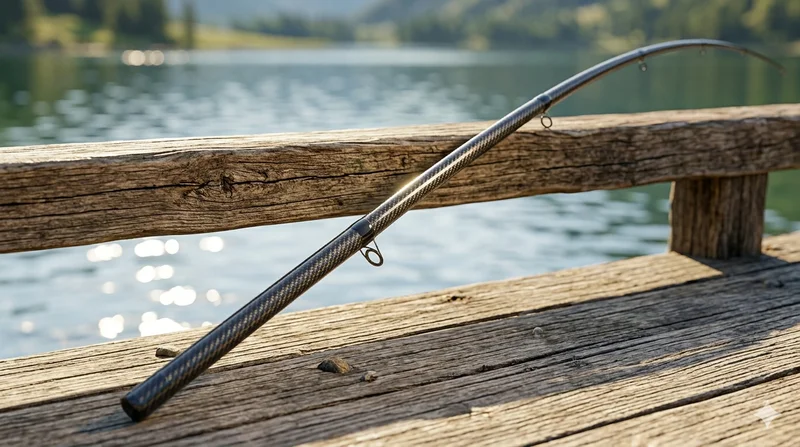
Carbon Fiber Fishing Rod Blank
High-quality carbon fiber fishing rod blank manufactured from multiple grades of Toray carbon fiber cloth. Available in a wide range of lengths, powers, and actions for freshwater and saltwater applications. Suitable for OEM rod building.
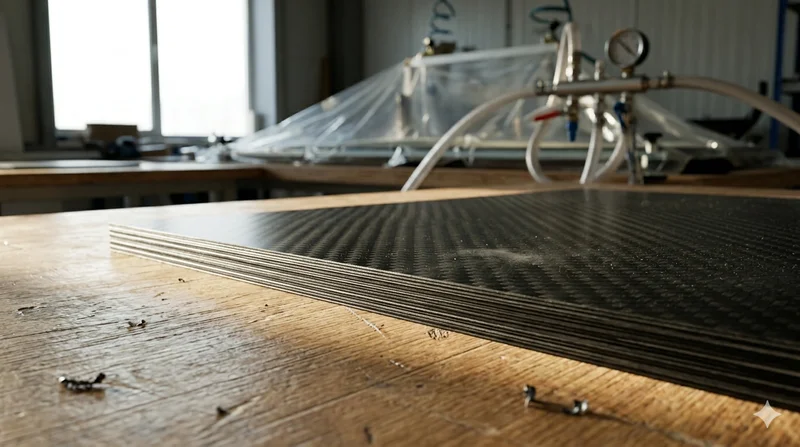
Carbon Fiber Plate — 3K Twill T700 3.0mm
Medium-thickness 3.0mm carbon fiber plate offering significantly higher load capacity while maintaining attractive 3K twill finish. Suitable for structural brackets, reinforcement plates, and load-bearing panels.

Carbon Fiber Plate — 3K Twill T700 1.5mm
Thin 1.5mm carbon fiber plate with 3K twill weave surface. Lightweight and stiff, commonly used for covers, panels, drone bodies, and applications requiring a premium aesthetic appearance.
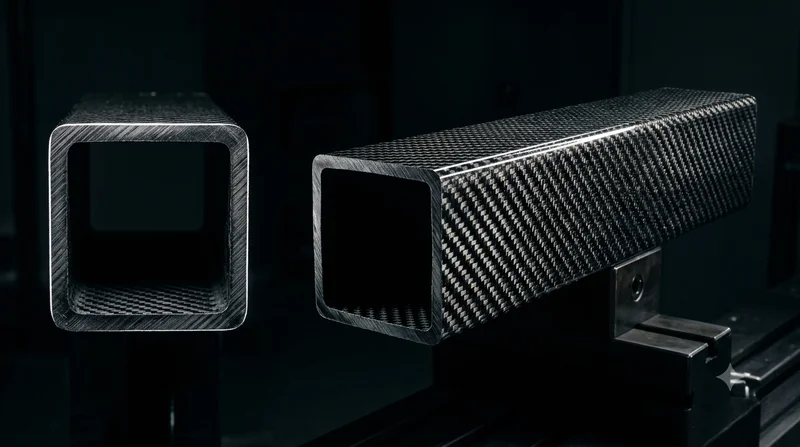
Square Carbon Fiber Tube — 3K Twill T700
Square cross-section carbon fiber tube manufactured with 3K twill weave for torsional strength. Preferred for structural frames, trusses, and support columns where rectangular geometry offers design flexibility.
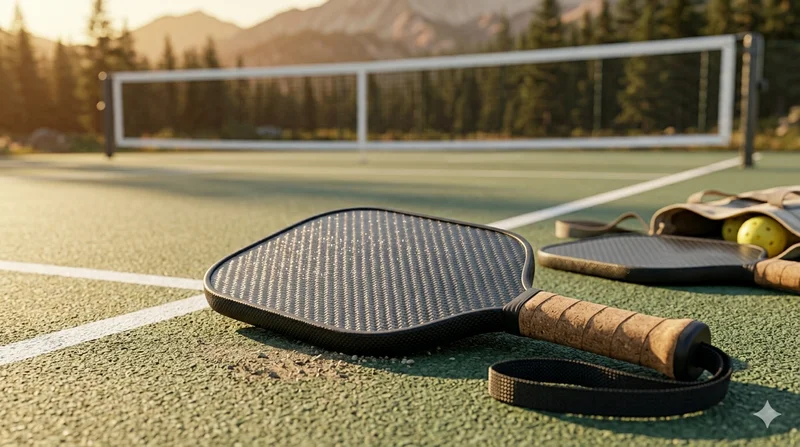
Carbon Fiber Pickleball Paddle
High-performance pickleball paddle with Toray T700 carbon fiber face and polypropylene honeycomb core. Delivers excellent power-to-weight ratio, spin generation, and vibration dampening for competitive play.