
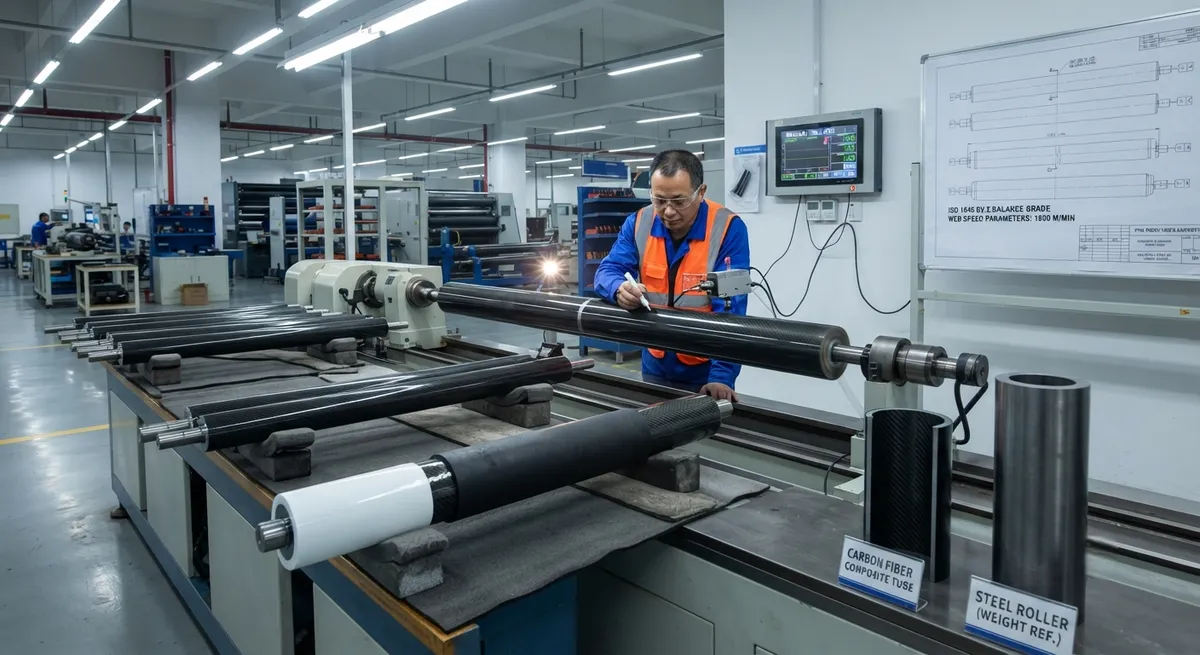
Industrial rollers — the long, hollow cylinders over which film, paper, packaging, and coated substrates travel — are among the most common wear and weight items in continuous web processing. On a wide film line, a steel or aluminum roll several meters long can sag under its own weight,
Introduction
Industrial rollers — the long, hollow cylinders over which film, paper, packaging, and coated substrates travel — are among the most common wear and weight items in continuous web processing. On a wide film line, a steel or aluminum roll several meters long can sag under its own weight, an ovality under tension can print or draw off the web path, and the sheer inertia of heavy rolls slows line speed and increases power consumption.
Carbon fiber composite rollers solve this. Because the roll core is a carbon fiber tube with a low coefficient of thermal expansion and unusually high stiffness-to-weight, the roll is dramatically lighter and stiffer than an equivalent steel roll at the same outer diameter. This article covers the stiffness-to-weight case, dynamic balancing, and the surface coatings that determine performance — with data validated for idlers, deflector rolls, and driven rolls used in gravure, flexographic, and film-coating lines.
Stiffness-to-Weight: The Core Advantage
The fundamental advantage of a carbon fiber roller is not absolute stiffness but stiffness per unit mass. A roll core made of a thick-wall unidirectional carbon fiber tube has a modulus along the axis of 80-110 GPa, several times that of the aluminum (69-72 GPa) and at a third of the density. The resulting specific stiffness (stiffness per unit mass) of a carbon fiber tube is roughly two to three times that of steel and higher than that of aluminum at a lower mass.
For a wide-web printer, that means a carbon fiber roll that is 2-3 times stiffer under bending than a steel roll of the same diameter, at a fraction of the weight. Thinner — hollow — rollers are allowed because the composite distributes the bending load across the required section. The practical result is that existing webs run faster, fewer support bearings are needed, sag is reduced, and the line operates without flutter. In gravure printing, where register accuracy of 0.1 mm across a wide web matters, roll stiffness has a direct effect on print registration.
Dynamic Balancing and Roll Rotation
At high web speeds, a small eccentric mass in a roll becomes a source of vibration. In a modern processing line running at meters per second, the natural concern is not weight but balance: run tolerance of a roller, given in terms of the residual eccentricity or mass moment, determines the force transmitted to the bearings and the web. For carbon fiber rolls, dynamic balancing is especially important: anisotropic parts could carry high point masses if the layup is uneven, so the balance tolerance must be checked after cure and the roll must be balanced in two planes (dynamic balancing), usually to ISO 1940 grade G 2.5 or G 1 relative to the operational RPM.
Because carbon fiber is stiffer, the wall thickness of the shell can be reduced, which lowers the mass moment of inertia, and the roll reaches its balance plane and rests at speed with less vibration. A rotating roll with a low mass moment of inertia ramps up faster and needs less motor torque. For example, a driven roller can reach operating rpm in a fraction of the time of a steel counterpart, improving throughput in start-and-stop or saw-tooth processes.
Surface Coatings: The Contact and Durability Layer
The carbon fiber roll core provides structure, but the surface governs the contract with the web. Because the bare composite surface is not suitable for direct contact with many substrates, rollers are finished with a coating that controls friction, release, and wear. The main options:
- Ceramic or plasma-sprayed coating: Applied to the carbon fiber core for abrasive webs that see high running wear, delivering a low-friction, high hardness contact surface.
- Rubber or polyurethane cover: The most common for driven rollers and spreading rollers; the rubber layer gives the roll a controllable friction coefficient of 0.8-1.0 for the web, and reduces slip and marks.
- Teflon / fluoro (PTFE) covers: For release and low-friction surfaces, where the web must not stick and the roll must resist pickup of adhesive or high-viscosity inks.
- Grooved or spiral surfaces: Machined into the core for air evacuation and bubble removal in lamination and vacuum-draw rolls.
The coating is the cost driver and the durability boundary of a composite roll. A well-applied coating protects the carbon core from local damage and thermal shock, while poor adhesion forces rework if the layup and surface preparation are not controlled.
Manufacturing Build-Up and Cost Model
Carbon fiber rollers are made in one of two ways:
- Filament winding: unidirectional carbon is laid along the axis on a mandrel and wound with a spiral wrap angle for hoop compensation of the section, then cured at around 150 °C, giving the highest axial modulus and a near-net hollow core.
- Pultrusion or LCM (liquid composite molding): Pultrusion of the CFRP tube delivers a family of diameters at predictable cost with excellent straightness and tight tolerances.
The cost of carbon fiber roller depends primarily on: core length and diameter, fiber grade, the coating, and the balance class. A carbon fiber idler is typically 3-8 times the price of a steel unit, but where web breakage risk, lower lifetime energy cost, and the ability to run at higher speed matter, this premium is often justified — especially in markets that place high value on change-over speed and cannot afford the weight of a heavy steel roll slowing the line.
Frequently Asked Questions
How much lighter is a carbon fiber roller than a steel roller of the same size?
A carbon fiber roller is typically 50-70% lighter than an equivalent steel roller and 30-50% lighter than an aluminum one of the same outer diameter. Because carbon fiber's specific stiffness (stiffness-to-weight ratio) is roughly 5-6 times higher than steel's, the roll can be made with a much thinner wall while still meeting the deflection budget, so the weight comes down sharply, and the line benefits from lower bearing load, lower motor torque, and faster ramp-up.
What dynamic balance grade do carbon fiber rollers need?
Most processing lines specify ISO 1940 dynamic balance grade G2.5 at the operating RPM, with less critical lines using G6.3. Carbon fiber rollers can meet these by balancing in two radial planes after the bearings and coating are applied. Because the composite part is lighter, the mass that an eccentricity represents is lower, so the same balance grade is reached with a smaller residual imbalance and produces less bearing force at high speed — a real advantage for high-threshold web speed.
Are carbon fiber rollers safe for contact printing with solvent-based inks?
Yes, because the ink never contacts the bare composite. A protective layer — ceramic, chrome or rubber cover a PTFE coating — is applied over the carbon core to seal its surface. The coating must be bonded with proper surface preparation, since the carbon surface is low-energy and requires etching or a primer to prevent delamination in solvent exposure. When the coating is correctly applied, the roll keeps the substrate from contacting the fibers, and the finished roll meets the same chemical-resistance profile as a conventional metal roll.
Surface Hardness and Roll Contact Data
| Parameter | Steel Roll | Aluminum Roll | Carbon Fiber Roll |
|---|---|---|---|
| Core density (g/cm³) | 7.85 | 2.70 | 1.55 |
| Axial modulus (GPa) | 210 | 70 | 80-110 |
| Specific stiffness (relative) | 27 | 26 | 60-70 |
| Relative roll weight for same outer diameter | 100% | 55% | 25-35% |
| Coefficient of thermal expansion (×10⁻⁶/K) | 12 | 23 | -0.5 to 0.5 |
| Dynamic balance achievable | G2.5 | G2.5 | G2.5/G6 |
| Contact surface | Coated/metal | Coated/anodized | Coated (carbon fiber core) |
Two numbers stand out. First, the coefficient of thermal expansion of carbon fiber is near zero, and it can be tuned slightly negative, so a large roll does not change its curl with temperature — critical for controlled web tension during a run. Aluminum, by comparison, changes diameter with heat and can cause tension shifts across a wide line. Second, the specific stiffness is roughly double that of a metal roll, letting the same roll run at greater span width without bending out of the print zone. Both are the base of the printing-line advantage.
Conclusion
Carbon fiber industrial rollers convert the material's combination of high stiffness and low density into performance on real printing and film lines. They allow longer, thinner rolls to run faster with less bearing force and lower energy; their near-zero thermal expansion keeps tension stable; and the dynamic balance of a lighter hollow shell gives faster ramp-up and better web handling. The coating and the balance grade are the two specifications that decide how much of this advantage is retained.
For B2B buyers specifying a new printing or film line roll, the place to start is the stiffness and deflection budget, the web speed and tension, the balance class, and the coating. Review our range of carbon fiber tubes and profiles suitable for roll cores, or contact our engineering team for a roll-specification consultation for your next line.
Related Articles
- Carbon Fiber Tube for Sale: Comparing Listings and Avoiding Bad Specs
- Carbon Fiber Engine Parts: High-Temperature Performance for Racing and Performance Vehicles
- Carbon Fiber Body Parts: Automotive Exterior Panels and Structural Components
- Carbon Fiber Drone Body Manufacturing: Monocoque Design and Production Methods
- Carbon Fiber Drone Parts Supplier: FPV Frames, Arms and Structural Components
- Filament Wound Epoxy Tubes: Industrial Applications from Oil and Gas to Aerospace
Interested in Our Products?
Contact our team for competitive pricing and technical specifications.
Get a QuoteRelated Products
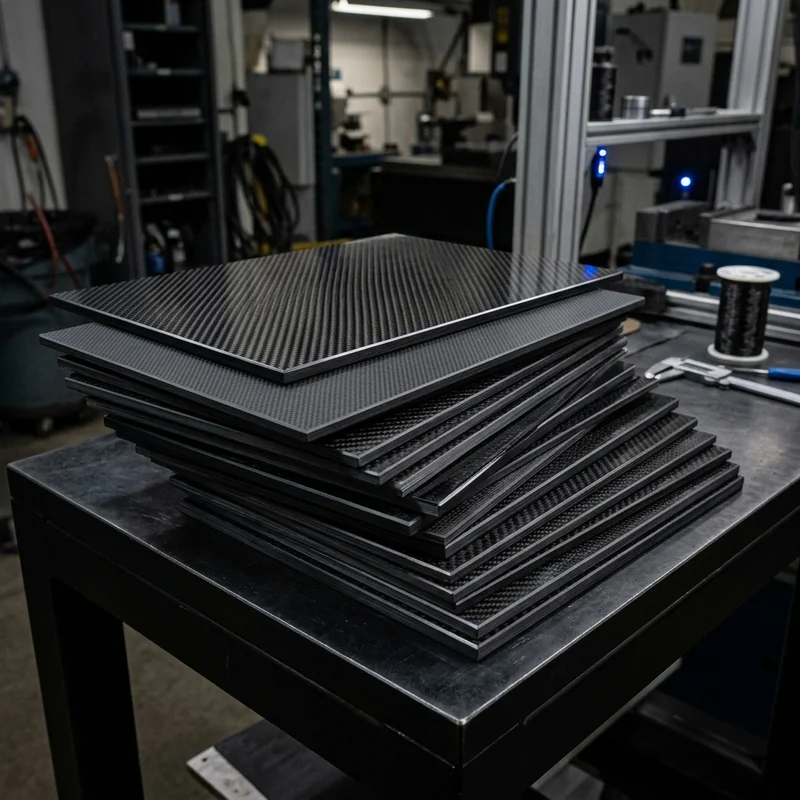
Carbon fiber standard plate-3k stripe
Lightweight, ultra-rigid standard sheets for drone fuselages, robot housings, facades and structural applications.

Carbon Fiber Plate — 3K Twill T700 3.0mm
Medium-thickness 3.0mm carbon fiber plate offering significantly higher load capacity while maintaining attractive 3K twill finish. Suitable for structural brackets, reinforcement plates, and load-bearing panels.

Carbon Fiber Plate — 3K Twill T700 1.5mm
Thin 1.5mm carbon fiber plate with 3K twill weave surface. Lightweight and stiff, commonly used for covers, panels, drone bodies, and applications requiring a premium aesthetic appearance.

Square Carbon Fiber Tube — 3K Twill T700
Square cross-section carbon fiber tube manufactured with 3K twill weave for torsional strength. Preferred for structural frames, trusses, and support columns where rectangular geometry offers design flexibility.
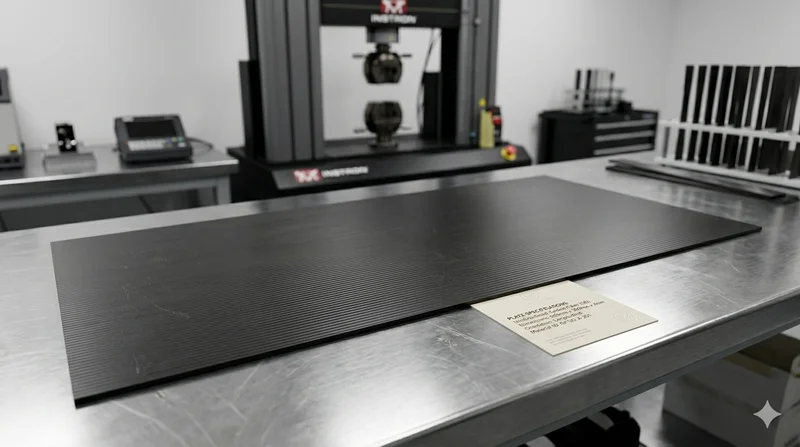
Carbon Fiber Plate — UD Unidirectional T700
Unidirectional carbon fiber plate with all fibers oriented in a single direction for maximum strength along the fiber axis. Essential for structural reinforcements, splints, and applications where load direction is predictable.