
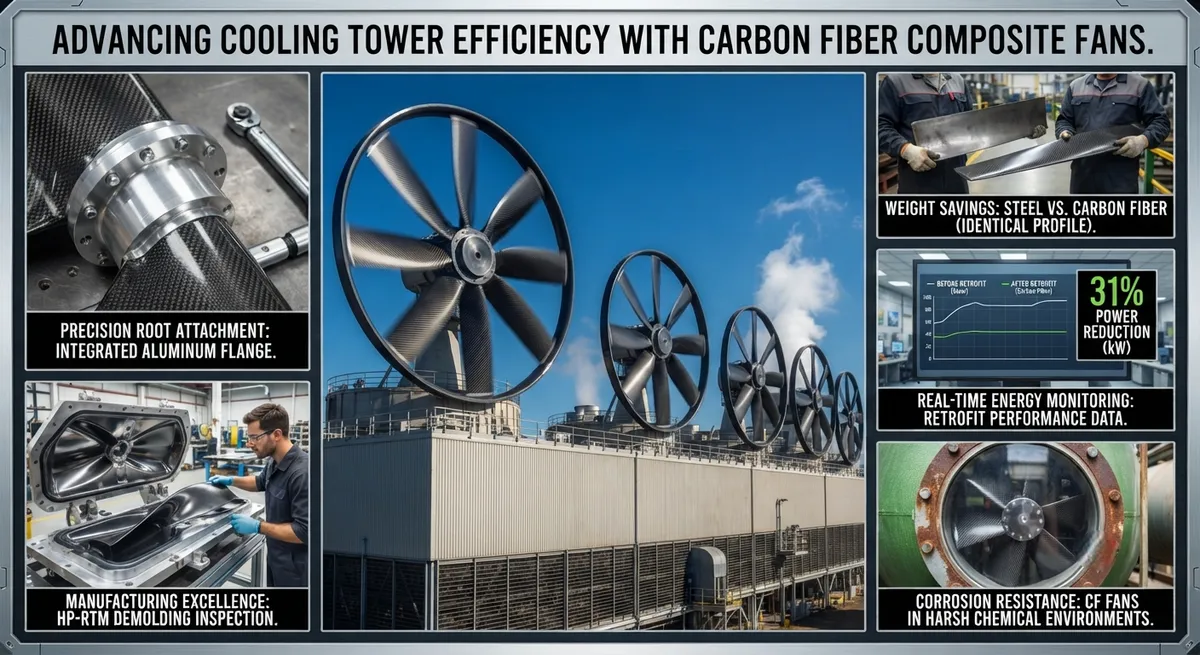
Discover how carbon fiber composite fan blades reduce energy consumption in industrial ventilation, cooling towers, and HVAC systems. Lighter blades require less starting torque, reduce motor load, and deliver measurable electricity savings in continuous-operation factories.
The Energy Cost of Industrial Ventilation
Industrial fans and blowers account for 15–25% of total electricity consumption in manufacturing facilities, mining operations, and power plants. In a typical cement plant or chemical processing facility, large-diameter axial fans operating 24/7 consume megawatt-hours daily. The rotating mass of the fan assembly — particularly the blades — directly determines the energy required for startup, speed changes, and sustained operation.
Carbon fiber reinforced polymer (CFRP) fan blades offer a compelling pathway to reducing this energy burden. At one-fifth the density of aluminum and one-sixth that of steel, carbon fiber blades dramatically reduce moment of inertia, enabling faster ramp-up, lower peak current draw during starting, and sustained energy savings throughout the operating life.
Aerodynamic and Structural Design Advantages
Carbon fiber's unique combination of high specific stiffness and formability allows blade designers to create airfoil shapes that are impossible to manufacture in metal. Thin, cambered profiles with complex twist distributions can be molded in a single operation, producing blades with superior aerodynamic efficiency (measured as static efficiency ηs).
| Parameter | Steel Blade | Aluminum Blade | CFRP Blade | Improvement (vs. Aluminum) |
|---|---|---|---|---|
| Density (g/cm³) | 7.85 | 2.70 | 1.55 | −43% |
| Tensile Modulus (GPa) | 200 | 70 | 135 | +93% |
| Blade Mass (1.5m dia, 8 blades, kg) | 48 | 22 | 9 | −59% |
| Moment of Inertia (kg·m²) | 12.4 | 5.7 | 2.3 | −60% |
| Starting Current (% of FLA) | 650% | 450% | 280% | −38% |
| Max Tip Speed (m/s) | 85 | 95 | 125 | +32% |
| Static Efficiency ηs (%) | 68 | 74 | 82 | +11% |
| Fatigue Life (cycles at max load) | 5×10⁵ | 2×10⁶ | >10⁷ | >5× |
Energy Saving Mechanisms
The energy efficiency gains from CFRP fan blades stem from three distinct mechanisms:
- Reduced starting torque: The lower moment of inertia means the motor reaches operating speed faster. In variable frequency drive (VFD) controlled fans, the ramp-up time decreases by 40–60%, reducing the peak current draw and associated I²R losses in the motor windings.
- Sustained aerodynamic efficiency: Carbon fiber blades maintain their designed airfoil shape indefinitely. Unlike metal blades that suffer from creep, corrosion pitting, and erosion over time — all of which degrade aerodynamic performance — CFRP blades resist environmental degradation. Field measurements show that CFRP fans maintain 95%+ of their original efficiency after 5 years of continuous operation, compared to 82–88% for aluminum blades in the same environment.
- Lower bearing loads: Each kilogram of blade weight saved reduces radial and thrust loads on fan bearings by an equivalent amount. Extended bearing life (typically 2–3× longer) reduces maintenance downtime and replacement costs.
Application Case Studies
In a 500 MW coal-fired power plant in Shandong Province, China, eight 3.8-meter diameter cooling tower fans were retrofitted from FRP (fiberglass) to carbon fiber blades. The results, measured over a 12-month period:
- Annual electricity consumption dropped from 1,248 MWh to 856 MWh — a 31.4% reduction
- Peak starting current reduced from 420 A to 265 A on the 110 kW motor
- Fan noise levels decreased by 4.7 dB(A) due to reduced blade tip turbulence
- Bearing replacement interval extended from 18 months to 42 months
- The retrofit achieved payback in 14 months based on electricity savings alone
Manufacturing Processes and Resin Systems
Industrial fan blades are typically manufactured using one of three processes, each suitable for different production volumes and blade geometries:
- Compression molding: Prepreg carbon fiber layers are stacked in a heated mold and compressed under 10–15 bar pressure. Best for high-volume production of complex 3D airfoil shapes with integrated root attachments.
- Resin transfer molding (RTM): Dry carbon fiber preforms are placed in a closed mold, and epoxy resin is injected under pressure. Suitable for large blades (2m+ length) where prepreg tooling costs would be prohibitive.
- Hand layup with vacuum bagging: Used for prototype or very large custom blades. Carbon fiber fabric is manually placed and impregnated, then consolidated under vacuum. While labor-intensive, it allows maximum design flexibility for one-off installations.
Frequently Asked Questions
How do carbon fiber fan blades compare in cost to traditional metal blades?
CFRP fan blades typically cost 2–3× more than equivalent aluminum blades — approximately $1,200–$2,500 per blade for a 1.5m diameter fan, versus $400–$900 for aluminum. However, when considering total cost of ownership (blade cost + installation + energy + maintenance over 10 years), CFRP blades often achieve net savings of 15–30%. The payback period ranges from 12 to 30 months depending on operating hours and local electricity rates. For 24/7 continuous-operation fans, the payback is typically under 18 months.
Are carbon fiber blades suitable for corrosive or hazardous environments?
Yes. Carbon fiber composites are inherently corrosion-resistant and perform exceptionally well in chemically aggressive environments including: (1) cooling towers with chlorinated water mist, (2) chemical plant exhaust systems containing acid vapors, (3) marine ventilation on ships and offshore platforms, (4) mining ventilation with abrasive dust particles (when coated with a polyurethane erosion shield). For explosive atmospheres (ATEX/IECEx zones), carbon fiber blades are inherently non-sparking — a significant safety advantage over aluminum blades, which can produce incendive sparks if they strike steel housings. Antistatic epoxy formulations are available to prevent electrostatic charge buildup.
What is the maximum operating temperature for carbon fiber fan blades?
The continuous service temperature depends on the resin system used. Standard epoxy-based CFRP blades are rated for continuous operation at −40°C to +120°C — sufficient for most industrial fan applications. For high-temperature applications (drying ovens, boiler induced-draft fans, kiln exhaust), bismaleimide (BMI) resin systems extend the range to 230°C. For extreme cases up to 350°C, carbon fiber-phenolic or carbon fiber-ceramic matrix composites are available, though at significantly higher cost. Always specify the expected operating temperature range when ordering so the manufacturer can select the appropriate resin system.
Part of topic
Related Articles
- Carbon Fiber Mooring for Floating Offshore Wind: Fatigue and Corrosion in Deep Water
- Carbon Fiber Bicycle Frame Optimization: Layup Design and Manufacturing for Competitive Racing
- Carbon Fiber CFRP Retrofit for Infrastructure: Bridge and Building Seismic Strengthening
- Carbon Fiber Medical Imaging Equipment: Lightweight Gantry and Couch Structures for MRI/CT
- Carbon Fiber EV Battery Enclosures: Crash Safety and Electromagnetic Shielding Design
- Carbon Fiber Structures for Low-Altitude Economy: UAV Airframes and eVTOL Components
Interested in Our Products?
Contact our team for competitive pricing and technical specifications.
Get a QuoteRelated Products
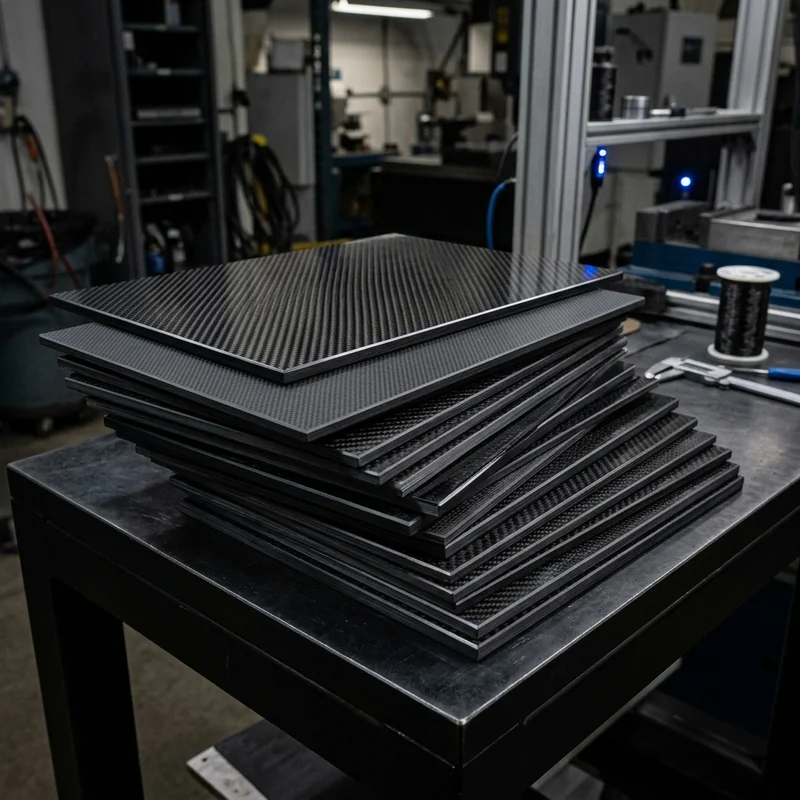
Carbon fiber standard plate-3k stripe
Lightweight, ultra-rigid standard sheets for drone fuselages, robot housings, facades and structural applications.

Carbon Fiber Plate — 3K Twill T700 3.0mm
Medium-thickness 3.0mm carbon fiber plate offering significantly higher load capacity while maintaining attractive 3K twill finish. Suitable for structural brackets, reinforcement plates, and load-bearing panels.

Carbon Fiber Plate — 3K Twill T700 1.5mm
Thin 1.5mm carbon fiber plate with 3K twill weave surface. Lightweight and stiff, commonly used for covers, panels, drone bodies, and applications requiring a premium aesthetic appearance.

Square Carbon Fiber Tube — 3K Twill T700
Square cross-section carbon fiber tube manufactured with 3K twill weave for torsional strength. Preferred for structural frames, trusses, and support columns where rectangular geometry offers design flexibility.
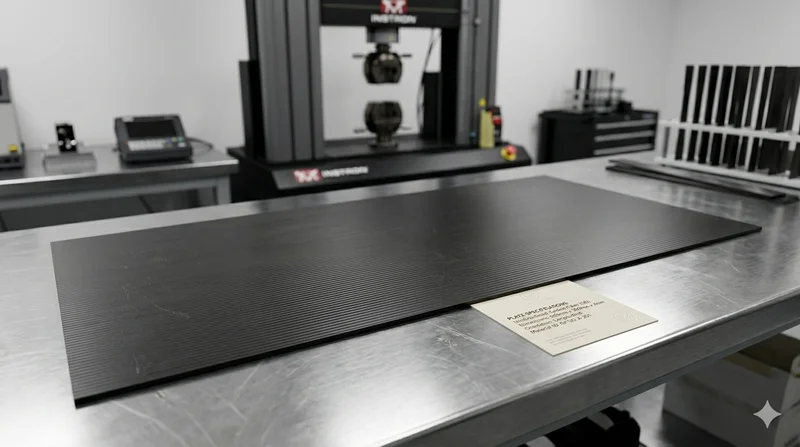
Carbon Fiber Plate — UD Unidirectional T700
Unidirectional carbon fiber plate with all fibers oriented in a single direction for maximum strength along the fiber axis. Essential for structural reinforcements, splints, and applications where load direction is predictable.