
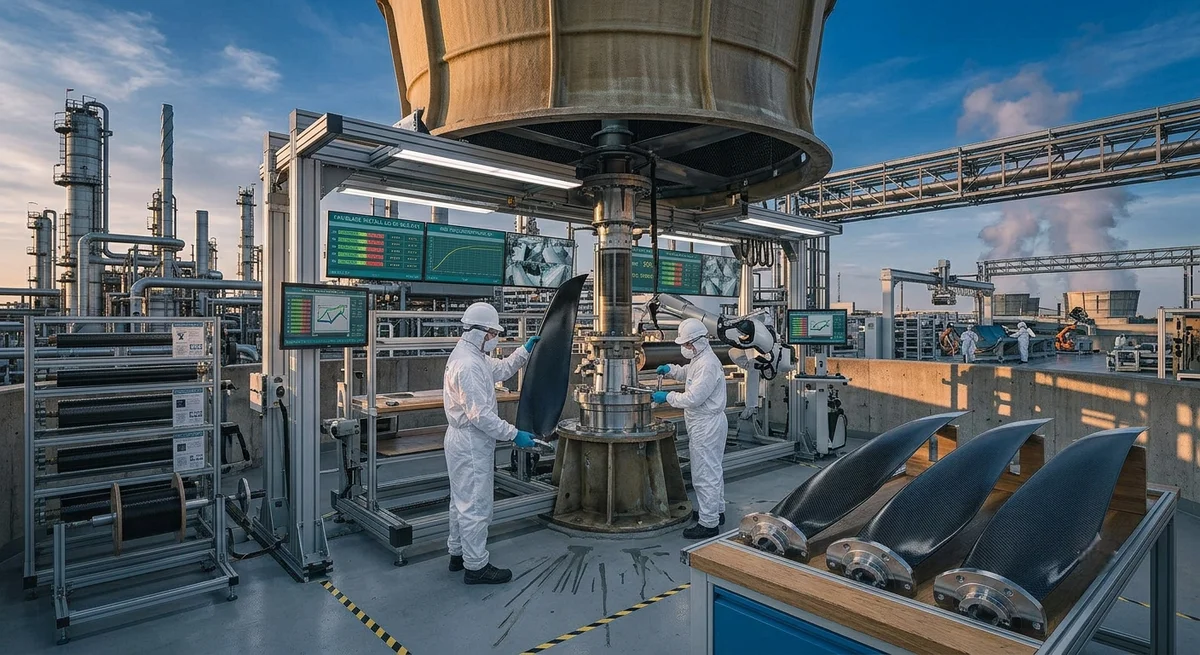
| | Initial blade set (6 blades, 2.4m fan) | $4,800 | $14,400 | −$9,600 | | Installation labor | $1,200 | $600 | +$600 | | Energy cost (8,000 hrs/yr × 10 yr) | $438,000 | $426,000 | +$12,000 | | Maintenance and inspections | $3,200 | $800 | +$2,400 | | Bearing replacements (2× vs 1×) | $4,600 | $2,3
| Density | 1.55–1.75 | 2.70 | 7.85 | 1.80–2.10 | g/cm³ |
|---|---|---|---|---|---|
| Tensile strength | 600–1,200 | 260–310 | 400–550 | 200–350 | MPa |
| Specific strength | 343–774 | 96–115 | 51–70 | 95–190 | MPa/(g/cm³) |
| Tensile modulus | 70–120 | 68–70 | 200–210 | 15–25 | GPa |
| Fatigue endurance limit (% UTS) | 60–70 | 25–35 | 40–50 | 25–35 | % |
| Thermal conductivity | 0.5–1.0 (transverse) | 167 | 50 | 0.3–0.5 | W/m·K |
| CTE | −1 to 0 | 23.6 | 11.7 | 5–6 | ×10⁻⁶/°C |
| Corrosion resistance | Excellent | Moderate (pitting) | Poor (rust) | Good | — |
| Typical blade weight (1.5m Ø fan) | 2.8–4.2 kg | 6.5–8.0 kg | 18–25 kg | 4.5–6.0 kg | kg |
| Relative material cost | 4.0–6.0× aluminum | 1.0× (baseline) | 0.5–0.7× | 0.8–1.2× | — |
Energy Efficiency Analysis
The most compelling case for carbon fiber fan blades is energy savings. A fan's power consumption follows the cube of rotational speed (Affinity Laws), but even at constant speed, blade weight reduction produces measurable efficiency gains.
| Fan Size | Motor Power | Alum. Blades | CF Blades | Weight Savings | Annual Energy Savings (8,000 hrs) | CO₂ Reduction |
|---|---|---|---|---|---|---|
| 1.2 m Ø axial fan | 15 kW | 5.2 kg/blade | 2.1 kg/blade | 60% | 1,850–2,400 kWh | 1,200–1,580 kg/yr |
| 1.8 m Ø cooling tower fan | 37 kW | 12.8 kg/blade | 4.5 kg/blade | 65% | 4,200–5,600 kWh | 2,760–3,680 kg/yr |
| 2.4 m Ø process fan | 75 kW | 22.0 kg/blade | 7.8 kg/blade | 65% | 8,500–11,200 kWh | 5,590–7,360 kg/yr |
| 3.0 m Ø mine ventilation fan | 150 kW | 38.0 kg/blade | 13.5 kg/blade | 64% | 16,000–21,000 kWh | 10,520–13,800 kg/yr |
The savings come from:
- Reduced rotational inertia: Lower moment of inertia means faster ramp-up to operating speed and less energy lost during deceleration cycles. For variable-speed fans (VFD-controlled), the energy savings from reduced inertia can reach 8–15% of total fan energy consumption.
- Lower bearing friction: 50–70% lighter blades reduce radial and axial bearing loads by 40–60%, decreasing frictional losses and extending bearing service life from 3–5 years to 8–12 years.
- Improved aerodynamic efficiency: The ability to mold complex 3D aerodynamic profiles in carbon fiber—including swept-tip designs and variable-camber sections—improves static efficiency by 3–7 percentage points over flat or simple-curved metal blades.
Corrosion Resistance and Chemical Compatibility
For industrial process cooling applications, corrosion is the primary failure mode for metal fan blades. Carbon fiber composites offer exceptional chemical resistance across a wide range of environments.
| Chemical Environment | Aluminum Blades | Steel Blades | CF Blades (Epoxy Matrix) |
|---|---|---|---|
| Salt spray (marine) | Severe pitting after 500 hrs | Rapid rust after 100 hrs | No degradation after 5,000 hrs |
| 10% sulfuric acid | Severe corrosion | Severe corrosion | Good (surface epoxy protected) |
| Chlorinated water (cooling towers) | Pitting and crevice corrosion | Rust and scale formation | Excellent, no degradation |
| 30% sodium hydroxide | Moderate corrosion | Severe corrosion | Good (resin-dependent) |
| Ammonia atmosphere | Stress corrosion cracking risk | Moderate corrosion | Excellent |
| SO₂/NOx (industrial exhaust) | Surface oxidation, gradual thinning | Rapid rust, section loss | Excellent with proper resin selection |
| 100% relative humidity condensate | Surface oxidation, staining | Rapid onset rust | No effect |
Note: Resin selection is critical for chemical resistance. For aggressive chemical environments, bisphenol A vinyl ester or novolac epoxy matrices are recommended over standard epoxy systems.
Installation and Maintenance Advantages
- Lighter handling: A single technician can safely handle and install a 1.5-meter carbon fiber blade (2.8–4.2 kg), versus two technicians for an equivalent aluminum blade (6.5–8.0 kg). This reduces installation labor costs by 30–50% and eliminates the need for mechanical lifting aids on smaller fans.
- No corrosion monitoring: Unlike metal blades that require periodic inspection for pitting, rust, and stress corrosion cracks, carbon fiber blades require only visual inspection for impact damage and surface coating integrity.
- Extended balancing intervals: The dimensional stability and uniform density of carbon fiber parts mean that factory-balanced blades maintain their balance specification 3–5× longer than metal blades, reducing field rebalancing frequency.
- Reduced motor bearing replacements: The 50–70% weight reduction directly translates to 40–60% lower bearing loads, with documented service life extensions from 3–5 years to 8–12 years in continuous-duty installations.
- Drop-in retrofit capability: Most carbon fiber fan blades are designed with standard mounting interfaces (tapered shafts, flange plates, or clamping hubs) that are compatible with existing fan hubs and drive systems, requiring no modification to the motor or drive train.
Cost Analysis: Total Cost of Ownership (10-Year Model)
| Cost Category | Aluminum Blades | CFRP Blades | CF Savings |
|---|---|---|---|
| Initial blade set (6 blades, 2.4m fan) | $4,800 | $14,400 | −$9,600 |
| Installation labor | $1,200 | $600 | +$600 |
| Energy cost (8,000 hrs/yr × 10 yr) | $438,000 | $426,000 | +$12,000 |
| Maintenance and inspections | $3,200 | $800 | +$2,400 |
| Bearing replacements (2× vs 1×) | $4,600 | $2,300 | +$2,300 |
| Corrosion-related repairs | $2,500 | $0 | +$2,500 |
| Total 10-Year Cost | $454,300 | $444,100 | +$10,200 |
| CF Payback Period | — | 3.2 years | — |
Even at a 3× initial cost premium, carbon fiber fan blades achieve cost parity within 3–4 years in continuous-duty applications, and deliver net savings over 10 years.
Case Study: Chemical Plant Cooling Tower Retrofit
A chlor-alkali chemical plant in Germany replaced six 2.4-meter aluminum axial fan blades on a fiberglass-reinforced plastic (FRP) cooling tower with carbon fiber blades in early 2024. The operating environment included chlorinated water mist, atmospheric salt, and intermittent SO₂ exposure. Results after 18 months:
- Motor current draw reduced by 9%, translating to 6,700 kWh annual savings per fan
- No corrosion damage detected (vs. moderate pitting on the removed aluminum blades after just 18 months)
- Vibration levels reduced from 4.2 mm/s to 1.8 mm/s (ISO 10816-3)
- Bearing temperatures reduced by 8°C due to lower radial loads
- Project ROI achieved in 3.2 years at current energy prices
Sourcing Considerations for B2B Buyers
- Supplier qualification: Verify that the CFRP blade manufacturer has ISO 9001:2015 and preferably AS9100 (aerospace) or EN 13445 (pressure vessel) certifications, ensuring consistent quality and traceability.
- Performance validation: Request static load and fatigue test data specific to the blade design. A reputable supplier will provide S-N curves for 10⁷ cycles minimum, demonstrating the endurance limit.
- Aero-acoustic optimization: Carbon fiber blades can be designed with specific trailing edge geometries and tip treatments that reduce noise by 2–5 dB(A) compared to metal blades, a valuable feature for noise-sensitive installations.
- UV and erosion protection: Ensure the blade surface includes a UV-resistant topcoat (polyurethane or acrylic) and optional leading edge protection for particulate-laden air streams.
- Custom tooling: For OEM applications requiring unique blade geometries, expect a one-time mold tooling charge of $5,000–$25,000 depending on blade size and complexity, with a lead time of 6–10 weeks.
Frequently Asked Questions
Q: Can carbon fiber fan blades be repaired if damaged?
A: Yes, minor damage (surface scratches, small edge chips, leading edge erosion) can be repaired using carbon fiber patch kits specifically formulated for composite fan blades. Major structural damage (through-cracks, delamination >50 mm diameter) typically requires blade replacement. Many suppliers offer a repair service with turnaround times of 5–10 business days. Unlike metal blades, composite repairs (when done correctly) can restore 90–100% of original strength.
Q: Do carbon fiber blades pose electrical safety risks in industrial environments?
A: Carbon fiber is electrically conductive, which requires attention in two areas: (1) Lightning strike protection for outdoor cooling tower and exhaust fans—this is addressed by incorporating a copper mesh or aluminum flame-sprayed layer in the blade layup; (2) Grounding—the fan hub must be bonded to ground to prevent electrostatic charge accumulation. When properly designed with these features, CFRP blades meet all applicable electrical safety standards (IEC 60079 for hazardous locations, ATEX Directive 2014/34/EU for explosive atmospheres).
Q: What is the typical service life of a carbon fiber fan blade?
A: With proper design and manufacturing quality, carbon fiber fan blades have an operational service life of 15–25 years in continuous industrial service, versus 8–12 years for aluminum and 5–8 years for steel blades in similar environments. The primary life-limiting factors are UV degradation of the surface coating (requiring recoating every 5–8 years) and potential impact damage from debris ingestion. The carbon fiber laminate itself has essentially infinite fatigue life when operated below the endurance limit.
Q: Are carbon fiber fan blades suitable for high-temperature process flows (150–250°C)?
A: Yes, with appropriate resin system selection. Standard epoxy systems are rated for continuous service up to 120–150°C. For higher temperatures (150–250°C), bismaleimide (BMI) or polyimide resin systems are recommended, though these increase blade cost by 40–80% and require longer cure cycles. Cyanate ester systems offer an intermediate option with 200–230°C service temperature and 20–30% cost premium over standard epoxy. Always consult the blade manufacturer for temperature-specific performance data.
Q: How do carbon fiber blade costs scale with production volume?
A: For quantities of 50–200 blade sets per year, expect $1,800–2,800 per blade (2.4 m diameter range). At 200–1,000 sets per year, volume pricing drops to $1,200–1,800 per blade. Above 1,000 sets, automated layup and compression molding can bring costs to $800–1,200 per blade. As a rule of thumb, carbon fiber blades reach cost parity with aluminum at a 3–4× price premium when energy costs, maintenance savings, and extended service life are factored in. For OEMs producing large volumes, custom mold tooling amortization can further reduce per-unit costs by 15–25%.
Conclusion
Carbon fiber industrial fan blades represent a mature, technically validated solution for B2B buyers seeking to differentiate their product lines through energy efficiency, corrosion resistance, and lower total cost of ownership. The technology has moved beyond early adoption into mainstream commercial deployment, with thousands of installations worldwide across HVAC, process cooling, power generation, and chemical processing sectors.
For HVAC equipment manufacturers and industrial process cooling OEMs, the message is clear: carbon fiber fan blades are no longer a premium option for niche applications—they are a cost-competitive, performance-enhancing solution with a proven ROI. As carbon fiber pricing continues its long-term downward trend (2–4% annual reduction) and manufacturing automation improves, the economic case for carbon fiber fan blades will only strengthen.
Related Articles
- Carbon Fiber Mooring for Floating Offshore Wind: Fatigue and Corrosion in Deep Water
- Carbon Fiber Bicycle Frame Optimization: Layup Design and Manufacturing for Competitive Racing
- Carbon Fiber CFRP Retrofit for Infrastructure: Bridge and Building Seismic Strengthening
- Carbon Fiber Medical Imaging Equipment: Lightweight Gantry and Couch Structures for MRI/CT
- Carbon Fiber EV Battery Enclosures: Crash Safety and Electromagnetic Shielding Design
- Carbon Fiber Structures for Low-Altitude Economy: UAV Airframes and eVTOL Components
Interested in Our Products?
Contact our team for competitive pricing and technical specifications.
Get a QuoteRelated Products
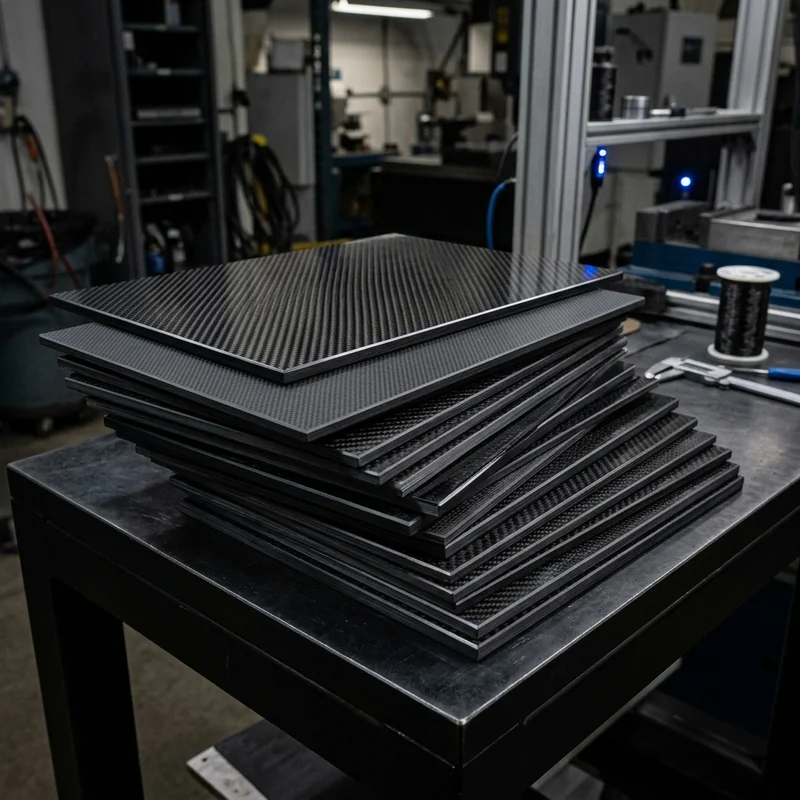
Carbon fiber standard plate-3k stripe
Lightweight, ultra-rigid standard sheets for drone fuselages, robot housings, facades and structural applications.

Carbon Fiber Plate — 3K Twill T700 1.5mm
Thin 1.5mm carbon fiber plate with 3K twill weave surface. Lightweight and stiff, commonly used for covers, panels, drone bodies, and applications requiring a premium aesthetic appearance.

Square Carbon Fiber Tube — 3K Twill T700
Square cross-section carbon fiber tube manufactured with 3K twill weave for torsional strength. Preferred for structural frames, trusses, and support columns where rectangular geometry offers design flexibility.

Carbon Fiber Plate — 3K Twill T700 3.0mm
Medium-thickness 3.0mm carbon fiber plate offering significantly higher load capacity while maintaining attractive 3K twill finish. Suitable for structural brackets, reinforcement plates, and load-bearing panels.
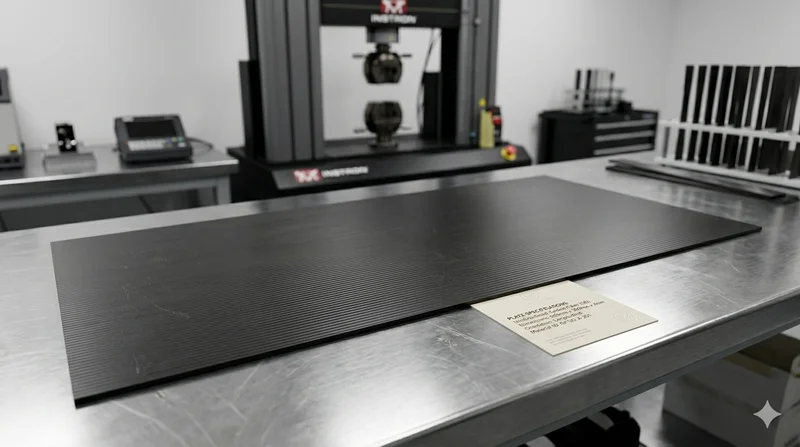
Carbon Fiber Plate — UD Unidirectional T700
Unidirectional carbon fiber plate with all fibers oriented in a single direction for maximum strength along the fiber axis. Essential for structural reinforcements, splints, and applications where load direction is predictable.