
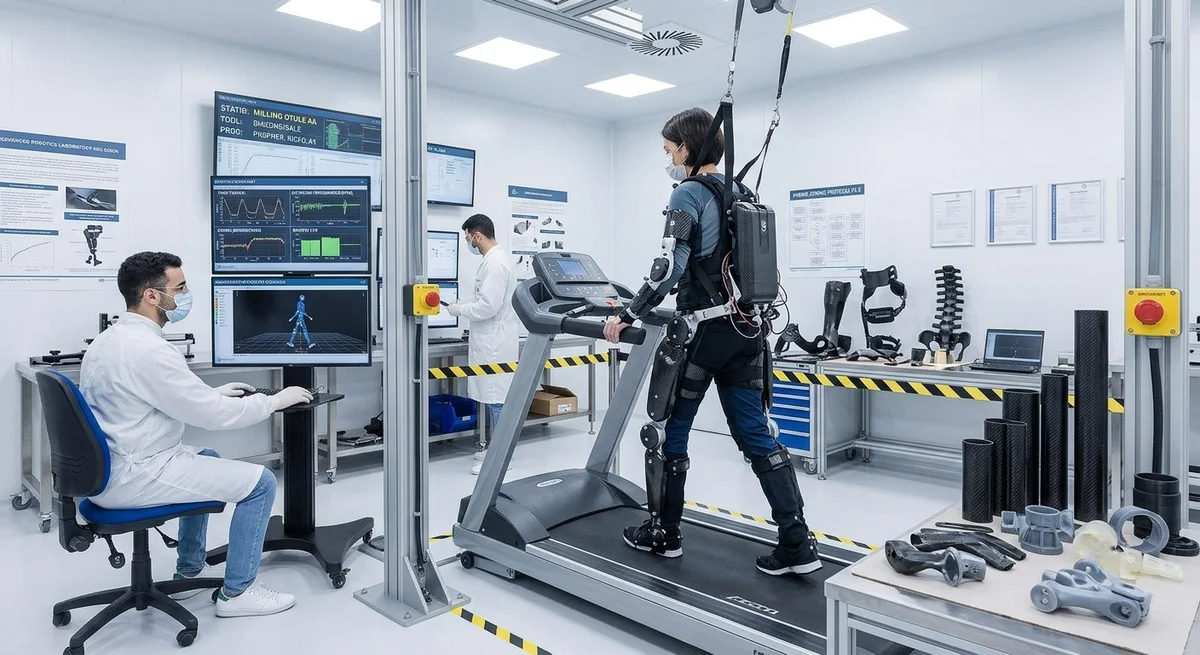
How carbon fiber composites enable lighter, stronger robotic exoskeletons for medical rehabilitation and industrial strength augmentation — material selection, structural design, and manufacturing methods.
Carbon Fiber in Robotic Exoskeletons: Structural Design for 2026
The global robotic exoskeleton market reached $1.8 billion in 2026, with carbon fiber composites playing a critical enabling role. Every kilogram of weight reduction directly translates to lower actuator torque requirements, longer battery life, and improved user comfort. This article examines how B2B buyers in medical and industrial sectors can leverage carbon fiber for exoskeleton structural components.
Material Properties Comparison for Exoskeleton Structures
| Property | Carbon Fiber (Standard Modulus) | Carbon Fiber (High Modulus) | Aluminum 7075-T6 | Titanium Ti-6Al-4V | CF Advantage |
|---|---|---|---|---|---|
| Density (g/cm³) | 1.55–1.60 | 1.60–1.65 | 2.81 | 4.43 | 44–65% lighter |
| Tensile modulus (GPa) | 135–150 (fabric) | 220–240 (unidirectional) | 71.7 | 113.8 | 1.2–3.4× |
| Specific stiffness (MN·m/kg) | 84–94 | 133–150 | 25.5 | 25.7 | 3.3–5.9× |
| Fatigue strength @10⁷ cycles | 60–70% of UTS | 55–65% of UTS | 30–40% of UTS | 50–60% of UTS | 1.5–2.3× |
| Vibration damping (tan δ) | 0.010–0.025 | 0.008–0.015 | 0.001–0.002 | 0.001–0.003 | 5–25× better |
| Thermal expansion (×10⁻⁶/°C) | 0–2 (quasi-isotropic) | −1 to 0 (0° direction) | 23.6 | 8.6 | Near-zero |
| Cost per kg (raw material) | $25–45 | $50–90 | $8–15 | $35–80 | — |
Key Structural Components in Exoskeletons
- Thigh and shank links: Load-bearing structural frames that connect hip, knee, and ankle joints. Carbon fiber pultruded tubes or braided prepreg layups replace aluminum extrusions, saving 40–55% weight while maintaining torsional stiffness. Typical wall thickness: 1.5–3.0 mm for medical exoskeletons, 2.5–5.0 mm for industrial load-bearing units.
- Backpack frame / torso support: The primary load path for industrial exoskeletons transferring payload to the ground. Hybrid carbon-glass prepreg (carbon 0°/glass ±45°) provides optimal stiffness-to-cost ratio. Weight target: <2.5 kg for a full torso assembly rated to 40 kg payload.
- Foot plates and ankle braces: High-cycle fatigue components requiring both stiffness and impact resistance. Carbon fiber with 2×2 twill weave (200–400 gsm) offers the best balance of conformability and strength for anatomical shapes.
- Joint housings: Thin-walled carbon fiber shells encapsulating actuators and sensors. Quasi-isotropic layup [0/45/90/−45]ₛ provides stiffness in all directions with minimum weight. Typical thickness: 0.8–1.5 mm.
- Adjustable arm supports (medical): Cantilevered structures supporting patient arm weight during rehabilitation. Carbon fiber's high specific stiffness (3–5× aluminum) reduces end-point deflection by 60–80% at the same weight.
Manufacturing Methods for Exoskeleton Components
| Method | Typical Parts | Tooling Cost | Volume Suitability | Cycle Time | FVF Achievable |
|---|---|---|---|---|---|
| Prepreg compression molding | Thigh links, torso frames | $5,000–20,000 | 1,000–50,000/yr | 15–45 min | 55–65% |
| Braided sleeve + resin infusion | Tubular links, arm supports | $1,000–5,000 | 100–5,000/yr | 60–120 min | 50–58% |
| 3D printing (CF-PA/CF-PEEK) | Custom braces, joint housings | $0 (no tooling) | 1–500/yr (custom) | 2–8 hours | 35–50% |
| Hand lay-up + vacuum bagging | Prototypes, complex curves | $500–3,000 | 1–100/yr | 4–24 hours | 40–55% |
| Filament winding | Thigh links (hollow) | $3,000–8,000 | 500–10,000/yr | 20–40 min | 60–68% |
Weight Budget: Typical Medical Exoskeleton (30 kg patient, lower-limb)
| Subsystem | Current Aluminum Design | Carbon Fiber Design | Weight Saved |
|---|---|---|---|
| Thigh links (pair) | 1.2 kg | 0.55 kg | 0.65 kg (54%) |
| Shank links (pair) | 0.9 kg | 0.42 kg | 0.48 kg (53%) |
| Torso/backpack frame | 1.8 kg | 0.85 kg | 0.95 kg (53%) |
| Foot plates (pair) | 0.6 kg | 0.28 kg | 0.32 kg (53%) |
| Joint housings (×4) | 0.8 kg | 0.35 kg | 0.45 kg (56%) |
| Adjustable supports | 0.5 kg | 0.22 kg | 0.28 kg (56%) |
| Total structural mass | 5.8 kg | 2.67 kg | 3.13 kg (54%) |
Design Considerations for B2B Buyers
- Certification requirements: Medical exoskeletons require ISO 13485 (quality management) and IEC 60601 (electrical safety). Structural composites should be tested per ASTM D3039 (tensile), D3410 (compression), and D3518 (shear). Industrial exoskeletons follow ISO 13482 for personal care robots.
- Fatigue life target: Minimum 5×10⁶ cycles for medical (therapy sessions), 10⁷ cycles for industrial (8-hour daily use). Carbon fiber composites comfortably exceed these targets at 40–50% of ultimate stress.
- Hygiene and cleaning: Carbon fiber surfaces must be sealed with polyurethane or epoxy topcoat for chemical resistance (disinfectants: ethanol, isopropyl alcohol, hydrogen peroxide). Gel coat finish preferred for easy cleaning.
- Interface with actuators: Metal inserts (stainless steel or titanium) bonded with epoxy film adhesive at joint interfaces. Bond line thickness: 0.10–0.25 mm. Pull-out strength: >800 N for M4 inserts.
- Batch-to-batch consistency: Specify ASTM D6856 for statistical process control of composite laminates. Target CV <5% for thickness and <8% for mechanical properties.
Q: What is the cost premium for switching from aluminum to carbon fiber in exoskeleton manufacturing?
A: For a typical lower-limb medical exoskeleton (production volume 2,000 units/year), the structural component cost increases from approximately $85 (aluminum, CNC machined + anodized) to $210 (carbon fiber prepreg, compression molded) — a 2.5× premium. However, the 3.1 kg weight reduction enables: (1) smaller actuators (saving $60–120 per unit), (2) reduced battery capacity by 30% (saving $25–40), and (3) improved clinical outcomes (shorter therapy duration, higher patient throughput). The net system cost increase is approximately 8–15%, with a payback period of 12–18 months through higher utilization. For industrial exoskeletons, the weight savings directly increase worker productivity — one German automotive assembly line study (2025) showed a 22% reduction in fatigue-related errors and 15% faster task completion with carbon fiber exoskeletons vs aluminum equivalents at 30% higher unit cost.
Q: Which carbon fiber form is best suited for exoskeleton link manufacturing?
A: The optimal material form depends on production volume and part geometry. For high-volume (>5,000 units/year) exoskeleton links with consistent geometry, non-crimp fabric (NCF) prepreg in compression molding is the industry standard — offering 55–65% FVF, excellent fiber alignment, and 15–30 minute cycle times. For medium-volume (500–5,000 units/year), braided carbon sleeves with resin transfer molding (RTM) provide cost-effective tooling (aluminum molds at $3,000–8,000) and produce hollow tubular links with integrated end fittings. For low-volume custom medical exoskeletons (<500 units/year), continuous carbon fiber 3D printing (CF-PA12 or CF-PEEK) enables patient-specific geometries without tooling investment, though at lower FVF (40–50%) and higher per-part cost. Twill weave prepreg (2×2, 200 gsm) remains the most versatile option for prototype-to-production transitions.
Q: How do carbon fiber exoskeletons perform in impact and overload scenarios?
A: Carbon fiber's limited strain-to-failure (0.5–1.5% depending on fabric architecture vs aluminum's 10–12% elongation) makes impact behavior a critical design consideration. Exoskeleton structural links should be designed with a minimum safety factor of 2.5× on ultimate strength (vs 1.5× for metal equivalents). For overload protection, three strategies are used: (1) hybrid carbon-glass layups with glass ±45° outer plies providing 200–300% higher impact energy absorption, (2) integrated crush zones at joint interfaces using aluminum honeycomb or foam cores, and (3) real-time load monitoring with strain gauges or FBG sensors embedded in the composite laminate. Drop-weight impact testing per ASTM D7136 should be conducted at 5 J (medical) to 15 J (industrial) impact energy levels. With proper design, carbon fiber exoskeleton links demonstrate equivalent or better energy absorption than aluminum at 50% lower mass.
Part of topic
Related Articles
- Carbon Fiber Mooring for Floating Offshore Wind: Fatigue and Corrosion in Deep Water
- Carbon Fiber Bicycle Frame Optimization: Layup Design and Manufacturing for Competitive Racing
- Carbon Fiber CFRP Retrofit for Infrastructure: Bridge and Building Seismic Strengthening
- Carbon Fiber Medical Imaging Equipment: Lightweight Gantry and Couch Structures for MRI/CT
- Carbon Fiber EV Battery Enclosures: Crash Safety and Electromagnetic Shielding Design
- Carbon Fiber Structures for Low-Altitude Economy: UAV Airframes and eVTOL Components
Interested in Our Products?
Contact our team for competitive pricing and technical specifications.
Get a QuoteRelated Products

Carbon Fiber Plate — 3K Twill T700 1.5mm
Thin 1.5mm carbon fiber plate with 3K twill weave surface. Lightweight and stiff, commonly used for covers, panels, drone bodies, and applications requiring a premium aesthetic appearance.
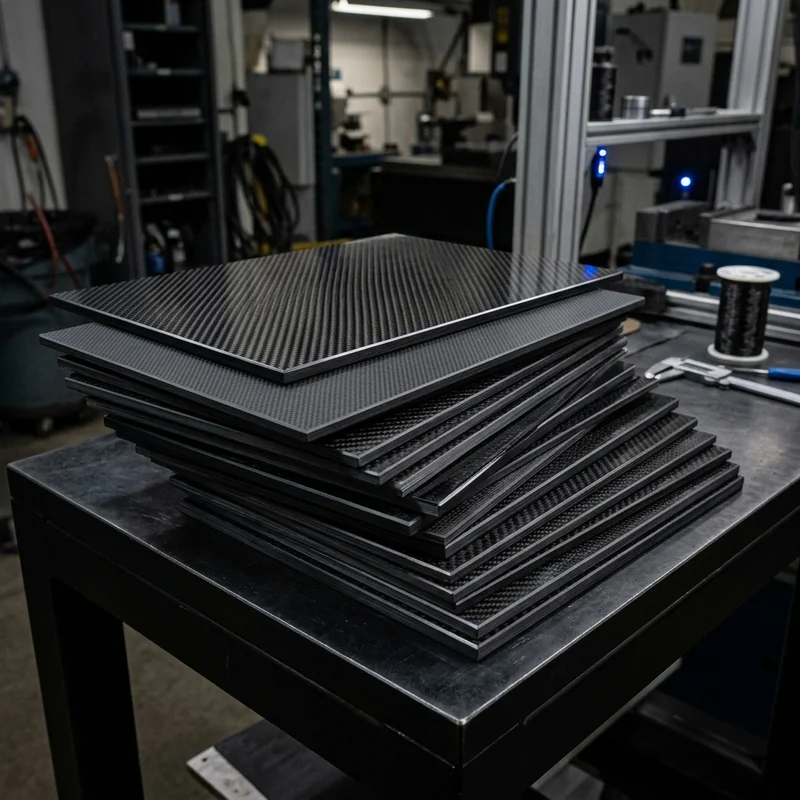
Carbon fiber standard plate-3k stripe
Lightweight, ultra-rigid standard sheets for drone fuselages, robot housings, facades and structural applications.

Square Carbon Fiber Tube — 3K Twill T700
Square cross-section carbon fiber tube manufactured with 3K twill weave for torsional strength. Preferred for structural frames, trusses, and support columns where rectangular geometry offers design flexibility.

Carbon Fiber Plate — 3K Twill T700 3.0mm
Medium-thickness 3.0mm carbon fiber plate offering significantly higher load capacity while maintaining attractive 3K twill finish. Suitable for structural brackets, reinforcement plates, and load-bearing panels.
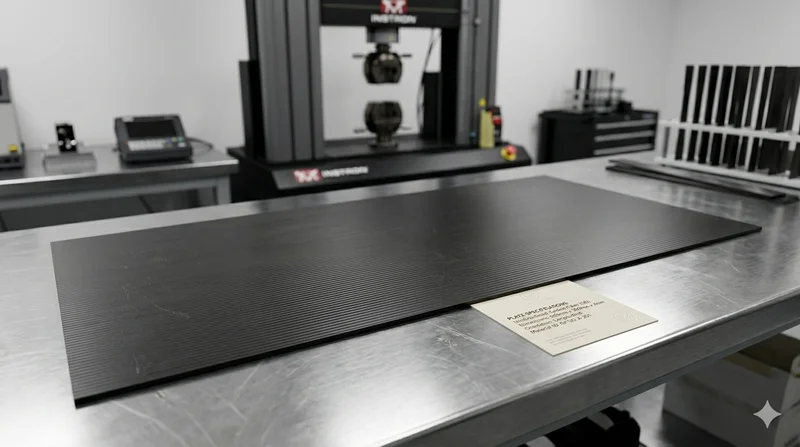
Carbon Fiber Plate — UD Unidirectional T700
Unidirectional carbon fiber plate with all fibers oriented in a single direction for maximum strength along the fiber axis. Essential for structural reinforcements, splints, and applications where load direction is predictable.