
Carbon fiber FRP reinforcement for concrete structures — wrapping, near-surface mounting, and internal rebar — with engineering data, design codes, and cost analysis for B2B construction buyers.
Carbon Fiber FRP in Construction: 2026 Engineering Guide
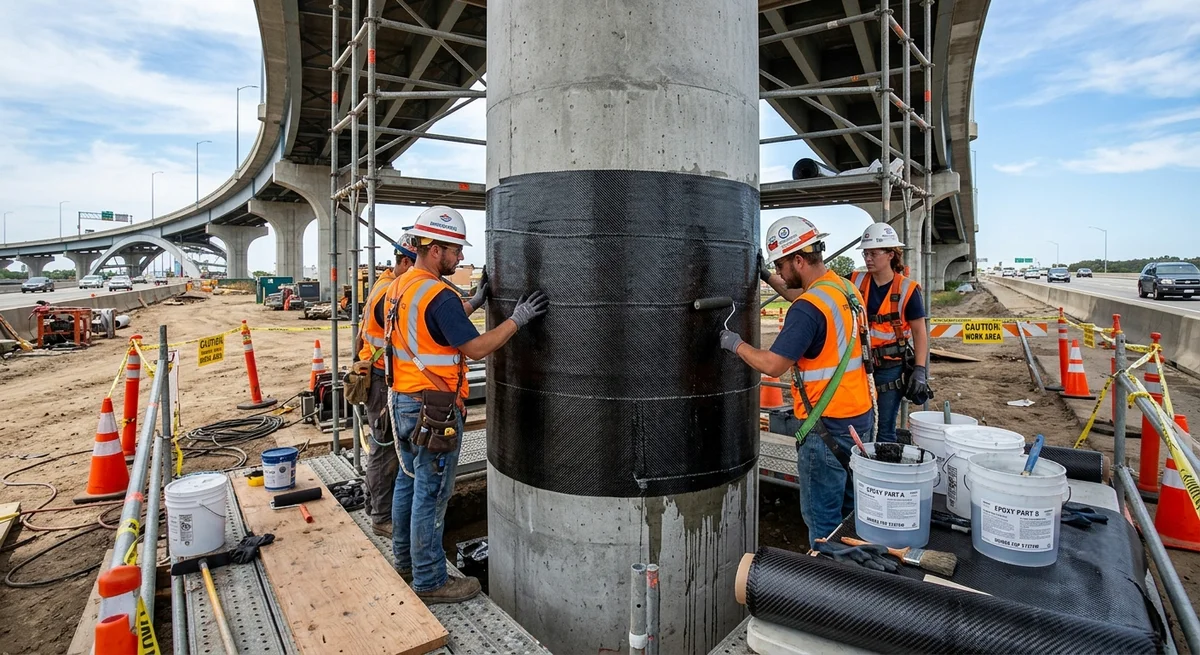
The construction industry consumed approximately 6,800 tonnes of carbon fiber in 2026 for structural reinforcement, growing at 8.5% CAGR. Carbon fiber reinforced polymer (CFRP) systems are used in three primary configurations: external bonded wrapping (EBR), near-surface mounted (NSM) strips/rods, and as internal reinforcement (CFRP rebar). This article provides engineering data for each method.
CFRP Reinforcement Methods Comparison
| Parameter | External Bonded Wrapping (EBR) | Near-Surface Mounted (NSM) | CFRP Rebar (Internal) |
|---|---|---|---|
| Fiber architecture | 0/90° fabric or unidirectional sheet | Pultruded strip or round bar | Pultruded ribbed bar |
| Typical FVF | 40-55% (wet lay-up) | 60-70% (pultruded) | 55-65% (pultruded) |
| Application thickness | 1-5 mm per layer | Strip: 10-20 mm deep | Bar: 6-32 mm diameter |
| Tensile strength (MPa) | 600-900 (per mm laminate) | 2,000-2,800 | 1,200-2,400 |
| Tensile modulus (GPa) | 40-60 | 120-165 | 100-140 |
| Bond to concrete | Epoxy adhesive | Epoxy grout in groove | Mechanical interlock (ribs/sand coating) |
| Fire protection needed? | Yes (plaster/vermiculite) | Yes (cover depth) | Inherent (concrete cover) |
| Installation rate (m²/day/crew) | 15-30 | 8-15 | N/A (cast-in-place) |
| Cost ($/m² of strengthened area) | $80-180 | $120-250 | $25-50 (rebar cost only) |
Column Wrapping for Seismic Retrofit: Design Example
A 500 mm diameter RC column with 8-φ16 mm longitudinal bars and φ8@200 mm ties is assessed as requiring seismic retrofit to achieve a ductility factor (μ) of 4.0 per ASCE 41-23. CFRP wrap design:
- Design axial load: 2,800 kN (0.25 f'c Ag)
- Target confinement pressure: f_l = 4.5 MPa (to achieve ε_cu ≥ 0.012)
- CFRP system: Unidirectional carbon fiber sheet, t_f = 0.167 mm/ply, E_f = 230 GPa, ε_fu = 0.017
- Required number of plies: 4 plies (n = f_l × D / (2 × t_f × E_f × ε_fe))
- Lap splice length: 200 mm (minimum 150 mm per ACI 440.2R-23)
- Corner radius: Minimum 25 mm (to prevent stress concentration and premature fiber rupture)
- Fiber orientation: 90° to column axis (hoop direction), with sacrificial 0° layer for protection
Design Codes and Standards (2026 Update)
| Code/Standard | Region | Scope | Key Provisions |
|---|---|---|---|
| ACI 440.2R-23 | USA | EBR and NSM design | Reduction factors: φ_f = 0.85, C_E = 0.85-0.95 |
| ASCE/SEI 41-23 | USA | Seismic retrofit | CFRP confinement models, drift limits |
| fib Bulletin 90 | Europe | FRP reinforcement design | Partial safety factors: γ_f = 1.2-1.5 |
| TR 55 (Concrete Society) | UK | EBR design | Strain limits, fire resistance |
| ISO 10406-1:2024 | International | FRP bar testing | Tensile, bond, creep rupture test methods |
| GB 50608-2024 | China | FRP in construction | Material specs, construction quality acceptance |
Cost Comparison: Concrete Column Retrofit (500 mm diameter × 4 m height)
| Method | Material Cost | Labor Cost | Total Cost | Weight Added | Ductility Improvement |
|---|---|---|---|---|---|
| Steel jacket (6 mm plate) | $2,800 | $3,200 | $6,000 | 295 kg | μ = 3.5-5.0 |
| CFRP wrap (4 plies) | $1,600 | $1,800 | $3,400 | 8.4 kg | μ = 3.8-4.5 |
| RC jacketing (150 mm) | $1,900 | $3,500 | $5,400 | 1,200 kg | μ = 3.0-4.0 |
| CFRP NSM strips | $2,100 | $2,400 | $4,500 | 3.2 kg | μ = 3.5-4.2 |
Q: What is the long-term durability of externally bonded CFRP in outdoor concrete structures?
A: Accelerated aging studies (5,000 hours QUV per ASTM G154, combined with freeze-thaw cycling per ASTM C666) show that properly installed CFRP systems retain >85% of initial tensile strength after 50-year simulated exposure, provided: (1) the epoxy adhesive has a Tg ≥60°C for outdoor use, (2) UV protection is provided by the topcoat (acrylic or polyurethane), and (3) the concrete substrate has surface strength ≥1.5 MPa (pull-off test per ASTM D4541). Field data from 20-year-old installations in Japan (Kobe Highway, retrofitted 2005) show CFRP wrap residual strength of 88-92% of original.
Q: Can CFRP reinforcement be applied to wet or underwater concrete surfaces?
A: Wet surface application is possible with specially formulated epoxy adhesives that bond to damp concrete (surface moisture ≤6% by weight, per ASTM D4263). Underwater application requires epoxy systems formulated for underwater curing (typical: bisphenol A/F blend with hydrophobic hardener). These systems have 15-25% lower bond strength than dry-cured systems — design bond stress should be reduced by 30% per ACI 440.2R-23. For submerged structures (bridge piers, marine piles), CFRP wrapping with underwater epoxy has been successfully used since the early 2000s, with documented service life exceeding 15 years in seawater splash zones.
Q: How does CFRP rebar compare to steel rebar for concrete reinforcement?
A: CFRP rebar offers 3-5× the tensile strength of Grade 60 steel (2,000-2,400 MPa vs 420 MPa) at 25% of the weight (1.9 g/cm³ vs 7.85 g/cm³). However, CFRP rebar has linear-elastic behavior to failure (no yielding) — requiring over-reinforced section design to ensure concrete crushing failure precedes rebar rupture. CFRP rebar is non-corrosive (ideal for marine, deicing-salt, and chemical environments), but costs 5-8× more than epoxy-coated steel rebar ($4-8/m for φ12 mm CFRP vs $0.80-1.20/m for steel). CFRP is also susceptible to creep rupture under sustained high stress and has reduced strength at elevated temperatures (retains 60% at 150°C, 20% at 300°C).
Part of topic
Related Articles
- Carbon Fiber Mooring for Floating Offshore Wind: Fatigue and Corrosion in Deep Water
- Carbon Fiber Bicycle Frame Optimization: Layup Design and Manufacturing for Competitive Racing
- Carbon Fiber CFRP Retrofit for Infrastructure: Bridge and Building Seismic Strengthening
- Carbon Fiber Medical Imaging Equipment: Lightweight Gantry and Couch Structures for MRI/CT
- Carbon Fiber EV Battery Enclosures: Crash Safety and Electromagnetic Shielding Design
- Carbon Fiber Structures for Low-Altitude Economy: UAV Airframes and eVTOL Components
Interested in Our Products?
Contact our team for competitive pricing and technical specifications.
Get a QuoteRelated Products
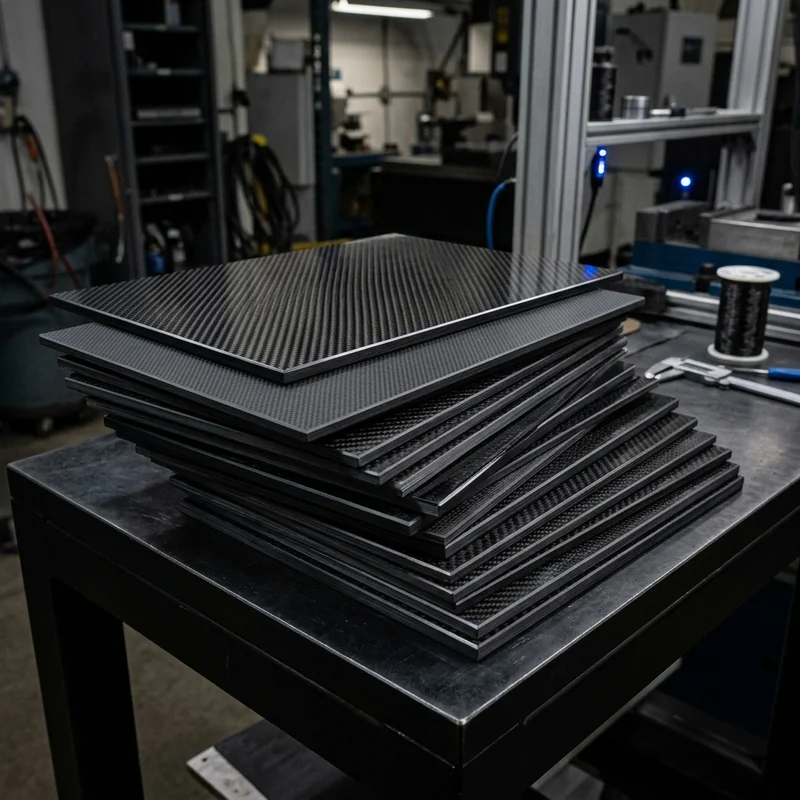
Carbon fiber standard plate-3k stripe
Lightweight, ultra-rigid standard sheets for drone fuselages, robot housings, facades and structural applications.

Carbon Fiber Plate — 3K Twill T700 1.5mm
Thin 1.5mm carbon fiber plate with 3K twill weave surface. Lightweight and stiff, commonly used for covers, panels, drone bodies, and applications requiring a premium aesthetic appearance.

Square Carbon Fiber Tube — 3K Twill T700
Square cross-section carbon fiber tube manufactured with 3K twill weave for torsional strength. Preferred for structural frames, trusses, and support columns where rectangular geometry offers design flexibility.

Carbon Fiber Plate — 3K Twill T700 3.0mm
Medium-thickness 3.0mm carbon fiber plate offering significantly higher load capacity while maintaining attractive 3K twill finish. Suitable for structural brackets, reinforcement plates, and load-bearing panels.
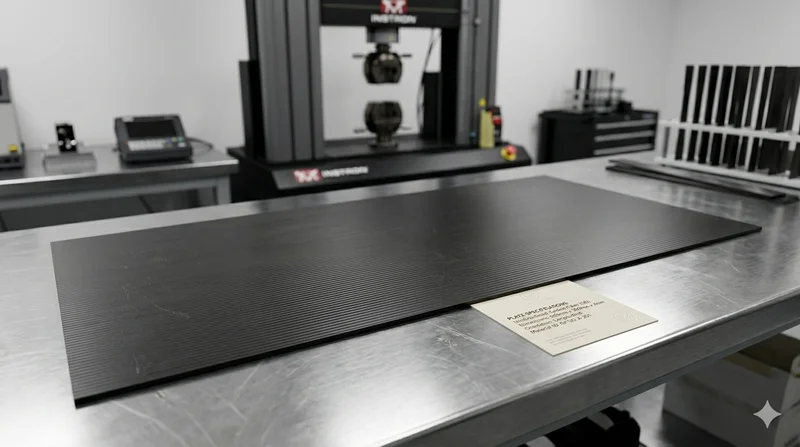
Carbon Fiber Plate — UD Unidirectional T700
Unidirectional carbon fiber plate with all fibers oriented in a single direction for maximum strength along the fiber axis. Essential for structural reinforcements, splints, and applications where load direction is predictable.