
Hydrogen fuel cell vehicles have spent two decades as a niche technology, held back less by the fuel cell stack than by storage: carrying enough hydrogen on board to deliver real range requires a tank that is simultaneously light, strong, and safe. The solution that has emerged is the T
Introduction
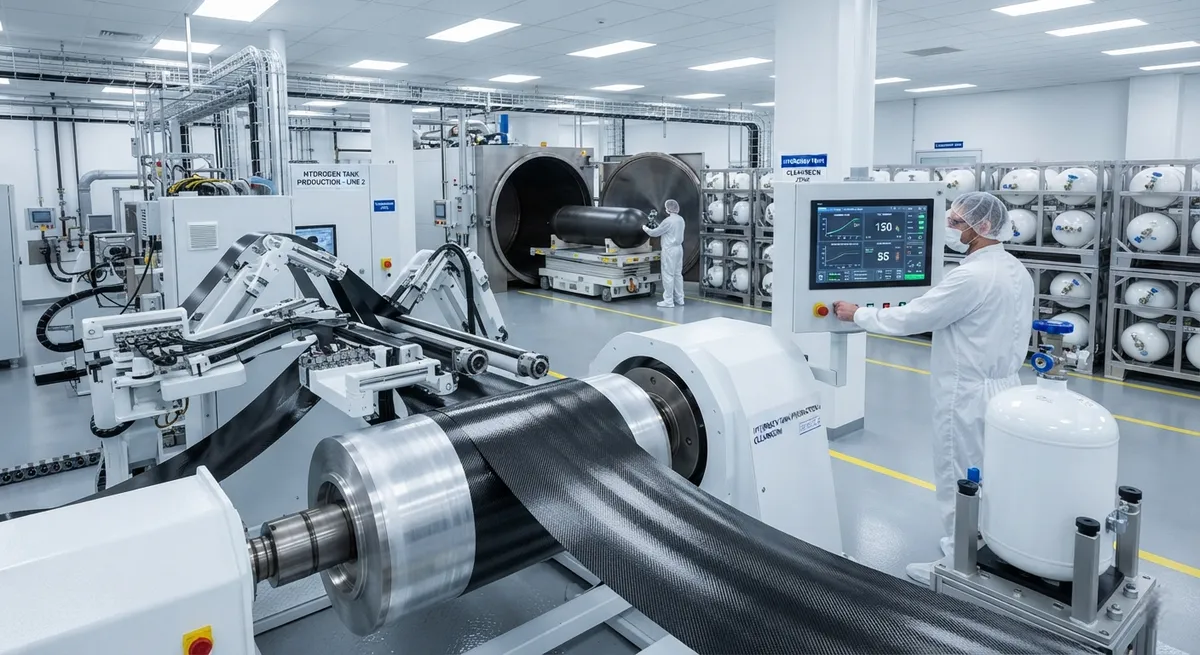
Hydrogen fuel cell vehicles have spent two decades as a niche technology, held back less by the fuel cell stack than by storage: carrying enough hydrogen on board to deliver real range requires a tank that is simultaneously light, strong, and safe. The solution that has emerged is the Type IV tank — a carbon fiber overwrapped pressure vessel with a polymer liner — operating at 70 MPa (about 700 bar). When Honda began producing the CR-V e:FCEV at its Performance Manufacturing Center (PMC) in Marysville, Ohio, it brought Type IV tank production to North American passenger vehicle manufacturing for the first time, with the tanks built on a production line that also supports the company's Class 8 hydrogen truck development.
This article looks at how the CR-V e:FCEV is made, what goes into a Type IV tank, and why the Ohio tank line matters beyond a single vehicle — as a marker for the industrialization of hydrogen storage in the US and for the carbon fiber suppliers serving that market.
The CR-V e:FCEV and Its Storage System
The CR-V e:FCEV is a plug-in fuel cell hybrid: a fuel cell system provides power, a battery adds plug-in capability, and the vehicle's total driving range is roughly 435 km (about 270 miles) per the US EPA estimate. Hydrogen is stored in Type IV tanks at 70 MPa, with a usable hydrogen capacity in the region of 4.3 kg. Several design details distinguish the vehicle:
- 70 MPa Type IV storage: The storage system uses carbon fiber composite tanks with polymer liners, the same architecture used in the previous-generation Honda Clarity Fuel Cell, refined for production efficiency.
- Plug-in architecture: The rechargeable battery extends daily driving range on electricity alone, positioning the vehicle as a practical first hydrogen ownership experience in markets with limited hydrogen stations.
- US assembly: The CR-V e:FCEV is assembled at the PMC in Ohio on a low-volume, high-craft production site that Honda retooled specifically for specialty vehicles, with the fuel cell system and tank integration performed in the same facility.
For the hydrogen storage industry, the notable fact is less the vehicle itself than the production environment: Type IV tanks are now being manufactured and integrated into a passenger vehicle on US soil, on a line designed for repeatable, certified composite pressure vessel output.
What a Type IV Tank Actually Contains
A Type IV hydrogen tank is a pressure vessel in four functional layers. The table below summarizes each layer and its role in the 70 MPa system:
| Layer | Material | Function |
|---|---|---|
| Polymer liner | High-density polyethylene or polyamide | Hydrogen permeation barrier; the innermost sealing layer |
| Carbon fiber overwrap | High-tensile carbon fiber (typically 12K-24K tow) in epoxy resin | Carries the structural load of 70 MPa internal pressure |
| Outer surface protection | Glass fiber or protective coating layer | Protects the carbon overwrap from abrasion and impact damage |
| Valve and boss | Aluminum or stainless steel | Gas flow interface and mounting point integration |
The carbon fiber overwrap is the heart of the design. Filament wound in a controlled pattern — helical windings for axial strength and hoop windings for circumferential strength — it must contain 700 bar of pressure safely while keeping the tank light enough for a passenger vehicle. A typical 70 MPa automotive tank stores roughly 4-5 kg of hydrogen in a vessel weighing 40-60 kg, which is why carbon fiber, with its strength-to-weight ratio, is the only practical material for the job.
From Tanks to Trucks: The Shared Production Line
Honda's hydrogen strategy in the US pairs the CR-V e:FCEV with work on a Class 8 fuel cell truck, and the two programs share tank technology. Large commercial vehicles need more hydrogen than a passenger car — a Class 8 tractor typically carries 40-80 kg across multiple tanks — but the underlying Type IV architecture, manufacturing process, and safety qualification approach are the same. The Ohio line therefore produces tanks at a scale and specification that supports both vehicle classes, allowing Honda to amortize the tank production capability across programs rather than building a dedicated line for a low-volume passenger vehicle.
This shared-line model matters for the supply chain. It creates a sustained, certified demand signal for aerospace-grade-quality carbon fiber in North America — the same fiber families used in airframe and pressure vessel applications — and it gives tank manufacturers a production template for scaling from passenger-scale programs to heavy commercial programs without restarting qualification from zero.
What It Means for the US Hydrogen Supply Chain
The CR-V e:FCEV tank line is a data point in a larger industrialization trend:
- Passenger-scale Type IV manufacturing is now in the US: North America is no longer solely an import market for fuel cell vehicle storage systems; production capability now exists onshore.
- Qualification infrastructure is being built: Certified 70 MPa tank production requires hydraulic burst testing, cyclic testing, material traceability, and compliance with standards such as SAE J2579 for automotive hydrogen storage — infrastructure that benefits every future program.
- Carbon fiber demand becomes an industrial graph: Each passenger FCEV uses roughly 40-60 kg of carbon fiber in its tanks; as volumes grow from thousands to tens of thousands of vehicles annually, the graph becomes meaningful for fiber producers and prepreggers alike.
None of this implies that hydrogen passenger vehicles are about to scale overnight — refueling infrastructure, hydrogen pricing, and vehicle cost remain structural constraints. But the tank production line is the kind of long-duration, high-certainty demand that the carbon fiber industry needs to justify capacity, and it anchors hydrogen storage manufacturing squarely inside the US industrial base.
Frequently Asked Questions
Why do hydrogen fuel cell vehicles use carbon fiber tanks instead of steel?
Because hydrogen's energy density by volume is very low, a vehicle must carry it at high pressure — 70 MPa — to achieve useful range, and the tank weight at that pressure becomes the dominant constraint. A steel tank strong enough to hold 700 bar would be so heavy that it would consume the range advantage hydrogen offers. Carbon fiber composite tanks (Type IV) achieve the same pressure rating at roughly a third to a quarter of the weight of a comparable metal vessel, which is the difference between a hydrogen vehicle with 400+ km of range and one that cannot carry enough fuel to be practical. The trade-off is cost: carbon fiber storage is expensive, which is why hydrogen storage remains a significant share of total fuel cell vehicle cost.
How much hydrogen can a passenger fuel cell vehicle store, and how far does it go?
Passenger fuel cell vehicles typically store 4-6 kg of hydrogen at 70 MPa across one or more Type IV tanks. The Honda CR-V e:FCEV, for example, stores roughly 4.3 kg of usable hydrogen and achieves an EPA-estimated range of about 435 km on hydrogen, with additional plug-in electric range from its rechargeable battery. For context, 1 kg of hydrogen contains about 33.3 kWh of energy, and a fuel cell system converts it to electricity at roughly 50-60% efficiency, so a well-designed FCEV achieves around 90-100 km per kilogram of hydrogen on the highway cycle. Range is ultimately determined by tank capacity, system efficiency, and driving conditions.
What certification standards apply to automotive Type IV hydrogen tanks?
In the US, the primary standard for automotive hydrogen storage systems is SAE J2579, which covers the design, manufacturing, and qualification of compressed hydrogen storage systems for fuel cell vehicles through a combination of testing and design analysis. Globally, comparable frameworks include UN GTR No. 13 and ECE R134 for vehicle hydrogen storage, and ISO 19881 for hydrogen pressure vessels. Certification involves burst testing to a multiple of nominal working pressure, hydraulic pressure cycling, hydrogen/air cycling where applicable, drop and penetration tests, leak testing, and material traceability requirements. These standards are why Type IV tank production requires a certified facility with controlled winding, curing, and inspection processes — and why the Ohio line represents real infrastructure, not just vehicle assembly.
Conclusion
The Honda CR-V e:FCEV and its Ohio Type IV tank line mark the arrival of carbon fiber hydrogen storage in North American passenger vehicle manufacturing. The technology itself — a polymer-lined, carbon fiber overwrapped pressure vessel at 70 MPa — is mature, but its production on US soil, on a line shared with a Class 8 truck program, is a step change in industrial presence. For the carbon fiber supply chain, the significance is concrete: a certified, sustained demand for high-tensile tow used in automotive pressure vessels, with a production template that scales from cars to commercial vehicles.
For engineers and buyers evaluating hydrogen storage materials, the practical questions are fiber grade selection, tow areal weight uniformity, winding-process qualification, and certification support. Explore our carbon fiber products for pressure vessel and hydrogen storage applications, or contact our engineering team to discuss material selection and qualification support for your Type IV tank program.
Part of topic
Related Articles
- Carbon Fiber Tube for Sale: Comparing Listings and Avoiding Bad Specs
- Carbon Fiber Engine Parts: High-Temperature Performance for Racing and Performance Vehicles
- Carbon Fiber Body Parts: Automotive Exterior Panels and Structural Components
- Carbon Fiber Drone Body Manufacturing: Monocoque Design and Production Methods
- Carbon Fiber Drone Parts Supplier: FPV Frames, Arms and Structural Components
- Filament Wound Epoxy Tubes: Industrial Applications from Oil and Gas to Aerospace
Interested in Our Products?
Contact our team for competitive pricing and technical specifications.
Get a QuoteRelated Products
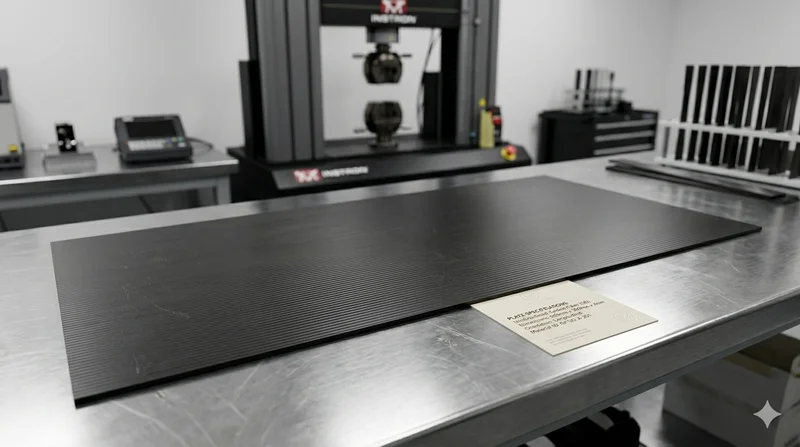
Carbon Fiber Plate — UD Unidirectional T700
Unidirectional carbon fiber plate with all fibers oriented in a single direction for maximum strength along the fiber axis. Essential for structural reinforcements, splints, and applications where load direction is predictable.

Carbon Fiber Plate — High-Gloss Decorative
High-gloss decorative carbon fiber plate with a mirror-like surface finish. The glossy coating enhances the visible 3K twill weave, creating a premium aesthetic for consumer-facing applications. Lightweight yet stiff, available in thin gauges for easy cutting and forming.
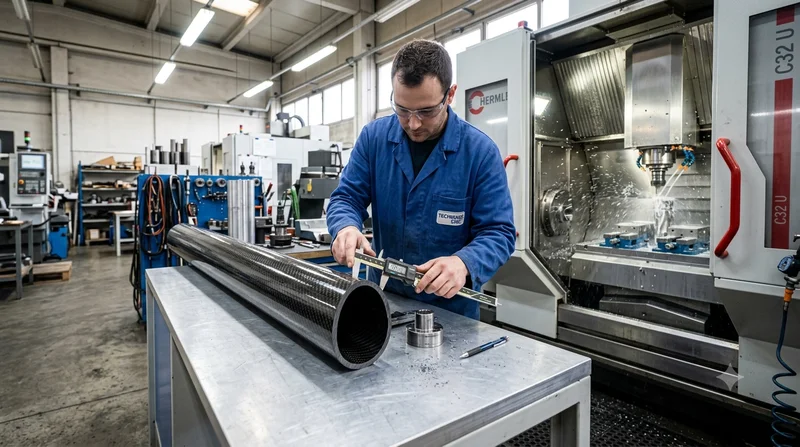
Oval/Streamline Carbon Fiber Tube
Streamline oval carbon fiber tube offering unique cross-section properties. Higher bending stiffness in the major axis direction while maintaining a slim profile. Perfect for aerodynamic applications and weight-optimized structures where space constraints demand non-round profiles.