
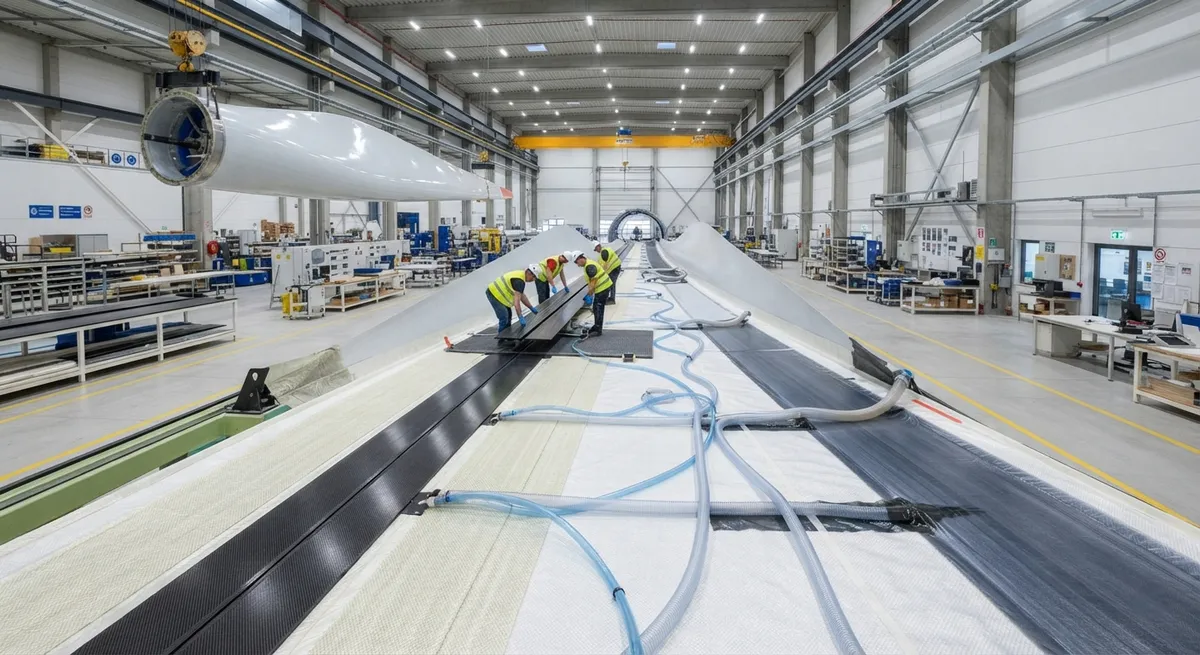
Wind blade spar caps are the primary load-carrying members of the blade: long, thick laminates that run from root to tip and resist the flapwise bending loads that dominate turbine operation. As rotor diameters have grown past 100 meters — with blades of 80-90 meters becoming standard f
Introduction
Wind blade spar caps are the primary load-carrying members of the blade: long, thick laminates that run from root to tip and resist the flapwise bending loads that dominate turbine operation. As rotor diameters have grown past 100 meters — with blades of 80-90 meters becoming standard for offshore platforms — spar caps must deliver higher stiffness with acceptable mass, because tip deflection limits and tower clearance constraints tighten with every meter of added length.
For two decades the industry answer was glass fiber: cheap, tough, and adequate for blades up to roughly 60 meters. Beyond that length, the stiffness-to-weight ratio of glass forces blade mass to grow faster than energy capture, and carbon fiber entered as the solution. But full-carbon spar caps are expensive, and their economics swing with carbon fiber prices that have moved sharply in recent years. The hybrid carbon/glass spar cap — carbon where stiffness is critical, glass where it is not — offers a middle path. A landmark validation on an 88.4-meter blade demonstrated weight reduction without added cost, and the approach is now a serious contender for next-generation 100-meter-class rotors.
Why Stiffness Dominates Spar Cap Design
Spar cap design is governed by three interacting constraints:
- Tip deflection: at full operating thrust, the blade tip must not approach the tower. Tower clearance requirements set a hard deflection budget that stiffness must satisfy.
- Gravity loads: blade mass creates cyclic gravity-induced bending, so every kilogram added to the spar cap multiplies fatigue loads across the entire blade.
- Buckling resistance: the compression side of the spar cap must resist buckling, which improves with stiffness and with sandwich construction on the cap flanges.
The stiffness challenge is quantified simply: E-glass has a tensile modulus of 85-90 GPa at a density of 2.6 g/cm³, while standard-modulus carbon fiber reaches 230-240 GPa at 1.8 g/cm³. Carbon therefore delivers roughly 2.6 times the stiffness at about 70% of the density — a specific stiffness advantage of roughly 3.5-3.7 times. For a 100-meter-class blade, that gap is the difference between a feasible design and an overweight one. The design question is not whether to use carbon, but how much, and where.
Hybrid Architectures in Practice
Hybrid spar caps place carbon only where it earns its cost. Four architectures dominate current practice:
- Chordwise hybrid: carbon pultrusions or laminates in the central cap region, glass in the cap edges and flanges. This is the most common architecture, since stiffness is needed in the cap core and glass carries the flange loads that govern buckling.
- Thickness-wise hybrid: carbon on the outer (tension) surface with glass beneath, or interleaved carbon and glass layers. This tailors stiffness distribution through the cap thickness and simplifies transitions between carbon and glass.
- Spanwise hybrid: carbon in the mid-span region where bending moments peak, transitioning to glass toward the root and tip. This maximizes material efficiency where loads are highest.
- Embedded carbon pultrusion: discrete carbon pultruded plates embedded inside a predominantly glass spar cap, providing a stiffness backbone with minimal manufacturing change.
The validated 88.4-meter blade used a hybrid layout combining carbon in the high-load regions with glass elsewhere, and the result — weight reduction at neutral cost — reflects the core economic logic: carbon is bought where its specific stiffness converts directly into structural saving, and glass is retained where it would otherwise be an idle cost.
Mechanical and Mass Trade-offs
The table below compares typical properties of all-glass, hybrid, and full-carbon spar cap configurations for a 100-meter-class blade:
| Parameter | All-Glass | Hybrid Carbon/Glass | Full Carbon |
|---|---|---|---|
| Cap tensile modulus (GPa) | 85-90 | 120-160 | 230-240 |
| Relative cap mass | 1.0 (baseline) | 0.75-0.85 | 0.55-0.65 |
| Relative material cost | 1.0 (baseline) | 1.1-1.3 | 1.6-2.2 |
| Fatigue sensitivity | Low (glass forgiving) | Moderate | Higher (strain-limited) |
| Manufacturing change | None | Moderate | High (handling, storage) |
The key insight is the region between the columns: a hybrid cap captures 40-60% of the mass saving of full carbon at 50-70% of the cost premium, with a fraction of the manufacturing risk. Whether the crossover point favors hybrid over full carbon depends on the carbon fiber price — which is exactly why hybrid designs have gained urgency during recent price volatility.
Manufacturing Considerations
Hybrid spar caps complicate manufacturing in specific, manageable ways. Pultruded carbon profiles arrive as dry, straight stock that requires humidity-controlled storage and careful handling to avoid edge damage; glass fabrics are more forgiving. Infusion compatibility is the main process risk: carbon and glass have different permeability, so resin flow front control must be tuned for the hybrid stack, and the carbon-glass interface must be designed to avoid dry spots or resin-rich zones at the transition. Vacuum infusion and resin transfer molding both handle hybrid stacks with adapted flow modeling, and the validated 88.4-meter blade demonstrates that the manufacturing risk is containable at production scale.
Quality assurance shifts as well. Ultrasonic inspection of hybrid caps must verify both the carbon region and the transition zone, and thermal imaging is increasingly used to detect porosity at carbon-glass interfaces. These are additions to existing blade QA practice, not fundamental changes, which is why OEMs view hybrid caps as a low-risk evolution rather than a new manufacturing paradigm.
The Carbon Price Hedge
The most strategic argument for hybrid spar caps is risk management. Carbon fiber prices for large-tow industrial grades have fluctuated substantially, driven by energy costs, capacity additions, and demand swings from aerospace and other sectors. A full-carbon blade design locks the economics of every blade produced to the carbon market; a hybrid design reduces carbon content per blade by 40-60%, cutting exposure proportionally. When carbon prices spike, hybrid designs remain affordable; when they fall, the hybrid architecture can be re-optimized toward more carbon. This optionality — adjusting the carbon-to-glass ratio within an already-qualified architecture — gives OEMs a hedging instrument that a fixed material choice cannot.
Frequently Asked Questions
Is a hybrid spar cap as strong and stiff as a full carbon one?
Not in raw numbers, but that is not the design objective. A hybrid cap is designed to meet the same deflection, strength, and fatigue requirements as a full carbon cap, and it does so with 40-60% of the mass saving still captured. Where full carbon provides margin beyond requirement, hybrid provides compliance with requirement at lower cost and lower risk. For stiffness-critical designs where mass is the absolute constraint — such as extreme offshore blades — full carbon may still win; for the broad range of 100-meter-class blades, hybrid meets the requirements with better economics.
How much weight does a hybrid carbon/glass spar cap save compared to all-glass?
Typically 15-25% of spar cap mass, and 5-10% of total blade mass, depending on the carbon-to-glass ratio and the blade length. The validated 88.4-meter blade demonstrated weight reduction at neutral cost, and the saving compounds across the blade: less cap mass means lower gravity-induced fatigue loads, which allows weight reduction in the webs, the skin, and the root joint. In 100-meter-class rotors, this compounding effect is often worth more than the direct cap mass saving itself.
When carbon prices fall, why not simply switch to full carbon spar caps?
Because the spar cap architecture is locked by the blade design and qualification program. The layup, the mold tooling, the infusion process, and the fatigue and static test evidence are all tied to the hybrid design; switching to full carbon requires a redesign, new tooling, and re-qualification — a multi-year, multi-million-dollar effort. The practical hedge is the opposite direction: fix a hybrid architecture that spans a range of carbon-to-glass ratios, and re-optimize the ratio within that qualified envelope as prices move. This preserves the qualification investment while capturing cost swings.
Conclusion
Hybrid carbon/glass spar caps answer the central tension of 100-meter-class blade design: how to get the stiffness that length demands without betting the blade's economics on the carbon market. By placing carbon only where stiffness converts into structural saving, hybrid designs capture 40-60% of full-carbon mass savings at 50-70% of the cost premium, with manufacturing risk proven containable at scale — the validated 88.4-meter blade is the evidence. As rotors push past 100 meters and carbon prices continue to move, the hybrid cap's flexibility to re-optimize its carbon-to-glass ratio within a qualified design makes it the rational default for next-generation blade platforms.
For blade OEMs and composite supply chains, the practical questions are carbon-to-glass ratio optimization, pultrusion supply partnerships, and qualification planning. Explore our carbon fiber and pultruded profile capabilities, or contact our engineering team to discuss hybrid spar cap material supply and development support.
Part of topic
Related Articles
- Carbon Fiber Drone Blades and Propellers: Stiffness, Balance and Noise Reduction
- Fiberglass Filament Wound Tubes: Cost-Effective Alternative to Carbon Fiber
- Filament Wound Epoxy Tube Design: Wall Thickness, Fiber Angle and Load Optimization
- Filament Wound Epoxy Tubes: Testing Standards and Quality Assurance
- Filament Wound Epoxy Tubes Manufacturing: Process and Quality Control
- Filament Wound Fiberglass Tube: Process Parameters and Performance vs Carbon Fiber
Interested in Our Products?
Contact our team for competitive pricing and technical specifications.
Get a QuoteRelated Products
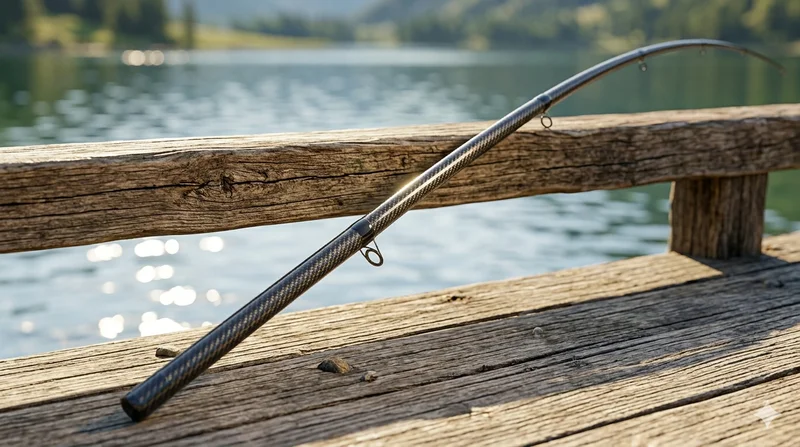
Carbon Fiber Fishing Rod Blank
High-quality carbon fiber fishing rod blank manufactured from multiple grades of Toray carbon fiber cloth. Available in a wide range of lengths, powers, and actions for freshwater and saltwater applications. Suitable for OEM rod building.
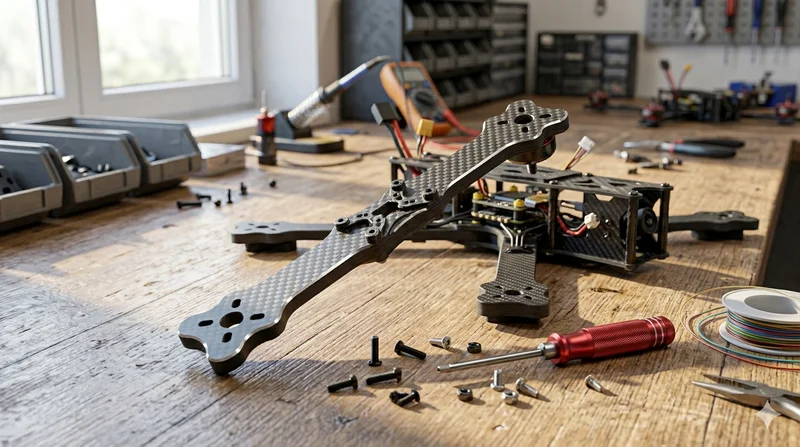
Carbon Fiber Drone Arm
Precision-molded carbon fiber drone arm combining unidirectional fiber for stiffness and woven layers for torsional strength. Designed for FPV, photography, and industrial drone platforms. Each arm is CNC-machined to exact specifications.
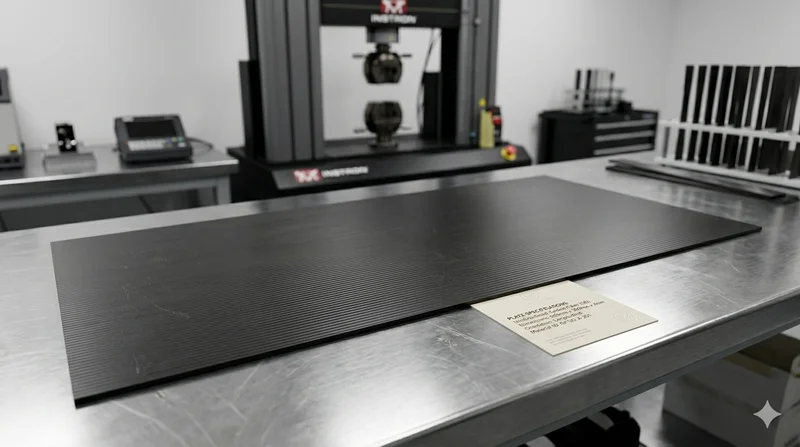
Carbon Fiber Plate — UD Unidirectional T700
Unidirectional carbon fiber plate with all fibers oriented in a single direction for maximum strength along the fiber axis. Essential for structural reinforcements, splints, and applications where load direction is predictable.
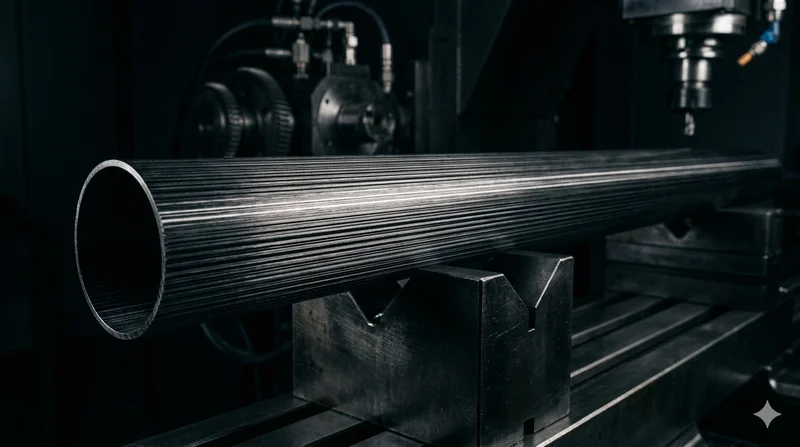
Round Carbon Fiber Tube — UD Unidirectional T700
Unidirectional (UD) round tube with all fibers aligned axially for maximum longitudinal stiffness. Ideal for applications requiring high bending rigidity with minimal weight, such as shafts, struts, and structural reinforcements.
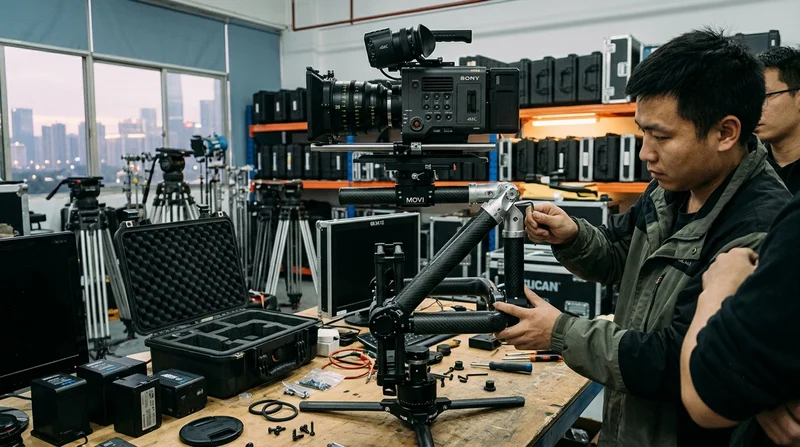
Custom Carbon Fiber Gimbal & Camera Mount
Lightweight carbon fiber gimbal arms and camera mounting components for aerial photography, film production, and broadcast applications. Our precision CNC machining ensures tight tolerances for vibration-sensitive equipment. Available in custom shapes to fit specific gimbal systems.