
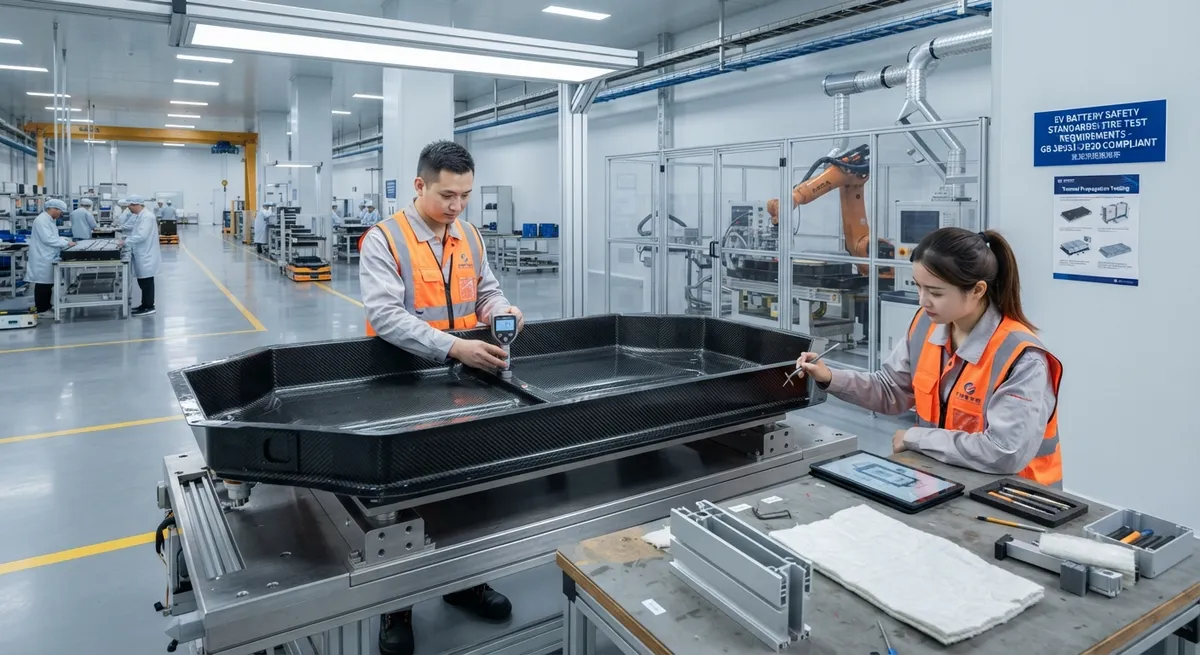
In 2025, carbon fiber battery enclosures accounted for roughly 40% of all carbon fiber used in automotive applications, and the segment is growing at a compound annual rate of 16.2%. The reason is straightforward: a carbon fiber enclosure weighs 30-40% less than an equivalent aluminum s
Introduction
In 2025, carbon fiber battery enclosures accounted for roughly 40% of all carbon fiber used in automotive applications, and the segment is growing at a compound annual rate of 16.2%. The reason is straightforward: a carbon fiber enclosure weighs 30-40% less than an equivalent aluminum structure, directly increasing EV range at a fixed battery capacity. But lightweighting is no longer the only design driver. As lithium-ion battery energy densities rise and fast-charging pushes cells harder, the enclosure has become the primary defense against thermal runaway propagation, and it must hold its structural integrity during a side impact at the same time.
This article examines the three performance pillars of the modern carbon fiber battery enclosure — thermal runaway containment, fire protection, and crash energy management — and gives B2B buyers the data needed to compare enclosure materials and protection strategies.
Why Thermal Runaway Defines Enclosure Design
Thermal runaway is the self-accelerating decomposition of a lithium-ion cell, triggered when internal temperature exceeds roughly 150-170 C. Once initiated, cell temperature can rise at more than 20 C per second, releasing flammable electrolyte vapor and reaching 600-900 C at the cell surface. If the escaping heat reaches neighboring cells, the event propagates through the pack as a chain reaction — and propagation, not the initial cell failure, is what turns a contained defect into a vehicle fire.
Regulators have responded with propagation-prevention requirements. China's GB 38031-2020 mandates that a single cell thermal runaway must not cause fire or explosion of the pack within 5 minutes of observation; the EU Battery Regulation 2023/1542 tightens this with a 60-minute evacuation requirement for large packs, and UN R100 specifies external fire resistance. These rules shift the enclosure's role from passive structure to active fire barrier, which changes material selection fundamentally.
Fire Protection Strategies for Carbon Fiber Enclosures
Standard aerospace-grade epoxy carbon fiber performs well mechanically but has a glass transition temperature around 180-200 C; sustained exposure above this softens the resin, and the resin itself is combustible. An unprotected CFRP enclosure cannot meet the 60-minute fire requirement alone. Production designs therefore combine the CFRP structure with a dedicated thermal barrier system:
- Intumescent coatings: Applied to the inner surface, these expand to 10-40 times their thickness above 200 C, forming an insulating char that slows heat transfer to the composite. They add 1-3 kg to a pack but extend fire resistance by 10-30 minutes depending on thickness.
- Ceramic fiber or mica blankets: A 3-6 mm mica or ceramic paper layer between the cells and the enclosure wall maintains temperatures below 200 C on the outer skin for 30-60 minutes during a runaway event.
- Fire-resistant thermoplastic matrices: Polyphenylene sulfide (PPS) and polyetheretherketone (PEEK) carbon fiber composites retain mechanical properties above 200 C and inherently resist combustion, eliminating most of the coating and blanket mass. Their cost is the trade-off.
- Venting and pressure management: Directional burst discs or vents release hot gas at 10-20 kPa overpressure, preventing pressure-driven structural failure that would otherwise crack the enclosure before the thermal barrier activates.
Material Comparison: Enclosure Options on Quantitative Data
| Property | Aluminum 6xxx Extrusion | AHSS Steel | CFRP (Epoxy, RTM) | CFRP (PPS, Thermoplastic) |
|---|---|---|---|---|
| Density (g/cm³) | 2.70 | 7.80 | 1.55 | 1.60 |
| Tensile modulus (GPa) | 70 | 210 | 120-150 (unidirectional) | 110-130 |
| Specific stiffness (GPa/(g/cm³)) | 26 | 27 | 77-97 | 69-81 |
| Continuous service temperature (C) | 150-200 | 400+ | 120-180 | 200-250 |
| Thermal conductivity (W/m·K) | 140-170 | 45-50 | 0.5-2 (through-thickness) | 0.5-2 |
| Fire behavior (unprotected) | Melts at 660 C | Non-combustible | Combustible resin | Self-extinguishing |
| Mid-size pack enclosure weight (kg) | 35-45 | 55-70 | 22-30 | 24-32 |
| Specific energy absorption (kJ/kg) | 40-70 | 80-110 | 90-150 | 100-160 |
| Cost index per enclosure | 1.0x | 0.7x | 1.6-2.2x | 2.0-2.6x |
Two numbers dominate this table. First, the specific stiffness of CFRP is three to four times that of aluminum, so the enclosure can be made thinner and lighter while still meeting stiffness targets for module alignment and NVH. Second, the specific energy absorption of carbon fiber — 90-160 kJ/kg — exceeds both aluminum and steel, meaning a CFRP enclosure absorbs more crash energy per kilogram than any metal alternative.
Crash Energy Management
In a side-impact event, the battery pack is the most vulnerable energy source in the vehicle: intrusion into the pack by as little as 10-20 mm can breach cells and initiate a short circuit. The enclosure's job is to convert crash kinetic energy into controlled material deformation without transferring it to the cells. Carbon fiber delivers this through its specific energy absorption: progressive crushing of a CFRP wall absorbs 90-150 kJ/kg versus 40-70 kJ/kg for aluminum extrusions, allowing a lighter structure to meet the same crash budget.
Production designs typically pair a CFRP cover or underbody panel with aluminum extrusions or steel in the side rails, tuning the energy absorption path: the metal components handle gross deformation, while the CFRP components provide stiffness and local resistance to intrusion. Where the enclosure itself is fully composite, integrally molded ribs and crash cones direct failure away from the module array.
Manufacturing Routes
Enclosure production follows three main routes today. Resin transfer molding (RTM) with woven or NCF carbon preforms is the workhorse for epoxy systems, with cycle times of 8-20 minutes per half shell and Class A-compatible surfaces. Compression molding of carbon fiber sheet molding compound (SMC-CF) reaches 3-8 minute cycles at fiber contents of 25-35% by weight, supporting mid-volume programs with lower tooling cost. Thermoplastic compression molding of CF-PPS or CF-PA66 laminates achieves 2-5 minute cycles, eliminates autoclave and post-cure steps, and — critically for this application — provides the intrinsic fire resistance and recyclability that epoxy systems lack. The trend in 2026 is toward thermoplastic matrices for enclosures, with epoxy RTM retained where thermal barriers are acceptable and cost is the priority.
Frequently Asked Questions
Does a carbon fiber battery enclosure actually prevent fires during thermal runaway?
No single material prevents thermal runaway — the enclosure contains it. A CFRP enclosure with a proper thermal barrier (intumescent coating, mica or ceramic blanket, or a fire-resistant thermoplastic matrix) keeps the outer skin below 200 C for 30-60 minutes while the pack vents hot gas through directional burst discs. This satisfies GB 38031-2020 and the EU 60-minute evacuation requirement, containing the event so it cannot propagate to the vehicle cabin. Without the barrier, an unprotected epoxy enclosure would soften and combust within minutes.
How much weight does a carbon fiber enclosure save compared to aluminum?
A carbon fiber epoxy enclosure weighs 22-30 kg for a mid-size EV pack, against 35-45 kg for an equivalent aluminum extrusion structure — a 30-40% saving. On a 75 kWh pack, that 10-15 kg reduction is roughly equivalent to adding 1-2 kWh of usable capacity at zero battery cost, or extending range by 8-15 km on the highway cycle. Thermoplastic versions weigh slightly more than epoxy (24-32 kg) because their higher-temperature matrix trades some specific stiffness, but they still beat aluminum by 25-35%.
Why would a buyer choose CFRP-PPS over epoxy carbon fiber for enclosures?
Fire safety and production speed. CF-PPS composites retain mechanical properties above 200 C, self-extinguish, and eliminate the need for intumescent coatings and most thermal blankets, removing 2-5 kg of protection mass and simplifying the assembly. Thermoplastic compression molding also cycles in 2-5 minutes versus 8-20 minutes for RTM, with no post-cure. The cost is roughly 25-40% higher per enclosure than epoxy CFRP and 2.0-2.6x aluminum. Choose PPS where the pack must meet the strictest fire regulations with minimal protection mass; choose epoxy where unit cost dominates.
Conclusion
The carbon fiber battery enclosure has become the defining composite application in the automotive industry because it solves three problems at once: it is the lightest structure that meets pack stiffness requirements, it absorbs more crash energy per kilogram than aluminum or steel, and — when paired with the right thermal barrier — it contains thermal runaway long enough to meet the world's strictest battery fire regulations. The 30-40% weight saving converts directly into range, while the intrinsically fire-resistant thermoplastic matrices now emerging remove the last compromise in the material selection.
For B2B buyers specifying enclosure materials, the key decisions are the resin system (epoxy vs. thermoplastic), the thermal barrier strategy, and the crash energy path. Review our carbon fiber sheet, laminate, and profile range for enclosure applications, or contact our engineering team for material selection and prototype support on your next battery pack program.
Part of topic
Related Articles
- Carbon Fiber Tube for Sale: Comparing Listings and Avoiding Bad Specs
- Carbon Fiber Engine Parts: High-Temperature Performance for Racing and Performance Vehicles
- Carbon Fiber Body Parts: Automotive Exterior Panels and Structural Components
- Carbon Fiber Drone Body Manufacturing: Monocoque Design and Production Methods
- Carbon Fiber Drone Parts Supplier: FPV Frames, Arms and Structural Components
- Filament Wound Epoxy Tubes: Industrial Applications from Oil and Gas to Aerospace
Interested in Our Products?
Contact our team for competitive pricing and technical specifications.
Get a QuoteRelated Products
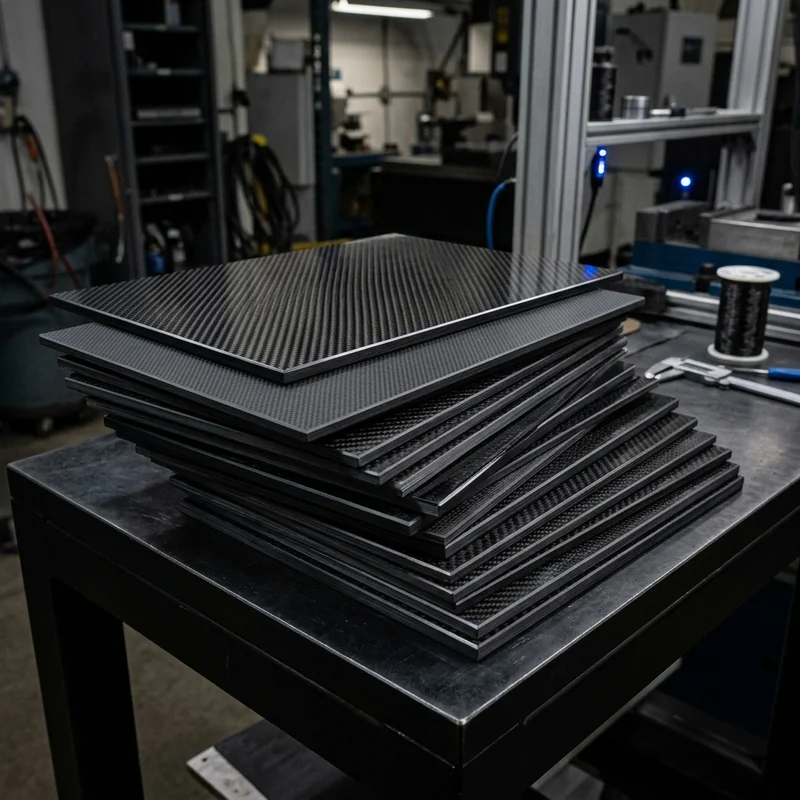
Carbon fiber standard plate-3k stripe
Lightweight, ultra-rigid standard sheets for drone fuselages, robot housings, facades and structural applications.

Carbon Fiber Plate — 3K Twill T700 3.0mm
Medium-thickness 3.0mm carbon fiber plate offering significantly higher load capacity while maintaining attractive 3K twill finish. Suitable for structural brackets, reinforcement plates, and load-bearing panels.

Carbon Fiber Plate — 3K Twill T700 1.5mm
Thin 1.5mm carbon fiber plate with 3K twill weave surface. Lightweight and stiff, commonly used for covers, panels, drone bodies, and applications requiring a premium aesthetic appearance.

Square Carbon Fiber Tube — 3K Twill T700
Square cross-section carbon fiber tube manufactured with 3K twill weave for torsional strength. Preferred for structural frames, trusses, and support columns where rectangular geometry offers design flexibility.
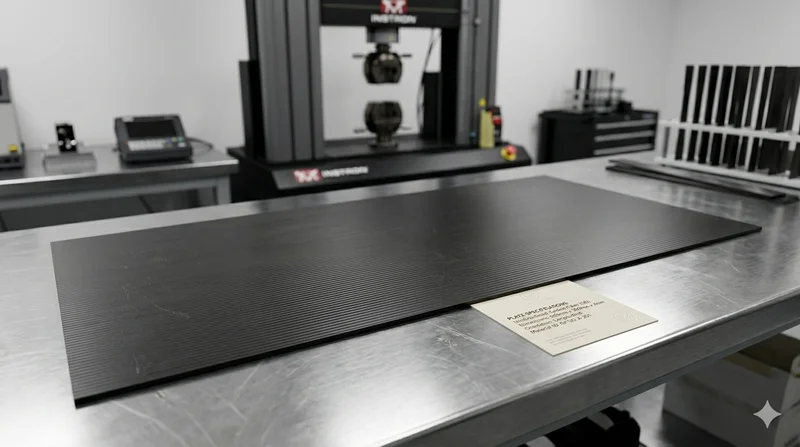
Carbon Fiber Plate — UD Unidirectional T700
Unidirectional carbon fiber plate with all fibers oriented in a single direction for maximum strength along the fiber axis. Essential for structural reinforcements, splints, and applications where load direction is predictable.