
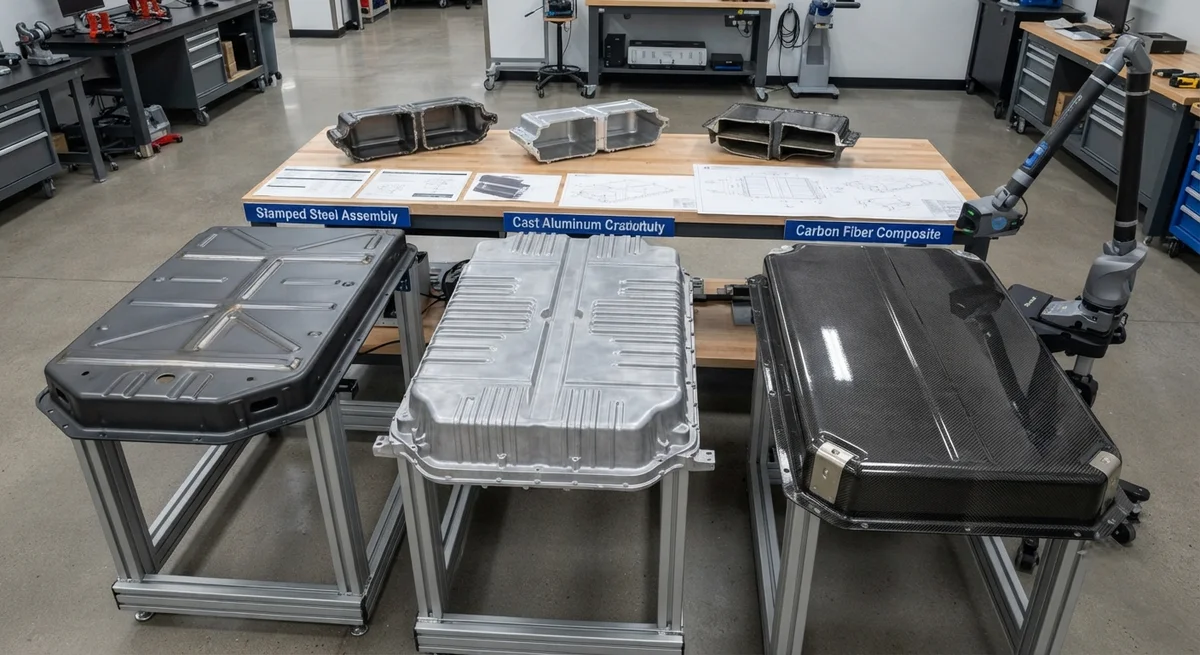
Compare carbon fiber, aluminum, and steel for EV battery enclosures across weight, cost, thermal management, crash safety, and manufacturability with detailed data tables.
Introduction: The Battery Enclosure Challenge in Electric Vehicle Design
The battery enclosure — or battery pack housing — is one of the most structurally and thermally demanding components in any electric vehicle. It must protect hundreds of lithium-ion cells from mechanical impact, vibration, moisture ingress, and thermal runaway propagation, while simultaneously contributing to the vehicle's structural rigidity and crash load path. As EV manufacturers race to extend driving range and reduce vehicle weight, the choice of enclosure material has become a critical engineering decision with far-reaching implications for cost, performance, and production scalability. Three material families dominate the current landscape: advanced high-strength steel, aluminum alloys, and carbon fiber reinforced polymer (CFRP) composites. Each offers distinct trade-offs across weight, cost, thermal behavior, crash performance, and manufacturability. This article provides a comprehensive, data-driven comparison of these three material options for EV battery enclosures, drawing on the latest industry research, OEM qualification data, and production case studies from leading vehicle manufacturers.
Weight Comparison and Range Impact
Weight reduction is the primary driver for exploring composite battery enclosures. A typical mid-size EV battery pack weighs between 350 and 600 kg, of which the enclosure structure accounts for approximately 80–120 kg for steel designs, 50–70 kg for aluminum, and 25–45 kg for carbon fiber composites. This represents a potential weight saving of 55–75 kg per vehicle when switching from steel to carbon fiber, or 20–40 kg when switching from aluminum to carbon fiber. Every 10 kg of weight reduction in the battery enclosure translates to approximately 1.5–2.5 km of additional driving range in a typical 400–500 km range vehicle, making the weight advantage of carbon fiber directly convertible to improved vehicle specifications. However, the relationship between enclosure weight and range is not linear — heavier vehicles require larger and heavier battery packs to achieve the same range, creating a compounding effect where lightweight enclosures enable smaller, less expensive battery packs for the same target range.
Comprehensive Material Comparison Table
| Property | Carbon Fiber (CFRP) | Aluminum (6061-T6) | Advanced High-Strength Steel (DP980) |
|---|---|---|---|
| Density (g/cm³) | 1.55–1.65 | 2.70 | 7.85 |
| Tensile Strength (MPa) | 600–1,200 (fiber-direction) | 310 | 980 |
| Specific Strength (MPa·cm³/g) | 370–730 | 115 | 125 |
| Thermal Conductivity (W/m·K) | 5–50 (varies by layup) | 167 | 45–50 |
| CTE (10⁻⁶/K) | −0.5 to 1.0 (anisotropic) | 23.6 | 12.0 |
| Enclosure Weight (kg, mid-size EV) | 25–45 | 50–70 | 80–120 |
| Per-Unit Material Cost ($/kg) | $18–45 | $3–6 | $1.50–3.00 |
| Tooling Cost (million $) | $3–8 (compression molding) | $5–15 (die casting) | $10–25 (stamping line) |
| Cycle Time (minutes/part) | 3–15 (compression molding) | 0.5–2 (die casting) | 0.1–0.5 (stamping) |
| Thermal Runaway Resistance | Excellent (char layer forms) | Moderate (melts at 660°C) | Good (high melting point) |
| EMI Shielding Effectiveness | Poor (needs metal mesh/foil) | Excellent (inherent) | Excellent (inherent) |
| Recyclability | Moderate (energy-intensive) | Excellent (high scrap value) | Excellent (fully recyclable) |
| Production Volume Suitability | Low–Medium (≤100k units/yr) | Medium–High | High (≥200k units/yr) |
Thermal Management Performance
Thermal management is arguably the most critical functional requirement for battery enclosures, as lithium-ion cells operate optimally within a narrow temperature window of 20–40°C and can suffer irreversible capacity loss or thermal runaway outside this range. Aluminum's high thermal conductivity (167 W/m·K) makes it an excellent heat spreader, allowing heat from cells to be conducted efficiently to cooling plates or radiator interfaces. Steel offers moderate conductivity (45–50 W/m·K), which is sufficient for most designs but requires larger cooling surface areas. Carbon fiber composites present a more complex thermal picture — their thermal conductivity is highly anisotropic, ranging from 5–10 W/m·K in the through-thickness direction to 30–50 W/m·K in the fiber plane, depending on fiber type, layup sequence, and matrix material. This means carbon fiber enclosures typically require integrated metallic thermal management inserts or dedicated cooling channels to achieve comparable thermal performance. However, carbon fiber offers an important advantage in thermal runaway scenarios — when exposed to the extreme temperatures of a cell thermal event (600–1,000°C), carbon fiber forms a stable char layer that resists burn-through much longer than aluminum, which can melt at 660°C, and provides comparable resistance to steel. Several OEM tests have demonstrated that carbon fiber enclosures contain thermal runaway propagation for 5–8 minutes longer than equivalent aluminum designs, providing critical time for occupant egress.
Crash Safety and Structural Performance
The battery enclosure serves as a structural member of the vehicle body, particularly in skateboard platform designs where the pack is integrated into the floor structure. In frontal, side, and pole impact scenarios, the enclosure must resist intrusion into the cell area while transferring loads to the vehicle frame. Steel enclosures benefit from well-understood, predictable deformation behavior and excellent energy absorption through plastic deformation — advanced high-strength steels can absorb 50–70 kJ/kg through controlled crumpling. Aluminum offers similar energy absorption on a per-mass basis (30–45 kJ/kg) but with lower absolute strength, requiring thicker wall sections to achieve equivalent performance. Carbon fiber composites exhibit exceptional specific energy absorption (60–90 kJ/kg), significantly outperforming both metals on a weight-normalized basis. However, CFRP failure is brittle rather than ductile — it absorbs energy through progressive crushing, delamination, and fiber fracture rather than plastic deformation. This requires different design approaches, including crush initiators, hybrid metal-composite interfaces, and over-designed joint regions. The trend among leading EV manufacturers is moving toward hybrid structures that combine carbon fiber panels with aluminum or steel subframes, leveraging the weight savings of composites where structural demands are lower while retaining metallic crash management in high-load zones.
Cost Analysis: Unit Economics and Total System Cost
At first glance, carbon fiber appears prohibitively expensive compared to steel and aluminum. Raw material costs of $18–45/kg for automotive-grade carbon fiber compare unfavorably with $1.50–3.00/kg for advanced high-strength steel and $3–6/kg for aluminum. However, a total-system-cost analysis reveals a more nuanced picture. The weight savings from carbon fiber enclosures enable downsizing of other vehicle systems — lighter enclosures require smaller suspension components, lower-capacity braking systems, and reduced structural reinforcement. These secondary savings can offset 30–50% of the carbon fiber cost premium. Additionally, carbon fiber compression molding requires significantly lower tooling investment ($3–8 million) compared to steel stamping lines ($10–25 million) or aluminum die-casting tooling ($5–15 million), making carbon fiber competitive at production volumes below 50,000–100,000 units per year — precisely the range where many premium and specialty EV manufacturers operate. When tooling amortization is factored into the per-unit cost, carbon fiber enclosures can achieve cost parity with aluminum at annual volumes of 30,000–50,000 units and with steel at 15,000–25,000 units.
Manufacturing and Production Considerations
- Steel enclosures benefit from the most mature manufacturing ecosystem, with well-established stamping, welding, and E-coating processes. Cycle times are fastest (6–30 seconds per stamping operation) and dimensional consistency is excellent. However, the high capital cost of stamping presses and die sets creates a high entry barrier.
- Aluminum enclosures offer a balance of manufacturability and performance. High-pressure die casting produces complex net-shape parts in 30–120 second cycles, while aluminum extrusion allows for efficient cross-section optimization. Joining aluminum requires specialized welding techniques (friction stir welding, laser welding) and careful galvanic corrosion management.
- Carbon fiber enclosures can be produced via compression molding of sheet molding compound (SMC), high-pressure resin transfer molding (HP-RTM), or rapid preforming with automated fiber placement (AFP). Cycle times of 3–15 minutes are achievable with fast-cure epoxy systems, and near-net-shape production minimizes material waste. The key challenges are ensuring consistent fiber orientation, managing void content below 2%, and integrating metallic inserts for grounding and attachment points.
EMI Shielding and Electrical Considerations
Electric vehicle battery enclosures must provide electromagnetic interference (EMI) shielding to protect sensitive electronics from the high-frequency switching noise generated by inverters and DC-DC converters, and to prevent electromagnetic radiation from the battery itself from interfering with vehicle telematics and external systems. Steel and aluminum provide inherent EMI shielding effectiveness of 60–100 dB across the frequency range of interest (100 kHz to 10 GHz) due to their electrical conductivity. Carbon fiber composites, by contrast, have significantly lower electrical conductivity — approximately 10⁴ S/m in the fiber direction and 10¹ S/m through the thickness, compared to 3.5×10⁷ S/m for aluminum. This means carbon fiber enclosures require integrated EMI shielding solutions such as embedded copper mesh, metallized surface layers, conductive paints, or bonded aluminum foil liners. Several OEMs have developed hybrid approaches where a thin aluminum sheet is co-cured with the carbon fiber structure, providing both EMI shielding and a thermal management surface in a single integrated component.
Future Outlook and Adoption Trends
The adoption of carbon fiber battery enclosures is accelerating, driven by the convergence of several factors: tightening regulatory requirements for EV range and efficiency, the growing availability of automotive-grade carbon fiber at declining costs, and the maturation of high-volume composite manufacturing processes. Tesla's structural battery pack, introduced in 2022, uses a honeycomb-aluminum design rather than carbon fiber, but several Chinese OEMs including NIO, BYD, and XPeng have announced carbon fiber battery enclosure programs for their premium vehicle lines. BMW's fifth-generation eDrive system incorporates glass fiber-reinforced polymer battery enclosures in selected models, serving as a cost-effective stepping stone toward full carbon fiber adoption. Industry analysts project that carbon fiber battery enclosures will capture 8–12% of the global EV market by 2030, up from approximately 2% in 2025, representing annual consumption of 15,000–25,000 metric tons of carbon fiber for this application alone.
Frequently Asked Questions
Is carbon fiber safe for battery enclosures in a crash?
Yes, when properly designed. Carbon fiber exhibits excellent specific energy absorption (60–90 kJ/kg) and resists thermal runaway propagation effectively. However, its brittle failure mode requires different design strategies than ductile metals, including crush initiators and hybrid metal-composite interfaces at load-bearing attachment points.
How much weight can carbon fiber save compared to aluminum?
A carbon fiber battery enclosure typically weighs 25–45 kg for a mid-size EV, compared to 50–70 kg for aluminum and 80–120 kg for steel. This represents a 40–50% weight reduction over aluminum and 60–70% over steel.
Does carbon fiber affect battery cooling performance?
Carbon fiber's thermal conductivity is anisotropic and generally lower than aluminum's, requiring integrated thermal management features such as embedded cooling channels, metallic heat spreaders, or hybrid metal-composite construction. The thermal performance of a well-designed carbon fiber enclosure can match aluminum with proper engineering.
What is the cost of a carbon fiber battery enclosure compared to aluminum?
On a per-unit basis, carbon fiber enclosures are currently 2–4× more expensive than aluminum equivalents at low volumes. However, at production volumes of 30,000–50,000 units per year, total system cost can reach parity when accounting for secondary weight savings in suspension, brakes, and structural reinforcement.
Part of topic
Related Articles
- Carbon Fiber Mooring for Floating Offshore Wind: Fatigue and Corrosion in Deep Water
- Carbon Fiber Bicycle Frame Optimization: Layup Design and Manufacturing for Competitive Racing
- Carbon Fiber CFRP Retrofit for Infrastructure: Bridge and Building Seismic Strengthening
- Carbon Fiber Medical Imaging Equipment: Lightweight Gantry and Couch Structures for MRI/CT
- Carbon Fiber EV Battery Enclosures: Crash Safety and Electromagnetic Shielding Design
- Carbon Fiber Structures for Low-Altitude Economy: UAV Airframes and eVTOL Components
Interested in Our Products?
Contact our team for competitive pricing and technical specifications.
Get a QuoteRelated Products

Carbon Fiber Plate — 3K Twill T700 1.5mm
Thin 1.5mm carbon fiber plate with 3K twill weave surface. Lightweight and stiff, commonly used for covers, panels, drone bodies, and applications requiring a premium aesthetic appearance.
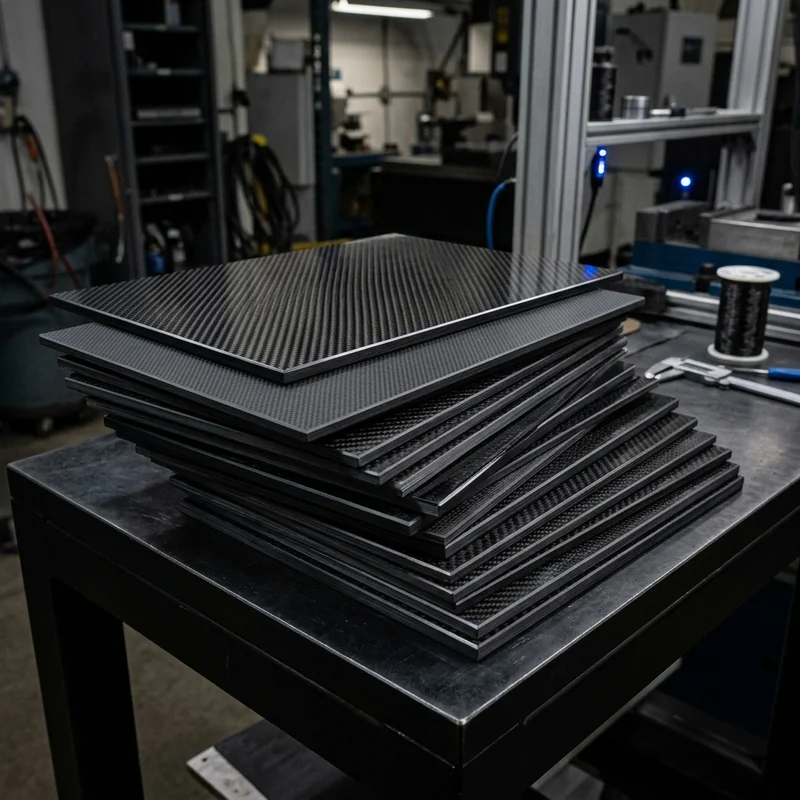
Carbon fiber standard plate-3k stripe
Lightweight, ultra-rigid standard sheets for drone fuselages, robot housings, facades and structural applications.

Square Carbon Fiber Tube — 3K Twill T700
Square cross-section carbon fiber tube manufactured with 3K twill weave for torsional strength. Preferred for structural frames, trusses, and support columns where rectangular geometry offers design flexibility.

Carbon Fiber Plate — 3K Twill T700 3.0mm
Medium-thickness 3.0mm carbon fiber plate offering significantly higher load capacity while maintaining attractive 3K twill finish. Suitable for structural brackets, reinforcement plates, and load-bearing panels.
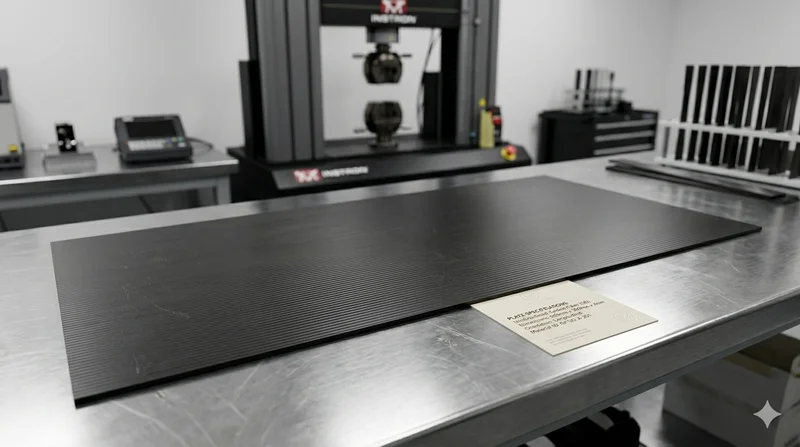
Carbon Fiber Plate — UD Unidirectional T700
Unidirectional carbon fiber plate with all fibers oriented in a single direction for maximum strength along the fiber axis. Essential for structural reinforcements, splints, and applications where load direction is predictable.