
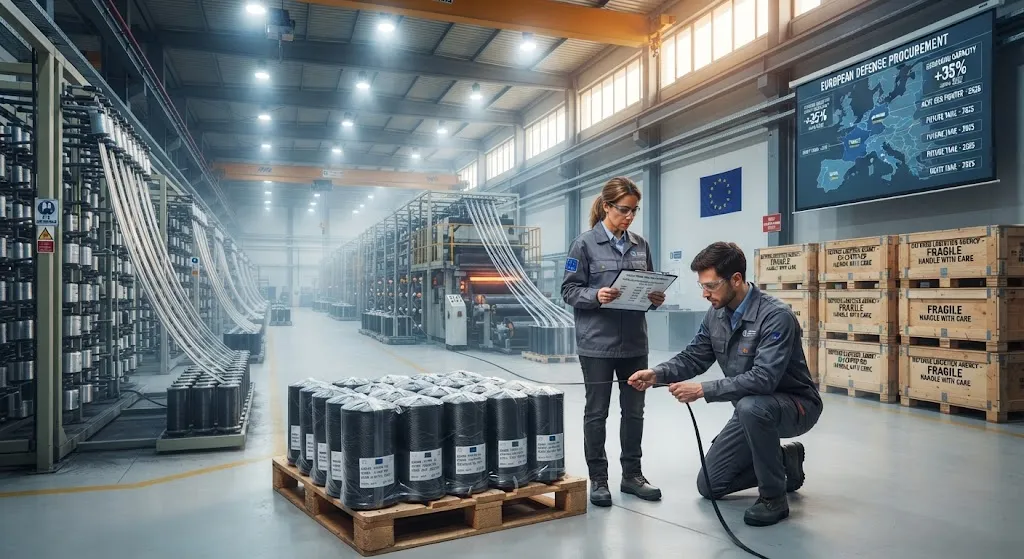
Europe's defense budgets have been rising for two consecutive years, and the composite industry is now seeing the consequences in its order books. Airlift and fighter sustainment programs need structural carbon fiber, drone programs need lightweight airframes at volume, and missile prod
Introduction
Europe's defense budgets have been rising for two consecutive years, and the composite industry is now seeing the consequences in its order books. Airlift and fighter sustainment programs need structural carbon fiber, drone programs need lightweight airframes at volume, and missile production lines consume wound composite tubes in quantities that were unthinkable a few years ago. What changed in early 2026 is that this demand stopped arriving as occasional project orders and started being locked into multi-year commitments. Two announcements frame the shift: Toray Carbon Fibers Europe confirmed an expansion of its European manufacturing footprint in March 2026, and Syensqo wrapped a five-year supply agreement with European customers at the start of the year.
For composites buyers outside defense — wind energy, automotive, sports equipment, infrastructure — the significance is indirect but real. Fiber capacity is a finite, headline-graded asset: when defense programs sign long-dated volume commitments, the remaining capacity available to industrial buyers shrinks, and the terms under which it is offered change. This article traces the two announcements, compares the new contract model with the project-based purchasing it replaces, and explains what the rearmament-driven demand means for allocation, pricing and security of supply.
The Defense Spending Context
The demand that triggered both moves is broad-based. European NATO members have been translating higher budget pledges into actual procurement, and the programs that consume the most composite material are fighter fleet sustainment, next-generation air combat development, long-range munitions and unmanned systems. The table below summarizes the main demand drivers and the composite content they carry:
| Demand driver | Composite applications | Typical material demand | Supply model |
|---|---|---|---|
| Fighter fleet sustainment | Wing skins, empennage, radomes, spares and repairs | High-modulus and intermediate-modulus CF, continuous | Program-based with growing baseline |
| Next-generation air combat | Structural airframe for demonstrators | IM grades, qualification-bound batches | Development contracts |
| Unmanned systems at scale | Airframes, arms, rotor blades, sensor mounts | Standard-modulus CF in high volume, short cycles | Fast-cycle tenders, volume frameworks |
| Munitions and missile lines | Wound motor casings, fins, launch tubes | Filament-wound CF tow, escalating output | Multi-year production commitments |
None of these drivers is new in isolation; several have existed for decades. What is new is simultaneity: sustainment, development and munitions demand are climbing at the same time, which compounds the pressure on fiber producers who must grow capacity while allocations remain uncertain.
Toray Carbon Fibers Europe Expansion
Toray Carbon Fibers Europe announced in March 2026 that it would expand its European production footprint, citing defense and export demand as the primary drivers. The company already operates one of the largest carbon fiber facilities in Europe, and the expansion is understood to cover both precursor and carbonization capacity, which are the two rate-limiting steps in the fiber supply chain. Because precursor capacity takes years to bring online, an expansion announcement of this type signals a supply outlook that runs well beyond the current procurement cycle.
European aerospace-grade fiber capacity has historically been tight even without defense pull: the continent's aircraft programs, space launchers and a growing base of industrial customers already compete for a limited number of domestic lines. The rearmament cycle adds a priority customer with multi-year visibility, which in practice reorders the queue rather than simply lengthening it — and a reordered queue is what buyers experience as allocation pressure.
The expansion matters to European buyers for two reasons. First, it increases the region's self-sufficiency in aerospace-grade fiber at a moment when defense programs are being asked to document supply-chain security. Second, the new tonnage is being framed as committed capacity: a meaningful share is already earmarked under long-term agreements rather than sold on the merchant market. That framing is the real change — European fiber supply is moving from a spot-driven market toward one where multi-year commitments decide who gets the material.
The Syensqo Five-Year Supply Agreement
Syensqo, the specialty chemicals and materials group formed from the split of Solvay, signed a five-year supply agreement with European customers in January 2026. The deal covers multiple composite material grades and is structured as a framework: volumes, standard grades and commercial terms are agreed up front, with annual adjustments limited to indexation mechanisms rather than wholesale renegotiation. For the customers involved, the agreement converts a recurring sourcing headache — unpredictable availability and price swings on a one-year horizon — into a predictable multi-year position.
The five-year structure is the detail worth focusing on, because it represents a genuine shift in how European defense composites are bought. Traditional procurement ran on project awards: a production run would trigger a purchase order, the supplier would allocate from free capacity, and the next run would start the negotiation over. Five-year agreements change the underlying economics of the fiber plant: committed volume justifies investment in new lines, and the plant can plan conversion and staffing against a visible horizon. The comparison below shows the practical difference between the contract models now competing in the European market:
| Contract model | Typical horizon | Price mechanism | Capacity commitment | Risk bearer |
|---|---|---|---|---|
| Spot / project purchase | Single order | Market price at order | Free capacity only | Buyer |
| Annual framework | 12 months | Annual indexation | Partial reservation | Shared |
| Multi-year supply agreement | 3-5 years | Indexation with caps | Dedicated capacity | Both, contractually |
| Strategic partnership / JV | 5-10 years | Cost-sharing formulas | Co-invested capacity | Both, structurally |
Each step up the ladder trades flexibility for security. A multi-year agreement locks the customer into volume obligations, but it also locks the supplier into allocation, which is precisely the guarantee defense programs need as their production baselines grow.
What the Shift Means for Industrial Buyers
The consequences of rearmament-driven lock-up are felt first by industrial buyers who compete with defense programs for the same fiber windows. Five practical effects are worth anticipating:
- Allocation tightening: when dedicated tonnage is committed to long-term defense agreements, the merchant market that industrial buyers draw from becomes smaller in any given quarter.
- Rising minimum order thresholds: suppliers booking committed capacity prefer fewer, larger, longer orders; small and medium industrial orders face longer waiting times.
- Qualification duplication: defense and aerospace grades have separate qualification dossiers, and buyers engaging defense-adjacent suppliers must re-verify material documentation rather than reuse civil certificates.
- Indexation formulas: multi-year pricing structures shift cost volatility through index clauses; buyers should audit their supply agreements for alignment with the new terms rather than assume fixed pricing persists.
- Security-of-supply clauses: industrial buyers are increasingly asked to accept volume-obligation or commitment clauses in exchange for allocation, mirroring the defense contract model.
The net message is that the European composite market is becoming more structured, and the buyers who adapt their contracting behavior earliest will hold the strongest positions when the next allocation squeeze arrives.
Frequently Asked Questions
Why does European rearmament affect carbon fiber supply for non-defense buyers?
Carbon fiber production capacity is finite and slow to expand, so when defense programs sign multi-year volume commitments, those commitments reserve a share of the plant's output for the duration of the agreement. The remaining merchant capacity that industrial buyers draw from becomes smaller and less predictable. Because defense demand is now arriving through longer contracts with dedicated allocation, the effect on industrial availability is structural rather than temporary, which is why contract terms — not just price — have become the deciding factor in European fiber supply.
What exactly did Toray announce in Europe in March 2026?
Toray Carbon Fibers Europe announced an expansion of its European production footprint in March 2026, with defense and export demand cited as the primary drivers. The expansion covers both precursor and carbonization capacity — the two rate-limiting steps in fiber production — and a meaningful share of the resulting tonnage is expected to be reserved under long-term supply agreements rather than sold on the merchant market. Because precursor lines take years to commission, the announcement effectively signals a multi-year supply outlook for European buyers.
How do five-year agreements like the Syensqo deal change pricing?
Five-year agreements replace annual renegotiation with a framework under which volumes, standard grades and commercial terms are fixed up front, and annual changes are limited to indexation mechanisms with defined caps. This removes the largest source of price volatility — the annual reset — and transfers risk from spot-market swings into a predictable formula shared between buyer and supplier. In exchange, the buyer accepts volume obligations, which is the security the supplier needs to justify dedicating capacity and investing in new production lines.
Conclusion
The European rearmament cycle has changed how composite reinforcement is bought and sold on the continent. Toray Carbon Fibers Europe's expansion announcement in March 2026 and Syensqo's five-year agreement at the start of the year are two expressions of the same underlying shift: defense programs are converting their demand into multi-year commitments with dedicated allocation, and fiber supply is following the same structure. For industrial buyers, the implications are allocation tightening, changing minimum order thresholds and a contracting environment that now rewards long-horizon planning over spot purchasing.
If your programs rely on stable European carbon fiber supply, review our carbon fiber product range or contact our engineering team to discuss supply commitments, qualification documentation and allocation planning under the new contracting environment.
Part of topic
Related Articles
- Recycled Carbon Fiber Market Forecast 2030: Technology Maturity and Commercialization Path
- South Korea Carbon Fiber Market 2026: Hydrogen Economy and Shipbuilding Innovation
- Wind Turbine Blade Leading Edge Protection 2026: Polyurethane, Tape, and Metallic Shield Solutions
- China Carbon Fiber Overcapacity 2026: Price War Impact and Industry Consolidation
- India Carbon Fiber Market 2026: Wind Energy, Aerospace, and Defense Expansion
- PAN Precursor Market 2026: Acrylonitrile Supply and Carbon Fiber Cost Structure
Interested in Our Products?
Contact our team for competitive pricing and technical specifications.
Get a QuoteRelated Products

Carbon Fiber Fishing Rod Blank
High-quality carbon fiber fishing rod blank manufactured from multiple grades of Toray carbon fiber cloth. Available in a wide range of lengths, powers, and actions for freshwater and saltwater applications. Suitable for OEM rod building.
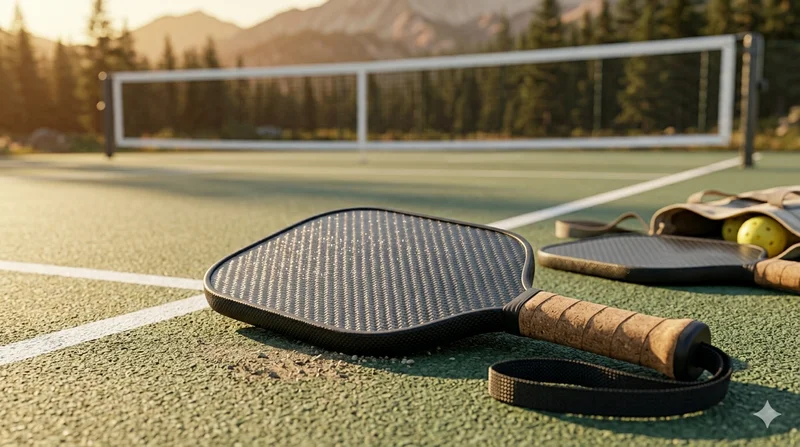
Carbon Fiber Pickleball Paddle
High-performance pickleball paddle with Toray T700 carbon fiber face and polypropylene honeycomb core. Delivers excellent power-to-weight ratio, spin generation, and vibration dampening for competitive play.
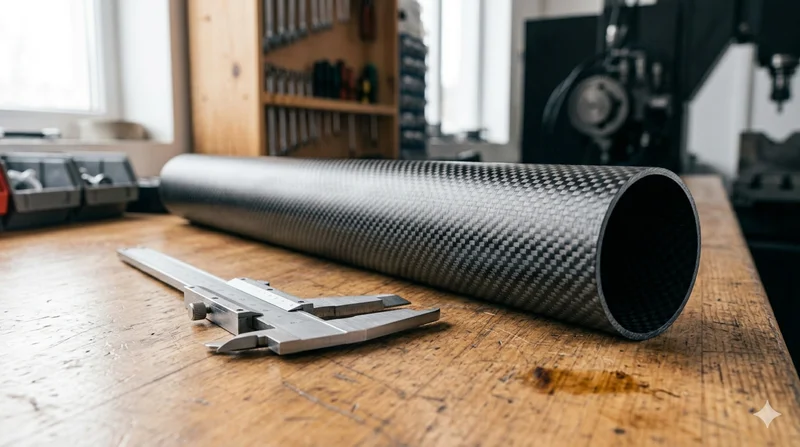
Round Carbon Fiber Tube — 3K Plain Weave T700
Standard round carbon fiber tube manufactured from Toray T700 grade fiber with 3K plain weave. Offers balanced strength and stiffness for general industrial applications including robotics, automation, sports equipment, and aerospace structures.
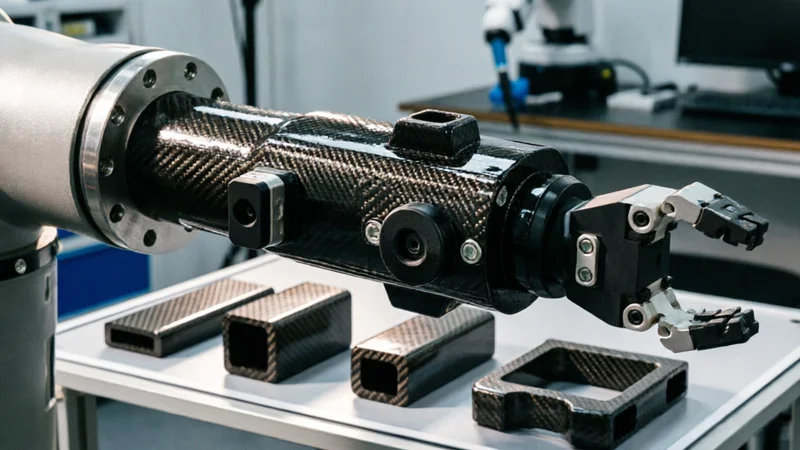
Carbon Fiber Robot End Effector Link — Custom Shape & Sensor Integration
Custom-shaped carbon fiber end effector links for robotic arms. Designed for automation integrators and research labs requiring lightweight, rigid connections between the robot wrist and gripper/tool. Can incorporate sensor mounting bosses, cable routing channels, and quick-change interfaces.

Custom Carbon Fiber Musical Instrument Parts
Carbon fiber components for musical instrument manufacturing offering superior dimensional stability, low weight, and consistent acoustic properties. We produce carbon fiber bows, guitar necks, violin chin rests, drum shells, and wind instrument bodies. Carbon fiber instruments are immune to humidity changes and temperature fluctuations that affect wooden instruments.