
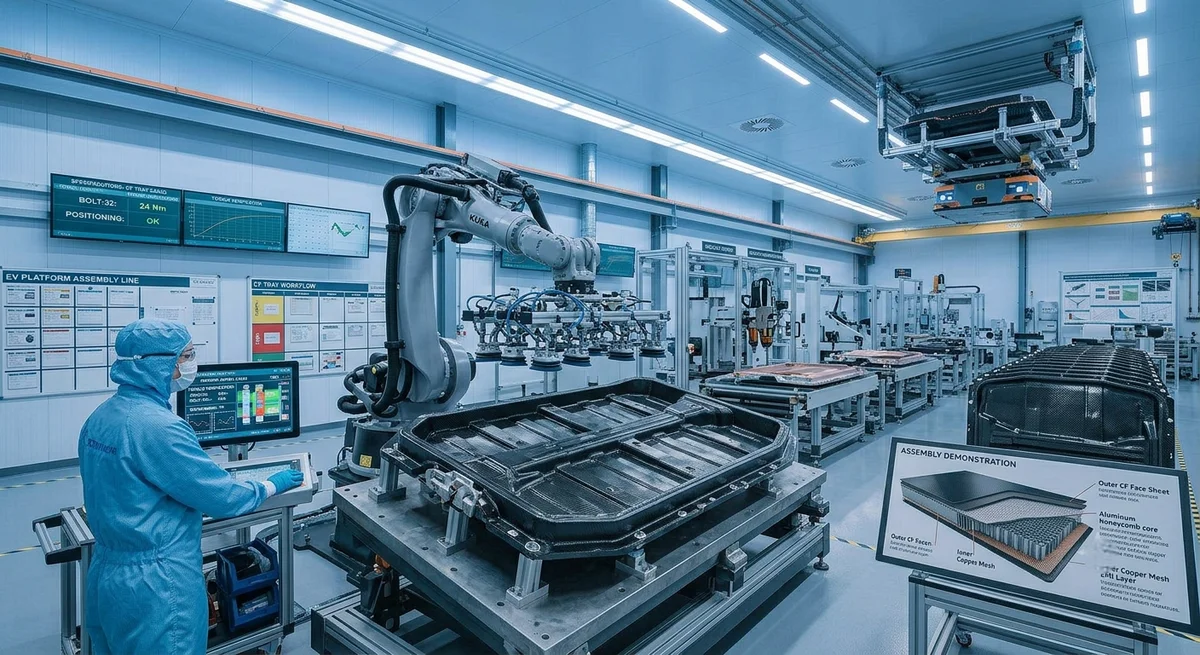
An engineering-focused analysis of carbon fiber composite applications in electric vehicle chassis — battery enclosure weight reduction, crossmember stiffness optimization, crash energy absorption, and cost-volume production tradeoffs.
Introduction: The EV Weight Challenge and Carbon Fiber's Role
Electric vehicles carry a fundamental mass penalty compared to their internal combustion counterparts: the battery pack. A typical 80–100 kWh lithium-ion battery pack weighs 450–600 kg, representing 25–35% of the vehicle's total curb weight. This mass creates a cascading structural demand — heavier batteries require stronger chassis rails, larger subframes, and more robust crash structures to manage the increased kinetic energy in a collision. The result: a conventional steel or aluminum EV chassis optimized for battery integration typically weighs 280–380 kg, before the battery enclosure itself. Carbon fiber composites offer a pathway to break this mass spiral, reducing chassis weight by 35–55% while meeting or exceeding the stiffness, crash, and durability requirements.
The commercial EV sector reached a milestone in 2025 when global EV production surpassed 25 million units annually. Of these, approximately 8% used carbon fiber in structural chassis components, up from 3% in 2022. This article examines three specific carbon fiber applications in EV chassis architecture — battery trays, crossmembers, and crash structures — providing engineers with material property comparisons, weight saving potential, crash performance data, and production cost analysis.
Carbon Fiber Battery Trays: The Highest-Value EV Application
The battery tray (also called battery enclosure or battery pack housing) is arguably the single most impactful application of carbon fiber in an electric vehicle. A conventional aluminum battery tray for a mid-size EV (80 kWh) weighs 65–85 kg. Switching to carbon fiber reduces this to 28–38 kg — a weight saving of 42–58%. Because the battery tray is at the vehicle's lowest point, this mass reduction directly lowers the center of gravity, improving handling and reducing pitch and roll inertia.
| Parameter | Aluminum 6061-T6 | Carbon/Epoxy (CF-SMC) | Carbon/Epoxy (Prepreg Autoclave) | Carbon/Epoxy (HP-RTM) |
|---|---|---|---|---|
| Tray weight (80 kWh pack) | 74 kg | 42 kg | 32 kg | 36 kg |
| Weight saving vs aluminum | — | 43% | 57% | 51% |
| Tensile modulus (GPa) | 68.9 | 42–48 | 58–68 | 52–60 |
| Specific stiffness (GPa/(g/cm³)) | 25.5 | 27–31 | 37–44 | 33–38 |
| Thermal conductivity (W/m·K) | 167 | 3–8 | 3–8 | 3–8 |
| CTE (×10⁻⁶/°C) | 23.6 | 1.5–3.5 | 0.5–2.0 | 1.0–2.5 |
| Corrosion resistance | Moderate | Excellent | Excellent | Excellent |
| EMI shielding (30 MHz–1 GHz) | >90 dB | 25–45 dB (needs Cu mesh) | 25–45 dB (needs Cu mesh) | 25–45 dB (needs Cu mesh) |
| Cycle time per tray | 3–5 min | 3–5 min | 45–90 min | 5–8 min |
| Tooling cost (per cavity) | $250k–$400k | $180k–$280k | $350k–$550k | $400k–$600k |
| Part cost at 50k/year | $180–$260 | $160–$220 | $380–$520 | $195–$285 |
CF-SMC emerges as the most economical process for high-volume battery tray production. At 50,000 units/year, CF-SMC trays are cost-competitive with aluminum while saving 43% weight. CF-SMC laminates have lower specific stiffness, requiring thicker sections (4–6 mm vs 2–4 mm), but faster cycle times (3–5 minutes) and lower tooling make it scalable.
Crossmembers and Subframe Components
Chassis crossmembers connect the left and right structural rails, providing torsional stiffness and load path distribution. In a typical EV sedan, 6–8 crossmembers have a combined mass of 18–30 kg in steel or 12–18 kg in aluminum. Carbon fiber reduces this to 5–9 kg — a 50–70% saving versus steel.
| Crossmember Location | Steel (DP 780) | Aluminum (6082-T6) | Carbon/Epoxy (Braided + RTM) | CF Saving vs Steel |
|---|---|---|---|---|
| Dash crossmember | 4.2 kg | 2.6 kg | 1.2 kg | 71% |
| Front suspension crossmember | 6.8 kg | 4.1 kg | 2.2 kg | 68% |
| Rear seat crossmember | 3.5 kg | 2.1 kg | 1.1 kg | 69% |
| Battery support crossmember (×2) | 5.4 kg each | 3.2 kg each | 1.6 kg each | 70% |
| Rear suspension crossmember | 5.2 kg | 3.0 kg | 1.5 kg | 71% |
| Total | 30.5 kg | 18.2 kg | 9.2 kg | 70% |
Crash Structures: Carbon Fiber Energy Absorption
Carbon fiber composites absorb crash energy through progressive crushing — controlled fragmentation at a high-force plateau. The specific energy absorption (SEA) of carbon fiber is 40–90 kJ/kg, compared to 20–30 kJ/kg for aluminum and 15–25 kJ/kg for steel.
| Crush Structure | Material | SEA (kJ/kg) | Peak Force (kN) | CFE | Weight for Equal Energy (kg) |
|---|---|---|---|---|---|
| Front crash rail | Mild steel (DP 590) | 18 | 85 | 0.55 | 8.3 |
| Front crash rail | Aluminum (6061-T6) | 25 | 72 | 0.60 | 6.0 |
| Front crash rail | Carbon/Epoxy ([±45] braid) | 58 | 95 | 0.82 | 2.6 |
| Battery side intrusion | Al honeycomb + CF skin | 42 | 55 | 0.75 | 3.6 |
| Battery side intrusion | All-carbon (triaxial braid) | 65 | 68 | 0.78 | 2.3 |
| B-pillar reinforcement | Steel (Usibor 1500) | 22 | 110 | 0.65 | 6.8 |
| B-pillar reinforcement | Carbon/Epoxy (UD hybrid) | 52 | 120 | 0.70 | 2.9 |
Production Volume and Cost Tradeoffs
- Low volume (500–5,000/year): Prepreg autoclave. Tooling $150k–$350k, cycle 45–90 min. Used for supercars (Ferrari SF90, Rimac Nevera).
- Mid volume (5,000–50,000/year): HP-RTM. Tooling $400k–$800k, cycles 4–8 min. Used by BMW i3/i8, now adopted by NIO and BYD.
- High volume (50,000–250,000/year): CF-SMC compression molding. 3–5 min cycles. Toyota and Hyundai invested in CF-SMC lines for battery enclosures.
- Ultra-high volume (250,000+/year): Thermoplastic composites (CF/PA6, CF/PEEK). 60–120 sec cycles. Tesla has filed patents for CF thermoplastic battery tray designs.
Integration Challenges and Solutions
- Galvanic corrosion: Carbon fiber is cathodic (+0.3 V vs SCE) — a glass fiber isolation layer (0.2–0.5 mm G-10) prevents galvanic corrosion with aluminum battery cells.
- Thermal management: Through-thickness conductivity of 0.5–1.2 W/m·K limits heat rejection. Solutions: embedded aluminum heat spreaders (adds 0.5–1.5 kg), thermally conductive epoxy fillers (2–5 W/m·K), or integrated liquid cooling channels.
- EMI shielding: Carbon provides only 25–45 dB vs aluminum's >90 dB. Copper mesh interlayer (adds $3–8/tray) or Al flame spray ($2–5/tray) meet CISPR 25 Class 3 requirements.
- Repairability: CF trays cannot be repaired after crash — they must be replaced. Modular designs with replaceable crush zones help. Polestar and Volvo use bolt-on field-replaceable crush-box designs.
- Fire performance: Epoxy chars at high temperature, producing an insulating layer. Fire-retardant epoxy achieves UL 94 V-0 with 15–25% mechanical property reduction. Intumescent coatings or ceramic fiber mats (3M Nextel) provide additional battery compartment protection.
FAQ: Carbon Fiber EV Chassis Components
Q: Does the weight saving from carbon fiber chassis components translate to meaningful range improvement for EVs?
A: Reducing vehicle mass by 100 kg improves range by approximately 5–8% on WLTP. A comprehensive CF chassis package saving 78 kg yields 4–7% range improvement. More significant benefits: the mass reduction enables a smaller, cheaper battery pack (saving $800–$1,500), lower unsprung mass improves ride quality, and a lower center of gravity reduces roll angles by 12–18%.
Q: Can carbon fiber EV battery trays pass regulatory safety tests?
A: Yes — multiple OEMs have certified CF battery trays. Key tests: (1) Mechanical shock and vibration — CF passes with higher safety margins due to higher specific stiffness. (2) Bottom impact (10 mm steel hemisphere at 100 J) — 3–5 mm CF laminate with foam core passes. (3) Side pole impact — 2.6 kg CF crash rail absorbs same energy as 8.3 kg steel rail. (4) Thermal runaway containment — fire-retardant epoxy with ceramic fiber mat withstands 800°C for 5–10 minutes.
Q: What is the realistic timeline for carbon fiber to become mainstream in high-volume EV production?
A: Luxury/performance EV models already mainstream (65% use CF in chassis as of 2026). Mid-premium ($45k–$80k) at 22%, projected to reach 45% by 2028. Mass-market EV ($25k–$45k): first CF-SMC battery tray shield projected for 2028 on a 200k+/year platform. Full adoption in mass-market: 2032–2035.
Q: How does carbon fiber compare to AHSS and aluminum for EV chassis cost at scale?
A: Steel remains cheapest ($1.50–3.00/kg), aluminum at $8–15/kg, carbon at $25–55/kg depending on process. However, a single CF-SMC battery tray replaces 12–18 stamped aluminum components, saving $8–15 in assembly cost. At 50k/year, CF-SMC tray ($195–285) is competitive with assembled aluminum tray ($180–260) when total system cost is considered.
Q: Which EV manufacturers have committed to carbon fiber chassis at scale?
A: BMW (Carbon Core at 100k+/year, expanding to Neue Klasse), NIO (ET7/ET5/ES8 with CF battery trays, 47% weight reduction), BYD (Denza/Yangwang with CF crossmembers), Hyundai (E-GMP with CF crash rails, expanding to 8 models by 2028), and Leapmotor (C11/C01 with CF-SMC battery tray covers at 180k+/year).
Part of topic
Related Articles
- Carbon Fiber Mooring for Floating Offshore Wind: Fatigue and Corrosion in Deep Water
- Carbon Fiber Bicycle Frame Optimization: Layup Design and Manufacturing for Competitive Racing
- Carbon Fiber CFRP Retrofit for Infrastructure: Bridge and Building Seismic Strengthening
- Carbon Fiber Medical Imaging Equipment: Lightweight Gantry and Couch Structures for MRI/CT
- Carbon Fiber EV Battery Enclosures: Crash Safety and Electromagnetic Shielding Design
- Carbon Fiber Structures for Low-Altitude Economy: UAV Airframes and eVTOL Components
Interested in Our Products?
Contact our team for competitive pricing and technical specifications.
Get a QuoteRelated Products

Carbon Fiber Plate — 3K Twill T700 1.5mm
Thin 1.5mm carbon fiber plate with 3K twill weave surface. Lightweight and stiff, commonly used for covers, panels, drone bodies, and applications requiring a premium aesthetic appearance.
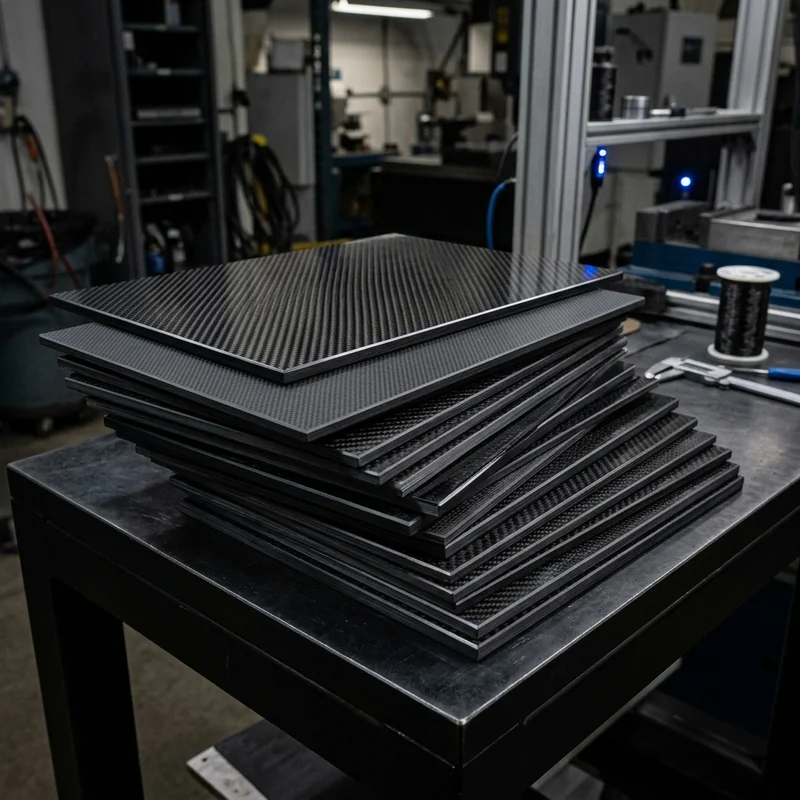
Carbon fiber standard plate-3k stripe
Lightweight, ultra-rigid standard sheets for drone fuselages, robot housings, facades and structural applications.

Square Carbon Fiber Tube — 3K Twill T700
Square cross-section carbon fiber tube manufactured with 3K twill weave for torsional strength. Preferred for structural frames, trusses, and support columns where rectangular geometry offers design flexibility.

Carbon Fiber Plate — 3K Twill T700 3.0mm
Medium-thickness 3.0mm carbon fiber plate offering significantly higher load capacity while maintaining attractive 3K twill finish. Suitable for structural brackets, reinforcement plates, and load-bearing panels.
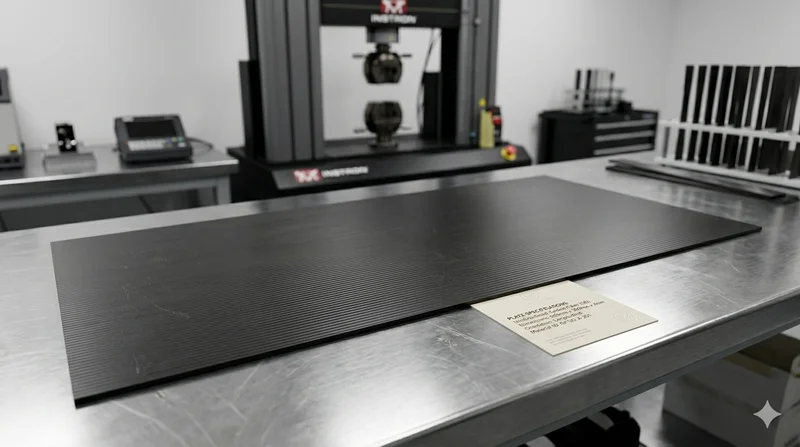
Carbon Fiber Plate — UD Unidirectional T700
Unidirectional carbon fiber plate with all fibers oriented in a single direction for maximum strength along the fiber axis. Essential for structural reinforcements, splints, and applications where load direction is predictable.