
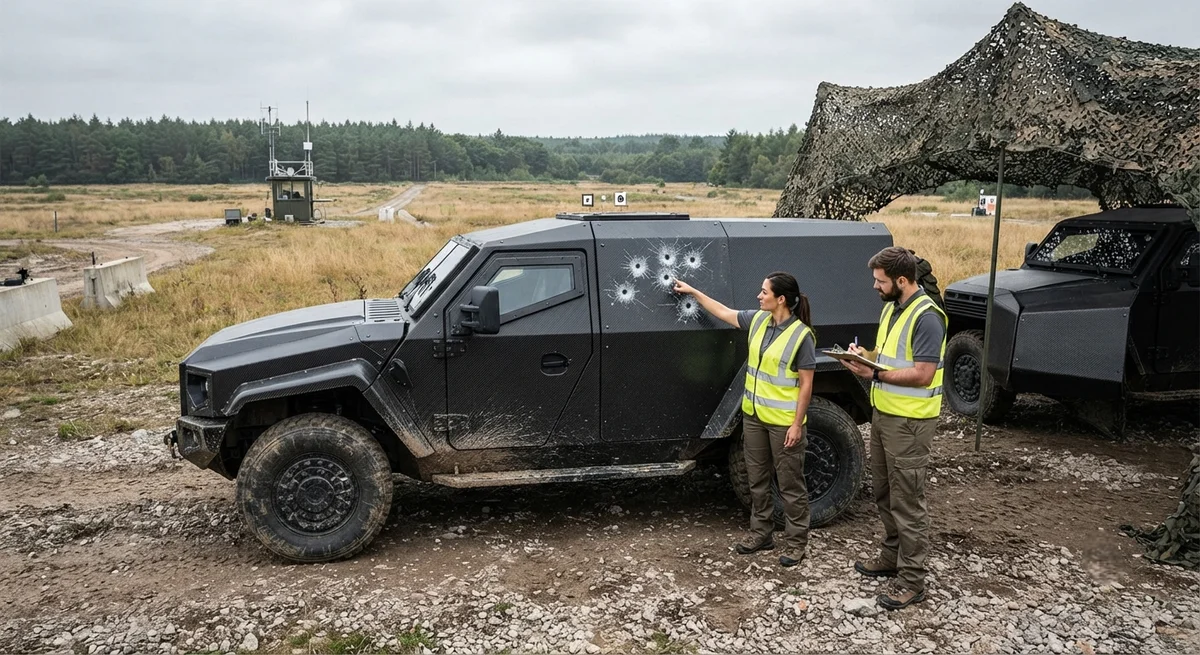
Carbon fiber composite armor systems are increasingly deployed on military ground vehicles to reduce weight while maintaining or improving ballistic protection. This article provides a technical analysis of carbon fiber armor solutions for armored personnel carriers, light tactical vehicles, and main battle tanks.
Introduction: The Weight-Armor Paradox in Military Vehicle Design
Modern military ground vehicles face an intensifying conflict between two critical design requirements: protection and mobility. Each kilogram of armor added to protect against evolving battlefield threats directly impacts vehicle mobility, fuel consumption, transportability, and deployability. Carbon fiber composite armor offers a path to break this paradigm, providing equivalent or superior ballistic protection at 30–50% weight savings compared to conventional rolled homogeneous armor (RHA) steel.
For B2B defense suppliers and vehicle integrators, understanding the ballistic performance characteristics, manufacturing scalability, and system-level integration requirements of carbon fiber armor is essential for developing next-generation protected mobility platforms. The shift toward carbon fiber armor represents not merely a material substitution, but a fundamental rethinking of vehicle protection architecture, where mass efficiency, multi-threat capability, and structural integration converge.
Carbon Fiber Armor Configurations
Monolithic Carbon Fiber Panels
Monolithic carbon fiber panels produced from woven or unidirectional prepreg materials provide a baseline armor solution. Typical layup configurations use 10–40 plies of high-strength carbon fiber fabric (6K or 12K tow) in an epoxy or phenolic resin matrix, consolidated via autoclave or compression molding at 120–180°C and 5–10 bar pressure. Areal densities range from 15–60 kg/m² depending on the threat level. While monolithic carbon fiber panels offer excellent stiffness-to-weight ratios and good ballistic protection against fragmenting threats, their performance against armor-piercing projectiles is significantly enhanced when integrated into multi-layer configurations.
Multi-Layer Hybrid Armor Systems
| STANAG 4569 Level | Threat | Projectile Mass (g) | Velocity (m/s) | Carbon Fiber Only (kg/m²) | Hybrid Ceramic-CF (kg/m²) | RHA Equivalent (mm) | Weight Savings vs RHA |
|---|---|---|---|---|---|---|---|
| Level 1 | 7.62 × 51 mm NATO ball | 9.65 | 833 | 22 | 18 | 8 | 45% |
| Level 2 | 7.62 × 39 mm API BZ | 7.75 | 695 | 30 | 24 | 12 | 42% |
| Level 3 | 7.62 × 51 mm AP (WC core) | 10.0 | 930 | 42 | 32 | 16 | 40% |
| Level 4 | 14.5 × 114 mm API | 63.4 | 911 | 68 | 52 | 30 | 35% |
| Level 5 | 25 mm APDS-T (Bushmaster) | 135 | 1,360 | 95 | 78 | 50 | 30% |
Hybrid armor systems combine a hard strike face—typically silicon carbide (SiC), aluminum oxide (Al₂O₃), or boron carbide (B₄C) ceramic tiles—with a carbon fiber composite backing plate. The ceramic layer erodes and fractures the projectile core, while the carbon fiber backing absorbs residual kinetic energy through delamination, fiber tensile failure, and back-face deformation. This synergistic arrangement achieves the best balance of weight efficiency and multi-hit capability across all STANAG threat levels.
Ballistic Performance Mechanisms
Energy Absorption and Failure Modes
- Fiber tensile failure: The primary energy absorption mechanism. High-strength carbon fibers absorb kinetic energy through tensile deformation and fracture at strain rates exceeding 1,000 s⁻¹.
- Delamination: Interlaminar separation propagates radially from the impact point, dissipating energy through matrix cracking and fiber-matrix debonding.
- Matrix cracking and pulverization: Thermoset matrices shatter, while thermoplastic matrices absorb additional energy through plastic deformation mechanisms.
- Back-face deformation: Maximum BFS limited to 44 mm per STANAG 4569 to prevent behind-armor blunt trauma (BABT) to vehicle occupants.
The ballistic performance of carbon fiber armor is heavily influenced by fiber type, with intermediate-modulus (IM) fibers such as T800 (295 GPa modulus, 5.9 GPa tensile strength) providing superior ballistic energy absorption compared to standard high-strength (HS) fibers. IM fibers achieve approximately 15–20% higher specific energy absorption (SEA) values when tested against Fragment Simulating Projectiles (FSPs), making them the preferred reinforcement for weight-critical armor applications.
Manufacturing Methods for Armor Panels
- Autoclave consolidation: Highest fiber volume fraction (60–65%), lowest void content (<1%). Cost: USD 150–300/kg.
- Compression molding: Medium-volume, 20–60 min cycles. Cost: USD 80–150/kg.
- Vacuum bag only (VBO) curing: Lower capital investment, suitable for large panels. Cost: USD 100–200/kg.
- Rapid compression molding: Emerging technology with 2–10 min cure times. Limited ballistic data available.
The manufacturing process selection involves trade-offs between mechanical performance, production rate, and cost. For high-rate production programs such as light tactical vehicle fleets, rapid compression molding of fast-cure epoxy or phenolic prepregs offers a path to economically viable armor production. Lower-volume programs for main battle tanks can justify the higher cost of autoclave processing to achieve maximum ballistic protection per unit weight.
System-Level Integration Considerations
- Attachment methods: Bolted connections through metallic inserts bonded into the composite panel are preferred over adhesive bonding for field-replaceable armor. Floating nut plates and threaded inserts provide removable attachment points without compromising the composite structure.
- Environmental durability: Armor systems must maintain ballistic performance across the full military operational temperature range (−46°C to +71°C) and resist degradation from salt spray, fuel exposure, hydraulic fluid, and decontamination chemicals.
- Multi-hit capability: Ballistic qualification requires the panel to stop multiple impacts within a 300 mm × 300 mm area. Hybrid ceramic-CF systems with lateral confinement of ceramic tiles achieve 3–5 hit capability at Level 3 and above.
- Electromagnetic compatibility: Carbon fiber's electrical conductivity (10–100 μΩ·m) affects vehicle radar cross-section and electromagnetic shielding. Grounding paths through metallic inserts must be designed to prevent galvanic corrosion at the carbon fiber-metal interface while maintaining EMI/EMC performance.
Vehicle-Specific Application Considerations
Each military vehicle class presents distinct requirements for carbon fiber armor integration. Light tactical vehicles (JLTV, Humvee replacements) benefit most from weight reduction, where every kilogram saved translates directly into improved payload capacity or enhanced mobility. Armored personnel carriers (Stryker, Boxer) can leverage carbon fiber armor to achieve higher levels of protection within existing weight budgets. Main battle tanks (M1 Abrams, Leopard 2) use carbon fiber primarily for add-on armor modules and spall liners rather than primary structural armor, exploiting the material's excellent stiffness and fragmentation containment properties.
Frequently Asked Questions
Question 1: How does carbon fiber armor compare to aramid (Kevlar) armor?
Carbon fiber provides superior stiffness (230–400 GPa vs 70–120 GPa) and higher compressive strength, making it more effective against armor-piercing projectiles. Aramid fibers have higher tensile elongation and better multi-hit performance. For small arms and fragmentation threats, carbon fiber-aramid hybrids achieve the best balance.
Question 2: What are the main challenges in scaling carbon fiber armor production?
Key challenges: raw material consistency (areal weight ±2%, resin content ±1%), autoclave bottleneck (4–8 hour cure cycles), 100% ultrasonic inspection requirements, ballistic lot acceptance testing (5 shots per lot), and limited suppliers of certified defense-grade prepreg.
Question 3: Can carbon fiber armor be repaired in the field?
Non-structural damage can be repaired using vacuum bag repair kits with room-temperature-curing resin. Structural damage (penetrating >50% thickness or covering >10% area) requires panel replacement. Military programs typically carry 10–15% spares inventory.
Question 4: What are the through-life cost implications of carbon fiber armor?
While the initial procurement cost of carbon fiber armor panels is 2–4× higher than equivalent steel armor, total ownership costs can be lower when the full life cycle is considered. Weight reduction translates into lower fuel consumption (typically 10–15% reduction over 15-year service life), reduced wear on suspension and powertrain components, and the ability to transport more vehicles per strategic airlift mission. A comprehensive life-cycle cost analysis should account for these operational savings against the higher acquisition cost.
Conclusion
Carbon fiber composite armor systems provide 30–50% weight savings compared to steel armor across STANAG 4569 threat levels 1 through 5. Multi-layer hybrid configurations with ceramic strike faces and carbon fiber backing offer the best performance, particularly against armor-piercing threats at higher threat levels. As manufacturing methods mature and production volumes increase, the cost per kilogram of ballistic-grade carbon fiber armor continues to decrease, making it an increasingly viable option for a broader range of military vehicle platforms. YongXian CarbonFiber produces ballistic-grade carbon fiber fabrics and prepreg systems compatible with epoxy, phenolic, and thermoplastic resin matrices, with T800-grade intermediate-modulus carbon fiber specifically engineered for armor applications. Contact our defense materials team for technical data sheets, ballistic test reports, and material qualification support.
Part of topic
Related Articles
- Carbon Fiber Mooring for Floating Offshore Wind: Fatigue and Corrosion in Deep Water
- Carbon Fiber Bicycle Frame Optimization: Layup Design and Manufacturing for Competitive Racing
- Carbon Fiber CFRP Retrofit for Infrastructure: Bridge and Building Seismic Strengthening
- Carbon Fiber Medical Imaging Equipment: Lightweight Gantry and Couch Structures for MRI/CT
- Carbon Fiber EV Battery Enclosures: Crash Safety and Electromagnetic Shielding Design
- Carbon Fiber Structures for Low-Altitude Economy: UAV Airframes and eVTOL Components
Interested in Our Products?
Contact our team for competitive pricing and technical specifications.
Get a QuoteRelated Products
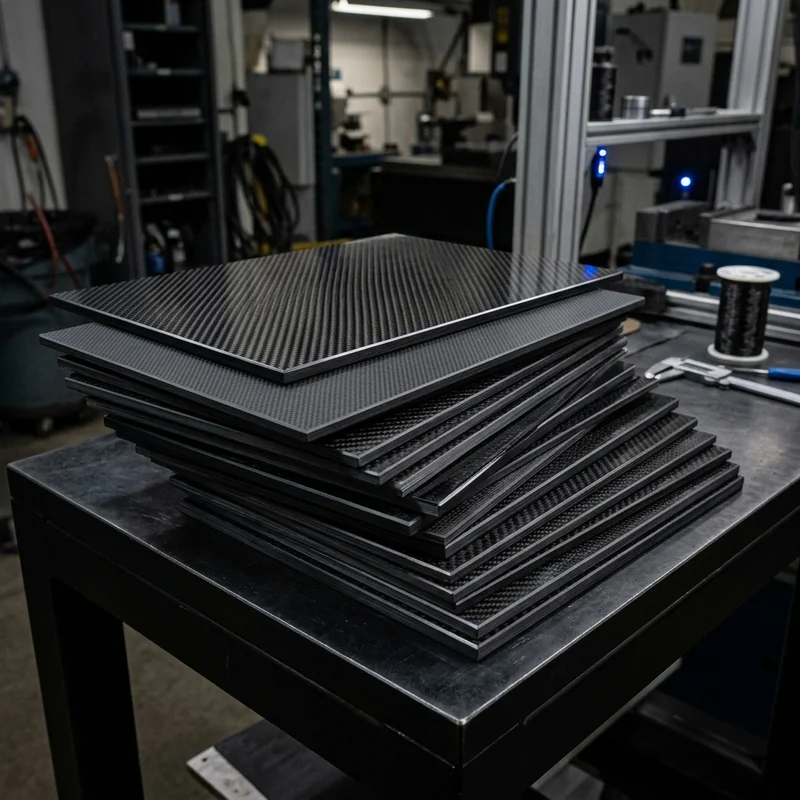
Carbon fiber standard plate-3k stripe
Lightweight, ultra-rigid standard sheets for drone fuselages, robot housings, facades and structural applications.

Carbon Fiber Plate — 3K Twill T700 1.5mm
Thin 1.5mm carbon fiber plate with 3K twill weave surface. Lightweight and stiff, commonly used for covers, panels, drone bodies, and applications requiring a premium aesthetic appearance.

Square Carbon Fiber Tube — 3K Twill T700
Square cross-section carbon fiber tube manufactured with 3K twill weave for torsional strength. Preferred for structural frames, trusses, and support columns where rectangular geometry offers design flexibility.

Carbon Fiber Plate — 3K Twill T700 3.0mm
Medium-thickness 3.0mm carbon fiber plate offering significantly higher load capacity while maintaining attractive 3K twill finish. Suitable for structural brackets, reinforcement plates, and load-bearing panels.
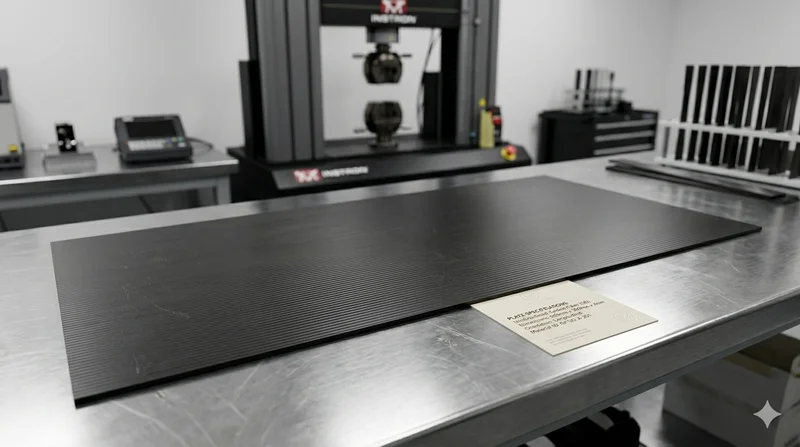
Carbon Fiber Plate — UD Unidirectional T700
Unidirectional carbon fiber plate with all fibers oriented in a single direction for maximum strength along the fiber axis. Essential for structural reinforcements, splints, and applications where load direction is predictable.