
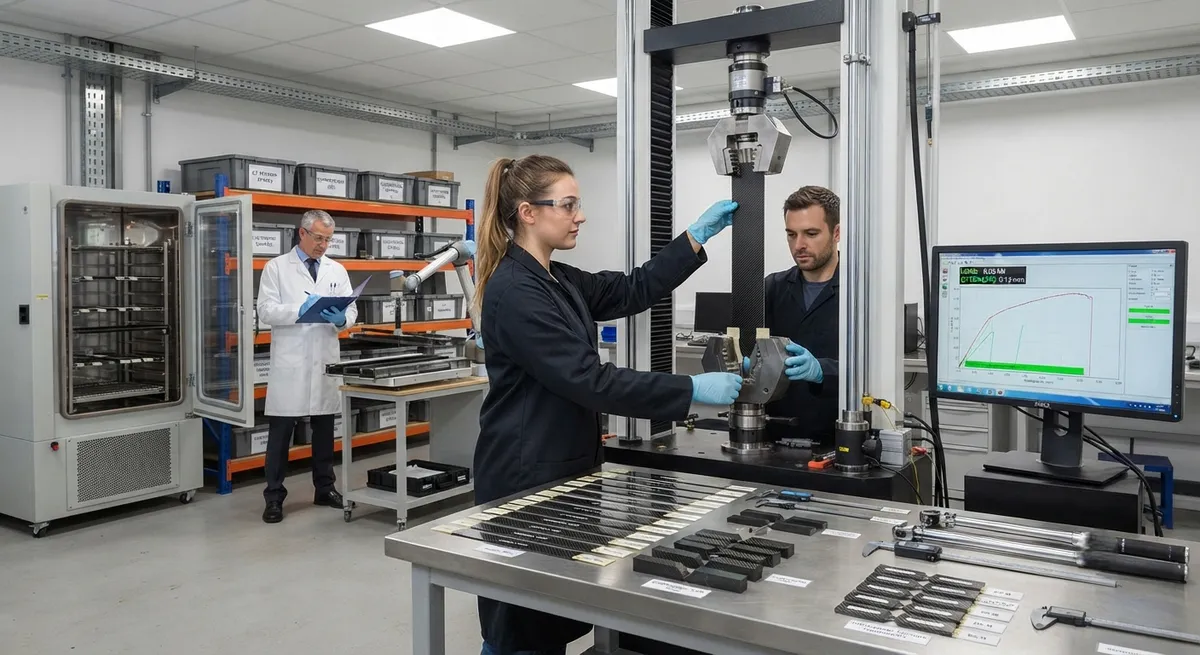
Before a carbon fiber part flies, drives, or presses against a load, a laboratory must prove the material does what the engineer assumed. That proof is mechanical testing, and for composites it is far more demanding than testing homogeneous metals. Because carbon fiber composites are an
Introduction
Before a carbon fiber part flies, drives, or presses against a load, a laboratory must prove the material does what the engineer assumed. That proof is mechanical testing, and for composites it is far more demanding than testing homogeneous metals. Because carbon fiber composites are anisotropic — behavior differs along and across the fibers — each fiber orientation must be tested, and a family of test methods exists across the two major standards bodies, ASTM and ISO, to capture every critical load mode.
For B2B buyers and QC engineers, that landscape can be confusing: different standard numbers appear for similar tests, and specimens vary in size and fixtures. This article gives a field-ready overview of the primary carbon-fiber test methods mapped to the acceptance and release workflow, with standard numbers, test coupons, fixtures, and interpreted properties for each.
Why Composite Testing Differs from Metal Testing
Unlike isotropic metals where a single tensile test describes the material, a composite test program must map an orthogonal matrix of properties dependent on fiber orientation: 0°, 90°, and off-axis laminates all give different results. Four factors behind the standards explain the extra complexity:
- Anisotropy and orientation mapping: A [0°] layup reports fiber-dominated strength; a [90°] coupon isolates the matrix and interface; a [±45°] traces the shear response. No single test defines the material.
- Specimen geometry is critical: Doubled thickness, tab rotation, and grip length must match the standard precisely because every deviation shifts the measured value.
- Environmental conditioning: Most methods specify conditioning (for example ASTM D3039 at room-temperature dry) plus optional wet, hot, or cold states so results cover the service envelope the part will actually see.
- Statistical data basis: Certification is built on dozens of replicate coupons to compute an A-basis or B-basis allowable with statistical confidence, never a single pair of values.
Test Methods at a Glance
The table below lists the primary mechanical test methods for carbon fiber composites, their ASTM and ISO numbers, the coupon type, and the property each establishes. Correct pairing of the standard with the property is the first step to a defensible result:
| Test Method | ASTM | ISO | Specimen / Fixture | Property Measured |
|---|---|---|---|---|
| Tensile (0°/90° laminate) | ASTM D3039 | ISO 527-4/-5 | Tabbed flat coupon | Tensile strength, modulus, Poisson |
| Compression | ASTM D3410 / D695 | ISO 14126 | Tabbed coupon, IITRI/four-point | Compressive strength & modulus |
| In-plane shear (Iosipescu) | ASTM D5379 | ISO 14129 | V-notched coupon | In-plane shear strength, modulus |
| In-plane shear (±45°) | ASTM D3518 | ISO 14129 | ±45° laminate coupon | In-plane shear (average) |
| Interlaminar shear (short beam) | ASTM D2344 | ISO 14130 | Short beam, three-point | Apparent interlaminar shear strength |
| Mode I fracture toughness | ASTM D5528 | ISO 15024 | DCB specimen | G_IC delamination resistance |
| Compression after impact | ASTM D7137 | ISO 18352 | Impacted panel coupon | CAI residual strength |
Tensile Testing: ASTM D3039 / ISO 527
Tensile testing is the most common acceptance gate. In D3039, a rectangular flat coupon with bonded tabs is gripped in a universal test machine and loaded until failure, with strain captured by an extensometer or video system along the gauge length. A 0° laminate reports the fiber-dominated tensile strength (typically 600-700 MPa for a standard modulus T700 laminate), while a 90° coupon reports the low, matrix-dominated strength (around 40-70 MPa). ISO 527-4 and 527-5 cover the same idea for composites but specify a different specimen geometry and alignment, so results from the two bodies are directly comparable only when the coupon, fiber volume, and orientation are identical.
The most common field errors are tab pull-out from excessive alignment pressure, a gauge length too short for accurate strain measurement, and skipped environmental conditioning that voids the quoted humidity. All three are avoided by following the standard's specimen dimension table and conditioning clause precisely.
Compression and Shear Methods
Compression testing is harder to run well because both ends of failure compete under the ram: the coupon can split by transverse cracking before failing in true compression, or it can buckle as a column. Standards solve this two ways — a short unsupported gauge length and tabs that protect the grip. ASTM D3410 uses the IITRI fixture with large tabbed coupons, ASTM D695 a shorter column for lower-modulus materials, and ISO 14126 is the global standard for carbon-fiber compressive modulus and strength. For in-plane shear, the V-notched Iosipescu coupon (ASTM D5379) generates a near-pure shear, while the ±45° laminate (ASTM D3518, ISO 14129) report the average in-plane shear modulus most OEMs quote. Interlaminar shear via the short-beam test (ASTM D2344) is the fast, laminate-level QC screening of fiber-matrix quality used in incoming inspection.
Quality Control and the Release Workflow
In production, QC laboratories use a layered approach rather than running every test every batch. Incoming material is screened with short-beam interlaminar shear plus one tensile modulus because these are sensitive to fiber volume and intermediary changes. On qualification batches, the full matrix — tensile (D3039), compression (D3410), Iosipescu shear (D5379), DCB toughness (D5528), and CAI (D7137) — is run on a minimum meaningful number of coupons (five per state typically for a basis), and the laminate toughness is cross-checked against traceability to the recipe. Results are recorded in a format that supports A/B-basis statistics, the laminate processing record, and the acceptance band for production. Rejecting a parts at any step invokes the process of inspection of the coupon and a rerun of the affected material contribution, not a pass-through.
Frequently Asked Questions
Do ASTM and ISO mechanical test results for carbon fiber ever give the same number?
Not necessarily. The two standards use different coupon geometries, gauge sections, and test speeds, so the values of a modulus or strength may differ by several percent. For a given material and 0° orientation, the tensile modulus is often close between these (both derive from the fiber volume), but the compressive strength and especially the failure mode can differ. Always state which standard you used when you quote a number — mixing ASTM D3039 strength with ISO 527 modulus in the same design book can produce an unusable design value. If you need cross-standard comparability, keep coupon orientation, fiber volume fraction, and conditioning identical and note the data source.
Why do my compression values come out lower than the manufacturer sheet?
Compression strength is sensitive to specimen preparation, tab alignment, and end defects. Lower measured values than the datasheet usually trace to one of three causes: the coupon buckled before compressive crush because the unsupported length was too long; tabs peeled or misaligned causing premature edge failure; or the part's actual fiber volume fraction is lower than the 55-60% used to publish the datasheet. Recheck the coupon alignment relative to the fiber axis, confirm the unsupported gauge length matches ASTM D3410 exact dimensions, and measure the actual fiber volume by acid digestion. If all three are correct and the value is still low, the material batch itself may be below that data point, and the CAI assign as B-basis.
Which single test should I run for daily production QA of a carbon part?
For a fast, sensitive, laminate-level daily qualifier, the short-beam interlaminar shear test (ASTM D2344) is the strongest candidate. It is quick, cheap, uses a small specimen, and it is sensitive to hydration, void content, and interlayer quality at the fiber level. Pair it with a tensile modulus check on a defined orientation for the structural check. This combination monitors daily variation and catches a manufacturing problem early without the cost and fixture needs of a full tensile/compression/impact campaign at full triangulation, reserving the full matrix for the initial qualification and periodic audits.
Conclusion
Mechanical testing under ASTM and ISO is how a carbon fiber part goes from a promising material to a certified component. The tensile, compression, shear, interlaminar, and impact methods that appear in this family map directly to the load-bearing properties designers and inspectors rely on, while the conditioning and statistical basis turn a single coupon into a design value that can be safely used. For QC teams, the correct pick of a daily qualifier plus the full matrix on qualification is a low-cost way to keep quality consistent.
If your project needs validated testing data, a sanctioned lab, or material with known properties, explore our carbon fiber fabrics, prepregs, and qualified laminates, or contact our engineering team to discuss a material acceptance program for your specific application and standard requirement.
Related Articles
- Filament Wound Epoxy Tubes Advantages: Over Metal and Pultruded Alternatives
- Carbon Fiber Tube Strength: Analysis Methods and Design Allowables
- Filament Wound Epoxy Tubes: Mechanical Properties and Material Data Sheets
- Carbon Fiber Drone Blades and Propellers: Stiffness, Balance and Noise Reduction
- Fiberglass Filament Wound Tubes: Cost-Effective Alternative to Carbon Fiber
- Filament Wound Epoxy Tube Design: Wall Thickness, Fiber Angle and Load Optimization
Interested in Our Products?
Contact our team for competitive pricing and technical specifications.
Get a QuoteRelated Products
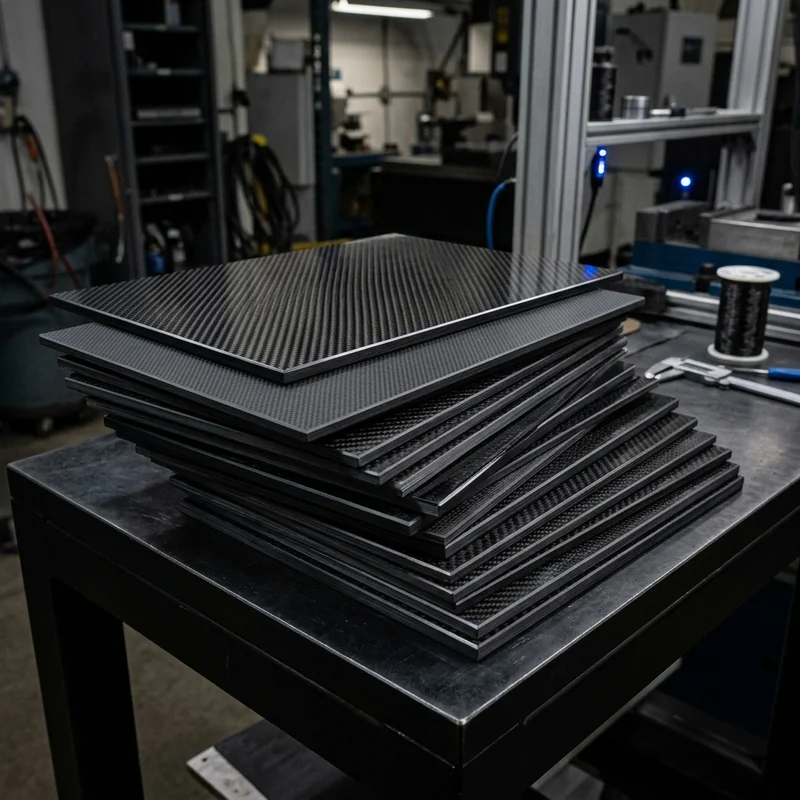
Carbon fiber standard plate-3k stripe
Lightweight, ultra-rigid standard sheets for drone fuselages, robot housings, facades and structural applications.
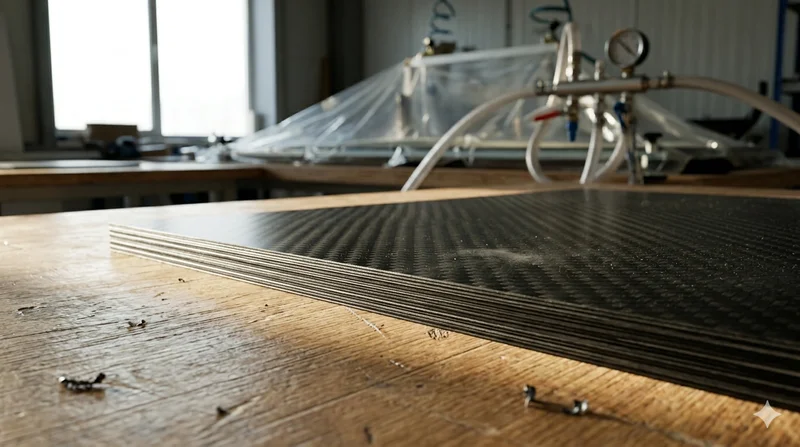
Carbon Fiber Plate — 3K Twill T700 3.0mm
Medium-thickness 3.0mm carbon fiber plate offering significantly higher load capacity while maintaining attractive 3K twill finish. Suitable for structural brackets, reinforcement plates, and load-bearing panels.
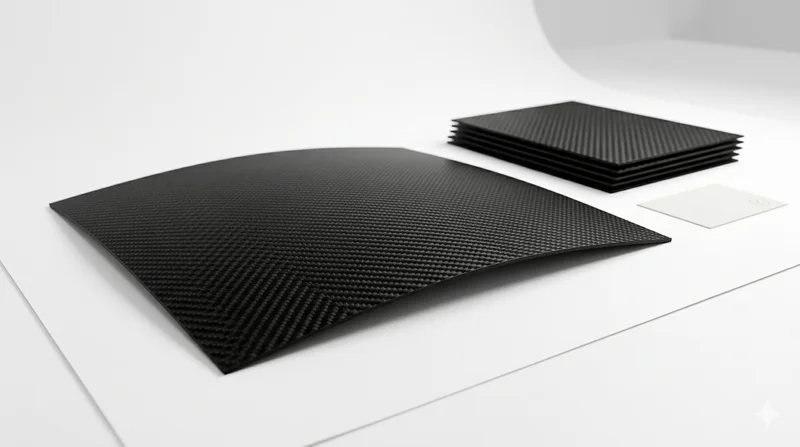
Carbon Fiber Plate — 3K Twill T700 1.5mm
Thin 1.5mm carbon fiber plate with 3K twill weave surface. Lightweight and stiff, commonly used for covers, panels, drone bodies, and applications requiring a premium aesthetic appearance.
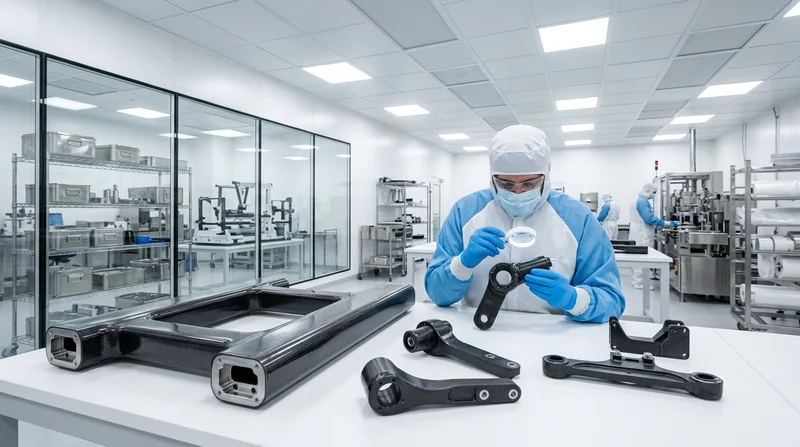
Custom Carbon Fiber Medical Device Components
Medical-grade carbon fiber components manufactured for imaging equipment, surgical instruments, and patient support systems. Carbon fiber's radiolucency (X-ray transparency) and high strength-to-weight ratio make it ideal for CT scanner beds, wheelchair frames, surgical robot arms, and MRI-compatible accessories. Biocompatible resin systems available.
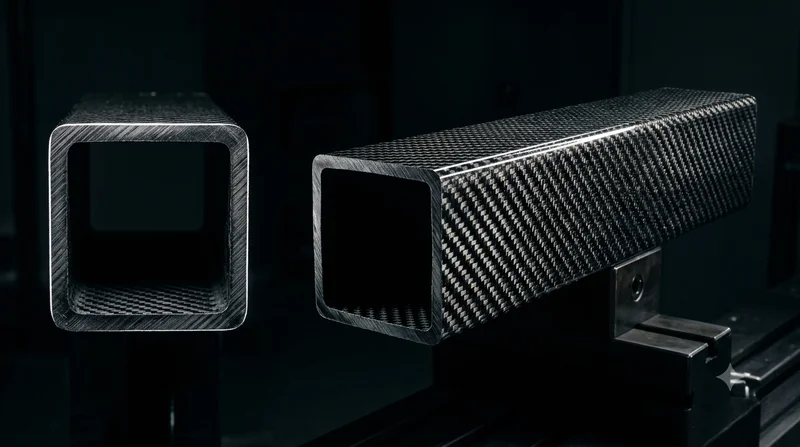
Square Carbon Fiber Tube — 3K Twill T700
Square cross-section carbon fiber tube manufactured with 3K twill weave for torsional strength. Preferred for structural frames, trusses, and support columns where rectangular geometry offers design flexibility.