
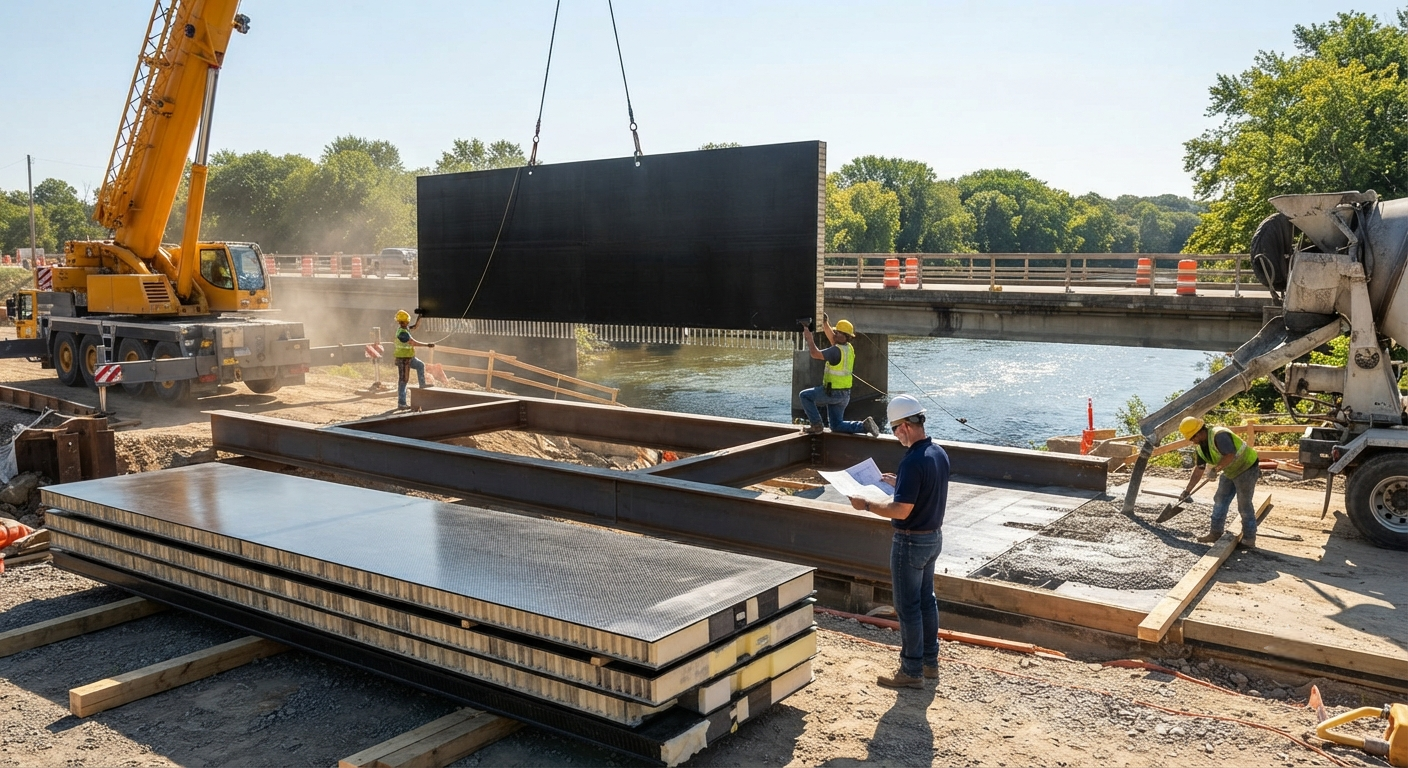
Comprehensive analysis of CFRP bridge deck systems covering sandwich panel design, pedestrian and vehicular applications, movable bridge advantages, lifecycle cost analysis, and global installation case studies.
Carbon Fiber Composite Bridge Decks: Material Advantages and Structural Performance
Carbon fiber reinforced polymer (CFRP) bridge decks represent a transformative approach to bridge infrastructure, offering weight savings of 70% to 80% compared to conventional reinforced concrete decks while providing superior corrosion resistance, fatigue performance, and installation speed. Unlike steel and concrete, CFRP does not suffer from chloride-induced corrosion — the primary degradation mechanism for reinforced concrete bridge decks in cold climates where deicing salts are applied. With over 40% of the 620,000 bridges in the United States classified as structurally deficient or functionally obsolete, and European infrastructure agencies facing a maintenance backlog exceeding €100 billion, CFRP bridge deck systems offer a durable, low-maintenance alternative that extends service life from 50 years to 100+ years with minimal intervention.
The structural design of CFRP bridge decks typically utilizes a sandwich panel configuration comprising carbon fiber face sheets bonded to a lightweight core material — most commonly closed-cell polyurethane foam, balsa wood, or aluminum honeycomb. The face sheets carry the flexural loads, while the core transfers shear between the face sheets and provides out-of-plane stiffness. For vehicular bridge decks, the top face sheet must resist concentrated wheel loads of up to 100 kN (HS-20 truck loading per AASHTO) with minimal deflection, requiring face sheet thicknesses typically in the range of 3 to 8 mm of carbon fiber laminate. The core thickness is governed by the required deck stiffness — typically spanning 75 to 200 mm for pedestrian bridges and 150 to 350 mm for vehicular bridges.
| Property | CFRP Sandwich Deck | Reinforced Concrete Deck | Steel Orthotropic Deck |
|---|---|---|---|
| Self-Weight (kg/m²) | 45–80 | 400–700 | 150–300 |
| Flexural Strength (MPa) | 400–800 (face sheet) | 5–7 (concrete in tension) | 250–350 (yield) |
| Flexural Modulus (GPa) | 60–120 (face sheet) | 25–30 | 200 |
| Design Service Life (years) | 75–100+ | 50–75 (with maintenance) | 40–70 (with painting) |
| Corrosion Resistance | Excellent — no corrosion | Poor — rebar corrosion | Moderate — requires coating |
| Installation Rate (m²/day) | 200–400 | 40–80 | 80–150 |
| Fatigue Endurance (cycles) | 2×10⁶ (no degradation) | 1×10⁶ (crack initiation) | 5×10⁵ (weld detail dependent) |
| Thermal Conductivity (W/m·K) | 0.3–0.5 (through-thickness) | 1.5–2.5 | 50–60 |
The rapid installation capability of CFRP bridge decks is particularly valuable for movable (bascule) bridges, where the dead weight of the deck directly determines counterweight requirements and opening mechanism capacity. The CF Bridge Replacement project on Interstate 84 in Connecticut — the first vehicular CFRP bridge deck in North America — installed 690 m² of CFRP deck in 12 working days, compared to an estimated 45 days for a conventional reinforced concrete solution. The 80% weight reduction allowed reuse of the existing steel girder substructure, saving $2.3 million in structural modification costs. Similar projects in Japan — where over 200 CFRP bridge decks have been installed since 2005 — report installation savings of 60% to 75% in construction time and lifecycle cost reductions of 25% to 40% through elimination of corrosion maintenance.
Pedestrian Bridge Applications
CFRP pedestrian bridge decks represent the most mature application segment, with over 500 CFRP pedestrian bridges installed globally as of 2025. The lightweight nature of CFRP enables longer spans — single spans of 30 to 50 meters are achievable without intermediate piers — and allows installation in environmentally sensitive areas where heavy construction equipment cannot access. The Lleida Pedestrian Bridge in Spain (2012) features a 38-meter clear span CFRP deck with pultruded carbon fiber I-beam sections supporting a glass-fiber sandwich panel wearing surface. The total deck mass of 12 tonnes represents a 75% reduction compared to a concrete alternative, enabling the slender, elegant cross-section that won the project multiple design awards.
- Pultruded CFRP Profiles: Continuous pultrusion manufacturing produces I-beams, box sections, and orthotropic plates at rates of 1 to 3 meters per minute. Pultruded sections with fiber volume fractions of 60% to 65% achieve flexural strengths of 500 to 800 MPa. Standard section depths range from 100 mm to 600 mm for pedestrian bridge applications.
- Vacuum-Infused Sandwich Panels: For custom geometries — curved decks, variable-depth sections, integrated railings — vacuum-assisted resin transfer infusion (VARTM) produces monolithic CFRP panels up to 4 meters wide and 20 meters long. The VARTM process achieves fiber volume fractions of 50% to 58% with void contents below 1%.
- Adhesive-Bonded Connections: CFRP deck panels are joined using two-part epoxy structural adhesives with overlap lengths of 75 to 150 mm. The bonded joints are designed to develop the full strength of the face sheets, with joint efficiencies of 85% to 95% under static and fatigue loading.
- Modular Deck Systems: Standardized CFRP deck modules (typically 1.2 m × 2.4 m to 2.4 m × 6.0 m) are prefabricated in factory conditions and transported to site by flatbed truck. The modules include integrated shear connectors for composite action with steel or concrete girders, typically stainless steel studs bonded into the CFRP during manufacture.
Vehicular Bridge Applications
Vehicular CFRP bridge decks require more substantial structural design due to AASHTO HS-20 or Eurocode 1 vehicle loadings. The first major vehicular CFRP bridge deck in the United States was installed on Salem Avenue Bridge in Dayton, Ohio in 1997 — a 7.3-meter span carrying two lanes of traffic. Since then, vehicular CFRP decks have been installed on over 200 bridges worldwide, including highway bridges in Japan (the Yoshida Bridge, FRP deck span 36 meters), military tactical bridges (the U.S. Army's Heavy Dry Support Bridge with CFRP deck panels), and European motorway overpasses (the A1 motorway in Slovenia, with a 42-meter span CFRP deck replacing a deteriorated concrete structure).
The design of vehicular CFRP bridge decks must address the concentrated nature of tire contact patch loads. AASHTO LRFD specifications require that the deck withstand a 71 kN wheel load applied through a 250 mm × 500 mm tire contact area, with a 1.75 dynamic load factor and a 1.5 multiple presence factor for multi-lane loading. For CFRP sandwich decks, this requires the top face sheet to resist punching shear through the core. Typical solutions include local thickening of the top face sheet in the wheel path, insertion of high-density foam inserts in the core at tire contact locations, or integration of a thin lightweight concrete wearing surface bonded to the CFRP top face sheet. The wearing surface — typically 25 to 50 mm of ultra-high-performance concrete (UHPC) or polymer-modified mortar — distributes concentrated wheel loads over a wider area and provides the skid resistance required for vehicular traffic.
Movable Bridge Applications
CFRP bridge decks offer transformative advantages for movable bridges — bascule, lift, and swing spans — where every tonne of deck weight directly translates into counterweight mass, mechanical system capacity, and operating power requirements. The Brunel Swing Bridge in Bristol, UK — a 45-meter CFRP swing span installed in 2018 — achieved a deck weight of 35 tonnes compared to an estimated 180 tonnes for a concrete alternative, reducing the counterweight requirement by 145 tonnes and enabling the use of the existing pivot mechanism without reinforcement. The bridge's electrical operating system — originally designed for the heavier concrete deck — uses 40% less energy following the CFRP installation, with annual energy savings of 12,000 kWh.
For bascule bridges, the weight reduction from CFRP decks enables longer leaves, increased opening angles, or rehabilitation of deficient structures without strengthening the existing trunnion and rack-and-pinion systems. The Miami River Movable Bridge in Florida — a double-leaf bascule with CFRP deck panels installed on both leaves — demonstrated a 65% reduction in opening drive motor current draw after CFRP deck installation. The bridge also benefits from CFRP's corrosion resistance in the coastal marine environment, where salt-laden air and splash exposure cause rapid deterioration of steel decks and concrete reinforcement. The annual maintenance cost for the CFRP deck sections is projected at $3,000, compared to $25,000 to $40,000 for equivalent steel deck sections requiring periodic recoating and corrosion repair.
Frequently Asked Questions
How long do CFRP bridge decks last compared to concrete or steel?
CFRP bridge decks have a design service life of 75 to 100+ years with minimal maintenance — primarily periodic inspection and joint resealing at 10 to 15 year intervals. This compares favorably with reinforced concrete decks (50 to 75 years with joint repairs and cathodic protection) and steel orthotropic decks (40 to 70 years with periodic recoating every 8 to 12 years). Accelerated aging tests on CFRP decks — including UV exposure, freeze-thaw cycling, and saltwater immersion per AASHTO specifications — have demonstrated retention of 85% to 95% of initial mechanical properties after simulated 100-year exposure. Field examinations of CFRP decks installed in the late 1990s confirm no structural degradation after 25+ years in service, validating the accelerated test predictions.
Are CFRP bridge decks more expensive than conventional alternatives?
Initial material costs for CFRP bridge decks are 1.5 to 3 times higher than conventional reinforced concrete or steel decks. However, when evaluated on a lifecycle cost basis — including fabrication, transportation, installation, maintenance, user delay costs during construction, and end-of-life considerations — CFRP decks achieve 20% to 40% lower total ownership costs. The faster installation reduces traffic disruption costs (user delay costs are often the largest component of bridge replacement projects, averaging $25,000 to $50,000 per lane-day for major highways), and the elimination of corrosion maintenance eliminates 60% to 70% of ongoing maintenance expenditures. For movable bridges, the counterweight savings of $50,000 to $200,000 per tonne of weight reduction further offset the initial material premium.
Can CFRP bridge decks be used with existing steel or concrete girders?
Yes. CFRP bridge decks are designed to achieve composite action with existing steel and concrete girders through mechanical shear connectors. Stainless steel studs or bolts are cast into the CFRP deck during manufacture and connected to the girder top flange through shear pockets grouted with non-shrink cementitious or epoxy grout. The composite action transfers longitudinal shear between the deck and girder, enabling the CFRP deck to contribute to the overall bridge flexural stiffness. Compatibility testing conducted at the University of California San Diego established that the CFRP-to-steel shear connection achieves 90% to 100% of the strength of a conventional steel stud-to-concrete slab connection, with better fatigue performance due to the absence of concrete cracking at the shear connector base.
Part of topic
Related Articles
- Carbon Fiber Mooring for Floating Offshore Wind: Fatigue and Corrosion in Deep Water
- Carbon Fiber Bicycle Frame Optimization: Layup Design and Manufacturing for Competitive Racing
- Carbon Fiber CFRP Retrofit for Infrastructure: Bridge and Building Seismic Strengthening
- Carbon Fiber Medical Imaging Equipment: Lightweight Gantry and Couch Structures for MRI/CT
- Carbon Fiber EV Battery Enclosures: Crash Safety and Electromagnetic Shielding Design
- Carbon Fiber Structures for Low-Altitude Economy: UAV Airframes and eVTOL Components
Interested in Our Products?
Contact our team for competitive pricing and technical specifications.
Get a QuoteRelated Products
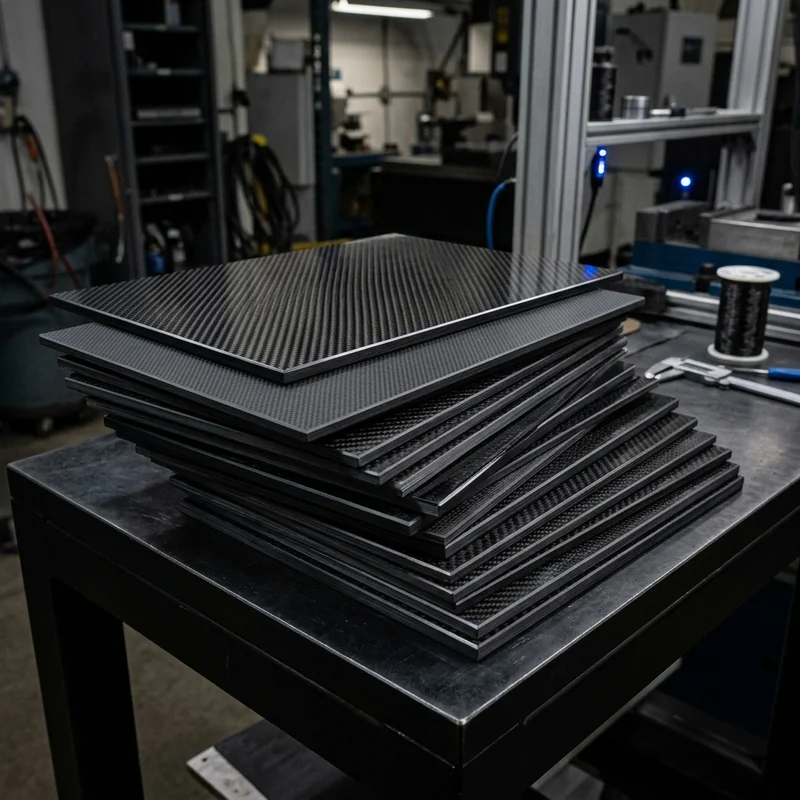
Carbon fiber standard plate-3k stripe
Lightweight, ultra-rigid standard sheets for drone fuselages, robot housings, facades and structural applications.

Carbon Fiber Plate — 3K Twill T700 3.0mm
Medium-thickness 3.0mm carbon fiber plate offering significantly higher load capacity while maintaining attractive 3K twill finish. Suitable for structural brackets, reinforcement plates, and load-bearing panels.

Carbon Fiber Plate — 3K Twill T700 1.5mm
Thin 1.5mm carbon fiber plate with 3K twill weave surface. Lightweight and stiff, commonly used for covers, panels, drone bodies, and applications requiring a premium aesthetic appearance.

Square Carbon Fiber Tube — 3K Twill T700
Square cross-section carbon fiber tube manufactured with 3K twill weave for torsional strength. Preferred for structural frames, trusses, and support columns where rectangular geometry offers design flexibility.
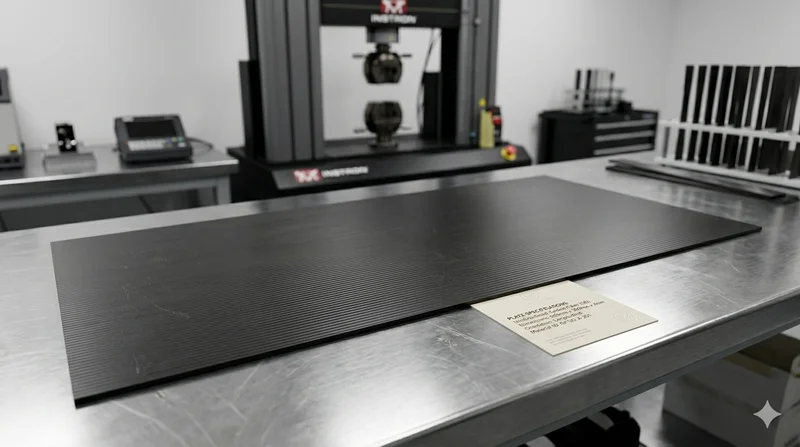
Carbon Fiber Plate — UD Unidirectional T700
Unidirectional carbon fiber plate with all fibers oriented in a single direction for maximum strength along the fiber axis. Essential for structural reinforcements, splints, and applications where load direction is predictable.