
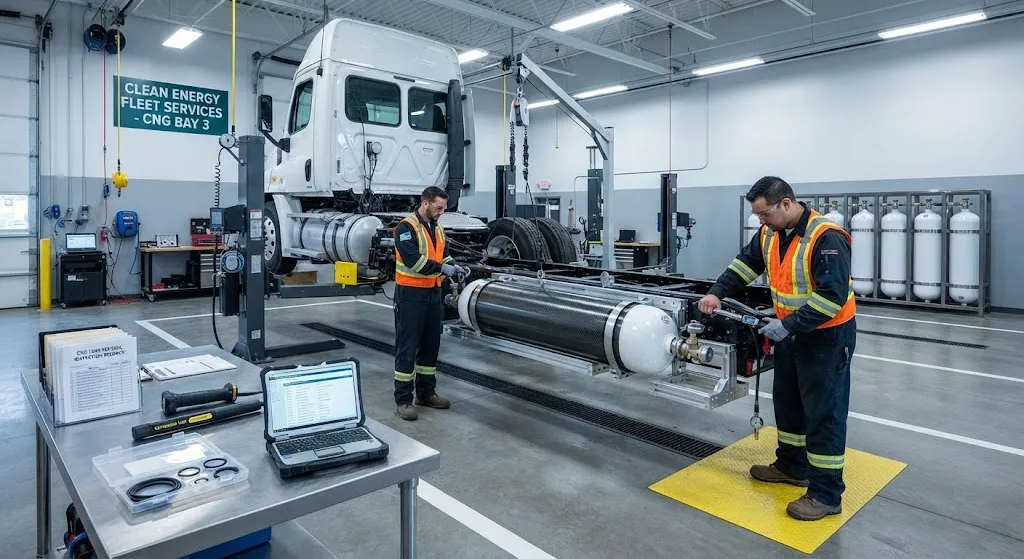
Natural gas vehicles have never captured the headlines earned by battery-electric trucks, yet they quietly carry a large share of long-haul and regional freight across Asia, the CIS, and Latin America. Compressed natural gas is cheap, abundant, and burnable in proven engines, and the in
Introduction
Natural gas vehicles have never captured the headlines earned by battery-electric trucks, yet they quietly carry a large share of long-haul and regional freight across Asia, the CIS, and Latin America. Compressed natural gas is cheap, abundant, and burnable in proven engines, and the infrastructure for it — compressor stations and refueling points — already exists wherever pipeline gas reaches. The bottleneck has always been the tank: steel cylinders are heavy, and a truck that needs eight or twelve of them gives up hundreds of kilograms of payload before a single box is loaded.
Composite over-wrapped cylinders close that gap. A Type IV CNG tank weighs roughly a third of its steel predecessor, which on a multi-tank truck converts directly into revenue cargo. This article walks through the tank type spectrum, the market arithmetic across the main NG regions, and the honest answer to the question every fleet asks: whether a CNG investment still makes sense while the industry migrates toward hydrogen.
The Tank Type Spectrum
CNG vehicle cylinders fall into four classes, defined by the liner and the wrapping strategy. All four store gas at the same nominal pressures — typically 200 bar, with some heavy-duty programs at 250 bar — so the differences are weight, cost, fatigue life, and failure mode.
| Type | Liner | Composite wrap | Weight vs steel | Cost tier | Typical use |
|---|---|---|---|---|---|
| Type I | Full steel | None | Baseline | Lowest | Legacy conversions, low-cost fleets |
| Type II | Steel (reinforced) | Hoop wrap only | 30-45 percent lighter | Low | Buses, regional trucks |
| Type III | Aluminum | Full wrap | 50-60 percent lighter | Medium | Trucks, high-cycling fleets |
| Type IV | Polymer | Full wrap | 60-70 percent lighter | Highest | Premium NG trucks, payload-critical |
The engineering logic of the progression is simple. Type II uses hoops to carry the hoop stress while the steel liner takes the axial load, which cuts weight at modest cost. Type III removes the heavy liner entirely from the load path and wraps the whole cylinder, trading cost for a further step in lightness. Type IV replaces metal with a polymer liner that only seals the gas, allowing the composite shell to carry 100 percent of the structural load — the lightest configuration, and the one where carbon fiber earns its premium.
Where Composite CNG Earns Its Cost
The payback of a Type III or Type IV tank is a payload, not a headline. A typical heavy truck installation of eight to twelve cylinders weighing around 60 to 90 kilograms each in Type I steel becomes roughly a third of that weight in Type IV composite, releasing 350 to 500 kilograms of payload on the same chassis. For a fleet paid per tonne-kilometer, that difference is a direct revenue line, and it compounds on routes where the truck runs full both ways.
| Region | Market driver | Typical tank route |
|---|---|---|
| China | Gas-to-diesel price gap, large conversion programs | Type II retrofits, rising Type IV share |
| India | Rapid CNG station rollout, city logistics mandates | Type II/III OEM fitment, conversion kits |
| CIS and Eastern Europe | Local gas abundance, established NG fleets | Type I dominant, Type II growing |
| Latin America | Brazil, Colombia, Argentina NG fleets | Type I/II conversions, budget-constrained |
| European Union | GHG reduction, LNG long-haul plus CNG regional | Type IV OEM trucks, lighter integration |
Certification is the other half of the cost story. CNG cylinders for vehicles are covered by ISO 11439 for in-service use and, in the EU, by the type approval framework of ECE R110. A composite tank program therefore carries the full qualification burden — burst, fatigue cycling, and environmental exposure — which is why established cylinder makers dominate supply and why buyers should treat "cheap untype-approved composite tanks" as a safety red flag rather than a bargain.
CNG and Hydrogen as Parallel Tracks
Fleets often ask whether CNG investment will be stranded when hydrogen arrives. The short answer is that the two systems will run in parallel for at least a decade on the roads that matter here. Hydrogen heavy-duty vehicles operate at 350 or 700 bar with fundamentally different cylinders and standards; they require production and dispensing infrastructure that does not exist in most of South Asia, the CIS, or Latin America, and green hydrogen prices remain far above the gas price that makes CNG conversions self-funding today.
- Weight budget: quantify payload release per tank set — Type IV frees 350-500 kg on a typical eight-tank truck, which pays at every full-load kilometer.
- Space envelope: frame-mount, roof-mount, or in-chassis options change stock-keeping and installation complexity more than cylinder price does.
- Certification path: confirm ISO 11439 and ECE R110 approval for the target territory before any commercial commitment.
- Maintenance regime: composite tanks follow periodic inspection schedules; liner permeability in Type IV requires purging and leak checks that steel never needed.
- Total cost of ownership: model fuel savings against the tank premium over a five-year horizon; in high-utilization freight the payload gain alone usually justifies Type IV.
The parallel-track view also matters for suppliers. The winding, curing, and testing competencies built for CNG composite cylinders transfer directly to hydrogen vessel programs, and the manufacturing base that masters Type IV CNG today is the same base that will supply 700-bar hydrogen storage tomorrow. A petal installed now is not stranded: it is the dry run for the higher-pressure product family.
Frequently Asked Questions
When does a Type IV CNG tank pay back versus Type I steel?
In high-utilization trucking the payback is driven by payload rather than by fuel savings alone. A Type IV installation releasing 350-500 kilograms lets a fleet carry more billable cargo on routes that are payload-limited, which in competitive freight markets is worth thousands of euros per truck per year. At current tank premiums, high-mileage regional trucks with eight or more cylinders typically recover the extra cost within two to three years of operation. Budget-constrained conversions running light cargo should stay with Type II, where the weight saving already delivers most of the benefit at a fraction of the cost.
Will CNG tanks become obsolete when hydrogen trucks arrive?
Not in the markets where the volume is today. Hydrogen heavy-duty requires 350-700 bar production and dispensing infrastructure that is being built first in the EU and parts of North America; in South Asia, the CIS, and Latin America, gas compression and dispensing are already in place and the price gap still favors natural gas by a wide margin. The practical transition is a decade or more, and the competencies — composite winding, liner handling, burst and fatigue qualification — carry over directly to hydrogen vessels. A CNG tank program today is best understood as the lower-pressure first step of the same product family.
Can a composite CNG tank be converted into a hydrogen tank later?
No, not by retrofit. Hydrogen Type IV cylinders operate at 700 bar against CNG's 200-250 bar, demand different liner permeability control, and must be certified to different standards such as ECE R134 and ISO 19881. The tank itself cannot be re-rated safely across that pressure gap. What transfers is the industrial capability: the winding line, the fiber and liner suppliers, the burst-test infrastructure, and the qualification experience. Operators should plan CNG as a current revenue asset and hydrogen as a future product line built on the same factory floor.
Conclusion
Composite CNG tanks convert the oldest argument against natural gas trucks — carrying weight — into a payload advantage. Type II captures most of the improvement at minimal cost, Type IV unlocks the full 350-500 kilogram payload release, and both sit inside certification frameworks that have been proven over decades of commercial service. In parallel, the same winding and qualification base becomes the natural platform for hydrogen storage, so the investment hedges rather than conflicts with the energy transition.
For fleets and integrators comparing tank options, review our carbon fiber and composite cylinder materials, or contact our team to discuss fiber selection, winding supply, and qualification support for CNG or hydrogen programs.
Part of topic
Related Articles
- Carbon Fiber Mooring for Floating Offshore Wind: Fatigue and Corrosion in Deep Water
- Carbon Fiber Bicycle Frame Optimization: Layup Design and Manufacturing for Competitive Racing
- Carbon Fiber CFRP Retrofit for Infrastructure: Bridge and Building Seismic Strengthening
- Carbon Fiber Medical Imaging Equipment: Lightweight Gantry and Couch Structures for MRI/CT
- Carbon Fiber EV Battery Enclosures: Crash Safety and Electromagnetic Shielding Design
- Carbon Fiber Structures for Low-Altitude Economy: UAV Airframes and eVTOL Components
Interested in Carbon Fiber Plates?
Contact our team for competitive pricing and technical specifications.
Get a QuoteRelated Products
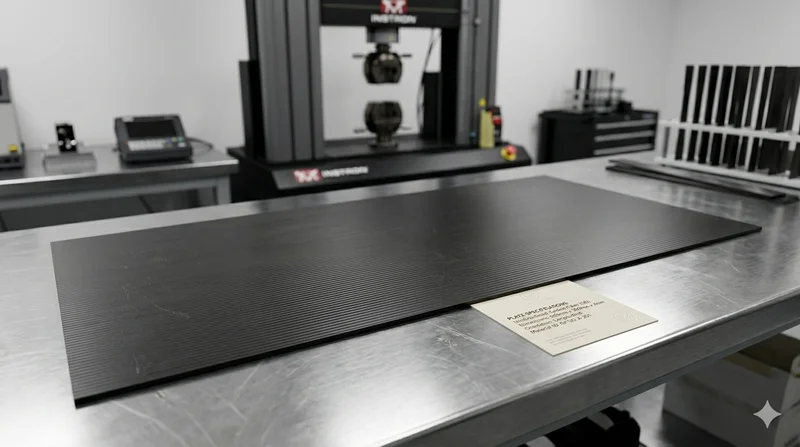
Carbon Fiber Plate — UD Unidirectional T700
Unidirectional carbon fiber plate with all fibers oriented in a single direction for maximum strength along the fiber axis. Essential for structural reinforcements, splints, and applications where load direction is predictable.

Carbon Fiber Plate — High-Gloss Decorative
High-gloss decorative carbon fiber plate with a mirror-like surface finish. The glossy coating enhances the visible 3K twill weave, creating a premium aesthetic for consumer-facing applications. Lightweight yet stiff, available in thin gauges for easy cutting and forming.