
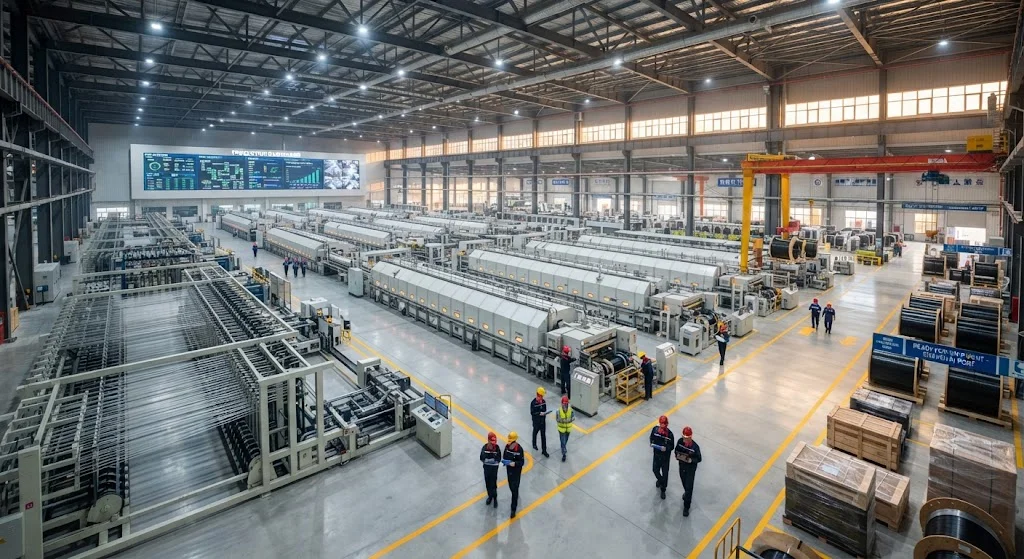
For two decades the benchmark question about carbon fiber supply was a question of price: when would Chinese capacity push industrial-grade tow down to commodity levels? That question has been answered. The new question is a question of structure: what happens when the same production b
Introduction
For two decades the benchmark question about carbon fiber supply was a question of price: when would Chinese capacity push industrial-grade tow down to commodity levels? That question has been answered. The new question is a question of structure: what happens when the same production base that delivered the price compression also holds, in a single country's hands, roughly half of the world's manufacturing capability? The shift from price competition to concentration risk is the defining change in the carbon fiber market of the mid-2020s, and it touches every buyer who assumed diversity of supply was a permanent feature of the industry.
Chinese suppliers crossed the half-share threshold in 2024, overtaking the leadership position that Toray — the industry's historical benchmark — had held for the prior two decades. The milestone is not merely symbolic. Market power of that scale changes the game theory of the industry: pricing, allocation priorities, and export policy all become instruments a concentrated producer can wield. This article quantifies the concentration, traces how it becomes leverage as large-tow supply tightens, and assesses how Western buyers are adapting.
Measuring the Concentration
The half-share milestone is best understood against the structure of the rest of the market. The table below compares China's position with the other major producing regions:
| Region | Share of global capacity | Position in the supply chain | Key constraint |
|---|---|---|---|
| China | Roughly 50 percent | Full chain: PAN precursor, tow, fabrics, and downstream parts | High-end aerospace grade still partly dependent on imports and licenses |
| Japan | Roughly 15-20 percent | Aerospace-grade leadership: Toray, Teijin, Mitsubishi | Capacity growth slow; qualification bottlenecks limit new entrants |
| United States | Roughly 15 percent | Defense and aerospace stronghold; large-tow industrial positions | Smaller industrial base; dependence on imported precursor in places |
| Europe | Roughly 10-15 percent | Toray Abidos, SGL, Solvay/Syensqo-linked positions; strong downstream | Limited upstream scale; wind and aerospace compete for fiber |
No other single country or company holds a comparable share, and no Western bloc together exceeds the Chinese base. Concentration of this degree means that global carbon fiber prices and availability now depend heavily on the operating and export decisions of a single country's producers.
Market Power and How It Compounds
Market power in carbon fiber is not just the capacity number; it is what the number enables in market behavior. A producer with a large share can set the reference price for industrial tow, because competitors must defend margin against a base that enjoys scale economics, domestic feedstock, and integrated PAN production. That pricing power cascades: when Chinese producers raise export prices to protect domestic margins, the world price follows upward; when they prioritize domestic demand, export allocation tightens.
The compounding effect is visible in the large-tow segment. Large-tow fiber — the 48K and heavier formats used heavily in wind energy and industrial applications — has been the volume engine of the Chinese industry, and through 2025 and into 2026 its supply has grown structurally tighter on the export market. Chinese domestic demand for wind, infrastructure, and automotive composite parts consumes an increasing share of national output, and export allocations for large-tow are quoted on increasingly selective terms. A market that once had many sellers with excess capacity now has the largest seller facing domestic demand that absorbs its own output.
Export Policy as the Leverage Multiplier
Concentrated capacity turns routine commercial decisions into policy instruments. The experience of other critical materials — gallium, germanium, and rare-earth elements have all seen export controls since 2023 — shows how Beijing treats dual-use material leverage when strategic value aligns with capacity dominance. Carbon fiber has elements of the same profile: it is a dual-use material with civil demand across wind, aerospace, and automotive, and a military value chain where high-modulus grade availability matters.
The relevant question is not whether controls will be introduced tomorrow, but how the leverage they represent changes buyer expectations today. Buyers holding a single-source dependency on Chinese industrial tow are, in effect, holding an unprotected position against a policy shock. The emerging consensus among Western procurement teams treats Chinese carbon fiber much as energy imports were treated a decade ago: useful, sometimes essential, but no longer compatible with an unhedged supply posture.
Western Response: De-Risking Strategies in Practice
Adjustment is already underway across the three largest consuming regions, and the pattern is recognizable from earlier critical-material shocks:
- Qualification of alternative sources: Western aerospace and defense programs are accelerating qualification of Japanese, US, and European fiber where margins exist, accepting that diversification costs time and money today to avoid exposure later.
- Domestic capacity incentives: the US and EU are channelling defense and infrastructure funding into domestic large-tow and aerospace-tow projects, with procurement preferences written into defense and wind solicitations.
- Long-term locked supply: buyers with the scale to commit are moving toward multi-year agreements with non-Chinese suppliers, trading spot flexibility for allocation security.
- Recycling as a supply hedge: reclaimed fiber and repurposed composite scrap are being reframed, in part, as a domestic buffer against import dependence.
- Inventory and buffer stock thinking: downstream converters are shifting from just-in-time tow inventories to strategic buffer positions sized against plausible disruption windows.
None of these measures reverses Chinese capacity; they rebalance the exposure. The goal is not to eliminate Chinese supply but to ensure that no critical program depends on it unhedged.
The 2028 Risk Scenario
The concentration risk has a time dimension that makes it more acute than a static market-share reading suggests. Large-tow supply is projected to remain tight through 2025-2026, and multiple independent analyses flag 2028 as the point at which the imbalance could turn sharp — a scenario in which global demand for industrial tow outruns the available supply net of Chinese domestic absorption. In that scenario, export allocation is the swing factor: the difference between a balanced market and a sharp shortage is decided by how much of Chinese capacity is directed outward.
Western buyers are not waiting to find out which side of that swing they land on. The restructuring described above — qualification, incentives, locked agreements, recycling hedges, and buffer inventory — is precisely the playbook that de-risks a market before the crisis arrives. The strategic consequence for the industry is clear: supply security has moved from a procurement footnote to the organizing principle of carbon fiber sourcing strategy.
Frequently Asked Questions
Does China's roughly 50 percent capacity share mean it also controls half of global supply?
Not exactly. Capacity is the manufacturing capability; supply is that capability deployed through operating decisions. Chinese producers hold a dominant share of capacity but still choose export volumes case by case, influenced by domestic demand, margins, and policy. The risk is not that half of the world's fiber suddenly disappears; it is that the export allocation of that half becomes a discretionary variable in a concentrated market.
Is there a realistic path to reducing dependence on Chinese industrial fiber?
In the medium term, partial. Qualification of Japanese, US, and European aerospace-grade alternatives is realistic for high-value programs, but industrial large-tow volume is harder to replace quickly because Western capacity is smaller and capital for new lines is only now being committed. Recycling and expanded domestic capacity can meaningfully reduce marginal dependence within three to five years, which is why the 2028 window — before new Western lines fully ramp — is the period of maximum exposure.
Has China actually used export controls on carbon fiber, or is this speculative?
To date, China has not imposed the kind of export controls on carbon fiber that it has applied to gallium, germanium, and rare-earth elements. But the strategic logic that produced those controls — dual-use material dominance plus geopolitical tension — overlaps substantially with carbon fiber's profile, and market behavior (selective export allocation, domestic prioritization) already produces some of the same effects without any formal control. The hedging response of Western buyers does not require controls to materialize; it only requires the risk to be non-negligible.
Conclusion
China's passage to half of global carbon fiber capacity marks the end of the price-competition era and the start of a concentration-risk era. A single country now holds the scale that once belonged to a single company, with the market power and policy leverage that scale implies, and the tightening large-tow balance through 2025-2026 pushes the risk toward a potentially sharp 2028 shortfall. The Western response — qualification, domestic incentives, locked agreements, recycling hedges, and buffer inventory — defines the new sourcing playbook. For any buyer whose products depend on industrial or aerospace fiber, the strategic question is no longer the price of next month's order but the resilience of next decade's supply chain.
To assess how the shifting supply landscape affects your material specification, explore our carbon fiber fabric and tow range, or contact our team for a sourcing-risk review of your composite supply chain.
Part of topic
Related Articles
- Recycled Carbon Fiber Market Forecast 2030: Technology Maturity and Commercialization Path
- South Korea Carbon Fiber Market 2026: Hydrogen Economy and Shipbuilding Innovation
- Wind Turbine Blade Leading Edge Protection 2026: Polyurethane, Tape, and Metallic Shield Solutions
- China Carbon Fiber Overcapacity 2026: Price War Impact and Industry Consolidation
- India Carbon Fiber Market 2026: Wind Energy, Aerospace, and Defense Expansion
- PAN Precursor Market 2026: Acrylonitrile Supply and Carbon Fiber Cost Structure
Interested in Our Products?
Contact our team for competitive pricing and technical specifications.
Get a QuoteRelated Products

Carbon Fiber Fishing Rod Blank
High-quality carbon fiber fishing rod blank manufactured from multiple grades of Toray carbon fiber cloth. Available in a wide range of lengths, powers, and actions for freshwater and saltwater applications. Suitable for OEM rod building.

Carbon Fiber Plate — 3K Twill T700 3.0mm
Medium-thickness 3.0mm carbon fiber plate offering significantly higher load capacity while maintaining attractive 3K twill finish. Suitable for structural brackets, reinforcement plates, and load-bearing panels.

Carbon Fiber Plate — 3K Twill T700 1.5mm
Thin 1.5mm carbon fiber plate with 3K twill weave surface. Lightweight and stiff, commonly used for covers, panels, drone bodies, and applications requiring a premium aesthetic appearance.

Square Carbon Fiber Tube — 3K Twill T700
Square cross-section carbon fiber tube manufactured with 3K twill weave for torsional strength. Preferred for structural frames, trusses, and support columns where rectangular geometry offers design flexibility.

Carbon Fiber Pickleball Paddle
High-performance pickleball paddle with Toray T700 carbon fiber face and polypropylene honeycomb core. Delivers excellent power-to-weight ratio, spin generation, and vibration dampening for competitive play.