Carbon fiber plate machining is the operation that turns a flat laminated sheet into a drilled, pocketed, edge-finished part ready for assembly, and it behaves nothing like machining aluminum or steel. The same principles that make carbon fiber plate stiff — hard fibers in a brittle matrix — make it
Introduction
Carbon fiber plate machining is the operation that turns a flat laminated sheet into a drilled, pocketed, edge-finished part ready for assembly, and it behaves nothing like machining aluminum or steel. The same principles that make carbon fiber plate stiff — hard fibers in a brittle matrix — make it abrasive on tooling, prone to delamination at exits, and unforgiving of dull bits. This guide covers the full process: how to cut carbon fiber plate without chipping, which cutting method fits which geometry, what tolerances are realistic on holes and edges, what drives cost per part, and how to qualify a supplier for custom carbon fiber cutting runs. Whether you are ordering five prototype plates or five hundred production ones, the sections below give you the numbers and checks that separate a clean part from a scrapped one.
If you have ever received plates with breakout on the hole exits, fuzzy edges or holes out of position, the sections below explain where the process went wrong and how to specify the next order so it lands right.
Cutting Methods for Carbon Fiber Plate
Choosing the cutting method is the first decision in carbon fiber plate machining, and it depends on edge quality, batch size, thickness and how close features sit to the edge. The table summarizes the four methods buyers actually use.
| Method | Best for | Edge quality | Typical tolerance | Relative cost |
|---|---|---|---|---|
| CNC router (diamond or PCD bit) | Profiles, pockets, 3-20 mm plate | Good, minor fuzz without sealing | +/- 0.15 mm | Low to medium |
| Waterjet (abrasive) | Complex outlines, no heat affected zone | Good, slight taper | +/- 0.20 mm | Medium |
| Diamond saw / panel saw | Straight cuts, sheet sizing | Very good on straight lines | +/- 0.30 mm on length | Low |
| Punch press (carbide die) | High-volume holes, thin plate under 3 mm | Good holes, edge risk nearby | +/- 0.10 mm on hole position | Low per part at volume |
Most production parts combine methods: saw the blank to size, route the outline and pockets, then drill or punch the holes. Waterjet wins when you need complex shapes with no heat and can accept the taper; routing wins on cost for the common case of a rectangular plate with a few holes and one cutout.
Tolerances Achievable in Carbon Fiber Plate Machining
Tolerance claims should be split by feature type, because a plate can hold tight holes while its overall length drifts. Realistic numbers for 3-10 mm quasi-isotropic plate, measured at 20 C after stress relief:
- Overall length and width: +/- 0.20 mm for saw-cut blanks, +/- 0.10 mm for CNC-finished outlines.
- Hole diameter: drill to +0.05/-0.00 mm after reaming; punched holes hold +/- 0.05 mm but work only in thin plate.
- Hole position: +/- 0.10 mm on a routed pattern, tighter only with a drill jig or CNC drill cycle.
- Flatness: 0.3 mm over 300 mm for standard plate; 0.1 mm possible on stress-relieved, precision-ground stock.
- Edge perpendicularity: 0.2 degrees typical for routed edges, 0.5 degrees for waterjet without post-processing.
The two variables that move these numbers most are plate residual stress and exit support. Laminates cured under uneven pressure spring slightly when cut loose, and holes drilled without a backup board lift fibers at the exit. Specify stress-relieved plate for tight flatness, and require backup support in the machining instructions.
How to Cut Carbon Fiber Plate Without Delamination
Delamination at hole exits and profile edges is the single most common defect in carbon fiber plate machining, and it is almost always process control rather than material fault. Four rules cover most cases:
- Cut speed and feed: run diamond or PCD tooling at 400-800 m/min surface speed with feed per tooth around 0.05 mm; pushing faster raises heat and lifts plies.
- Tool geometry: use up-cut geometry for profiling to pull fibers toward the spoilboard, and a brad-point or diamond drill for holes; never reuse a dull bit on carbon.
- Backup and clamping: clamp over a sacrificial board, drill with backup, and avoid clamping pressure directly over unsupported spans.
- Seal after cutting: lightly sand the edge and apply a thin epoxy or edge sealer to lock loose fibers — this is also the step most often skipped in cheap quotes.
Dust is not optional housekeeping: carbon dust is conductive, abrasive and a respiratory hazard. Any serious shop runs extraction at the tool and keeps the machine enclosure closed; if a supplier's shop floor is gray with settled dust, treat that as a process red flag.
Carbon Fiber Plate Cutting Cost and Lead Time
Cost per part in custom carbon fiber cutting tracks machine time, tooling amortization and finishing labor more than material. Ballpark figures for 5 mm quasi-isotropic plate in batches of 10 to 500:
- Simple rectangle with 4-8 holes: 6-15 USD per part at 50 pieces, dropping about 30 percent at 500.
- Profile with pockets and cutouts: 15-40 USD per part at 50 pieces, driven by routing time.
- Setup and programming: 40-120 USD per design, waived or reduced on repeat orders.
- Lead time: 5-10 working days for prototypes, 10-20 days for production lots including inspection.
The cheapest quote is often the one that skips edge sealing, inspection reports and backup-supported drilling — the defects show up at assembly, where rework costs more than the saved cents. Ask what is included: cutting only, or cutting plus deburr, seal, clean and a dimensional report.
Qualifying a Supplier for Custom Carbon Fiber Cutting
A supplier qualification checklist for carbon fiber plate machining should cover capability, process control and commercial terms in one pass:
- Capability: machine list (CNC router, waterjet, saw), maximum plate size, thickness range and materials stocked.
- Tooling policy: PCD or diamond tooling on hand, tool change intervals, and whether they cut carbon on the same machine as metals without isolation.
- Quality system: first-article inspection, dimensional report format, and how they handle delamination found at inspection.
- Evidence: ask for a sample part with holes and a sealed edge, plus references from a similar batch size.
Send a drawing with critical dimensions marked, the laminate schedule or equivalent, annual volume and the acceptance criteria you will inspect against. Suppliers who answer with questions about layup and exit support understand the process; suppliers who quote from the drawing alone are guessing.
Frequently Asked Questions
What tolerance can carbon fiber plate machining hold?
For 3-10 mm quasi-isotropic plate: overall size +/- 0.10 to 0.20 mm depending on cutting method, hole diameter +0.05/-0.00 mm after reaming, hole position +/- 0.10 mm on a CNC pattern, and flatness 0.3 mm over 300 mm for standard stock. Tighter flatness needs stress-relieved or ground plate, and tight holes need reaming after drilling rather than drilling to size in one pass.
Should I cut carbon fiber plate myself or send it out?
Cut it yourself if you already run a CNC router with dust extraction, diamond tooling and a backup board, and your volume is low enough that setup time does not dominate. Send it out when you need waterjet complexity, tight hole patterns, sealed edges or volume pricing — a professional shop amortizes tooling and inspection across many jobs, which is where the per-part cost advantage comes from.
How do I prevent delamination when drilling holes?
Use a backup board under the plate, a sharp diamond or brad-point drill, moderate spindle speed with consistent feed, and a peck cycle on thicker plate. Ream to final size instead of drilling straight to it, and deburr both faces with fine abrasive paper. If exits still lift, the usual causes are a dull bit, no backup, or feed too fast at break-through.
Conclusion
Carbon fiber plate machining succeeds when you treat it as an abrasive-laminate process rather than a metal process: pick the cutting method by geometry and edge requirement, quote tolerances by feature type instead of one blanket number, control delamination with sharp tooling, correct feeds and backup support, and budget for edge sealing and inspection instead of skipping them. Cost per part follows machine time and finishing labor, so the cheap quote that omits sealing and dimensional reports is rarely cheap after assembly. Qualify suppliers with a sample part, a clear drawing and questions about layup and exit support, and you will get plates that fit the first time. To discuss tolerances, plate stock and custom carbon fiber cutting for your next build, browse our carbon fiber plate range or contact our engineering team with your drawing and volume.
Part of topic
Related Articles
- Carbon Fiber Compression Molded Plate: Process, Specs and Sourcing
- Carbon Fiber Plate vs Aluminum Plate: Key Differences Compared
- Carbon Fiber Tube vs Aluminum Tube: Key Differences Compared
- Carbon Fiber Plate Polishing Service: Process, Tolerance and Cost
- Carbon Fiber Tube Polishing: Process, Tolerance and Cost
- Carbon Fiber Rod Diameter Sizes: Standard Specs and Selection
Interested in Our Products?
Contact our team for competitive pricing and technical specifications.
Get a QuoteRelated Products
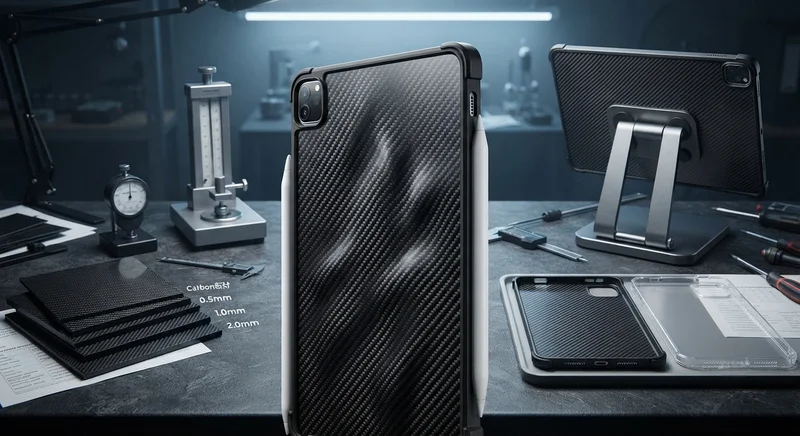
Carbon Fiber Tablet Case — Ultra-Light Protective Shell
Lightweight carbon fiber protective case for tablets and iPads. Molded from T700 3K prepreg with reinforced corner protection. Adds minimal weight while providing superior rigidity and drop protection compared to polycarbonate or silicone cases. Ideal for field workers, enterprise deployments, and professionals requiring durable tablet protection.
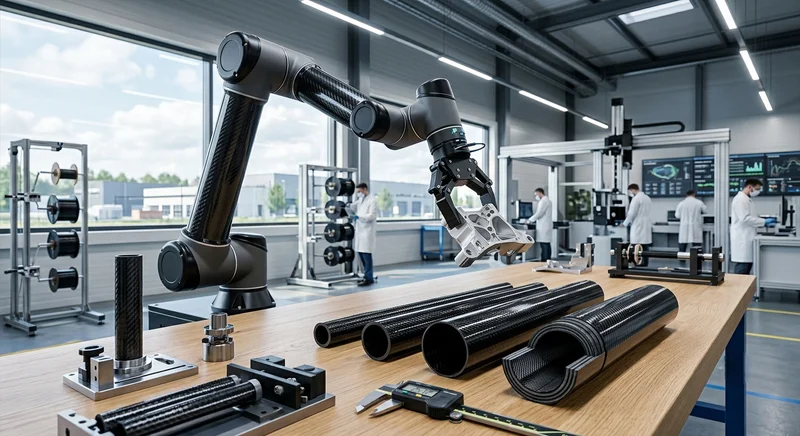
Carbon Fiber Robotic Arm Tube — High-Stiffness Lightweight Replacement
Precision-wound carbon fiber tubes for robotic arm links, replacing steel or aluminum in collaborative robots (cobots) and industrial manipulators. Achieve 3× the specific stiffness of aluminum with significant weight reduction, enabling faster acceleration and higher payload capacity.
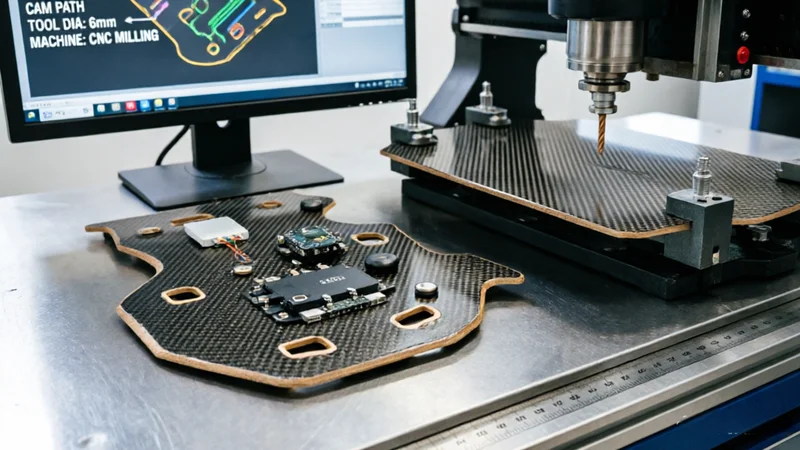
Carbon Fiber Drone Frame Base Plate — 3K Twill T700
CNC-machined carbon fiber base plates for drone frame assemblies. Cut from 3K twill weave T700 prepreg with precision CNC routing. Pre-drilled mounting patterns compatible with common flight controller and power distribution board layouts. Available in 1.5mm to 5mm thickness.
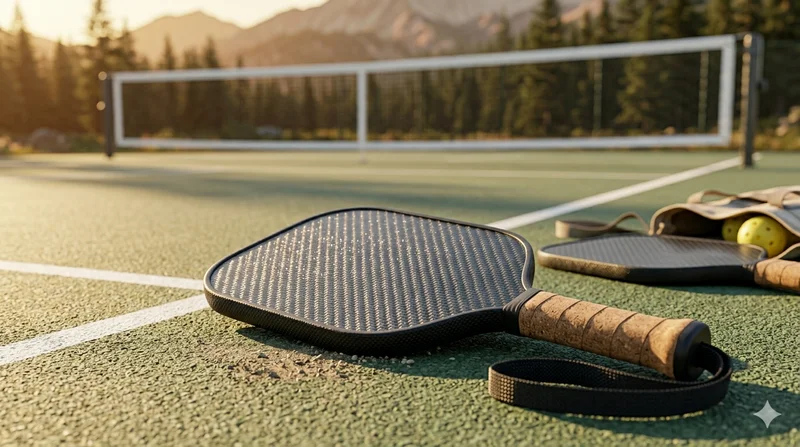
Carbon Fiber Pickleball Paddle
High-performance pickleball paddle with Toray T700 carbon fiber face and polypropylene honeycomb core. Delivers excellent power-to-weight ratio, spin generation, and vibration dampening for competitive play.
Round Carbon Fiber Tube — UD Unidirectional T700
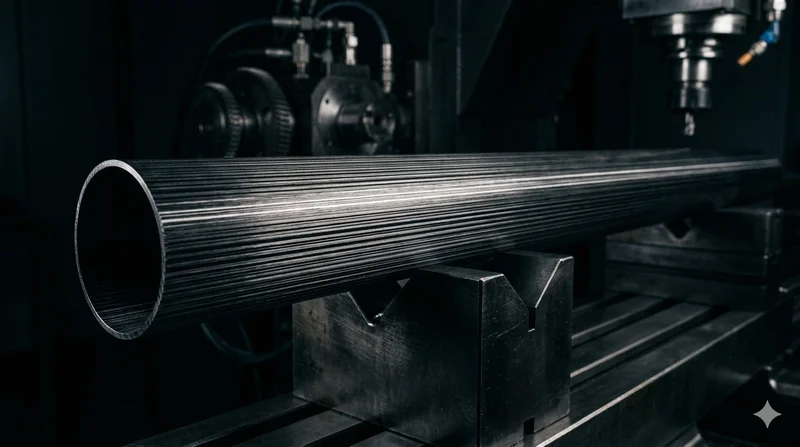
Unidirectional (UD) round tube with all fibers aligned axially for maximum longitudinal stiffness. Ideal for applications requiring high bending rigidity with minimal weight, such as shafts, struts, and structural reinforcements.