
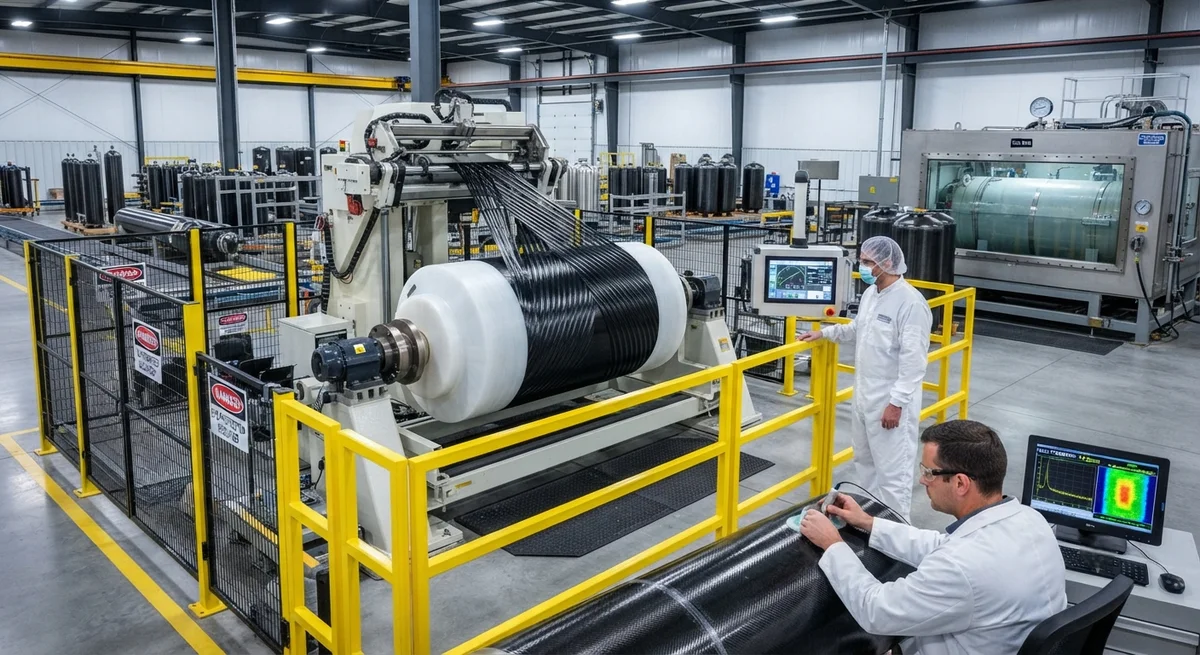
BMW's confirmed 2028 production of the iX5 Hydrogen fuel cell SUV signals a transformative shift for the carbon fiber industry. Each vehicle requires 60–80 kg of carbon fiber for its Type IV hydrogen storage tanks — 3–5 times more than a battery-electric vehicle. This technical analysis examines Type IV tank manufacturing, Type III vs Type IV comparison data, certification requirements, and the supply chain implications for B2B carbon fiber suppliers targeting the emerging hydrogen mobility market.
BMW Confirms Hydrogen X5 for 2028 Production
BMW has officially announced that the hydrogen fuel cell version of its X5 SUV, the BMW iX5 Hydrogen, will enter series production in 2028. This landmark decision positions BMW as the first major premium automotive OEM to commit to commercial-scale hydrogen passenger vehicle production. At the heart of this vehicle's hydrogen storage system lies a Type IV carbon fiber composite tank — a filament-wound pressure vessel that demonstrates the critical role advanced composites play in the hydrogen mobility ecosystem.
The iX5 Hydrogen prototype, which has been undergoing real-world testing since 2023, stores approximately 6 kg of hydrogen at 700 bar (10,000 psi) in two Type IV tanks. These tanks are constructed using carbon fiber-reinforced polymer (CFRP) with a polyamide (PA6) or high-density polyethylene (HDPE) inner liner, designed to meet the stringent safety requirements of UN ECE R134 and EC 79/2009 regulations. For B2B carbon fiber suppliers, this announcement signals a potential step-change in demand: if hydrogen fuel cell vehicles achieve even 2–3% of global light vehicle sales by 2035, annual carbon fiber demand for Type IV tanks could reach 18,000–25,000 tonnes.
Type IV Tank Design and Manufacturing Process
Type IV tanks represent the current state of the art in hydrogen storage for automotive applications. Unlike Type III tanks, which use an aluminum liner wrapped with carbon fiber, Type IV tanks employ a fully polymer liner (typically HDPE or PA6) that is overwrapped with carbon fiber composite. This design offers several advantages: it is 15–25% lighter than Type III, completely corrosion-resistant, and has an unlimited fatigue life in the liner due to the polymer's elastic behavior.
The manufacturing process for Type IV tanks involves several precision-controlled stages:
- Liner molding: The polymer liner is rotational-molded or injection-molded, then annealed to relieve internal stresses. Wall thickness is typically 2–4 mm for a 700-bar rated vessel. The liner must be flaw-free — any pinhole defect will cause hydrogen permeation and eventual tank failure.
- Filament winding: The liner is mounted on a winding mandrel and over-wrapped with carbon fiber tow impregnated with epoxy resin. Computer-controlled winding machines apply the fiber at precisely calculated angles (typically ±15° to ±90°) to create a composite structure optimized for the hoop and axial stresses of high-pressure hydrogen storage. For a typical 140-liter tank, 8–12 km of carbon fiber tow (12K–24K) is used.
- Curing: The wound tank is cured at 120–150°C in a programmable oven, following a cure cycle that may last 4–8 hours. The epoxy resin system is specifically formulated for hydrogen service — it must exhibit low hydrogen permeability (< 6×10⁻¹⁴ mol·m⁻¹·s⁻¹·Pa⁻¹), high temperature stability, and resistance to rapid gas decompression (RGD) damage.
- Testing and certification: Every tank must pass a 1.5× design pressure hydrostatic test (1,050 bar for a 700-bar tank), leak testing with helium mass spectrometry, and burst pressure verification (typically > 1,575 bar). In addition, sample tanks from each production batch must pass bonfire testing, impact testing, and hydrogen cycling (1,000+ cycles from ambient to 700 bar and back).
Type III vs. Type IV: A Technical Comparison
For B2B decision-makers evaluating hydrogen storage solutions, understanding the differences between Type III and Type IV tanks is critical:
| Parameter | Type III (Aluminum + CF) | Type IV (Polymer + CF) | Advantage |
|---|---|---|---|
| Liner material | Aluminum alloy (6061-T6) | HDPE or PA6 | Type IV (corrosion-free) |
| Weight (140L, 700 bar) | 95–110 kg | 75–90 kg | Type IV (15–25% lighter) |
| Carbon fiber content | 55–70 kg | 60–80 kg | Similar |
| Hydrogen permeation | Negligible (metal barrier) | Low (polymer barrier requires thicker liner) | Type III |
| Corrosion resistance | Moderate (aluminum alloys susceptible to galvanic corrosion) | Excellent (fully polymer liner) | Type IV |
| Cycle life | Limited by aluminum liner fatigue (10,000–15,000 cycles) | Unlimited liner fatigue life | Type IV |
| Manufacturing cost (100k/yr) | $1,800–$2,500 per tank | $1,500–$2,200 per tank | Type IV (10–15% cheaper) |
| Temperature range | -40°C to +85°C | -40°C to +85°C | Equal |
| Recyclability | Metal liner recyclable; CF composite hard to separate | Polymer liner melt-recyclable; CF composite hard to separate | Type III (slight edge) |
Certification Requirements for Automotive Hydrogen Tanks
The regulatory landscape for Type IV hydrogen tanks is complex and varies by region. B2B suppliers must ensure their carbon fiber materials meet the requirements of:
- UN ECE R134 (Global): The primary international regulation for hydrogen-fueled vehicle components. Requires burst pressure ≥ 2.25× nominal working pressure, 45,000+ hydrogen pressure cycles, and bonfire test survival for 10+ minutes. Carbon fiber must exhibit minimum tensile strength of 3,500 MPa in the composite form.
- EC 79/2009 and EU 406/2010 (Europe): European regulations governing hydrogen storage systems. Include specific requirements for permeation (< 45 NmL/h/L of tank volume), hydrogen cycling (500 cycles at extreme temperatures), and drop testing from 1.8 meters.
- SAE J2579 (North America): Defines performance-based requirements for hydrogen storage systems. Notably requires 1,500+ hydrogen pressure cycles at 85°C (hot cycling), simulating the extreme thermal conditions inside a parked vehicle in direct sunlight.
- ISO 19880-1 (International): Gaseous hydrogen fueling station standard that also provides references for onboard storage system qualification that many national regulators adopt.
Market Implications for Carbon Fiber Suppliers
BMW's 2028 production commitment has significant implications for the carbon fiber supply chain. Each iX5 Hydrogen vehicle requires an estimated 60–80 kg of carbon fiber for its two Type IV tanks. By comparison, a battery-electric BMW iX uses approximately 15–25 kg of carbon fiber for body panels and structural components. The hydrogen vehicle's carbon fiber intensity is 3–5 times higher per vehicle.
If BMW achieves sales of 50,000–100,000 hydrogen X5 units annually by 2032, the carbon fiber demand for this single model would reach 3,000–8,000 tonnes per year. Combined with adoption from other OEMs — including Toyota (Mirai Gen 2), Hyundai (NEXO successor), Daimler Truck, and Volvo — the total automotive hydrogen tank carbon fiber market could exceed 25,000 tonnes annually by 2035, representing approximately 8–12% of total global carbon fiber demand.
Key supply chain considerations include:
- Carbon fiber for Type IV tanks requires specific tow tension and sizing chemistry optimized for high-speed wet filament winding. Standard aerospace-grade fibers may not perform optimally in this process.
- Long-term supply agreements with automotive OEMs require carbon fiber producers to maintain consistent quality across millions of kilometers of fiber — a challenge that has historically taken years to qualify.
- The cost target for automotive-grade hydrogen tank carbon fiber is $15–20/kg by 2030, down from the current $25–35/kg range, requiring continued production scale-up and precursor cost reduction.
Frequently Asked Questions
How does the hydrogen storage density of Type IV tanks compare to battery energy density?
The comparison depends on the metric used. A Type IV tank at 700 bar stores hydrogen at a gravimetric density of approximately 4.5–5.5 wt% (kg H₂ per kg of total tank system) and a volumetric density of 25–30 g H₂ per liter of tank volume. On a system level, this translates to an energy density of approximately 1.5–1.8 kWh/kg (gravimetric) and 0.6–0.8 kWh/L (volumetric) when considering hydrogen's lower heating value of 33.3 kWh/kg. By comparison, current lithium-ion battery packs achieve 0.15–0.25 kWh/kg and 0.3–0.5 kWh/L. This means hydrogen storage offers 6–10× higher gravimetric energy density than batteries, making it highly attractive for heavy-duty and long-range applications. However, the round-trip efficiency of the hydrogen pathway (well-to-wheel) is 25–35%, compared to 70–80% for battery-electric, which is why hydrogen is better suited for use cases where fast refueling, long range, and low weight are prioritized over energy efficiency.
What carbon fiber grades are used in Type IV hydrogen tanks?
Type IV hydrogen tanks typically use standard-modulus (230–250 GPa) carbon fiber with a tensile strength of 4,500–5,500 MPa, in 12K–24K tow formats. Toray T700SC, Teijin Tenax HTS40, and Mitsubishi TR50S are commonly specified grades. The fiber must have specific sizing chemistry optimized for epoxy resin compatibility in wet filament winding processes. Key quality parameters include: tensile strength CV < 5% (coefficient of variation), sizing content of 0.8–1.2% by weight, and a filament diameter of 7.0 ± 0.5 µm. Large-tow fibers (50K) are being evaluated for cost reduction but currently face challenges achieving the uniform resin impregnation required for the consistent strength distribution demanded by pressure vessel certification standards.
Are Type IV tanks safe in a vehicle collision?
Yes, Type IV tanks are designed with safety as the highest priority. They undergo extensive crash testing as part of vehicle homologation. The UN ECE R134 regulation requires that tanks survive a rear-end collision at 80 km/h with 40% overlap, a side impact at 60 km/h, and a frontal impact at 56 km/h (full width). In addition, tanks must pass a localized impact test where a 10-kg hemispherical impactor strikes the tank at 15 m/s — simulating the energy of a pointed object hitting the tank in a severe crash. The carbon fiber composite structure is inherently damage-tolerant: cracks in the matrix do not propagate catastrophically as they would in a metal tank. Instead, hydrogen leaks slowly through any cracks that reach the liner, and onboard hydrogen sensors (set to alarm at 1% hydrogen concentration in air) detect leaks within seconds. The BMW iX5 Hydrogen prototype has passed all Euro NCAP crash tests, and BMW has not reported any hydrogen tank failures in its multi-year test fleet spanning over 1 million kilometers of real-world driving.
Part of topic
Related Articles
- Carbon Fiber Mooring for Floating Offshore Wind: Fatigue and Corrosion in Deep Water
- Carbon Fiber Bicycle Frame Optimization: Layup Design and Manufacturing for Competitive Racing
- Carbon Fiber CFRP Retrofit for Infrastructure: Bridge and Building Seismic Strengthening
- Carbon Fiber Medical Imaging Equipment: Lightweight Gantry and Couch Structures for MRI/CT
- Carbon Fiber EV Battery Enclosures: Crash Safety and Electromagnetic Shielding Design
- Carbon Fiber Structures for Low-Altitude Economy: UAV Airframes and eVTOL Components
Interested in Our Products?
Contact our team for competitive pricing and technical specifications.
Get a QuoteRelated Products
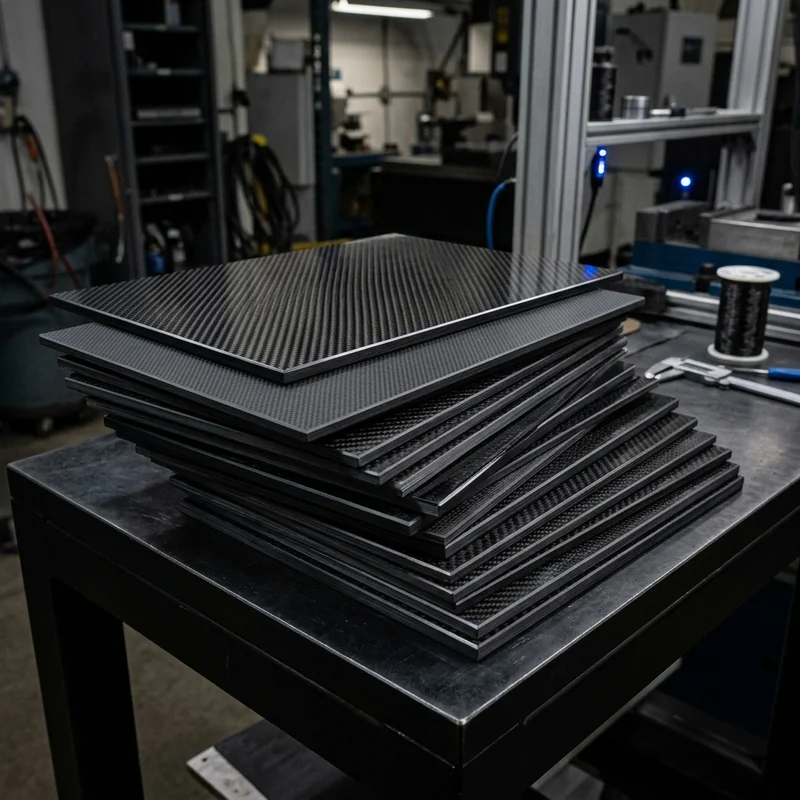
Carbon fiber standard plate-3k stripe
Lightweight, ultra-rigid standard sheets for drone fuselages, robot housings, facades and structural applications.

Carbon Fiber Plate — 3K Twill T700 1.5mm
Thin 1.5mm carbon fiber plate with 3K twill weave surface. Lightweight and stiff, commonly used for covers, panels, drone bodies, and applications requiring a premium aesthetic appearance.

Square Carbon Fiber Tube — 3K Twill T700
Square cross-section carbon fiber tube manufactured with 3K twill weave for torsional strength. Preferred for structural frames, trusses, and support columns where rectangular geometry offers design flexibility.

Carbon Fiber Plate — 3K Twill T700 3.0mm
Medium-thickness 3.0mm carbon fiber plate offering significantly higher load capacity while maintaining attractive 3K twill finish. Suitable for structural brackets, reinforcement plates, and load-bearing panels.
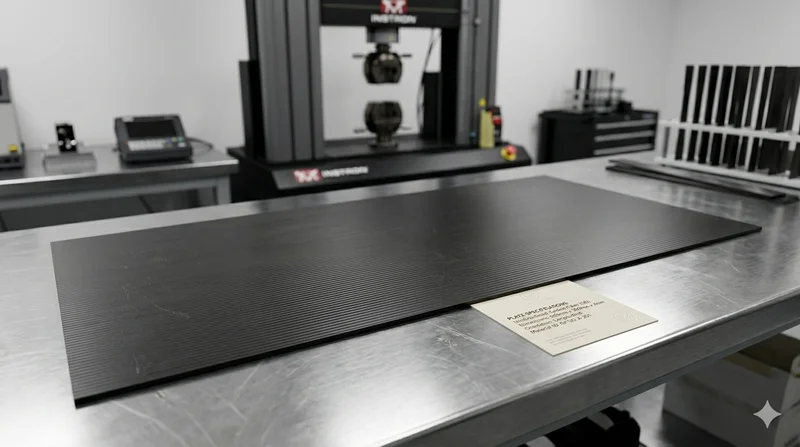
Carbon Fiber Plate — UD Unidirectional T700
Unidirectional carbon fiber plate with all fibers oriented in a single direction for maximum strength along the fiber axis. Essential for structural reinforcements, splints, and applications where load direction is predictable.