
Aircraft cabin interiors represent one of the most compelling weight reduction opportunities in commercial aviation. A typical narrowbody aircraft contains 1,500-2,500 kg of cabin interior components — seats, overhead bins, sidewalls, floor panels, lavatories, and galley equipment — man
Introduction
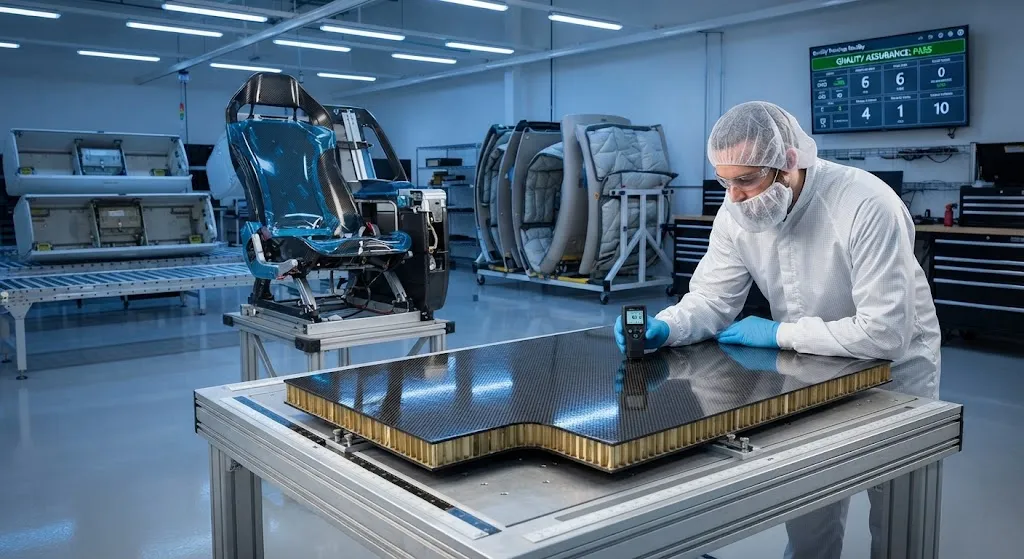
Aircraft cabin interiors represent one of the most compelling weight reduction opportunities in commercial aviation. A typical narrowbody aircraft contains 1,500-2,500 kg of cabin interior components — seats, overhead bins, sidewalls, floor panels, lavatories, and galley equipment — many of which are still manufactured from aluminum, fiberglass, or honeycomb sandwich structures designed decades ago. Replacing these with carbon fiber reinforced polymer (CFRP) composites offers 30-50% weight reduction per component, translating to 150-500 kg per aircraft and annual fuel savings of $15,000-50,000 per plane at current fuel prices.
For carbon fiber suppliers and interior manufacturers, this market represents a significant growth vector. The global aviation interiors market is projected to reach $38B by 2030, with composite content increasing from 15-20% to 25-30% of interior component weight. This article examines the CFRP material systems qualified for aviation interiors, reviews the structural designs driving adoption, explains the FAR 25.853 fire safety compliance pathway, and evaluates the economic case for composite cabin components.
Material Systems for Aviation Interiors
Aviation interior CFRP components must satisfy three competing requirements: low weight, fire safety, and structural performance. The material systems addressing these requirements include:
| Material System | Application | Fire Rating | Weight Savings vs Aluminum |
|---|---|---|---|
| Phenolic/glass honeycomb sandwich | Floor panels, sidewalls | FAR 25.853 compliant | 25-35% |
| Epoxy/carbon quasi-isotropic laminate | Seat structures, brackets | FAR 25.853 with fire barrier | 35-50% |
| PEEK/carbon fabric | High-temperature brackets | FAR 25.853 compliant (inherent) | 40-55% |
| Phenolic/carbon modified laminate | Seat pans, overhead bins | FAR 25.853 compliant | 30-45% |
| PMI foam core / carbon skin | Large flat panels | With fire barrier treatment | 30-40% |
Phenolic resin systems dominate interior applications because they produce low heat release rates, minimal smoke density, and low toxic gas emissions — the three critical FAR 25.853 compliance criteria. Carbon fiber reinforcements provide the stiffness and strength for structural performance, while honeycomb or foam cores create the sandwich structures that achieve high specific stiffness for large flat panels.
Structural Designs Driving Adoption
Several cabin interior components are particularly well-suited to CFRP construction:
- Floor panels: The largest single weight category — CFRP honeycomb sandwich floor panels replace aluminum panels at 25-35% weight reduction while improving impact resistance. Boeing 787 and Airbus A350 both use CFRP floor panels throughout the cabin, establishing the baseline for next-generation interior programs.
- Seat structures: Business class and premium economy seats increasingly use CFRP seat pans, backrests, and armrests. The weight savings per seat (3-5 kg) translates directly to fuel savings across the fleet. Recaro and Zodiac Aerospace offer CFRP seat structures that meet dynamic crash loading requirements at reduced weight.
- Overhead bins: The shift from pivot-style to side-swing overhead bins creates larger, deeper bin structures where CFRP honeycomb panels provide the required stiffness-to-weight ratio. Airbus A320neo's XL bins use composite construction to increase bin volume by 10% while reducing weight by 15%.
- Sidewall and ceiling panels: Large-format CFRP panels with phenolic honeycomb cores replace fiberglass panels, reducing weight by 20-30% while improving surface finish consistency and reducing installation labor.
- Lavatories and galleys: Molded CFRP structures for lavatory walls and galley carts offer weight savings and design freedom for complex curved geometries.
FAR 25.853 Fire Safety Compliance
FAR 25.853 is the gatekeeper regulation for aviation interior materials, requiring compliance with fire safety tests that simulate cabin fire conditions:
- Burn test (60-second vertical Bunsen burner): Materials must self-extinguish within specified time limits after flame removal, with maximum char length and drip-free criteria. Phenolic and modified epoxy resins typically pass without additional treatment.
- Heat release rate (OSU calorimeter): Materials must achieve peak heat release ≤65 kW/m² and total heat release ≤65 kW·min/m² over 5 minutes. Carbon fiber/phenolic systems achieve 25-40 kW/m² peak, well within limits.
- Smoke density: Optical density must remain below Ds(4) = 200 at 4 minutes in the NBS smoke chamber. Phenolic resin systems typically achieve Ds(4) values of 5-15, far below the limit.
- Toxic gas emissions: Maximum allowable concentrations for HCN, CO, NOx, SO₂, and HCl are specified per AC 25.853-4. Phenolic resins produce minimal toxic emissions due to their aromatic char-forming chemistry.
CFRP interior components qualify through a layered compliance approach: the resin system provides inherent fire resistance, fire barrier films or coatings add protection where needed, and design features (edge sealing, ventilation paths) prevent flame spread.
Economic Case for Composite Cabin Interiors
The economic justification for CFRP cabin interiors rests on fuel savings, maintenance cost reduction, and passenger experience improvements:
- Fuel savings: Each kilogram of cabin weight reduction saves approximately 3,000 kg of fuel per year on a narrowbody aircraft (based on 1,500 flight hours and fuel price of $0.80/kg). At 100 kg total cabin weight reduction, annual fuel savings reach $240,000 per aircraft.
- Maintenance reduction: CFRP floor panels and sidewalls show 40-60% lower maintenance costs than aluminum equivalents due to corrosion resistance, scratch resistance, and reduced repainting requirements.
- Passenger experience: Lighter, more contoured CFRP seat structures enable improved ergonomic design, wider seat widths, and larger overhead bins — factors that influence airline purchasing decisions and passenger satisfaction scores.
- Residual value: Aircraft with composite interiors retain 2-4% higher residual value due to lower weight, reduced maintenance, and modern appearance.
For a 180-seat narrowbody fleet of 100 aircraft, the total lifetime savings of a full CFRP interior retrofit reach $25-40M in fuel, maintenance, and residual value benefits — a compelling return on the $50,000-100,000 per aircraft interior upgrade cost.
Frequently Asked Questions
How does CFRP cabin interior weight compare between single-aisle and widebody aircraft?
Single-aisle aircraft (A320neo, 737 MAX) typically contain 1,500-2,000 kg of cabin interior components, with CFRP retrofit potential of 150-300 kg weight reduction (10-15% of total interior weight). Widebody aircraft (A350, 787) contain 3,000-5,000 kg of interior components, with CFRP retrofit potential of 300-600 kg. However, widebody aircraft already incorporate more composite content in their baseline interiors (the 787 uses CFRP floor panels and sidewalls throughout), so the incremental benefit of further CFRP upgrades is lower than for single-aisle aircraft, many of which still use legacy aluminum and fiberglass interiors.
What are the main challenges in qualifying CFRP materials for cabin interiors?
Three challenges dominate. First, fire safety compliance requires extensive testing of specific material combinations (resin, fiber, core, adhesive, paint, film), with each variation requiring separate certification — a process that takes 6-12 months and costs $50,000-150,000 per material system. Second, cabin interior components must meet dynamic crash loading requirements (16g vertical, 9g forward) that demand validated structural analysis and component-level testing. Third, the aesthetic requirements — surface finish, color consistency, scratch resistance — add qualification criteria beyond structural performance, requiring visual inspection standards and customer approval processes that extend development timelines.
Can CFRP cabin components be repaired in-service?
CFRP cabin interior components can be repaired using several methods depending on damage severity. Surface scratches and minor dents can be repaired with fillers and touch-up coatings that restore appearance without structural intervention. Delamination damage up to 25 mm diameter can be repaired using injection bonding with low-viscosity epoxy adhesive. Larger damage requiring structural repair follows OEM-approved repair schemes that include scarf sanding, patch layup, and local curing with heat blankets. Repair turnaround time is typically 2-8 hours per component, significantly faster than aluminum panel repair that may require replacement due to permanent deformation.
Conclusion
CFRP composites are transforming aircraft cabin interiors, delivering 30-50% weight reduction in seats, floor panels, overhead bins, and sidewalls while meeting FAR 25.853 fire safety requirements through phenolic and modified epoxy resin systems. The economic case — $240,000 annual fuel savings per aircraft at 100 kg cabin weight reduction — drives adoption across single-aisle and widebody platforms, with the global aviation interiors composite content projected to increase from 15-20% to 25-30% by 2030.
For carbon fiber suppliers and interior manufacturers, this market offers substantial growth potential. Explore our carbon fiber fabric and reinforcement portfolio for aviation interior applications, or contact our engineering team to discuss material specifications for your cabin interior program.
Part of topic
Related Articles
- Carbon Fiber Mooring for Floating Offshore Wind: Fatigue and Corrosion in Deep Water
- Carbon Fiber Bicycle Frame Optimization: Layup Design and Manufacturing for Competitive Racing
- Carbon Fiber CFRP Retrofit for Infrastructure: Bridge and Building Seismic Strengthening
- Carbon Fiber Medical Imaging Equipment: Lightweight Gantry and Couch Structures for MRI/CT
- Carbon Fiber EV Battery Enclosures: Crash Safety and Electromagnetic Shielding Design
- Carbon Fiber Structures for Low-Altitude Economy: UAV Airframes and eVTOL Components
Interested in Carbon Fiber Plates?
Contact our team for competitive pricing and technical specifications.
Get a QuoteRelated Products

Carbon Fiber Plate — 3K Twill T700 1.5mm
Thin 1.5mm carbon fiber plate with 3K twill weave surface. Lightweight and stiff, commonly used for covers, panels, drone bodies, and applications requiring a premium aesthetic appearance.
Carbon Fiber Plate — High-Gloss Decorative
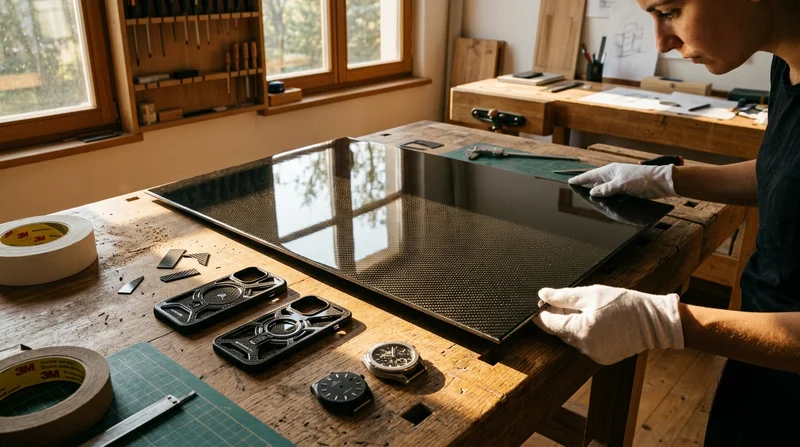
High-gloss decorative carbon fiber plate with a mirror-like surface finish. The glossy coating enhances the visible 3K twill weave, creating a premium aesthetic for consumer-facing applications. Lightweight yet stiff, available in thin gauges for easy cutting and forming.