
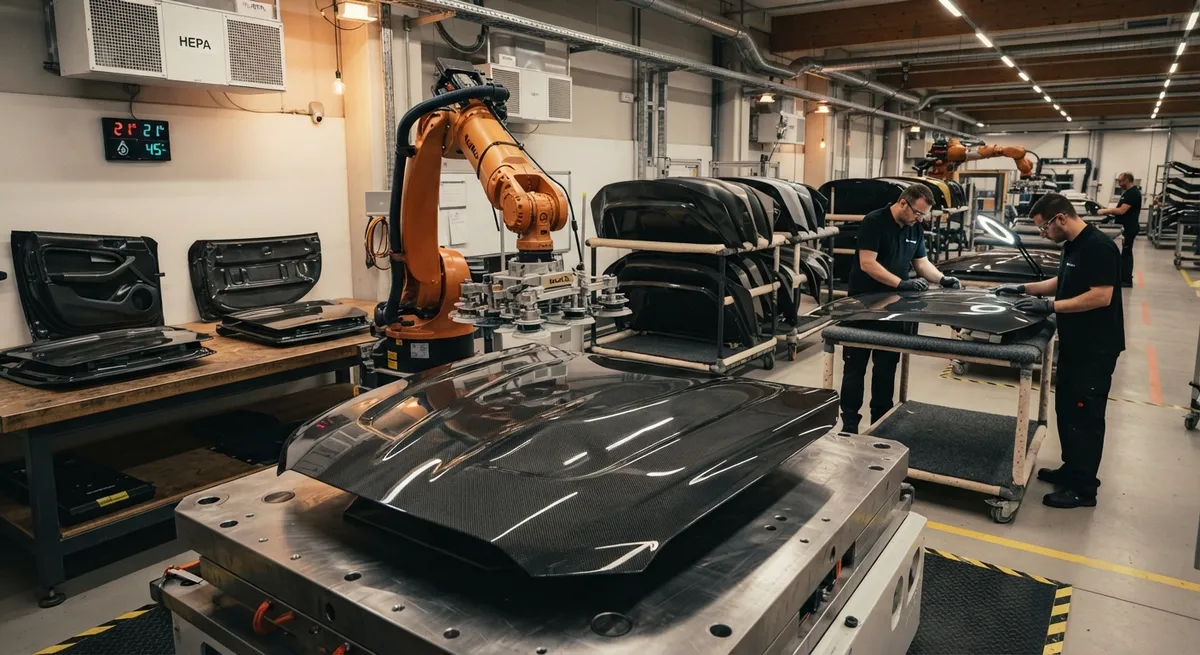
Automotive closure panels — hoods, trunk lids, and door outers — represent one of the fastest-growing applications for carbon fiber composites in the automotive sector. Unlike structural components such as chassis frames or crash structures, closure panels face a unique combination of requirements:.
Automotive closure panels — hoods, trunk lids, and door outers — represent one of the fastest-growing applications for carbon fiber composites in the automotive sector. Unlike structural components such as chassis frames or crash structures, closure panels face a unique combination of requirements: large visible surfaces demanding Class A finish, paint-line thermal exposure up to 180°C, dimensional stability across temperature extremes, and mass production cycle times measured in minutes rather than hours. This article presents a comprehensive technical overview for automotive engineers and Tier-1 suppliers evaluating carbon fiber closure panel programs for premium vehicles.
Market Context and Growth Drivers
The global automotive carbon fiber composites market reached USD 4.2 billion in 2025, with closure panels accounting for approximately 18% of volume. Premium OEMs including BMW, Mercedes-Benz, Lamborghini, and Ferrari have established carbon fiber closure panel programs on multiple platforms. Key drivers include:
- Weight reduction: A carbon fiber hood saves 50–65% versus steel and 35–45% versus aluminum, translating to 8–15 kg mass reduction per closure panel set
- Center of gravity lowering: Replacing a steel hood and trunk lid reduces vehicle front/rear axle unsprung mass, improving handling dynamics
- Design freedom: Composite tooling enables complex geometry — integrated heat extraction vents, sculpted power-dome surfaces, and thin-edge styling lines impossible in stamped metal
- Brand differentiation: Exposed carbon fiber weaves on hoods and trunk spoilers have become a status marker in the USD 80,000+ vehicle segment
Manufacturing Process Comparison
| Parameter | Prepreg Autoclave | HP-RTM | Wet Compression Molding |
|---|---|---|---|
| Cycle time (per panel) | 60–120 min | 4–10 min | 3–6 min |
| Fiber volume fraction | 62–68% | 55–62% | 45–55% |
| Class A surface capability | Excellent (in-mould coated) | Good (requires post-finish) | Moderate (requires significant post-finish) |
| Tooling cost (USD per panel set) | $800,000–1,500,000 | $500,000–900,000 | $200,000–400,000 |
| Panel cost at 50,000 units/yr (USD) | $180–280 | $95–150 | $75–120 |
| Annual production capacity (panels) | 5,000–15,000 | 50,000–120,000 | 80,000–200,000 |
| Automation level | Low (manual layup dominant) | High (robotic preforming, injection) | Medium (automated SMC cutting, manual loading) |
| Energy consumption (kWh/panel) | 45–70 | 8–15 | 6–10 |
Material Selection
Fiber Architecture
The choice of carbon fiber reinforcement architecture significantly influences both mechanical performance and surface quality:
- Unidirectional (UD) prepreg: Used for localized reinforcement in hinge and latch areas. High modulus (230–290 GPa) fibers allow thin (0.8–1.2 mm) local doublers without visible surface read-through.
- 2×2 twill woven fabric: The standard for visible carbon fiber applications. Best drapability over doubly curved surfaces (hood power domes, door waistlines). 200–300 gsm fabric weights provide 0.3–0.5 mm ply thickness.
- Non-crimp fabric (NCF): Preferred for HP-RTM processes. Multiaxial stitched layers (0°/±45°/90°) offer quasi-isotropic properties with minimal fiber waviness. Typical areal weight: 400–600 gsm.
- Carbon fiber SMC (sheet molding compound): Chopped fiber (25–50 mm length) in epoxy or vinyl ester matrix. Lower mechanicals but fastest cycle times. Suitable for inner panels or painted outer panels with non-structural requirements.
Resin Systems
Resin selection must satisfy both processing and in-service requirements:
| Property | Epoxy (prepreg) | Epoxy (HP-RTM) | Vinyl Ester (SMC) |
|---|---|---|---|
| Glass transition temperature (°C) | 160–220 | 140–180 | 120–150 |
| Paint bake compatibility | Excellent | Good | Moderate (requires thermal stabilization) |
| Surface quality (Ra, µm) | <0.5 (in-mould coated) | 0.5–1.5 | 1.0–3.0 |
| Repair compatibility | Excellent | Good | Limited |
| Relative material cost | 1.0x (baseline) | 0.75x | 0.5x |
Class A Surface Challenges
Achieving automotive Class A surface finish on carbon fiber closure panels remains the most technically demanding aspect of production. Three critical challenges must be addressed:
Fiber print-through: differential thermal expansion between carbon fibers (near-zero CTE) and the resin matrix causes fiber pattern telegraphing through paint after thermal cycling. Mitigation strategies include low-profile additives, surface veil layers, and in-mould coating (IMC) applied during the molding cycle before the resin fully cures.
Porosity management: entrapped air at ply interfaces or along tow boundaries produces pinholes visible after painting. HP-RTM processes control this via vacuum-assisted injection (1–5 mbar residual pressure). Prepreg requires autoclave pressure of 6–8 bar for void content below 1%.
Thermal expansion matching: closure panels must maintain fit tolerances (±1.0 mm) across a temperature range of −40°C to +80°C in service. The CTE mismatch between carbon fiber (0–2 × 10⁻⁶/K) and adjacent steel or aluminum body panels (12–23 × 10⁻⁶/K) requires careful design of attachment points and floating fastener strategies.
Production Integration with OEM Assembly Lines
Integrating carbon fiber closure panels into existing vehicle assembly lines presents logistical and process challenges:
- Paint line compatibility: Carbon fiber hoods and trunk lids must survive OEM e-coat bake cycles (180°C for 20–30 minutes). Resin systems must maintain dimensional stability through thermal cycling without post-cure distortion.
- Handling and fixturing: CFRP panels are 50–65% lighter than steel equivalents, requiring adjusted conveyor handling systems and modified robotic gripper end-effectors with compliant surfaces to avoid surface marking.
- Electrical conductivity: Carbon fiber's electrical conductivity differs from steel, requiring adapted electrostatic paint application parameters. Grounding points must be designed into the panel for consistent paint transfer efficiency.
- In-process inspection: Automated optical inspection (AOI) systems calibrated for the specific reflectance characteristics of CFRP surfaces are needed for 100% inline quality verification.
Cost Analysis by Closure Panel Type
A detailed cost breakdown for a typical luxury SUV program (30,000 units/year) using HP-RTM processing:
| Cost Component | Hood (USD) | Trunk Lid (USD) | Front Door Outer (USD per pair) |
|---|---|---|---|
| Carbon fiber reinforcement | $42 | $34 | $58 |
| Resin and consumables | $12 | $9 | $16 |
| Preforming | $8 | $6 | $12 |
| Molding and demolding | $14 | $11 | $20 |
| Trimming and drilling | $7 | $5 | $10 |
| Surface finishing and paint | $25 | $18 | $30 |
| Quality inspection | $6 | $4 | $8 |
| Assembly hardware | $11 | $9 | $15 |
| Total per panel | $125 | $96 | $169 (per pair) |
| Weight per panel (kg) | 4.2 | 3.1 | 2.8 (each) |
| Weight savings vs aluminum (%) | 42% | 40% | 38% |
FAQ
What is the minimum production volume for cost-effective carbon fiber closure panels?
For HP-RTM processing, the minimum economic volume is approximately 15,000–20,000 panels per year, assuming capital costs are amortized over a 5-year program. Below this threshold, prepreg autoclave processing becomes competitive because tooling costs are lower despite longer cycle times. For volumes exceeding 80,000 panels/year, wet compression molding (carbon SMC) becomes the most cost-effective option, though with trade-offs in surface quality and mechanical properties.
Can carbon fiber closure panels be repaired after collision damage?
Yes, but repair procedures differ fundamentally from metal panels. Cosmetic damage to painted outer surfaces can be repaired with standard body filler techniques if the underlying fiber layers are intact. Structural damage requires scarf repairs following manufacturer specifications, using matching prepreg or wet layup materials. Most OEMs specify dedicated carbon fiber repair centers for structural damage, as improper repairs can compromise crash performance. Insurance costs for CFRP-body vehicles remain approximately 15–25% higher due to specialized repair requirements.
How does carbon fiber closure panel production affect vehicle sustainability and end-of-life recyclability?
Carbon fiber closure panels offer two sustainability advantages during the use phase: weight reduction lowers fuel consumption (for ICE vehicles) or extends range (for EVs) by approximately 3–5% per 100 kg saved. However, end-of-life recyclability remains challenging. Current mechanical recycling (grinding and downcycling into non-structural materials) recovers about 40–60% of embodied energy. Emerging pyrolysis and solvolysis technologies can recover carbon fibers with 90–95% of virgin mechanical properties, but commercial recycling infrastructure remains limited. Several OEMs have implemented take-back programs for CFRP production waste and end-of-life panels.
Conclusion
Carbon fiber closure panels have transitioned from exotic supercar features to established production options across the premium automotive segment. The choice of manufacturing process depends primarily on production volume, surface quality requirements, and integration with existing OEM assembly infrastructure. HP-RTM has emerged as the preferred process for mid-volume programs (15,000–80,000 panels/year), offering the best balance of cycle time, surface quality, and cost. Prepreg autoclave remains the benchmark for ultra-high surface quality at low volumes, while wet compression molding (SMC) dominates high-volume applications where painted rather than exposed carbon surfaces are acceptable.
YongXian CarbonFiber supplies engineered carbon fiber fabrics and preforms optimized for automotive HP-RTM and prepreg processes, with consistent tow tension, areal weight tolerance of ±3%, and surface quality tailored to Class A applications. Contact our automotive composites team for technical consultation on process selection for your specific closure panel program.
Part of topic
Related Articles
- Carbon Fiber Mooring for Floating Offshore Wind: Fatigue and Corrosion in Deep Water
- Carbon Fiber Bicycle Frame Optimization: Layup Design and Manufacturing for Competitive Racing
- Carbon Fiber CFRP Retrofit for Infrastructure: Bridge and Building Seismic Strengthening
- Carbon Fiber Medical Imaging Equipment: Lightweight Gantry and Couch Structures for MRI/CT
- Carbon Fiber EV Battery Enclosures: Crash Safety and Electromagnetic Shielding Design
- Carbon Fiber Structures for Low-Altitude Economy: UAV Airframes and eVTOL Components
Interested in Our Products?
Contact our team for competitive pricing and technical specifications.
Get a QuoteRelated Products
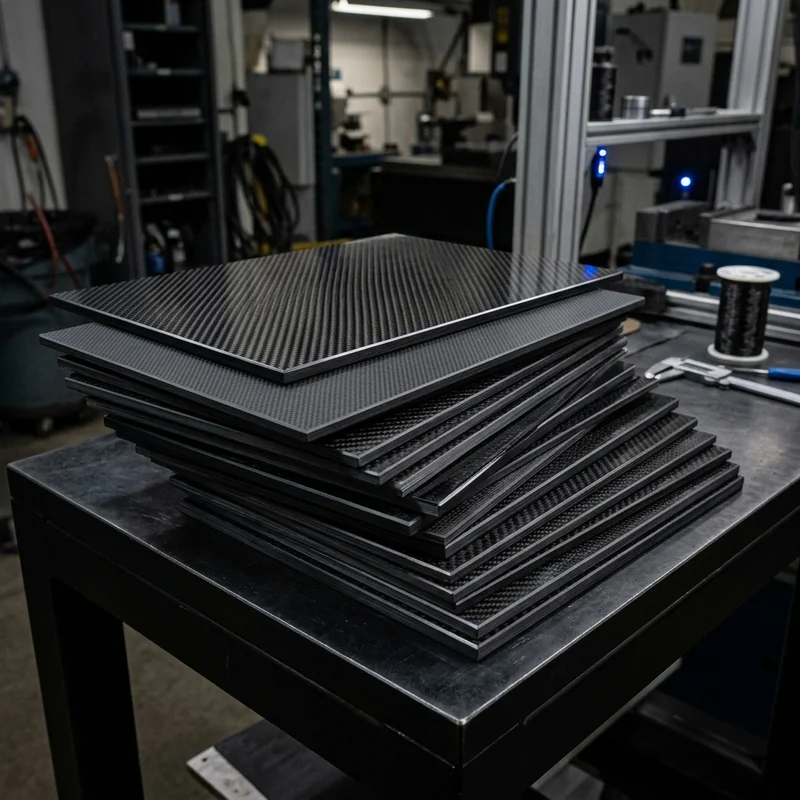
Carbon fiber standard plate-3k stripe
Lightweight, ultra-rigid standard sheets for drone fuselages, robot housings, facades and structural applications.

Carbon Fiber Plate — 3K Twill T700 3.0mm
Medium-thickness 3.0mm carbon fiber plate offering significantly higher load capacity while maintaining attractive 3K twill finish. Suitable for structural brackets, reinforcement plates, and load-bearing panels.

Carbon Fiber Plate — 3K Twill T700 1.5mm
Thin 1.5mm carbon fiber plate with 3K twill weave surface. Lightweight and stiff, commonly used for covers, panels, drone bodies, and applications requiring a premium aesthetic appearance.

Square Carbon Fiber Tube — 3K Twill T700
Square cross-section carbon fiber tube manufactured with 3K twill weave for torsional strength. Preferred for structural frames, trusses, and support columns where rectangular geometry offers design flexibility.
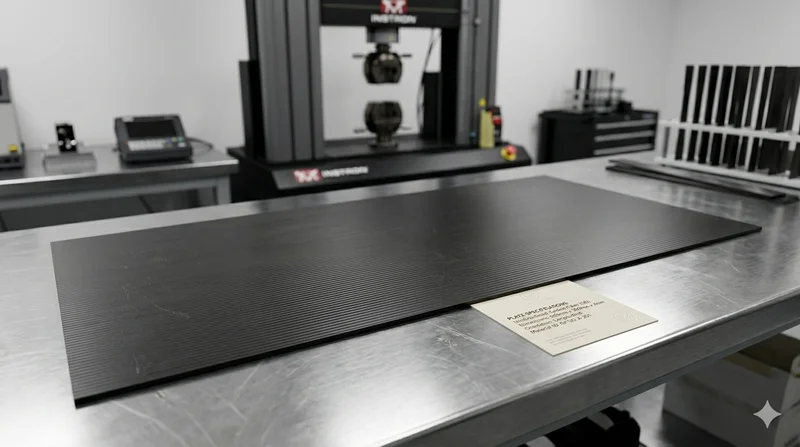
Carbon Fiber Plate — UD Unidirectional T700
Unidirectional carbon fiber plate with all fibers oriented in a single direction for maximum strength along the fiber axis. Essential for structural reinforcements, splints, and applications where load direction is predictable.