
Carbon Fiber Door Inner Panels: The Next Frontier in Automotive Lightweighting As automotive OEMs push toward stringent 2026–2030 CO₂ fleet emission targets — 95 g/km in Europe and equivalent standard...
Carbon Fiber Door Inner Panels: The Next Frontier in Automotive Lightweighting
As automotive OEMs push toward stringent 2026–2030 CO₂ fleet emission targets — 95 g/km in Europe and equivalent standards in China and North America — body-in-white (BIW) lightweighting has become a manufacturing priority. Among BIW subsystems, the door assembly represents a uniquely challenging opportunity: a single car door weighs between 18 and 32 kg in steel construction, with the inner panel comprising 55–65% of that mass. Replacing steel door inner panels with carbon fiber-reinforced polymer (CFRP) alternatives offers weight reductions of 40–55%, translating to 6–12 kg saved per vehicle across four doors.
Door inner panels are structurally and functionally complex components. They must provide impact intrusion resistance, support window regulator mechanisms, house side-impact airbags, mount speakers and wiring harnesses, and serve as the structural backbone for the entire door module. This functional density makes them ideal candidates for carbon fiber composite substitution, where tailored anisotropy and part consolidation can deliver simultaneous mass reduction and performance improvement.
Material Selection and Laminate Architecture
| Property | Steel (DP 590) | CFRP (UD Prepreg) | CFRP (NCF Infusion) | Target Requirement |
|---|---|---|---|---|
| Tensile modulus (GPa) | 210 | 135–150 (0°) | 120–135 (0°) | ≥100 |
| Density (g/cm³) | 7.85 | 1.55 | 1.48 | ≤2.0 |
| Areal weight (kg/m² @ 2.0 mm) | 15.7 | 3.1 | 2.96 | ≤3.5 |
| Ultimate tensile strength (MPa) | 590 | 1,800–2,500 | 1,500–2,000 | ≥800 |
| Impact energy absorption (J, 10 km/h) | 45 | 52–68 | 48–60 | ≥40 |
| Thermal expansion (×10⁻⁶/°C) | 11.7 | −0.5 to 0.5 (in-plane) | 0.5–2.0 (in-plane) | ≤2.5 |
| Fatigue endurance @ 10⁶ cycles (MPa) | 240 | 400–500 | 350–450 | ≥250 |
| Cycle time per part (minutes) | 0.8 (stamping) | 8–12 (prepreg/autoclave) | 5–8 (HP-RTM) | ≤12 |
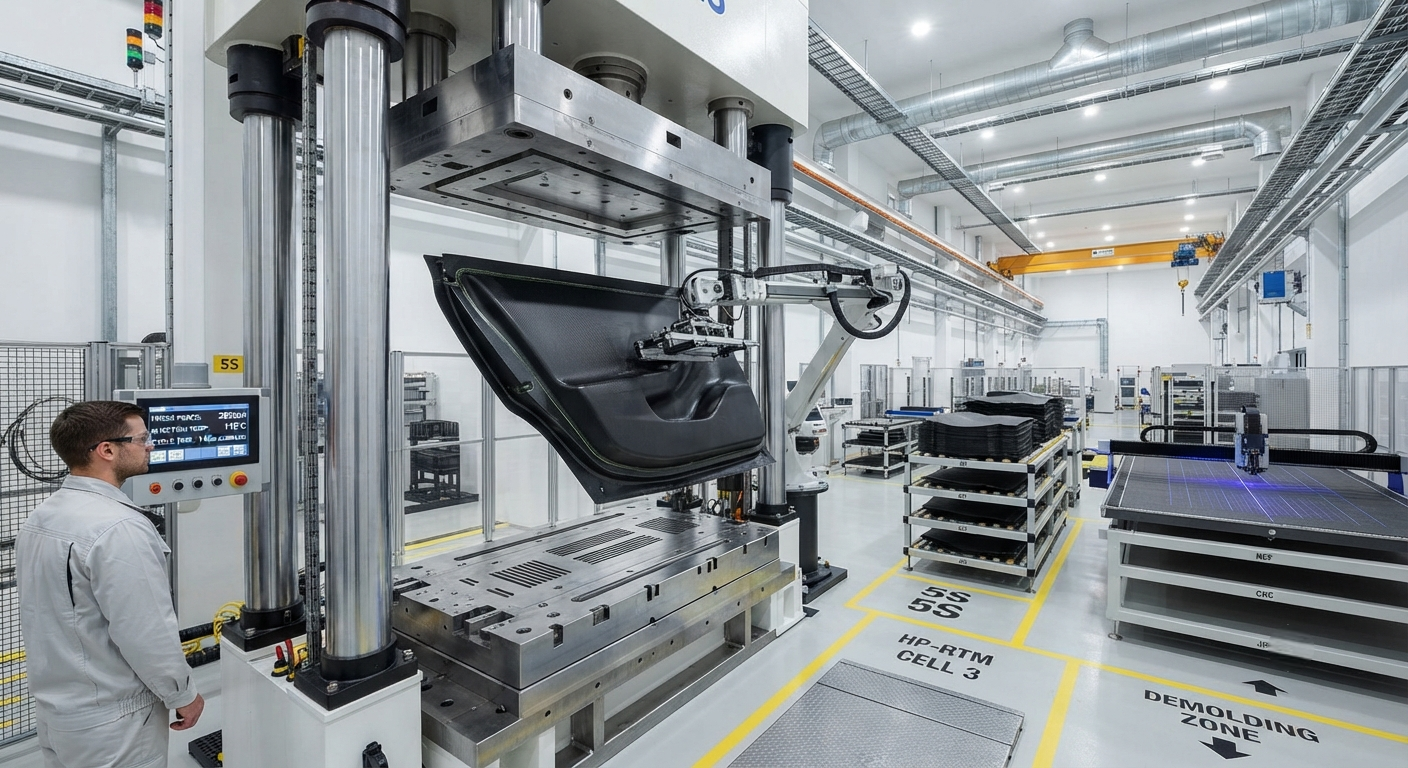
The optimal laminate architecture for door inner panels typically employs a hybrid layup combining standard-modulus (230 GPa) PAN-based carbon fiber in 12K and 24K tow sizes. A typical 6-ply quasi-isotropic stack — [0/45/90/−45]s — achieves the isotropic stiffness required for crash energy management while maintaining formability over complex geometries. For series production, high-pressure resin transfer molding (HP-RTM) with non-crimp fabric (NCF) preforms offers the best balance of mechanical performance, cycle time, and cost.
Module Integration Strategies
The true value of carbon fiber door inner panels extends beyond simple material substitution. The composite manufacturing process enables part consolidation — integrating multiple stamped steel brackets, reinforcement plates, and mounting structures into a single molded geometry.
Key integration opportunities include:
- Speaker basket mounting — acoustic chamber geometry molded directly into the inner panel, eliminating the separate stamped bracket (saves 0.4 kg per door)
- Window regulator rail inserts — co-cured aluminum or stainless inserts at critical guide rail attachment points, replacing bolted assemblies
- Side-impact beam integration — continuous carbon fiber loop incorporated into the inner panel perimeter, functioning as an integrated intrusion beam without a separate steel beam (saves 1.2–1.8 kg per door)
- Wire harness channels — molded-in conduits for electrical routing, eliminating plastic clips and cable ties
- Airbag deployment chute — tailored thickness zones in the upper inner panel to guide side-curtain airbag deployment, replacing the separate plastic chute (saves 0.3 kg per door)
- Check-strap mounting — localized fiber reinforcement around the door check-strap attachment, eliminating the need for a metal load-spreading plate
In a 2025 production program by a leading European automotive Tier 1 supplier, a CFRP door inner panel incorporating these integration strategies achieved a total module weight of 4.8 kg versus 11.2 kg for the baseline steel module — a 57% reduction. The integrated design eliminated 14 separate components and reduced assembly operations by 23 steps, contributing to a net cost saving of €6.50 per door despite higher raw material costs.
Crash Performance and Regulatory Compliance
Carbon fiber door inner panels must meet the same crashworthiness standards as their steel counterparts. The relevant regulatory framework includes:
- ECE R95 — Side-impact protection, requiring intrusion resistance at 50 km/h impact by a deformable barrier
- ECE R135 — Pole side-impact, requiring occupant protection against a 254 mm diameter pole at 32 km/h
- FMVSS 214 — U.S. side-impact dynamic test, requiring a minimum survival space after 54 km/h and 32 km/h impacts
- IIHS side crash test — Updated 2026 protocol with higher-impact barrier speed (60 km/h)
CFRP door inner panels demonstrate competitive or superior performance in these tests when properly designed. The high specific energy absorption (SEA) of carbon fiber — typically 50–80 kJ/kg versus 15–25 kJ/kg for steel — means a lighter structure can absorb equivalent crash energy. In a 2026 benchmarking study by the Automotive Composites Consortium, a 4.8 kg CFRP door inner panel achieved 14% greater side-impact energy absorption than a 10.5 kg steel baseline panel while meeting all FMVSS 214 requirements.
Cost Analysis and Production Scalability
The primary barrier to widespread adoption of CFRP door inner panels remains cost. Current production economics for high-volume applications require careful process selection:
- HP-RTM (High-Pressure Resin Transfer Molding) — Most cost-effective at volumes >50,000 parts/year, with cycle times of 5–8 minutes per part. Tooling cost is €0.8–1.5 million per cavity
- Prepreg compression molding — Suitable for medium volumes (10,000–50,000 parts/year), cycle times of 8–12 minutes. Higher material utilization (95%) but higher prepreg cost premium
- Automated fiber placement (AFP) + out-of-autoclave (OOA) cure — Best for low-volume, high-performance applications (<10,000 parts/year). Maximum design flexibility but highest per-part cost
- Thermoforming of organosheet — Emerging technology using consolidated CFRP sheets, offering 60-second cycle times but limited to components with less than 30% draw depth, suitable for inner panel geometries with moderate curvature
Frequently Asked Questions
Can carbon fiber door inner panels be repaired after a side-impact collision?
Yes, but repair procedures differ significantly from steel. Minor damage (surface cracks, shallow delamination) can be repaired using patch bonding with pre-cured carbon fiber patches and structural adhesives. Major damage typically requires full panel replacement. Several OEMs, including BMW and Audi, have published CFRP repair procedures for their composite-intensive vehicle programs. The repair cost for a CFRP door panel is typically 1.5–2.5× that of a steel panel, though this premium is partially offset by the panel's lower replacement frequency in non-structural impacts.
What joining methods are used to attach CFRP door inner panels to the outer panel and body?
The primary joining methods are structural adhesive bonding (2K epoxy or polyurethane adhesives with 25–35 MPa lap shear strength), mechanical fastening with aluminum or stainless steel self-piercing rivets (SPR), or hybrid joints combining both. Adhesive bonding provides uniform load distribution and avoids stress concentrations from drilling, but requires careful surface preparation (peel ply removal + atmospheric plasma treatment). Hybrid joints are preferred for the hem flange connection between inner and outer panels, offering both structural integrity and production robustness.
How does the coefficient of thermal expansion (CTE) mismatch affect door assembly tolerances?
The near-zero in-plane CTE of carbon fiber (−0.5 to 0.5 × 10⁻⁶/°C) differs significantly from the 23 × 10⁻⁶/°C of the aluminum outer panel and 11.7 × 10⁻⁶/°C of steel body structures. This mismatch is managed through three strategies: (1) flexible adhesive joints that accommodate differential thermal movement, (2) slotted bolt holes at key attachment points allowing ±1.5 mm of relative movement, and (3) matched curing cycles where the door assembly is bonded and cured at 20–25°C operational temperature range. Production experience at a European OEM shows that dimensional variation of CFRP door assemblies falls within ±0.8 mm, compared to ±0.6 mm for steel — well within typical body assembly tolerances of ±1.5 mm.
What is the realistic weight reduction target for a four-door vehicle using CFRP inner panels?
A realistic target is 24–40 kg total vehicle weight reduction for a D-segment sedan with four side doors. This breaks down as 6–10 kg per door pair (front doors are larger, carrying more integrated systems) and 4–7 kg per door pair for rear doors. In a recent production application on a 2025 European electric sedan, four CFRP door inner panels saved 38.4 kg versus the steel baseline, contributing to a total vehicle weight reduction of 42 kg when combined with a CFRP door outer panel. The weight saving translates to approximately 0.7–1.2 kWh of battery capacity reduction per 100 km of electric range in BEV applications.
Part of topic
Related Articles
- Carbon Fiber Mooring for Floating Offshore Wind: Fatigue and Corrosion in Deep Water
- Carbon Fiber Bicycle Frame Optimization: Layup Design and Manufacturing for Competitive Racing
- Carbon Fiber CFRP Retrofit for Infrastructure: Bridge and Building Seismic Strengthening
- Carbon Fiber Medical Imaging Equipment: Lightweight Gantry and Couch Structures for MRI/CT
- Carbon Fiber EV Battery Enclosures: Crash Safety and Electromagnetic Shielding Design
- Carbon Fiber Structures for Low-Altitude Economy: UAV Airframes and eVTOL Components
Interested in Our Products?
Contact our team for competitive pricing and technical specifications.
Get a QuoteRelated Products
Carbon fiber standard plate-3k stripe
Lightweight, ultra-rigid standard sheets for drone fuselages, robot housings, facades and structural applications.
Square Carbon Fiber Tube — 3K Twill T700
Square cross-section carbon fiber tube manufactured with 3K twill weave for torsional strength. Preferred for structural frames, trusses, and support columns where rectangular geometry offers design flexibility.
Carbon Fiber Plate — 3K Twill T700 3.0mm
Medium-thickness 3.0mm carbon fiber plate offering significantly higher load capacity while maintaining attractive 3K twill finish. Suitable for structural brackets, reinforcement plates, and load-bearing panels.
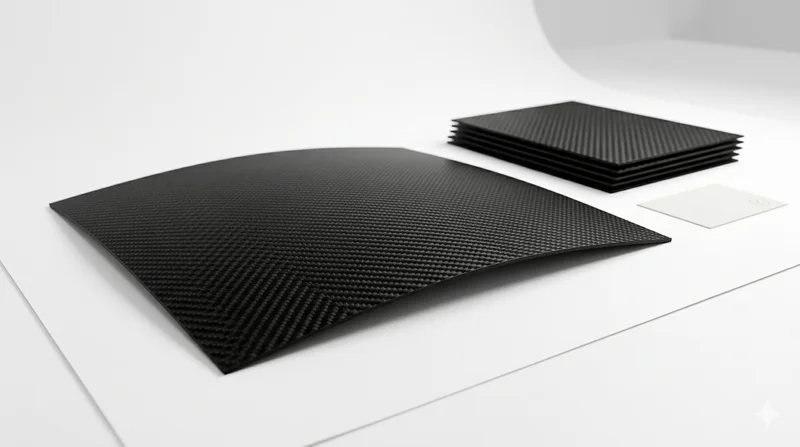
Carbon Fiber Plate — 3K Twill T700 1.5mm
Thin 1.5mm carbon fiber plate with 3K twill weave surface. Lightweight and stiff, commonly used for covers, panels, drone bodies, and applications requiring a premium aesthetic appearance.
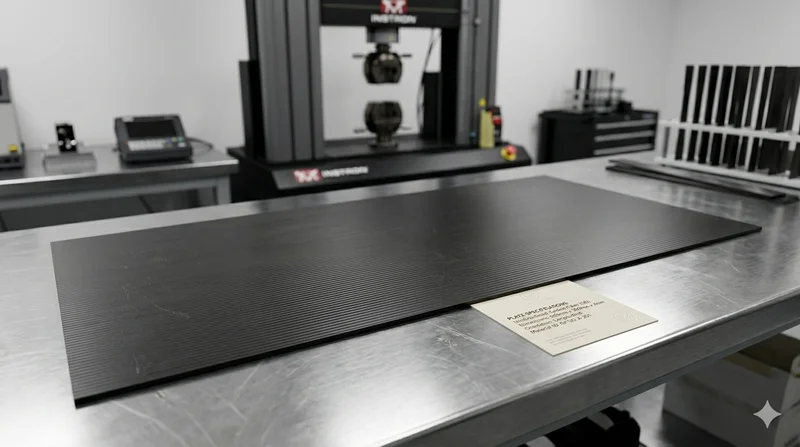
Carbon Fiber Plate — UD Unidirectional T700
Unidirectional carbon fiber plate with all fibers oriented in a single direction for maximum strength along the fiber axis. Essential for structural reinforcements, splints, and applications where load direction is predictable.