
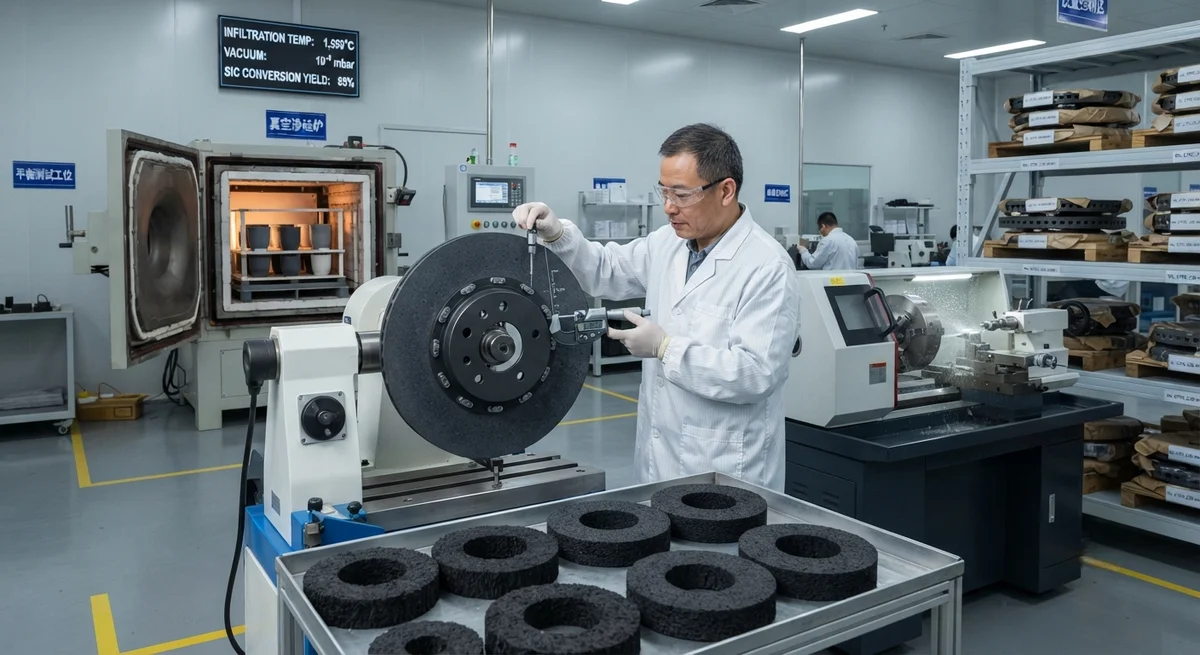
Carbon fiber-reinforced ceramic brake rotors offer significant advantages over cast iron: 60% weight reduction, operating temperatures exceeding 1,000°C, and 3-4x longer service life. Detailed comparison of manufacturing process, friction performance, and total cost of ownership.
The Evolution of Friction Brake Materials
Automotive brake rotors represent one of the most demanding engineering challenges in vehicle design, requiring materials that maintain stable friction coefficients across temperatures from -20°C to over 800°C, resist wear for 50,000-100,000 km of service, and contribute to unsprung mass reduction for improved ride and handling. Carbon fiber-reinforced ceramic (CFRC) brake rotors — commonly referred to as carbon-ceramic brakes — have emerged as the premier braking technology for high-performance vehicles, offering a compelling combination of mass reduction, thermal stability, and service life that significantly exceeds conventional cast iron and steel alternatives.
The global carbon-ceramic brake market was valued at approximately $3.1 billion in 2025, with projected growth to $6.8 billion by 2032 at a CAGR of 11.9%, driven by increasing adoption in electric vehicles and mainstream premium segments. Originally developed for aerospace applications and subsequently refined for Formula 1, carbon-ceramic brakes are now available as options on over 40 production vehicle models from manufacturers including Porsche, Ferrari, Lamborghini, Audi, BMW, Mercedes-Benz, and Chevrolet.
Manufacturing Process of Carbon Fiber-Reinforced Ceramic Brake Rotors
The production of CFRC brake rotors is a multi-stage process that combines carbon fiber reinforcement with a silicon carbide (SiC) ceramic matrix through liquid silicon infiltration (LSI):
- Stage 1 — Fiber preform fabrication: Chopped carbon fibers (typically 1-3 mm length, T300 or T700 grade) are mixed with phenolic resin binder and compression-molded into the rotor shape at 150-200°C and 10-20 MPa pressure. The preform contains 40-55% fiber volume fraction with a controlled pore structure essential for subsequent infiltration.
- Stage 2 — Carbonization (pyrolysis): The phenolic resin binder is pyrolyzed at 900-1,200°C in an inert nitrogen atmosphere, converting the binder into amorphous carbon. This step produces a porous carbon-carbon (C/C) preform with 15-25% open porosity, interconnected pore channels of 5-50 μm diameter, and sufficient mechanical integrity for handling.
- Stage 3 — Silicon infiltration: The porous C/C preform is placed in contact with solid silicon or silicon alloy powder and heated to 1,450-1,600°C in vacuum (10⁻²-10⁻³ mbar). Molten silicon is drawn into the porous structure by capillary action, where it reacts with the carbon matrix to form silicon carbide (SiC). The reaction C + Si → SiC is exothermic and self-sustaining once initiated. After infiltration, 10-25% of the pore volume remains as unreacted free silicon.
- Stage 4 — Finishing and coating: The rotor undergoes diamond grinding to achieve final dimensional tolerances of ±0.1 mm on the friction surface and ±0.05 mm on the mounting hub. A thin anti-corrosion coating — typically zinc phosphate or silicate-based — is applied to non-friction surfaces.
Performance Comparison: CFRC vs. Cast Iron vs. Steel Brake Rotors
| Parameter | CFRC (Carbon-Ceramic) | Cast Iron (GJ250/GJL250) | Steel (440C/Heat-Treated) |
|---|---|---|---|
| Density (g/cm³) | 2.0-2.3 | 7.2-7.3 | 7.8-7.9 |
| Mass per rotor (380 mm disc) | 5.8-6.8 kg | 10.5-12.5 kg | 11.5-13.5 kg |
| Maximum operating temperature (°C) | 1,400 (structural), 1,000 (friction stable) | 650-700 | 700-800 |
| Friction coefficient (cold, 100°C) | 0.35-0.50 | 0.35-0.45 | 0.30-0.40 |
| Friction coefficient (hot, 600°C) | 0.40-0.55 | 0.20-0.30 (fade) | 0.25-0.35 (fade) |
| Wear rate (mm³/MJ) | 1.5-3.0 | 8-15 | 6-12 |
| Service life (km, typical) | 200,000-300,000 | 50,000-80,000 | 60,000-100,000 |
| Fade resistance (consecutive stops from 200 km/h) | 12+ stops before 20% reduction | 3-5 stops before 30% reduction | 4-6 stops before 25% reduction |
The most significant performance differentiator for CFRC rotors is their fade resistance. Cast iron rotors experience a 30-50% reduction in friction coefficient at temperatures above 550°C due to the formation of a cementite (Fe₃C) surface layer and thermal decomposition of the friction film. CFRC rotors maintain stable friction coefficients up to 1,000°C because the SiC matrix does not undergo phase transitions within the operating temperature range, and the carbon fiber reinforcement provides consistent thermal conductivity — 40-60 W/m·K — for efficient heat dissipation.
Thermal Management and Weight Reduction Benefits
For performance vehicles, the thermodynamic advantage of CFRC rotors translates directly into on-track performance. The effective thermal mass of a 380 mm CFRC rotor (equivalent to 7-8 kg cast iron in thermal capacity) combined with its lower density means that total braking system mass for a four-wheel installation is reduced by 15-22 kg — equivalent to removing approximately 2% of total vehicle mass from unsprung locations. This reduction improves suspension response time by 8-12% and reduces the moment of inertia of the wheel assembly, allowing faster acceleration and deceleration of the rotating mass.
In electric vehicles, the mass reduction benefits are amplified. Each kilogram of unsprung mass saved on a brake rotor reduces the energy required for acceleration by approximately 0.02 kWh per 100 km under urban driving cycles. For a vehicle covering 200,000 km over its lifetime, the 20 kg braking system mass reduction saves approximately 800 kWh of electrical energy — equivalent to the battery capacity of a typical BEV.
Manufacturing Cost Analysis and Production Scale
| Cost Factor | CFRC Set (4 rotors) | Cast Iron Set (4 rotors) | Steel Set (4 rotors) |
|---|---|---|---|
| OEM cost per set | $3,500-6,000 | $200-400 | $350-650 |
| Aftermarket replacement cost | $4,500-8,000 | $400-800 | $600-1,200 |
| Pad replacement interval (sets per rotor life) | 4-6 pairs | 2-3 pairs | 2-3 pairs |
| Rotor replacement interval (km) | 200,000-300,000 | 50,000-80,000 | 60,000-100,000 |
| Cost per 100,000 km (rotors + pads) | $2,100-3,800 | $1,100-2,200 | $1,400-2,600 |
| Weight saving vs. cast iron | -18 to -22 kg | Baseline | +1-2 kg |
While the upfront cost of CFRC brake systems remains 10-15x higher than cast iron equivalents, the total cost of ownership over 300,000 km is converging rapidly. For performance vehicles that would otherwise replace cast iron rotors 3-5 times over their service life, the lifecycle break-even point occurs at approximately 180,000-220,000 km.
Current Limitations and Ongoing Development
Despite their advantages, CFRC brake rotors face several technical and economic challenges that continue to drive research and development:
- Low-temperature friction coefficient: Below 100°C, CFRC rotors exhibit lower friction coefficients (0.25-0.35) than cast iron, requiring optimized pad compound formulations. Manufacturers such as Brembo and SGL Carbon have developed dedicated ceramic brake pads with metal-free formulations that improve cold bite by 25-30%.
- Production cycle time: The complete CFRC manufacturing process — from fiber preforming through final machining — requires 12-18 days per batch, compared to 2-4 days for cast iron rotors. Efforts to reduce cycle time include microwave-assisted carbonization (reducing pyrolysis from 48 to 8 hours) and direct reactive melt infiltration using silicon-alloy systems with lower melting points.
- Recycling: CFRC rotors cannot be remelted like cast iron. Current recycling approaches include crushing and using the ceramic powder as a filler in new brake pad formulations or as an abrasive in industrial applications. Research into electrochemical separation of silicon carbide and carbon fiber for closed-loop recycling is ongoing at Fraunhofer IKTS.
Frequently Asked Questions
Are carbon-ceramic brake rotors suitable for everyday street driving, or are they only beneficial on race tracks?
Carbon-ceramic rotors are fully street-legal and provide benefits in everyday driving, though the performance advantage is most pronounced under sustained high-load conditions. For daily street use, the primary benefits are zero corrosion (no rust formation, even after rain or winter salt exposure — a persistent issue with cast iron rotors), consistent pedal feel across all temperature conditions, and a 3-4x longer service life that eliminates the need for mid-life rotor replacement. The main downsides for street use are the high upfront cost and reduced cold-bite performance during the first two stops from cold start (typically resolved after 50-100 m of brake application in cold weather). Most manufacturers recommend carbon-ceramic brakes for vehicles that will be driven more than 20,000 km/year, where the lifecycle cost advantage becomes measurable.
Can CFRC brake rotors be paired with standard organic brake pads, or do they require specific ceramic-compatible pads?
CFRC rotors require specifically formulated brake pads designed for ceramic friction surfaces. Standard organic (NAO) pads and semi-metallic pads are not recommended, as they produce inadequate friction coefficients (0.20-0.30) and may transfer material to the rotor surface, causing vibration and uneven wear. Dedicated ceramic brake pads — typically using a sintered metallic-ceramic formulation containing copper, tin, and ceramic friction modifiers — are required to achieve the specified performance. Key pad characteristics for CFRC rotors include: initial friction coefficient above 0.35 at 50°C, thermal stability to 900°C minimum, and compressibility below 100 μm under 10 MPa clamping pressure. Pad material hardness (Rockwell R 80-110) must be carefully matched to the rotor SiC content to avoid excessive pad wear or rotor scoring. Manufacturers including Brembo (CCM-R pad compound), Pagid (RSL-1), and Ferodo (DS2500) offer certified pad formulations for carbon-ceramic braking systems.
What is the noise, vibration, and harshness (NVH) profile of CFRC brake rotors compared to cast iron?
CFRC brake rotors have a distinct NVH signature that differs significantly from cast iron. The natural frequency of a CFRC rotor is 25-40% higher than an equivalent cast iron rotor due to the higher specific stiffness of the carbon-silicon carbide composite. This shifts the dominant resonance mode above 5,000 Hz, reducing the likelihood of low-frequency groan and moan (100-500 Hz) that commonly affects cast iron brakes. However, CFRC rotors are more susceptible to high-frequency squeal (8-16 kHz) in the 50-150°C temperature range, particularly if the pad compound is not optimized. Brake manufacturers address this through the addition of chamfered friction surfaces, multi-layer damping shims on the pad backplate, and careful porosity control in the C/C preform to modify the rotor's acoustic damping coefficient. Field data from Porsche's PCCB (Porsche Ceramic Composite Brake) system shows customer complaint rates for brake noise below 1.5%, comparable to or better than cast iron equivalents on the same vehicle platforms.
Part of topic
Related Articles
- Bio-Based Carbon Fiber Precursors: Lignin and Polyethylene for Low-Cost Production
- Large-Tow Carbon Fiber Cost Analysis: 48K vs 60K Price-Performance Comparison
- Carbon Fiber-Resin Interface Bonding: Surface Treatment and Coupling Agent Optimization
- Digital Twin for Carbon Fiber Manufacturing: Real-Time Process Monitoring and Defect Prevention
- Thermoplastic Carbon Fiber Welding for Automotive: Ultrasonic and Induction Welding Process Windows
- Large-Tow Carbon Fiber Wet Spinning: Process Optimization for 48K/60K Production Efficiency
Interested in Custom Carbon Fiber Products?
Contact our team for competitive pricing and technical specifications.
Get a QuoteRelated Products
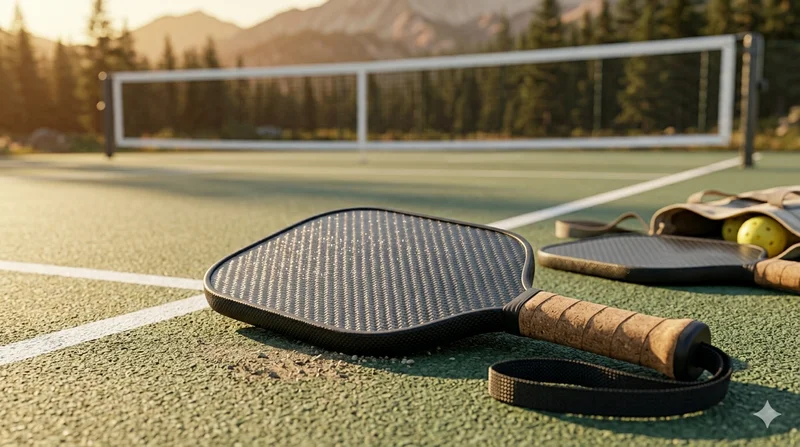
Carbon Fiber Pickleball Paddle
High-performance pickleball paddle with Toray T700 carbon fiber face and polypropylene honeycomb core. Delivers excellent power-to-weight ratio, spin generation, and vibration dampening for competitive play.
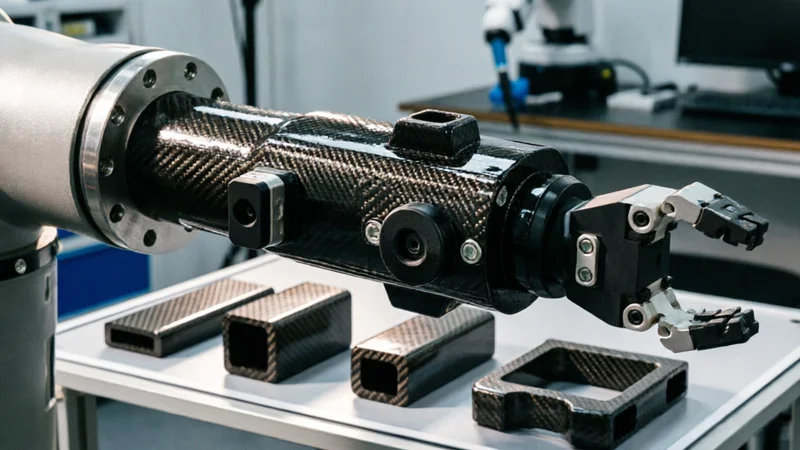
Carbon Fiber Robot End Effector Link — Custom Shape & Sensor Integration
Custom-shaped carbon fiber end effector links for robotic arms. Designed for automation integrators and research labs requiring lightweight, rigid connections between the robot wrist and gripper/tool. Can incorporate sensor mounting bosses, cable routing channels, and quick-change interfaces.
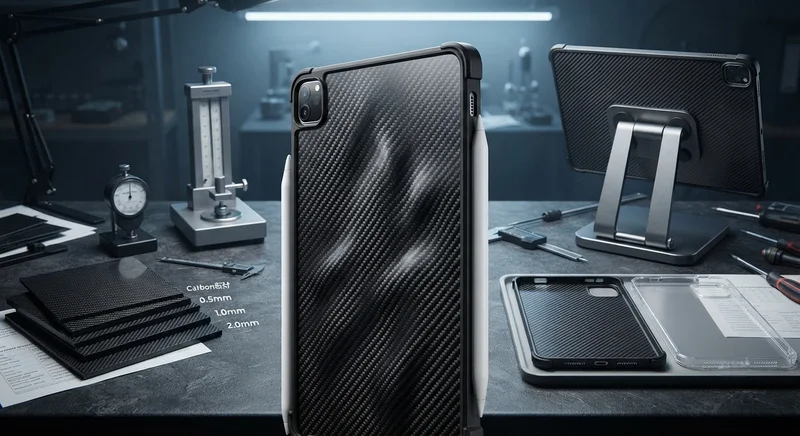
Carbon Fiber Tablet Case — Ultra-Light Protective Shell
Lightweight carbon fiber protective case for tablets and iPads. Molded from T700 3K prepreg with reinforced corner protection. Adds minimal weight while providing superior rigidity and drop protection compared to polycarbonate or silicone cases. Ideal for field workers, enterprise deployments, and professionals requiring durable tablet protection.
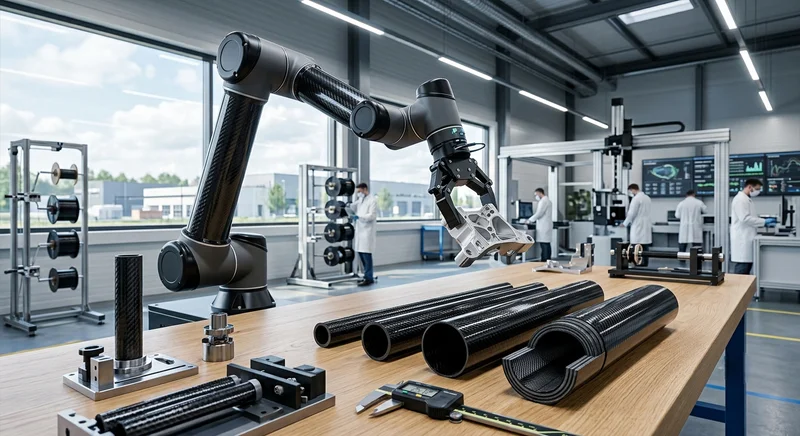
Carbon Fiber Robotic Arm Tube — High-Stiffness Lightweight Replacement
Precision-wound carbon fiber tubes for robotic arm links, replacing steel or aluminum in collaborative robots (cobots) and industrial manipulators. Achieve 3× the specific stiffness of aluminum with significant weight reduction, enabling faster acceleration and higher payload capacity.
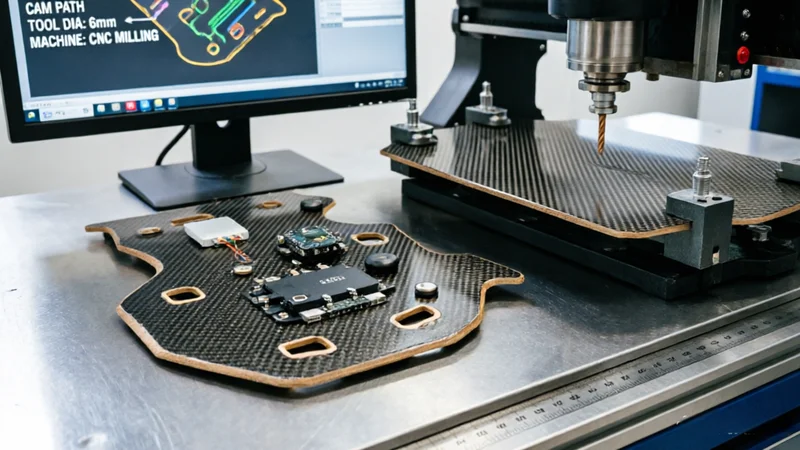
Carbon Fiber Drone Frame Base Plate — 3K Twill T700
CNC-machined carbon fiber base plates for drone frame assemblies. Cut from 3K twill weave T700 prepreg with precision CNC routing. Pre-drilled mounting patterns compatible with common flight controller and power distribution board layouts. Available in 1.5mm to 5mm thickness.