
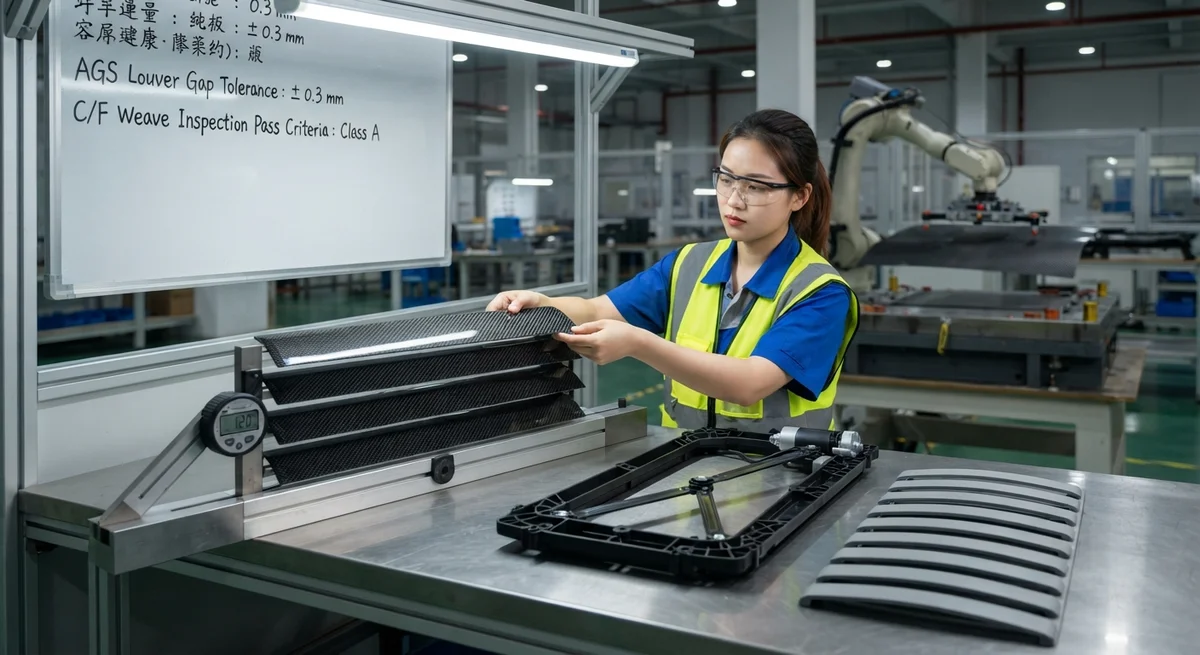
Active grille shutters are among the most effective aerodynamic devices on modern vehicles, yet they remain one of the least discussed. An active grille shutter is a set of movable louvers mounted behind the front grille that close at highway speeds to reduce airflow through the engine
Introduction
Active grille shutters are among the most effective aerodynamic devices on modern vehicles, yet they remain one of the least discussed. An active grille shutter is a set of movable louvers mounted behind the front grille that close at highway speeds to reduce airflow through the engine bay, cutting aerodynamic drag and improving efficiency. On electric vehicles, where every kilowatt-hour of battery energy must be stretched as far as possible, the AGS system directly influences driving range.
As EV platforms mature, engineers are replacing conventional plastic active grille shutters with carbon fiber composite versions. The shift is driven by three converging requirements: the need for thinner, lighter louver profiles that preserve cooling capacity, the demand for higher stiffness-to-weight ratios in vehicle front-end modules, and the premium that automakers place on every kilogram saved. This article explains the design function of carbon fiber active grille shutters, quantifies their range impact, and compares manufacturing approaches for B2B buyers.
Why Active Grille Shutters Matter for EVs
At speeds above 60 km/h, aerodynamic drag becomes the dominant energy consumer in an EV, accounting for 50-60% of total energy use on the highway cycle. The front grille opening is one of the largest sources of pressure drag: air entering the engine bay through a fully open grille creates turbulence and increases the vehicle's drag coefficient by 0.01-0.02 on a typical sedan. Closing the shutters at speed reduces this drag contribution by up to 80%.
For a mid-size EV with a drag coefficient of 0.26 and a battery capacity of 75 kWh, every 0.01 reduction in Cd extends range by roughly 8-12 km on the highway cycle. A properly sized AGS system delivers a 0.004-0.008 Cd improvement, translating to 3-9 km of additional range per charge at no battery cost. This makes the AGS one of the highest-return aerodynamic investments available.
The Case for Carbon Fiber Louvers
Conventional active grille shutters are injection-molded from glass fiber reinforced polyamide (PA-GF30) or polypropylene (PP-LGF), with typical louver thickness of 2.5-3.5 mm. These work well, but they carry a weight penalty and impose design constraints on the front-end module:
- Weight reduction: A carbon fiber AGS louver set weighs 40-55% less than an equivalent PA-GF30 assembly. A typical passenger car AGS module weighs 1.8-2.6 kg in glass-filled plastic; a carbon fiber version weighs 0.9-1.3 kg — a saving of 0.7-1.4 kg per vehicle that counts directly against the front axle weight budget.
- Thinner profiles: Carbon fiber louvers can be molded to 1.2-1.8 mm thickness while maintaining stiffness, preserving more open area for cooling when shutters are open and reducing flow restriction.
- Higher stiffness-to-weight: Carbon fiber's specific stiffness is 3-5 times that of PA-GF30, allowing wider, longer louver spans without sagging or flutter at high vehicle speeds.
- Dimensional stability: Carbon fiber shutters resist thermal deformation better than glass-filled plastics, maintaining louver gap tolerances from -40 C to +90 C operating range.
- Design language: Exposed carbon fiber shutters visible through open grilles serve as a performance cue on premium EVs, aligning with the brand language of performance-oriented electric models.
Performance Comparison: Materials for AGS Components
| Property | CFRP (Thermoset/Prepreg) | PA-GF30 (Injection) | PP-LGF (Injection) | Aluminum Sheet |
|---|---|---|---|---|
| Density (g/cm³) | 1.55-1.60 | 1.35-1.40 | 1.05-1.15 | 2.70 |
| Tensile modulus (GPa) | 120-150 (unidirectional) | 8-11 | 5-7 | 69-72 |
| Specific stiffness (GPa/(g/cm³)) | 75-95 | 6-8 | 5-7 | 26 |
| Typical louver thickness (mm) | 1.2-1.8 | 2.5-3.5 | 2.8-4.0 | 1.0-1.5 |
| Assembly weight, mid-size EV (kg) | 0.9-1.3 | 1.8-2.6 | 1.7-2.4 | 2.5-3.2 |
| Tooling cost index | 1.4-1.8x | 1.0x | 1.0x | 0.8x |
| Cycle time per part | 8-15 min (compression) | 40-70 s | 35-60 s | Stamped |
| Corrosion resistance | Excellent | Good | Good | Requires coating |
The table shows the fundamental trade-off: carbon fiber delivers a 40-55% weight saving and dramatically higher specific stiffness at the cost of longer cycle times and higher tooling investment. For premium and performance EVs — where the front-end module is a design focal point and every kilogram matters — the trade is increasingly attractive. For high-volume mainstream models, PA-GF30 remains cost-competitive.
Manufacturing Processes for Carbon Fiber AGS Components
Three manufacturing routes dominate carbon fiber AGS production:
- Compression molding with sheet molding compound (SMC-CF): Carbon fiber SMC with 20-30% fiber content by weight is compression molded in 8-15 minute cycles. This route supports semi-structural louver frames and housings at medium volumes with lower material cost than prepreg. Surface quality is good but not Class A.
- Prepreg compression molding: Unidirectional or woven prepreg is cut, stacked, and compression molded at 130-160 C for 10-20 minutes. This delivers the highest mechanical properties and is preferred for structural AGS frames that also carry crash-load paths in the front-end module.
- Thermoplastic overmolding hybrid: A carbon fiber reinforced thermoplastic (CF-PA66 or CF-PP) insert is injection overmolded with soft-touch TPE edges for sealing. This route achieves 60-90 second cycle times, approaching conventional plastic productivity while retaining a 30-40% weight saving.
System Integration and Actuation
A carbon fiber AGS system comprises the louver set, housing frame, actuator, and vehicle control interface. The CFRP housing frame provides the dimensional reference for louver alignment, achieving ±0.3 mm louver gap consistency versus ±0.6-0.8 mm for warped plastic frames. Sealing efficiency directly affects drag reduction: a 95% closed-seal efficiency delivers nearly the full 0.008 Cd benefit, while a 75% efficient seal delivers only about 60% of it.
Control strategy varies by manufacturer: Tesla-style systems close shutters above 40 km/h when cooling demand is low; European OEMs integrate AGS with thermal management controllers that modulate louver angle continuously between 0-90 degrees based on coolant temperature, motor load, and battery thermal state. Carbon fiber's low mass (40-55% lighter than plastic) reduces actuator torque requirements by 20-30%, enabling smaller motors and faster response — a secondary efficiency gain often overlooked in system design.
For most EV programs in 2026, the hybrid thermoplastic overmolding route offers the best balance: it fits existing injection molding supply chains, supports the necessary volumes, and still delivers meaningful mass reduction. Prepreg compression molding is reserved for flagship models where the AGS frame integrates structural function.
Frequently Asked Questions
How much driving range does a carbon fiber active grille shutter system add to an EV?
A carbon fiber AGS system delivers two compounding benefits. The aerodynamic effect adds 3-9 km of range per charge on the highway cycle for a typical mid-size EV (through 0.004-0.008 Cd reduction). The weight saving of 0.7-1.4 kg adds a further increment — roughly 0.5-1.5 km per charge. Combined, the system contributes 3.5-10 km per charge, equivalent to 0.4-1.1% of total range on a 500 km-rated vehicle, with no battery capacity increase required.
Is carbon fiber cost-effective for active grille shutters compared to glass-filled nylon?
It depends on program volume and positioning. At tooling amortization over 100,000+ units per year, the per-part cost of a hybrid thermoplastic carbon fiber AGS is 1.3-1.8 times that of a PA-GF30 version. For mainstream models where every dollar of bill of materials matters, glass-filled nylon remains the value choice. For premium and performance EVs — where the front-end module is a brand statement, the range benefit is marketed to customers, and weight reduction is a product goal — the 40-55% weight saving and 3-10 km range contribution justify the premium. Carbon fiber AGS economics also improve over time as SMC-CF material costs decline 5-8% annually.
Can carbon fiber AGS components survive stone impacts and UV exposure over a vehicle's lifetime?
Yes, with appropriate design. The louver set is mounted behind the grille, providing partial shielding from direct stone impact, but leading louvers still face debris at highway speeds. Design solutions include a toughened resin system (interlaminar fracture toughness above 400 J/m²), a 2K polyurethane clear coat on visible surfaces, and edge protection in the highest-exposure zones. UV-stable resin formulations maintain gloss and color retention over 10-year exterior durability testing per SAE J2527. Thermoplastic carbon fiber versions using PA66 or PP matrices also pass the full automotive thermal cycling and weathering validation (-40 C to +90 C, 1,000-hour xenon arc exposure).
Conclusion
Carbon fiber active grille shutters represent one of the clearest near-term opportunities for composites in mass-market transportation. The component's function — reducing aerodynamic drag on demand — directly serves the EV industry's central engineering challenge of range optimization, while the material shift to carbon fiber adds a 40-55% weight saving, enabling thinner profiles, better sealing, and reduced actuator load. The hybrid thermoplastic overmolding route now delivers this performance at cycle times compatible with automotive production volumes.
For B2B buyers evaluating AGS supply, the key specification criteria are louver stiffness-to-weight, closed-seal efficiency, and validated material durability. Explore our carbon fiber sheet and profile range suited to AGS louver and frame applications, or contact our engineering team for material selection guidance and prototype support for your next front-end module program.
Part of topic
Related Articles
- Carbon Fiber Mooring for Floating Offshore Wind: Fatigue and Corrosion in Deep Water
- Carbon Fiber Bicycle Frame Optimization: Layup Design and Manufacturing for Competitive Racing
- Carbon Fiber CFRP Retrofit for Infrastructure: Bridge and Building Seismic Strengthening
- Carbon Fiber Medical Imaging Equipment: Lightweight Gantry and Couch Structures for MRI/CT
- Carbon Fiber EV Battery Enclosures: Crash Safety and Electromagnetic Shielding Design
- Carbon Fiber Structures for Low-Altitude Economy: UAV Airframes and eVTOL Components
Interested in Our Products?
Contact our team for competitive pricing and technical specifications.
Get a QuoteRelated Products
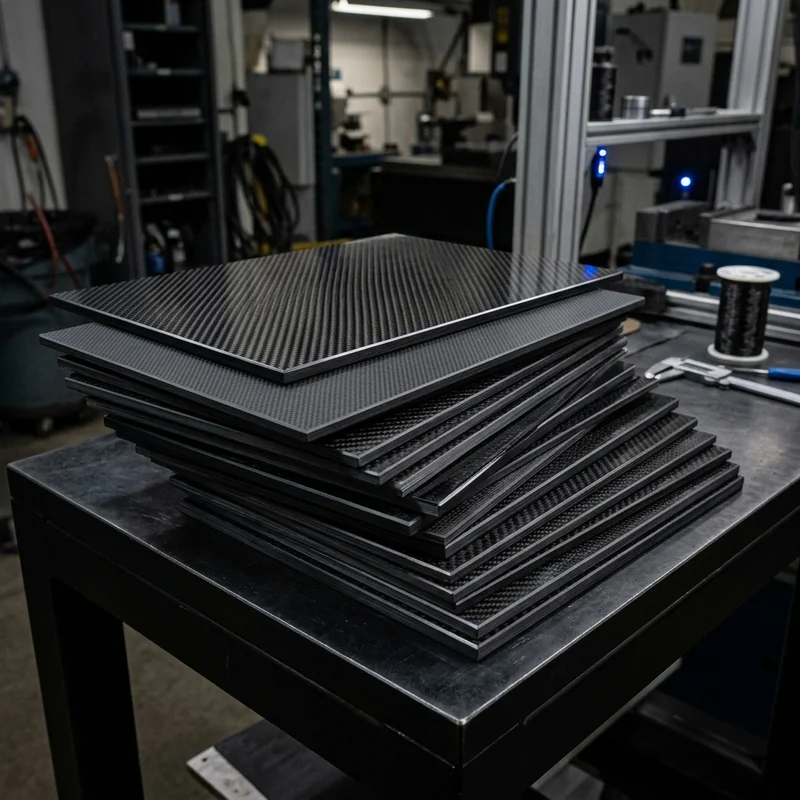
Carbon fiber standard plate-3k stripe
Lightweight, ultra-rigid standard sheets for drone fuselages, robot housings, facades and structural applications.

Carbon Fiber Plate — 3K Twill T700 3.0mm
Medium-thickness 3.0mm carbon fiber plate offering significantly higher load capacity while maintaining attractive 3K twill finish. Suitable for structural brackets, reinforcement plates, and load-bearing panels.

Carbon Fiber Plate — 3K Twill T700 1.5mm
Thin 1.5mm carbon fiber plate with 3K twill weave surface. Lightweight and stiff, commonly used for covers, panels, drone bodies, and applications requiring a premium aesthetic appearance.

Square Carbon Fiber Tube — 3K Twill T700
Square cross-section carbon fiber tube manufactured with 3K twill weave for torsional strength. Preferred for structural frames, trusses, and support columns where rectangular geometry offers design flexibility.
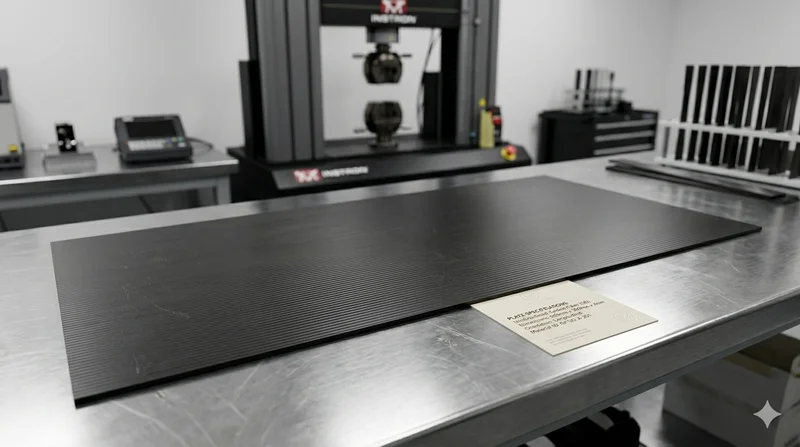
Carbon Fiber Plate — UD Unidirectional T700
Unidirectional carbon fiber plate with all fibers oriented in a single direction for maximum strength along the fiber axis. Essential for structural reinforcements, splints, and applications where load direction is predictable.