
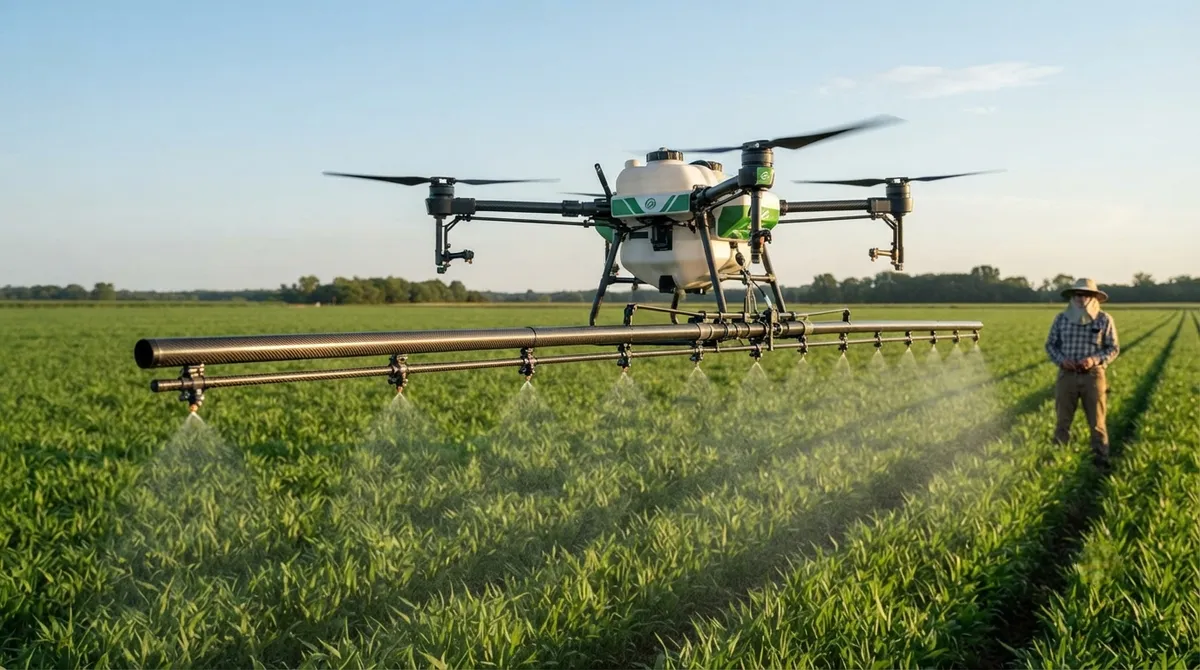
Agricultural drones have moved from a novelty to a core production tool in large-scale crop protection. A single rotary-wing platform with a 10-20 liter chemical tank can cover 15-30 hectares per hour, replacing manual backpack spraying and reducing chemical exposure for workers. One co
Introduction
Agricultural drones have moved from a novelty to a core production tool in large-scale crop protection. A single rotary-wing platform with a 10-20 liter chemical tank can cover 15-30 hectares per hour, replacing manual backpack spraying and reducing chemical exposure for workers. One component carries the entire payload of plant protection chemistry across the working width: the sprayer boom. It must be stiff enough to hold a flat, predictable spray pattern at speed, light enough to leave payload for chemicals, and resistant to the aggressive chemical concentrates it comes into constant contact with.
Metal booms were the first choice when drone spraying emerged, but the combination of weight, corrosion, and fatigue from maintenance vibrations quickly pushed manufacturers toward carbon fiber composites. This article details the material properties that make carbon fiber sprayer booms superior, the stiffness and deflection design considerations, the corrosion chemistry of the composite in agrochemical environments, and the manufacturing process options available to equipment makers.
Why Carbon Fiber for a Sprayer Boom
A sprayer boom is a simple structure in concept — a long, slender beam spanning the entire drone width, loaded by its own weight, the weight of attached nozzle assemblies, and the vertical force of chemical flow through the nozzles during a flyby. In operation it must deflect less than a few centimeters at the tip so that the outermost nozzles still hit their target swath, and it must tolerate repeated chemical loading, UV exposure, and washdown cycles between fields. Carbon fiber addresses each of these requirements better than the alternatives:
| Property | Carbon Fiber Tube | Aluminum 6061 Tube | Steel Tube |
|---|---|---|---|
| Tensile strength | 1,500-2,500 MPa | 310 MPa | 400-500 MPa |
| Elastic modulus | 100-300 GPa (layup dependent) | 69 GPa | 200 GPa |
| Density | 1.5-1.6 g/cm³ | 2.7 g/cm³ | 7.85 g/cm³ |
| Fatigue endurance | Aerospace-grade, no fatigue limit | Moderate under vibration | Good, but corrosion-prone |
| Chemical resistance | Excellent to agrochemicals | Corrodes with chloride fertilizers | Rusts, needs coating |
| Weight for a 2 m boom | 0.3-0.5 kg | 0.7-1.0 kg | 1.8-2.5 kg |
The stiffness-to-weight ratio is the dominant advantage. For a boom of fixed outer diameter, each stiffness, and chemical resistance makes carbon fiber weigh roughly 50-70% less than aluminum and 80% less than steel. On a drone whose useful payload is measured in liters of chemical payload at the top of the envelope, every kilogram saved on the structure becomes payload and more battery life on the airframe.
Corrosion Resistance in the Agrochemistry
The most underestimated reason agricultural drone manufacturers switch to carbon fiber is chemical corrosion. Contact with liquid fertilizers and pesticides brings surfaces into prolonged dependence with chemistry that is aggressive toward metals at various times during the season:
- Chloride-based fertilizers: ammonium chloride, potassium chloride, and calcium chloride solutions are the primary cause of chloride pitting and stress corrosion cracking in aluminum and stainless booms.
- Copper sulfate sprays, commonly used as fungicides in orchards and vineyards, electrochemically attacks aluminum when wet with a loop with the airframe structure.
- Acidic formulations with (pH 2-5) chemically attack uncoated steel and slowly degrade powder-coated surfaces.
- Emulsifiable concentrates and surfactants slowly break down painted metal surfaces, exposing the raw metal underneath.
Carbon fiber reinforced polymer is inherently inert to these agrochemical - the epoxy or vinyl ester (polyester) matrix provides a sealed, non-reactive surface, and the carbon filaments themselves do not corrode, pit, or leach any electrochemical reaction products. No protective coating - anodizing, galvanizing, or powder coating - is needed to be maintained, which eliminates the two most common boom failures in agricultural service: pinhole corrosion at attachment holes and stress corrosion near bend points.
Sprayer Boom Stiffness and Deflection Control
The structural duty of the boom is bending: it is a simply supported or cantilevered beam under the evenly distributed weight of chemistry and its own weight, with concentrated loads at nozzle. Bending deflection at the tip must be kept small — typically 5-15 mm — because a drooping tip changes the spray angle, reduces ground coverage at the edge of the swath, and causes the drone to compensate with slower flight speeds, lowering productivity.
Key design parameters for a carbon fiber booms derive from classical beam theory combined with composite lamina properties:
- Tube diameter vs. wall thickness: stiffness grows with the fourth power of radius (I = π(D⁴−d⁴)/64), so a modest diameter increase yields a large stiffness gain without adding a wall thickness or weight. A typical 14 mm OD boom with a 1.5 mm wall is stiffer than a 10 mm OD with a 2.5 mm wall at lower weight.
- Fiber orientation: axial (0-degree) carbon fibers provide the bending stiffness along the boom length, while ±45° layers carry shear and twist from the propeller downwash and yaw maneuver loads. A 0/±45/0 layup is typical for modest-diameter booms.
- Support spacing: highly continuous the clamping is to the airframe, the longer the effective span between supports and the larger the deflection. Dropping the support spacing from 0.5 m to 0.35 m reduces a mid- boom deflection for a given load by more than half.
For a 2-meter boom on a class-25-liter drone, a deflection budget of 5-8 mm under full tank is achieved with a one-piece carbon tube of 16 mm OD, 2 mm wall, giving a calculated mid-span stiffness up to 1,200-1,600 N·mm²/ (bending modulus range 120-150 GPa). At the same effort, aluminum would need a 34 mm OD, 3 mm wall, adding roughly 0.8 kg, while the measured deflection at the tip would be similar only up to 800 mm of the development.
Payload Efficiency and Economics
Weight saving has a direct, measurable effect on the economics of a spraying operation. Aerial spraying is reimbursed per hectare, and the operator economics are roughly linear with: the total tank volume per flight, the battery duration per flight and the turnaround time.
- Structure-to-payload conversion: saving 0.5 kg of boom weight on a drone with an empty weight of 15 kg and a 20-liter tank roughly increases payload efficiency by 2-3% per flight — a modest but compounding gain across thousands of hectares for flying per season.
- Battery draw: every kilogram removed reduces the current draw of the propulsion system at climb and during the deep cross-wind legs, adding 30-60 seconds of flight endurance per sort.
- Maintenance cycles: a carbon boom requires no painting, no anodizing awareness, and no spring re-coating; the replacement interval is length-chart lifecycle driven (typically ≥ 4 seasons) rather than corrosion driven (1-3 seasons for aluminum).
Cost-wise, a carbon fiber sprayer boom is 3-6 times the cost of an equivalent aluminum boom as a raw material component, but the total cost of ownership across a 1-year spraying cycle is often lower because of the elimination of rust repair, re-coating and the purchase of intermediate failure booms. The volume price of carbon tube in nominal agriculture drone diameters has been falling as pultrusion capacity around the world has scaled.
Manufacturing Options for Sprayer Booms
Agricultural drone boom manufacturers choose from a range of carbon fiber processing routes depending on their production volume and requirement for stiffness:
| Manufacturing process | Production volume | Typical OD range | Advantage | Limitation |
|---|---|---|---|---|
| Pultrusion (continuous) | High (meters per hour) | 8-40 mm round or custom | Lowest cost per meter, constant cross-section | Straight forms only |
| Roll-wrap + oven-cure | Medium | 8-60 mm | Flexible layups, low tooling | Slower, manual |
| Filament winding | Medium-high | 10-120 mm | High-pressure, consistent, angular strength | Higher tooling, not for small lots |
| Braided + resin transfer | Medium | 10-50 mm | Crash-integrity, complex sections | Higher cost |
For the majority of boom applications, carbon fiber pultrusion is the standard manufacturing route: low cost per meter, controlled fiber volume fraction (55-65%), and a consistent diameter, which simplifies the clamping and fitting of the nozzle hangers. The boom is then built in sections - a central section with tank-mount interface and two sides that end at the outer nozzles - connected by lightweight aluminum or carbon injection-molded parts.
Sprayer Boom Components and Airtightness
The complete boom assembly includes a set of parts beyond the carbon tube itself. The nozzle hangers are the most numerable moving parts and most likely to be affected by the chemical environment:
- Nozzle hangers and clamps: injection-molded polypropylene or PEEK, chosen for chemical inertness rather than replaced periodically.
- End caps and tip weights: protect the open carbon edge from fraying (a sealing coat with a thin epoxy) and add aerostatic mass at the tips to stabilize the boom.
- Center joint: a bolted or quick-release connecting the two half booms for transport and servicing.
- Chemical isolation: the boom is normally not a sealed fluid pipe; the chemical runs in separate delivery tubes that are zipped along the mounting angle, isolating the structural tube from the chemical line for maintenance.
With these details, the career of the boom is largely deterministic: UV exposure slowly yellows the clear protective lacquer but does not harm the fibers, and the main replacement driver is mechanical impact damage during transport, loss, or branch strikes - not chemical or fatigue failure.
Frequently Asked Questions
Why not just use an aluminum boom if it is cheaper?
Aluminum is indeed cheaper per meter, but on a drone its weight penalty directly reduces spray payload and battery flight time, and in the field the chemical corrosion of aluminum clamps and brackets creates recurring pinhole repairs and maintenance. Over a single spraying season, the total cost of ownership of an aluminum boom (buy, coat, repair corrosion, replace early) is typically higher than a carbon fiber boom once labor and down time are accounted for. Carbon fiber is the standard in agricultural drone spraying precisely because the margin question — payload per flight — ends up far more valuable than the difference in material cost per meter.
Will the spray chemical degrade the epoxy matrix of the composite?
Epoxy and vinyl ester resins are one of the corrosion-inert families used in chemical plants; they resist aqueous hydrochloric acid, low-concentration sulfuric acid, chlorides, and the solvents in most crop-protection formulations up to the matrix heat deflection. Mis-use of an aggressive solvent carrier (e.g. aromatic hydrocarbons, some crop oil adjuvants at 60-80 °C) over extended contact can soften the surface; for the mainstream aqueous and emulsion formulas used by agricultural drones, a wash cycle with clean water at season end is enough to keep the matrix intact for years. The boom matrix itself is not in the liquid wetted path, since spraying fluid flows inside separate delivery tubes packaged away from the structural member.
What diameter and layup do I need for a 20-40 liter spraying drone?
For a 20-liter tank there is usually a boom span of 1.6-2.2 m; a carbon boom of 22-26 mm OD with a 2 mm wall (0/±45/0 layup) provides the target tip deflection of 5-8 mm. For a heavier spray drone with 40-liter tanks and faster flight speeds a larger tube of 30-36 mm OD or a boom with internal foam density is preferred. The direct data point to start from: stiffness (EI) of the cross-section and the support spacing are the two overriding variables - refining the clamp position helps more than increasing tube diameter once stiffness is met.
Conclusion
Carbon fiber has become the default material for agricultural drone sprayer booms, not because it is the cheapest input, but because on the three dimensions that actually drive system performance - corrosion resistance under spraying chemicals, bending stiffness for a reliable flat pattern, and low weight for payload and battery - it dominates both aluminum flexion at a workable life-cycle cost. The supply side has matured too: pultrusion and filament winding now deliver sprayer boom tubes in the diameters and wall sections that drone manufacturers specify, with the tolerance and the squareness control needed for a clipped assembly.
For agricultural drone OEMs and spare-part suppliers that modern handling, sprayer boom tubes in standard OD sizes (20-36 mm) with 0±45 layups and sealed cut ends are available. Browse our carbon fiber tubing product range or contact our engineering team for a bending stiffness review and sizing of the boom for your platform.
Related Articles
- Carbon Fiber Tube for Sale: Comparing Listings and Avoiding Bad Specs
- Carbon Fiber Engine Parts: High-Temperature Performance for Racing and Performance Vehicles
- Carbon Fiber Body Parts: Automotive Exterior Panels and Structural Components
- Carbon Fiber Drone Body Manufacturing: Monocoque Design and Production Methods
- Carbon Fiber Drone Parts Supplier: FPV Frames, Arms and Structural Components
- Filament Wound Epoxy Tubes: Industrial Applications from Oil and Gas to Aerospace
Interested in Our Products?
Contact our team for competitive pricing and technical specifications.
Get a QuoteRelated Products
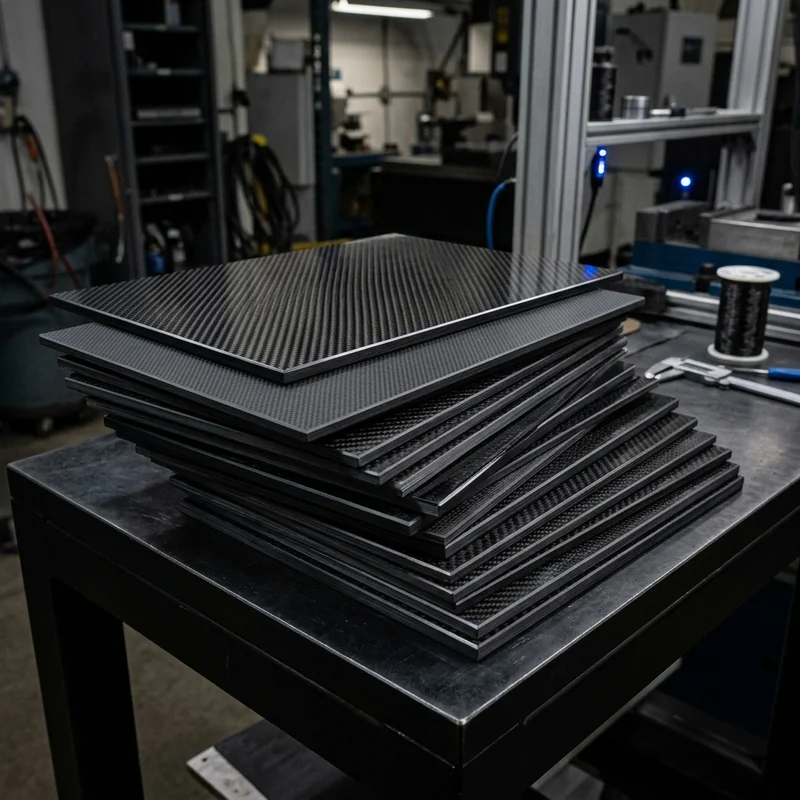
Carbon fiber standard plate-3k stripe
Lightweight, ultra-rigid standard sheets for drone fuselages, robot housings, facades and structural applications.

Carbon Fiber Plate — 3K Twill T700 3.0mm
Medium-thickness 3.0mm carbon fiber plate offering significantly higher load capacity while maintaining attractive 3K twill finish. Suitable for structural brackets, reinforcement plates, and load-bearing panels.

Carbon Fiber Plate — 3K Twill T700 1.5mm
Thin 1.5mm carbon fiber plate with 3K twill weave surface. Lightweight and stiff, commonly used for covers, panels, drone bodies, and applications requiring a premium aesthetic appearance.

Square Carbon Fiber Tube — 3K Twill T700
Square cross-section carbon fiber tube manufactured with 3K twill weave for torsional strength. Preferred for structural frames, trusses, and support columns where rectangular geometry offers design flexibility.
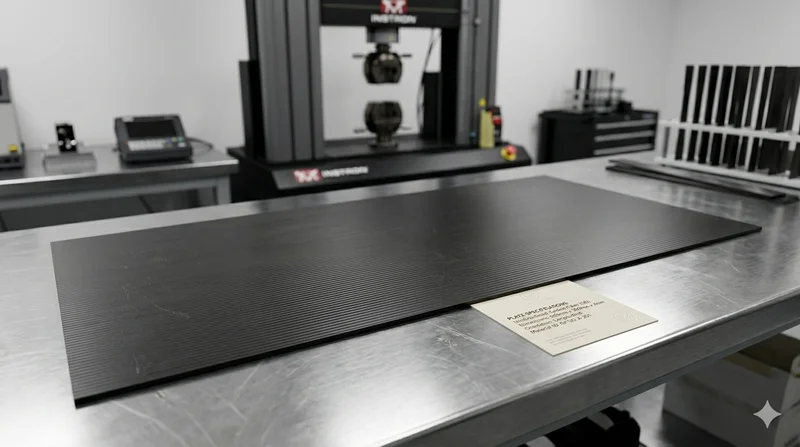
Carbon Fiber Plate — UD Unidirectional T700
Unidirectional carbon fiber plate with all fibers oriented in a single direction for maximum strength along the fiber axis. Essential for structural reinforcements, splints, and applications where load direction is predictable.