Carbon fiber composites have transformed aircraft interior design, offering weight reductions of 30-50% compared to traditional aluminum and thermoplastics while meeting stringent FAA/EASA flammability, smoke toxicity, and heat release (FST) requirements. This article examines the specific applications of carbon fiber in aircraft cabin interiors — sidewall panels, ceiling panels, lavatory modules, galley structures, overhead stowage bins, and partition walls — with technical specifications, certification pathways, and cost-benefit analysis for B2B buyers in aerospace supply chains.
# Carbon Fiber Aircraft Interior: Cabin Panels, Lavatory Modules, and Overhead Bin Components
## Summary
Carbon fiber composites have transformed aircraft interior design, offering weight reductions of 30-50% compared to traditional aluminum and thermoplastics while meeting stringent FAA/EASA flammability, smoke toxicity, and heat release (FST) requirements. This article examines the specific applications of carbon fiber in aircraft cabin interiors — sidewall panels, ceiling panels, lavatory modules, galley structures, overhead stowage bins, and partition walls — with technical specifications, certification pathways, and cost-benefit analysis for B2B buyers in aerospace supply chains.
---
## Market Context: Why Carbon Fiber for Aircraft Interiors?
The global aircraft interior market was valued at $28.3 billion in 2025 and is projected to reach $38.7 billion by 2031 (8.3% CAGR), with composite materials capturing an increasing share. Carbon fiber's adoption in interiors has accelerated for three reasons:
1. **Weight reduction**: Every kilogram saved on an airliner's interior translates to $2,500-3,000 in fuel savings over the aircraft's 20-25 year service life (Airlines for America, 2025). Replacing a 40 kg aluminum lavatory module with a 22 kg carbon fiber equivalent saves 18 kg per unit — across a fleet of 200 aircraft with 8 lavatories each, this is 28.8 tonnes of total weight reduction.
2. **Design freedom**: Carbon fiber's ability to mold complex double-curved geometries enables seamless, integrated interior designs with fewer joints and gaps — improving both aesthetics and cleaning compliance.
3. **Durability**: Carbon fiber panels resist impact damage from passenger luggage and service carts better than thin-gauge aluminum, with no corrosion in humid galley and lavatory environments.
### Table 1: Aircraft Interior Material Comparison (Per Square Meter)
| Property | Carbon Fiber Laminate | Aluminum 2024-T3 | Fiberglass/Phenolic | ABS Thermoplastic |
|---|---|---|---|---|
| Areal weight (kg/m²) @ 2 mm thickness | 3.2 | 5.4 | 4.1 | 4.8 |
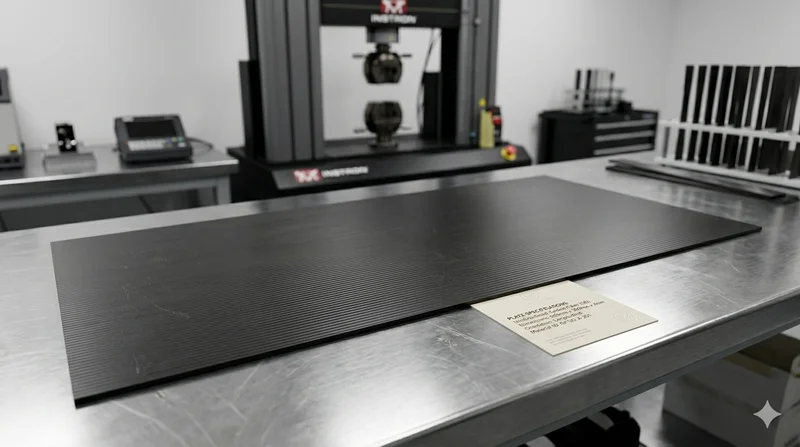
| Tensile strength (MPa) | 600-900 | 455 | 250-350 | 40-55 |
| Flexural modulus (GPa) | 50-65 | 71 | 18-25 | 2.0-2.5 |
| FST compliance | With phenolic resin | N/A (metallic) | Yes | With FR additives |
| Corrosion resistance | Excellent | Poor (needs coating) | Excellent | Excellent |
| Impact resistance (J, 2 mm panel) | 8-15 | 6-10 | 4-8 | 3-6 |
| Raw material cost ($/m²) | $45-85 | $18-30 | $25-40 | $15-25 |
| Fabricated panel cost ($/m²) | $120-220 | $80-140 | $90-160 | $55-90 |
| Service life (years) | 20-25 | 15-20 | 15-20 | 8-12 |
| Recyclability | Limited (pyrolysis) | Excellent | Moderate | Good |
---
## Sidewall and Ceiling Panels
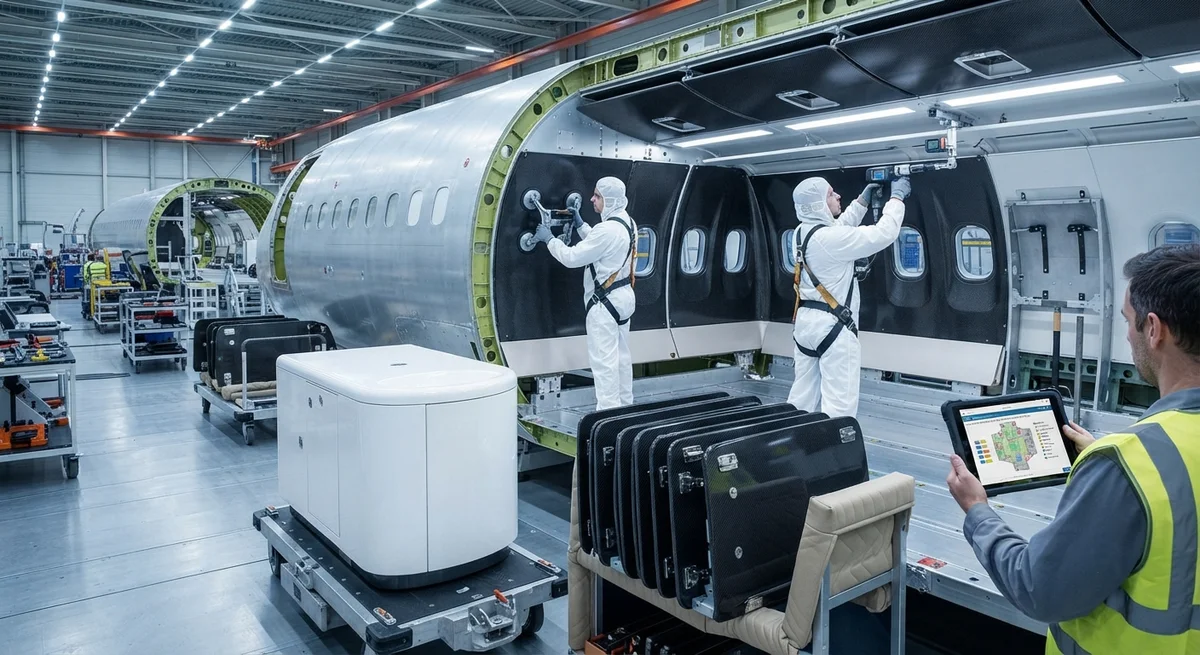
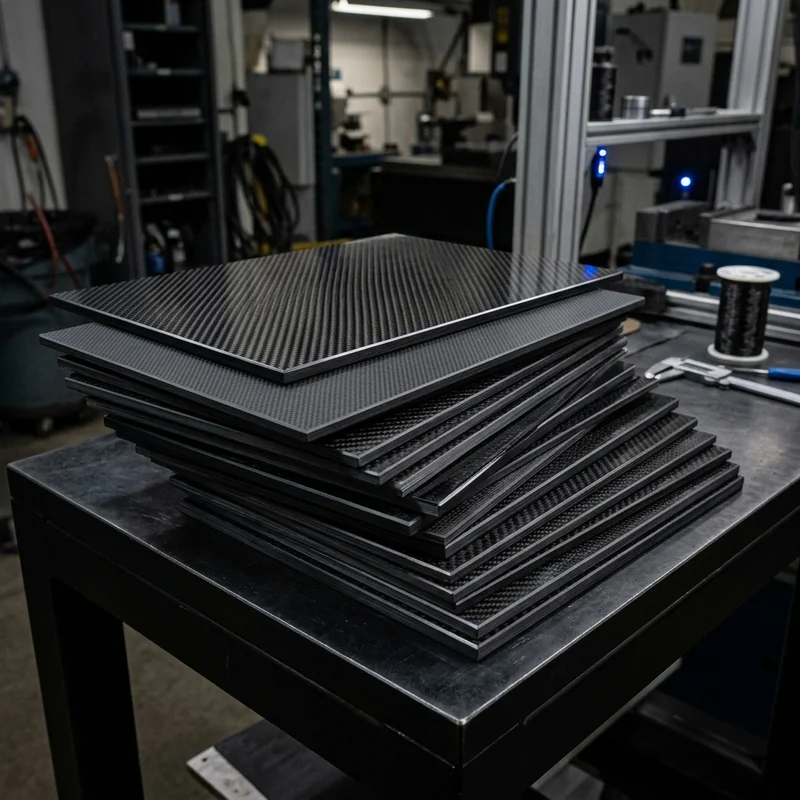
Cabin sidewall panels and ceiling panels together account for approximately 35% of the interior composite surface area on a narrowbody aircraft (Airbus A320: ~85 m² per shipset). Modern designs use phenolic resin matrix carbon fiber (CFRP-phenolic) for its inherent fire resistance — phenolic systems achieve the lowest peak heat release rate (≤35 kW/m² per FAR 25.853) and smoke density (Ds ≤100 in 4 minutes) among thermoset composites, often without requiring additional fire-retardant coatings.
### Key Specifications for Sidewall Panels
- **Standard thickness**: 1.5-3.0 mm (monolithic CFRP) or 6-12 mm (CFRP/Nomex honeycomb sandwich for impact zones)
- **Core material**: Nomex aramid honeycomb (2.4-4.8 mm cell size, 48-80 kg/m³ density) for sandwich panels
- **Surface finish**: Gloss level per Airbus DHS 600 or Boeing BSS 7202 spec; typical 60° gloss: 70-85 units for visible surfaces
- **Decorative laminate**: Optional high-pressure decorative laminate (HPDL) bonded to CFRP substrate via film adhesive
- **FST compliance**: Must meet FAR 25.853 (a) & (d), Appendix F Part I (vertical burn), Part IV (heat release: ≤65 kW/m² peak, ≤65 kW-min/m² total), Part V (smoke: Ds ≤200 in 4 minutes)
- **EMI shielding**: Surface resistivity ≤1.0 × 10⁵ Ω/sq (typically achieved with aluminum foil layer or conductive coating)
---
## Lavatory Modules
Aircraft lavatories present the most demanding interior application for carbon fiber composites. The module must integrate plumbing, electrical systems, waste tanks, lighting, and ventilation within a space typically measuring 0.8 × 1.2 × 2.1 m. Weight reduction in lavatory modules has direct revenue implications — each kilogram saved in the lavatory zone is approximately 0.8 kg of structural airframe weight (lever-arm ratio).
### Table 2: Carbon Fiber Lavatory Module Weight Breakdown
| Component | Traditional Aluminum (kg) | CFRP (kg) | Weight Saving |
|---|---|---|---|
| Floor structure | 6.8 | 3.5 | 3.3 kg (49%) |
| Sidewall panels (4 walls) | 5.2 | 2.8 | 2.4 kg (46%) |
| Ceiling panel | 1.4 | 0.7 | 0.7 kg (50%) |
| Door assembly | 4.5 | 2.3 | 2.2 kg (49%) |
| Countertop/sink surround | 2.1 | 0.9 | 1.2 kg (57%) |
| Sump and plumbing brackets | 1.8 | 0.8 | 1.0 kg (56%) |
| **Total module weight** | **21.8** | **11.0** | **10.8 kg (50%)** |
| *Add: waste tank (HDPE/composite)* | *2.5* | *1.6* | *0.9 kg (36%)* |
The CFRP lavatory module is typically manufactured as a semi-monocoque structure with co-cured stiffeners and integrated attachment points. Key manufacturing challenges include:
- **Waterproofing**: All cut edges must be sealed (epoxy edge sealant) to prevent moisture ingress into the laminate — hygroscopic swelling can cause dimensional changes of 0.1-0.3% in phenolic panels.
- **Chemical resistance**: Panels must withstand repeated exposure to acidic cleaning agents (pH 2-12) and disinfectants (isopropyl alcohol, quaternary ammonium compounds) — tested per Boeing D6-82479 or Airbus ABD0031 chemical resistance protocols.
- **Impact zones**: Door latch areas and countertop edges receive localized carbon fiber reinforcement (6-8 plies of plain-weave fabric) to withstand 3+ J impact loads from service cart contact.
- **Galley interface**: Attachment brackets must accommodate ±1.5 mm thermal expansion mismatch between the CFRP lavatory module and the aluminum/galley structure during flight cycles (−55°C to +45°C at the lavatory location).
---
## Overhead Stowage Bins
Overhead stowage bins (OHBs) represent the highest-volume interior carbon fiber application by part count. A single Airbus A320 family aircraft has 12-14 OHB units, each comprising a bucket (the structural shell), door, and hinge mechanism. Boeing's 737 MAX and Airbus A320neo families increasingly specify carbon fiber OHB doors and buckets for weight reduction.
### OHB Carbon Fiber Specifications
- **Bucket material**: Glass fiber/phenolic hybrid with localized carbon fiber reinforcement at hinge points (to reduce cost while maintaining stiffness at load-bearing areas)
- **Door material**: Carbon fiber/ phenolic with Class A surface finish (visible to passengers)
- **Typical laminate**: [0/90/±45]s symmetric quasi-isotropic lay-up, 4-6 plies, 1.0-1.6 mm total thickness
- **Load requirements**: Must support 75 kg uniformly distributed load per linear meter (EASA CS 25.1421) plus 6× safety factor for ultimate load
- **Hinge reinforcement**: Localized carbon fiber build-up to 3.0-4.0 mm at hinge attachment points
- **Fire resistance**: FAR 25.853 Appendix F Part IV (heat release) and Part V (smoke) — phenolic matrix provides compliance without additional fire barriers
---
## Certification Pathways
All carbon fiber interior components must be certified to the relevant FAA/EASA flammability, smoke, and toxicity (FST) standards. The primary certification route is through the Original Equipment Manufacturer's (OEM's) material qualification and the Supplemental Type Certificate (STC) for retrofit applications.
### Table 3: FST Certification Requirements for Aircraft Interior CFRP
| Test Standard | Requirement | Test Method | Typical CFRP-Phenolic Result |
|---|---|---|---|
| FAR 25.853(a) — Vertical burn 60s | Burn length ≤152 mm, after-flame ≤15 s, drip extinguishes ≤3 s | ASTM E119 / FAR App. F Part I | Burn: 45-80 mm, after-flame: 0-3 s |
| FAR 25.853(d) — Vertical burn 12s | Burn length ≤203 mm, after-flame ≤15 s | Same method, 12s exposure | Burn: 50-100 mm |
| FAR 25.853 (OHB compartments) — 60s vertical | Same as (a) | Same | Similar to (a) |
| Heat Release (FAR App. F Part IV) | Peak ≤65 kW/m², Total ≤65 kW-min/m² | Ohio State University (OSU) calorimeter | CFRP-phenolic: peak 25-40 kW/m², total 20-35 kW-min/m² |
| Smoke Density (FAR App. F Part V) | Ds (4 min) ≤200 | NBS smoke chamber (ASTM E662) | Ds: 40-80 (phenolic), 120-180 (epoxy) |
| Toxicity (Airbus ABD0031 / Boeing D6-51377) | Limits per gas species (CO, HCl, HF, HCN, NOx, SO2) | Specific gas analysis | Typically passes with phenolic; epoxy may require additives |
---
## Cost-Benefit Analysis
For a B2B buyer evaluating carbon fiber switch for aircraft interiors, the typical business case:
### Example: Widebody Aircraft Lavatory Retrofit (200 aircraft, 8 lavatories each)
- **Weight savings per lavatory**: 10.8 kg
- **Total fleet weight savings**: 200 × 8 × 10.8 = 17,280 kg
- **Fuel savings per kg per year**: $1,100 (at current fuel prices, 4,000 flight hours/year)
- **Annual fleet fuel savings**: 17,280 × $1,100 = $19,008,000
- **CFRP module cost premium vs aluminum**: ~$3,500 per lavatory (from $4,200 aluminum to $7,700 CFRP)
- **Total upfront premium**: 200 × 8 × $3,500 = $5,600,000
- **Payback period**: $5,600,000 / $19,008,000 = 0.29 years (3.5 months)
- **Lifecycle savings (20 years)**: $19,008,000 × 20 − $5,600,000 = $374,560,000
---
## FAQ
Q: What is the best resin system for aircraft interior carbon fiber parts requiring FST compliance?
A: Phenolic (phenol-formaldehyde) resin is the proven industry standard for aircraft interior composites requiring FST compliance — it achieves peak heat release rates of 25-40 kW/m², well under the FAR 25.853 limit of 65 kW/m², and smoke density (Ds) of 40-80, far below the 200 limit. However, phenolic has three drawbacks: (1) it requires moisture content of 6-8% in the prepreg for proper curing (making it incompatible with automated tape laying and AFP), (2) it produces water as a cure by-product (requiring controlled bleed cycles), and (3) its fracture toughness is lower than epoxy (150-250 J/m² vs 300-600 J/m²). For non-FST-critical interior parts where allowed, epoxy-phenolic hybrid systems offer better processing characteristics while maintaining acceptable FST performance (peak HRR ≤50 kW/m²). Newer polyimide and PEEK-based systems are emerging for ultra-high-temperature galley areas near ovens and coffee makers.
Q: How does the carbon fiber interior panel surface finish compare to thermoplastic alternatives?
A: Tool-side carbon fiber phenolic panels achieve a comparable surface finish to injection-molded thermoplastics — typical Ra values of 0.2-0.4 µm from polished stainless steel or nickel shell tools, versus 0.1-0.3 µm for injection-molded ABS or PC/ABS. However, the bag-side surface is noticeably rougher (Ra 0.8-2.0 µm) due to the breather/bleeder fabric imprint. Most aircraft interior applications either (a) orient the tool-side surface as the visible (passenger-facing) surface, (b) apply a decorative laminate overlay that masks the surface, or (c) use a gel coat or in-mold coating for Class A finish. For overhead bin doors, a Class A paint finish (paint system per Airbus DHS 600 or Boeing BSS 7202) applied over a primed CFRP surface achieves 60° gloss values of 70-85 units — visually indistinguishable from painted aluminum at half the weight.
Q: What is the service life of carbon fiber interior components, and how do they perform after 20+ years?
A: Carbon fiber phenolic interior panels have a demonstrated service life of 20-25 years in commercial aircraft — matching the typical airframe design life. Field data from in-service A320 aircraft (original CFRP sidewall panels installed in 2005-2008) show that after 15-18 years of service, panels retain 90-95% of original flexural strength. The primary degradation mechanism is not the carbon fiber or phenolic matrix but the decorative laminate overlay: edge lifting due to moisture cycling, UV yellowing of the decorative film, and scuffing from passenger luggage. When these surface-level issues arise (typically after 12-15 years), panels can be refurbished by replacing the decorative overlay rather than replacing the entire panel. Lavatory modules typically have a shorter service life (10-15 years) due to higher moisture exposure, chemical cleaning, and mechanical wear — though the CFRP structure itself is almost always in good condition when removed, with degradation limited to sealant joints, gaskets, and hardware.
Q: Can carbon fiber interior panels be repaired, or must they be replaced?
A: Minor damage in CFRP interior panels (scratches, small dents, edge delamination <25 mm) is repairable. The standard repair procedure per SRM (Structural Repair Manual) or CMM (Component Maintenance Manual): (a) remove damaged decorative overlay locally, (b) scarf-sand the damaged laminate area (20:1 taper ratio for scarf repair), (c) apply a wet lay-up repair patch using phenolic prepreg or film adhesive, (d) cure with heat blanket at 120-140°C, (e) re-apply decorative overlay matching original gloss and color. Major damage (penetration, core crushing in sandwich panels, delamination >50 mm) typically requires replacement. For sandwich panels, a core plug repair can restore structural integrity without full panel replacement if the damage is localized (area <100 cm²). Typical repair cost: $150-450 per repair event versus $800-2,500 for panel replacement. Airlines typically allow 2-3 repairs per panel before requiring replacement.