
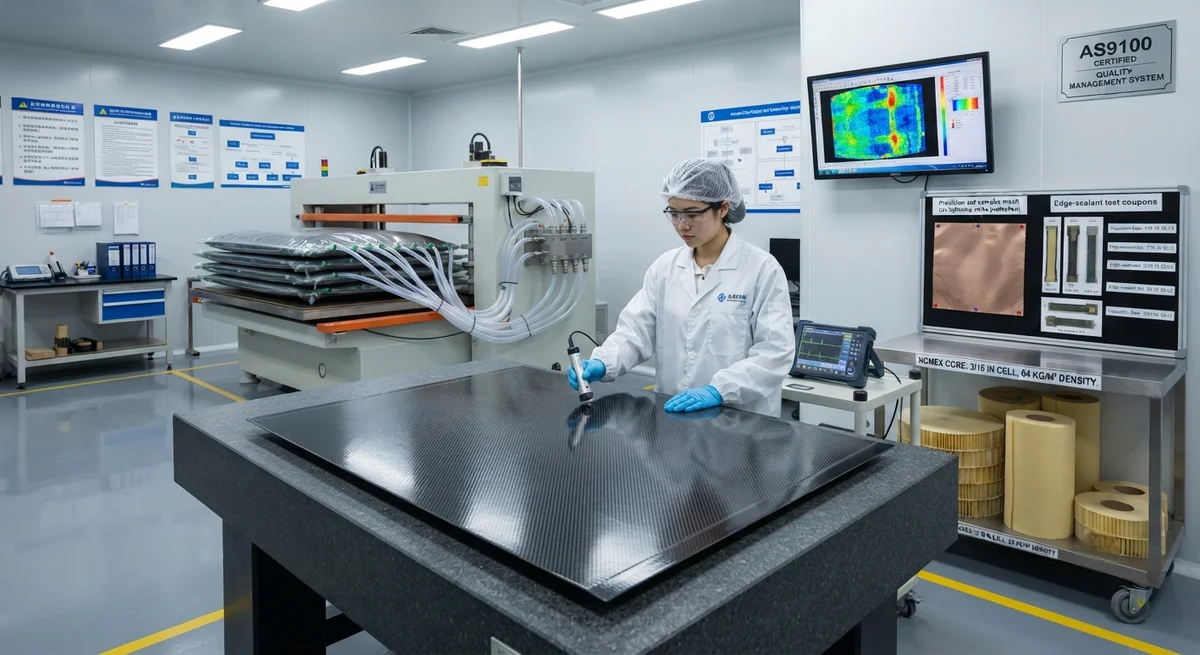
Carbon fiber composite cargo floor panels provide 35-55 kg weight savings per narrowbody aircraft with superior impact resistance. Material architecture, performance comparison, manufacturing process, and airline economics for commercial aircraft applications.
The Structural Demands of Cargo Compartment Flooring
Aircraft cargo compartment flooring operates in one of the most mechanically demanding environments in aerospace engineering. Floor panels must withstand concentrated point loads from cargo pallets and containers, repeated impact from loading equipment, abrasion from sliding cargo, exposure to hydraulic fluids and de-icing chemicals, and must meet stringent fire-smoke-toxicity (FST) requirements — all while contributing as little weight as possible to the airframe. Carbon fiber composite floor panels have increasingly displaced traditional aluminum honeycomb and fiberglass-reinforced phenolic panels in modern commercial aircraft, driven by demands for weight reduction, improved impact resistance, and longer maintenance intervals.
The global aerospace composites market reached $38.3 billion in 2025, with interior structural components — including cargo flooring — representing approximately 12% of this value. The adoption of CFRP cargo floor panels is accelerating, with every major narrowbody and widebody aircraft program either offering carbon fiber flooring as a baseline specification or as a weight-saving option. Boeing's 787 Dreamliner and Airbus A350 XWB both utilize composite cargo floor panels as standard, saving 35-55 kg per aircraft compared to conventional fiberglass/phenolic systems.
Material Architecture of Composite Cargo Floor Panels
Modern cargo compartment floor panels are sandwich structures consisting of multiple functional layers, each engineered to address specific performance requirements:
- Face sheets: Two to four plies of carbon fiber fabric — typically 2x2 twill or 5-harness satin weave — impregnated with flame-retardant epoxy or phenolic resin. Face sheet thickness ranges from 0.5-1.0 mm per side, providing flexural stiffness and impact load distribution. Intermediate modulus fibers (IM7 or T800 class, 290-300 GPa tensile modulus) are preferred for their superior damage tolerance.
- Core material: Nomex aramid honeycomb (HRH-10 or equivalent) in densities of 48-80 kg/m³ provides the shear core necessary for sandwich panel bending stiffness. Cell size is typically 3.2-4.8 mm (1/8-3/16 inch). For high-impact zones near cargo door thresholds, higher-density Nomex core (96-128 kg/m³) or closed-cell polyurethane foam core may be specified.
- Wear surface: The top face sheet incorporates a 0.1-0.3 mm wear-resistant layer — either a co-cured polyurethane film, a sprayed elastomeric coating, or a bonded aluminum foil with anti-skid texture. This layer protects the structural laminate from abrasion and prevents moisture ingress.
- Conductive layer: A copper or aluminum mesh (0.05-0.10 mm thickness) is incorporated between the wear surface and the top face sheet to provide electrical conductivity for static discharge and lightning strike protection per FAR 25.899.
- Moisture barrier: The edges of each panel are sealed with a polysulfide or polyurethane edge sealant to prevent moisture wicking into the honeycomb core, which could cause delamination during freeze-thaw cycles at altitude.
Performance Comparison: CFRP vs. Glass/Phenolic vs. Aluminum Honeycomb
| Parameter | CFRP Sandwich Panel | Glass/Phenolic Sandwich | Aluminum Honeycomb |
|---|---|---|---|
| Areal density (kg/m², 12 mm thick) | 4.5-5.5 | 6.5-8.0 | 8.5-11.0 |
| Flexural modulus (GPa) | 55-70 (face sheet direction) | 20-30 | 70 (aluminum skin only) |
| Impact resistance — 25 J drop weight (back-face damage) | No visible damage | Local cracking, repairable | Permanent dent, skin tear |
| Impact resistance — 50 J drop weight | Local delamination <10 mm | Through-penetration possible | Clear perforation |
| Taber abrasion resistance (CS-17 wheel, 1000 cycles) | 0.15-0.25 mm wear depth | 0.40-0.70 mm wear depth | 0.05-0.10 mm (bare Al) |
| Fluid resistance (Skydrol hydraulic fluid, 24 hr immersion) | No degradation | Slight swelling | Corrosion possible |
| FST compliance (per FAR 25.853 / ABD0031) | Pass (all categories) | Pass | Pass |
| Service life (years before replacement) | 15-20 | 8-12 | 10-15 |
The impact resistance advantage of CFRP face sheets is the single most important operational differentiator. Ground handling equipment — including cargo loaders, fork lifts, and dollies — frequently generates impact energies of 20-50 J during normal loading operations. Glass/phenolic panels may suffer through-penetration at 35-40 J, requiring unscheduled panel replacement and aircraft-on-ground (AOG) events. CFRP panels with IM7 fiber face sheets routinely absorb 50 J impacts with only localized delamination that can be detected and monitored through routine visual inspection.
Manufacturing Process and Quality Control
The production of CFRP cargo floor panels follows a tightly controlled manufacturing sequence designed to ensure consistent aerospace-grade quality:
- Prepreg cutting and kitting: Carbon fiber prepreg rolls are cut using Gerber or Lectra CNC cutting systems with nesting optimization achieving 85-92% material utilization. Each panel's ply stack is kitted with identification barcodes tracking resin batch, fiber lot, and expiration date.
- Core preparation: Nomex honeycomb sheets are cut to net shape, edge-filled with potting compound where fastener holes will be located, and pre-dried at 120°C for 2-4 hours to remove absorbed moisture that could cause blistering during cure.
- Layup and vacuum bagging: Face sheet plies are laid up on a female tool, Nomex core is positioned, and the top face sheet plies are applied. The assembly is vacuum-bagged with breather fabric, release film, and a vacuum level of 700-740 mmHg.
- Curing: Panels are cured in a platen press or autoclave at 130-180°C (depending on resin system) for 90-120 minutes under 2-6 bar pressure. Out-of-autoclave prepreg systems — such as Cytec's Cycom 5320 or Solvay's MTM44-1 — cure at 130-150°C under vacuum only, reducing capital requirements.
- NDT inspection: Every panel receives ultrasonic through-transmission inspection per ASTM E2580 to detect core crush, disbonds, and porosity exceeding 2% by volume. Sections near fastener holes are inspected by phased-array UT. First-article panels undergo CT scanning for internal geometry verification.
Weight Savings and Airline Economics
| Aircraft Type | CFRP Floor Panels (kg) | Glass/Phenolic Floor (kg) | Weight Saved (kg) | Annual Fuel Savings per Aircraft |
|---|---|---|---|---|
| B737 MAX / A320neo (narrowbody) | 110-140 | 160-190 | 35-55 | $4,500-7,500 |
| B787-9 / A350-900 (widebody) | 220-280 | 315-380 | 75-110 | $9,500-15,000 |
| B777-9 / A350-1000 (long-range widebody) | 310-380 | 420-510 | 95-140 | $12,000-19,000 |
| A380 (very large aircraft) | 450-550 | 600-720 | 140-180 | $17,000-24,000 |
For a typical widebody aircraft operating 4,000 flight hours per year with fuel at $2.50/gallon, the annual fuel savings of $9,500-15,000 from CFRP cargo floor panels provides a payback period of 2-4 years on the incremental cost premium. Over a 20-year service life, the net present value of the weight savings exceeds $150,000 per aircraft at current fuel prices.
Maintenance and Repair Considerations
CFRP cargo floor panels offer significantly longer inspection intervals and simpler repair procedures than glass/phenolic alternatives:
- Inspection program: Heavy maintenance checks (C-checks and D-checks) include visual inspection of cargo floor panels for delamination, edge seal integrity, and fastener condition. Thermographic inspection can detect hidden disbonds in less than 30 minutes per panel, versus 2-3 hours for ultrasonic inspection of glass/phenolic equivalent panels.
- Bonded patch repairs: Surface damage up to 25 mm diameter can be repaired with pre-cured patch kits using room-temperature-curing film adhesive, restoring 90-95% of original flexural strength. These repairs are signed off by a single certifying staff with composite repair rating (FAR Part 65), without requiring engineering approval for Zone 1 cosmetic repairs.
- Replacement cost: A typical CFRP cargo floor panel for a narrowbody aircraft costs $850-1,400 per panel (OEM pricing), compared to $500-850 for glass/phenolic equivalents. However, the 60-100% longer service life reduces the replacement frequency, making lifecycle cost comparable.
Frequently Asked Questions
How do CFRP cargo floor panels handle the repeated roller and dolly traffic from ULD loading systems?
CFRP cargo floor panels are specifically engineered for the concentrated rolling loads of unit load device (ULD) systems. The wear-resistant top layer — typically a 0.2 mm polyurethane film with anti-skid properties — withstands over 100,000 roller passes without wear-through in laboratory testing per ARINC 837 specification. The surface hardness (Shore D 70-80) of the wear layer prevents the formation of grooves from the 8-15 mm diameter steel rollers standard on cargo handling systems. The integral conductive mesh maintains electrical continuity between the cargo restraint tracks, ensuring static charge dissipation below 10⁷ Ω per FAR 25.899. Field data from Delta Air Lines' 787 fleet shows average CFRP cargo floor panel service life of 16.2 years before first replacement, compared to 9.4 years for the glass/phenolic panels on their 767 fleet operating under similar route structures and cargo volumes.
What certification testing is required for CFRP cargo floor panels to be approved for commercial aircraft installation?
CFRP cargo floor panels must pass a comprehensive certification test matrix per FAR Part 25 (Airworthiness Standards: Transport Category Airplanes) and applicable airframe manufacturer specifications. Required tests include: (1) Static strength — ultimate load testing at 1.5x limit load for concentrated point loads of 2,500-4,500 kg (representing loaded pallet corner loads), distributed load of 750 kg/m², and rolling point load of 150 kg on a 10 mm diameter roller. (2) Impact resistance — 25 J and 50 J drop weight testing per ASTM D7136 at -40°C, room temperature, and +70°C. (3) Flammability per FAR 25.853 — vertical burn (60-second flame application, self-extinguish within 15 seconds, burn length under 150 mm), heat release (OSU rate ≤ 65 kW/m², total ≤ 65 kW·min/m²), and smoke density (Dₛ within 4 minutes ≤ 200). (4) Fluid resistance — 24-hour immersion in Skydrol hydraulic fluid, Jet A fuel, de-icing fluid, and cleaning solvents with less than 2% weight gain and no visible degradation. (5) Environmental durability — 1,000 hours of temperature cycling from -55°C to +70°C with 95% RH condensation cycles, plus 30 days of salt fog exposure per ASTM B117. Panels certified to Airbus ABD0031 or Boeing D6-55133 typically meet or exceed all these requirements.
Can CFRP cargo floor panels be repaired in the field, or do they require depot-level maintenance?
Field-level repair is feasible for minor damage, significantly reducing aircraft-on-ground time. The Aerospace Industry Association (AIA) and SAE International standard ARP4995 defines three repair categories: Category A repairs (cosmetic surface damage — scratches, minor abrasions not penetrating the wear layer) can be performed by line maintenance with an approved touch-up kit containing room-temperature-curing polyurethane coating applied by brush or spray, no inspection required beyond visual check. Category B repairs (wear layer penetration or minor face sheet damage less than 12.5 mm diameter) can be performed at the base maintenance level using pre-cured bonded patch kits that cure at room temperature or with heat blanket application at 60-80°C for 4-8 hours. These repairs restore 85-95% of original flexural strength and do not require engineering approval. Category C repairs (face sheet damage exceeding 12.5 mm, core crush, or fastener hole damage) must be performed at a depot maintenance facility with composite repair capability, using vacuum-bag consolidation and hot-bonding equipment. Category C repairs restore 100% of original strength and require non-destructive inspection and engineering sign-off per the manufacturer's Structural Repair Manual (SRM).
Part of topic
Related Articles
- Carbon Fiber Mooring for Floating Offshore Wind: Fatigue and Corrosion in Deep Water
- Carbon Fiber Bicycle Frame Optimization: Layup Design and Manufacturing for Competitive Racing
- Carbon Fiber CFRP Retrofit for Infrastructure: Bridge and Building Seismic Strengthening
- Carbon Fiber Medical Imaging Equipment: Lightweight Gantry and Couch Structures for MRI/CT
- Carbon Fiber EV Battery Enclosures: Crash Safety and Electromagnetic Shielding Design
- Carbon Fiber Structures for Low-Altitude Economy: UAV Airframes and eVTOL Components
Interested in Our Products?
Contact our team for competitive pricing and technical specifications.
Get a QuoteRelated Products
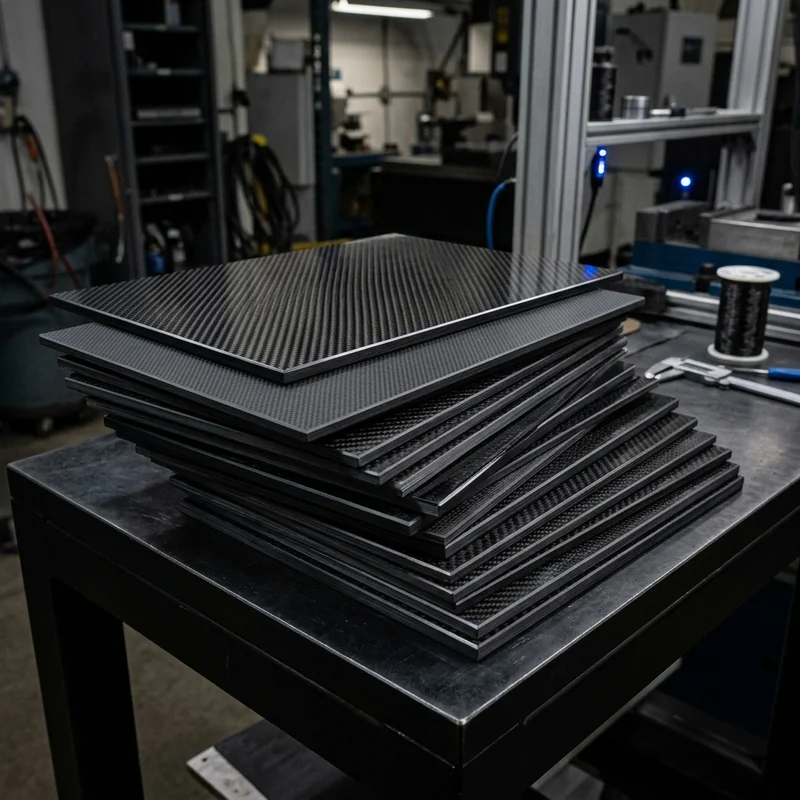
Carbon fiber standard plate-3k stripe
Lightweight, ultra-rigid standard sheets for drone fuselages, robot housings, facades and structural applications.

Carbon Fiber Plate — 3K Twill T700 3.0mm
Medium-thickness 3.0mm carbon fiber plate offering significantly higher load capacity while maintaining attractive 3K twill finish. Suitable for structural brackets, reinforcement plates, and load-bearing panels.

Carbon Fiber Plate — 3K Twill T700 1.5mm
Thin 1.5mm carbon fiber plate with 3K twill weave surface. Lightweight and stiff, commonly used for covers, panels, drone bodies, and applications requiring a premium aesthetic appearance.

Square Carbon Fiber Tube — 3K Twill T700
Square cross-section carbon fiber tube manufactured with 3K twill weave for torsional strength. Preferred for structural frames, trusses, and support columns where rectangular geometry offers design flexibility.
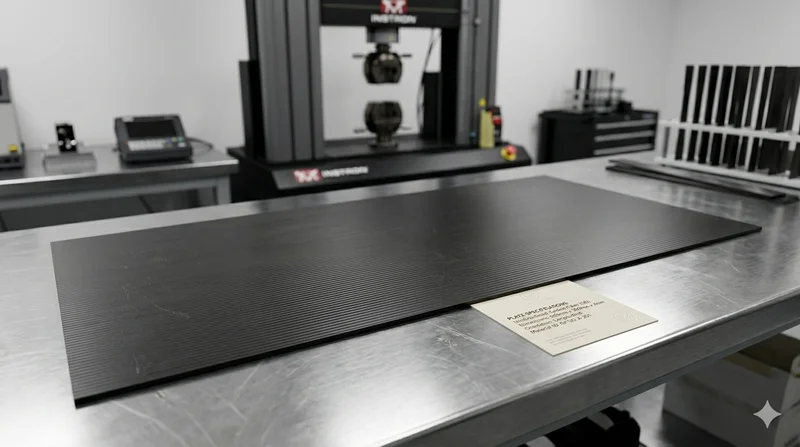
Carbon Fiber Plate — UD Unidirectional T700
Unidirectional carbon fiber plate with all fibers oriented in a single direction for maximum strength along the fiber axis. Essential for structural reinforcements, splints, and applications where load direction is predictable.