When the first 100-meter wind turbine blade was certified less than a decade ago, it was a milestone that seemed difficult to repeat. By 2026, 100-meter-plus blades are the mainstream of offshore wind development. The clearest signal came in May 2026, when a 107-meter blade — reported a
Introduction
When the first 100-meter wind turbine blade was certified less than a decade ago, it was a milestone that seemed difficult to repeat. By 2026, 100-meter-plus blades are the mainstream of offshore wind development. The clearest signal came in May 2026, when a 107-meter blade — reported as the largest commercial blade to leave a Chinese factory — rolled out of a Fujian facility, destined for 12-16 MW offshore turbines and consuming more than eight tonnes of carbon fiber per blade. That single blade contains more carbon fiber than many entire aircraft programs used in a year a decade ago.
Crossing the 100-meter line is not simply a matter of scaling up a longer mold. Blade mass grows roughly with the cube of the length, and gravity loads grow with mass, so every additional meter demands disproportionately more structure. Glass fiber, which dominates blades up to around 90 meters, reaches its practical limit; the spar cap — the blade's main load-bearing member — must switch to carbon fiber to keep the blade light enough to be viable. This article examines the 107-meter milestone, the design shift that 100 meters forces, and how large-tow carbon spar caps are manufactured and qualified at industrial scale.
The 107-Meter Milestone in Context
The 107-meter Fujian blade represents the current frontier of commercial blade manufacturing. To appreciate its scale, it helps to see it against the recent evolution of the industry:
| Blade Length | Turbine Class | Typical Debut | Spar Cap Material | Carbon Fiber per Blade |
|---|---|---|---|---|
| ~75-80 m | 8-10 MW offshore | 2019-2021 | Glass (some carbon) | 0-3 t |
| ~90-95 m | 12-14 MW offshore | 2022-2024 | Hybrid glass-carbon | 3-5 t |
| ~107 m | 12-16 MW offshore | 2025-2026 | Carbon (large-tow) | 8+ t |
| ~115-120 m (in development) | 18-20 MW offshore | 2027+ | Carbon (pultruded) | 10-15 t |
At 107 meters, a single blade weighs on the order of 55-65 tonnes and sweeps an area of more than 10,000 square meters per blade. The carbon fiber in the spar cap accounts for roughly 8-15% of blade weight but carries most of the bending load, making it the highest-value material in the blade. The progression in the table is the story of offshore wind's entire material strategy: carbon fiber stops being an option and becomes the enabling technology.
Why 100 Meters Forces the Carbon Switch
The physics of blade scaling is unforgiving. Structural loads from gravity scale with blade mass, and blade mass grows faster than length as the structure must carry its own increasing weight. A glass spar cap that is adequate at 80 meters becomes too heavy at 100 meters: the extra weight demands more structure, which demands more weight, in a spiral that quickly consumes the aerodynamic efficiency gains of the longer blade. Carbon fiber breaks that spiral because its specific stiffness and specific strength are roughly three times those of glass fiber.
The comparison is direct. Glass spar caps typically use glass fiber at a modulus around 80-90 GPa, while carbon spar caps use fiber at 230-300 GPa — three times stiffer. Carbon laminates also save 20-40% in weight for the same stiffness. On a 107-meter blade, the weight saving from a carbon spar cap is on the order of several tonnes per blade, which translates into lower gravity loads on the root, a lighter pitch system, and better fatigue margins. Without carbon, the 107-meter blade would be either impossibly heavy or structurally over-constrained.
Large-Tow Carbon Fiber and the Spar Cap
The carbon fiber that makes 100-meter blades possible is not aerospace fiber. Wind blades use large-tow, industrial-grade carbon fiber — typically 48K, 50K, or higher tow counts — at a fraction of aerospace-grade cost. The demand profile is enormous: a single 107-meter blade uses 8-10 tonnes of carbon fiber, a 12-16 MW turbine needs three blades, and a typical offshore wind farm of 60 turbines consumes more than 1,500 tonnes of carbon fiber. This is why wind energy has become the largest industrial market for carbon fiber, and why Chinese producers such as Zhongfu Shenying, Guangwei, and Jilin's Sinofibers have built dedicated large-tow lines.
| Spar Cap Architecture | Fiber Type | Tensile Modulus | Weight Saving vs Glass | Manufacturing Route |
|---|---|---|---|---|
| Glass spar cap | E-glass, high-modulus | 80-90 GPa | Baseline | Layup/infusion |
| Hybrid glass-carbon | E-glass + large-tow carbon | 100-140 GPa | 10-20% | Layup + carbon pultrusion |
| All-carbon (non-pultruded) | 50K large-tow | 230-260 GPa | 25-35% | Unidirectional layup, infusion |
| All-carbon (pultruded) | 50K large-tow | 230-260 GPa | 25-35% | Pultruded plates, bonded stack |
Pultruded spar cap plates have become the manufacturing route of choice for the largest blades. Instead of laying up dry fiber and infusing it on the mold, manufacturers pultrude continuous plates of unidirectional carbon, then stack and bond them into the spar cap during blade assembly. Pultrusion is faster, produces higher fiber volume fractions with fewer voids, and yields more consistent mechanical properties — all critical at the eight-tonne-plus-per-blade quantities the 107-meter design requires.
Manufacturing Scale-Up: Molds, Infusion, and Logistics
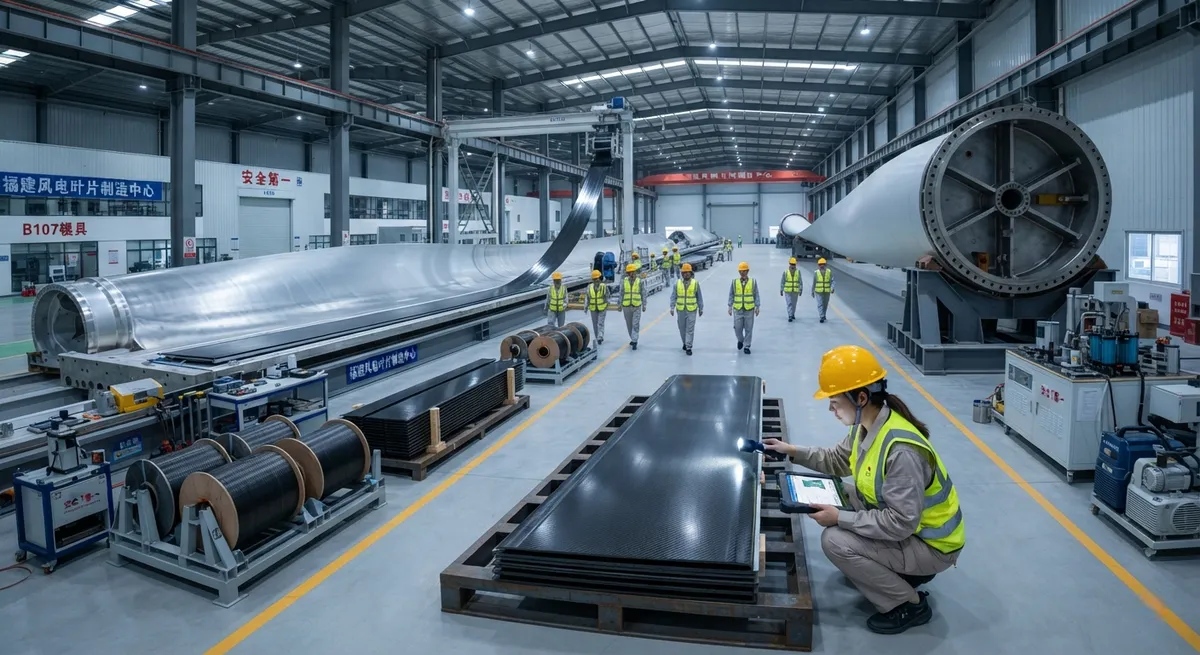
Building a 107-meter blade stretches every step of the factory. The mold itself is more than 100 meters long and must hold tight dimensional tolerance across its length; the infusion of a carbon-heavy blade requires careful resin flow management to avoid dry spots in the thick spar cap region; and the cured blade must be moved, finished, and shipped without damage. The practical consequences are visible in factory design: longer and heavier molds, automated layup and pultrusion integration, larger curing and post-cure ovens, and logistics that treat the blade as an oversized and delicate load.
- Automated layup: The spar cap layers, in particular, are increasingly placed by automated systems to achieve the precision and repeatability that eight tonnes of fiber demands.
- Infusion control: Large blades are infused with epoxy in a single-shot process; carbon's higher stiffness and lower permeability than glass require tuned flow media and resin systems to ensure complete wet-out.
- Joining and bonding: The pultruded spar cap stack is bonded into the shell with adhesive; bond line quality is the dominant quality risk and is verified with ultrasonic inspection.
- Factory-to-port logistics: A 107-meter blade cannot be transported by standard road freight; factories are located at or near ports with blade-specific transport and handling infrastructure.
The scale-up is as much a supply chain problem as a manufacturing problem. Each 107-meter blade commits eight-plus tonnes of carbon fiber, and a factory producing 100 blades per year needs more than 800 tonnes of large-tow carbon fiber annually — a procurement volume that has shaped the commercial relationships between blade makers, turbine OEMs, and carbon fiber producers.
Qualification and Fatigue
Qualifying a 100-meter-plus blade is the most demanding test program in composite manufacturing. The blade must pass static strength tests up to the design ultimate load, fatigue tests simulating 20-25 years of operation and millions of load cycles, and full-scale tests that validate the analytical models. For carbon spar caps specifically, the qualification focus is on bond-line integrity between pultruded plates, fatigue behavior at the high stress ratios the spar cap sees, and the transition regions where the carbon cap meets the glass shell.
The qualification evidence is what separates a working 107-meter blade from a demonstration. Standards such as IEC 61400-5 govern blade design and testing, and the test regime — static to failure, 20-25 year fatigue simulation, and structural health monitoring during operation — is the same whether the blade is built in Fujian, Denmark, or Spain. For the composite supply chain, the implication is that material consistency matters as much as peak performance: a spar cap supplier must deliver hundreds of tonnes of fiber with stable mechanical properties, or the blade's fatigue margin cannot be certified.
Frequently Asked Questions
Why can't glass fiber be used for 100-meter-plus blades?
Glass fiber can build a 100-meter blade, but not an economically viable one. The problem is gravity: blade mass grows with length, and a glass spar cap heavy enough to carry the loads of a 107-meter blade adds so much mass that the blade's own weight consumes its load-carrying capability. The design spiral — heavier structure needs heavier structure to support it — makes glass-only blades inefficient beyond roughly 90 meters. Carbon fiber's three-times-higher specific stiffness and specific strength allow a lighter spar cap that breaks the spiral, which is why essentially all blades above 100 meters use carbon spar caps. Some designs use hybrid glass-carbon architectures, but the dominant approach for the largest blades is an all-carbon spar cap.
How much carbon fiber is in a 107-meter blade?
Reported figures for the 107-meter Fujian blade put carbon fiber content at more than eight tonnes per blade, primarily in the spar cap. A 12-16 MW turbine carries three such blades, so each turbine commits roughly 24-30 tonnes of carbon fiber; a 60-turbine offshore wind farm consumes on the order of 1,500-1,800 tonnes. This is why wind energy is now the largest single industrial market for carbon fiber, and why large-tow industrial-grade fiber — rather than aerospace-grade — has its own dedicated production lines. The exact content varies by design, with some 107-meter-class blades reported between eight and ten tonnes.
What is a pultruded spar cap and why is it used for large blades?
A pultruded spar cap is made of continuous unidirectional carbon fiber plates produced by pultrusion: fiber tows are pulled through a resin bath and a heated die, emerging as a constant cross-section solid plate. These plates are then cut to length, stacked to the required thickness, and bonded into the blade shell as the spar cap. Pultrusion is preferred for the largest blades because it is fast and repeatable, yields high fiber volume fractions (60-70%) with very low void content, and produces consistent mechanical properties across the hundreds of tonnes of material a blade factory consumes. Bonded pultruded stacks also integrate cleanly with automated blade assembly, which is why pultrusion has become the default route for 100-meter-plus spar caps.
Conclusion
The 107-meter Fujian blade is the current proof that 100-meter-plus blades are a manufacturing reality, and it anchors a shift that is reshaping the entire carbon fiber industry. Crossing 100 meters forces the carbon switch in the spar cap, elevates large-tow industrial fiber into the largest volume channel in wind energy, and makes pultrusion the manufacturing route of choice. Every 107-meter blade commits eight-plus tonnes of carbon fiber, and every offshore wind farm commits thousands of tonnes — demand that is already driving dedicated large-tow production lines and long-term supply relationships across the composite supply chain.
For suppliers and buyers working on blade spar caps and large-tow carbon fiber, explore our industrial carbon fiber range for wind energy, or contact our engineering team to discuss large-tow fiber supply, pultrusion materials, and qualification support for blade programs.
Part of topic
Related Articles
- Carbon Fiber Tube for Sale: Comparing Listings and Avoiding Bad Specs
- Carbon Fiber Engine Parts: High-Temperature Performance for Racing and Performance Vehicles
- Carbon Fiber Body Parts: Automotive Exterior Panels and Structural Components
- Carbon Fiber Drone Body Manufacturing: Monocoque Design and Production Methods
- Carbon Fiber Drone Parts Supplier: FPV Frames, Arms and Structural Components
- Filament Wound Epoxy Tubes: Industrial Applications from Oil and Gas to Aerospace
Interested in Carbon Fiber Plates?
Contact our team for competitive pricing and technical specifications.
Get a Quote